Nyumbani Children’s Home and Donations
Today we spent much of the day back at the Nyumbani Children’s Home. We arrived in the morning in time to go to church with everyone.
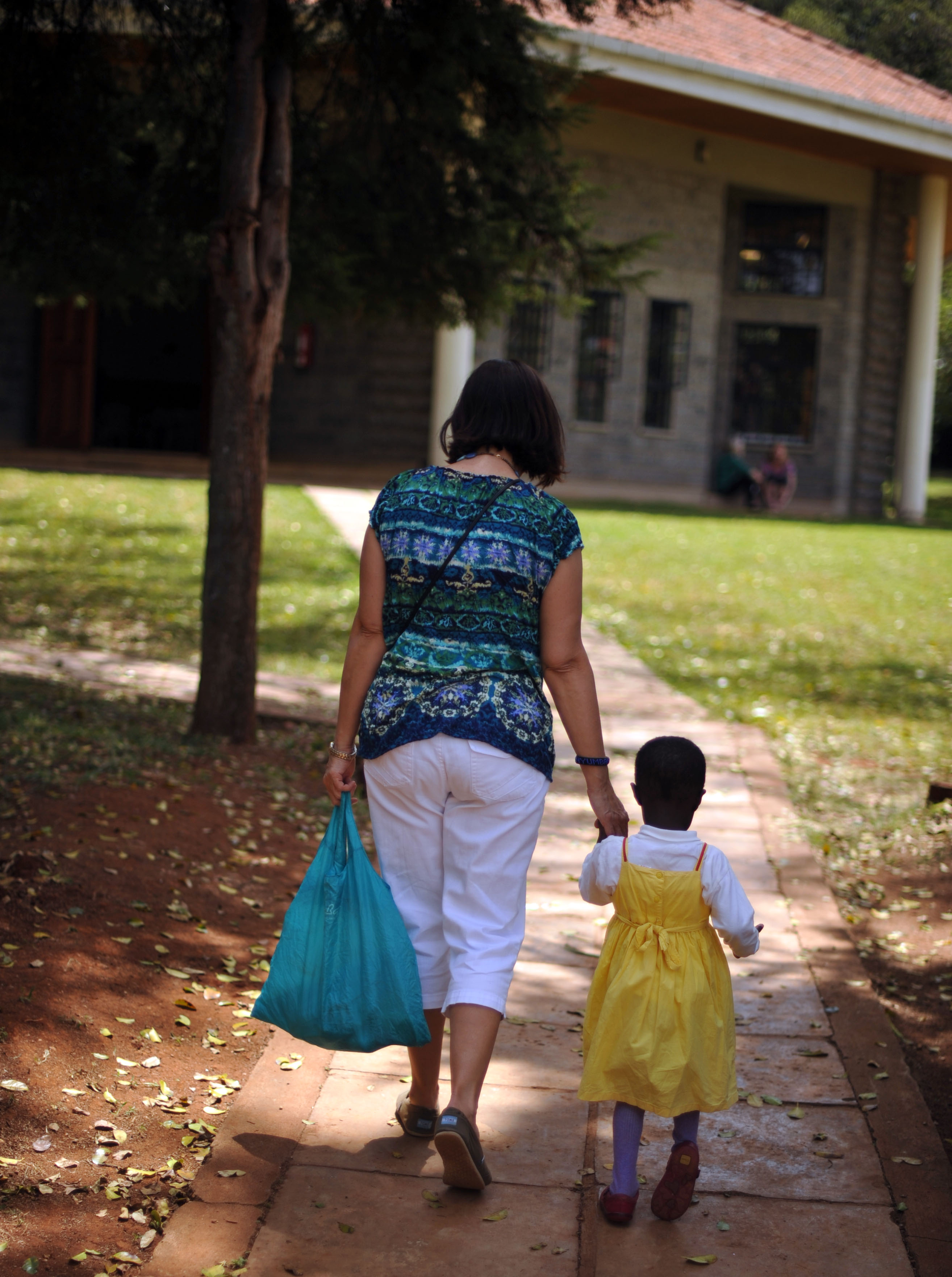
Deb walking with a child to church
There has been an a feeling of excitement in the air throughout the past week as this has been the week of the summit meeting when all of the International Board Members and the Kenyan Board members meet with the Nyumbani administrators to discuss the Nyumbani programs, the progress, needs, future plans, etc. Today was the final day, so some special events were planned. I loved watching these children of the Board Members play since as the saying goes children have alot to teach us.
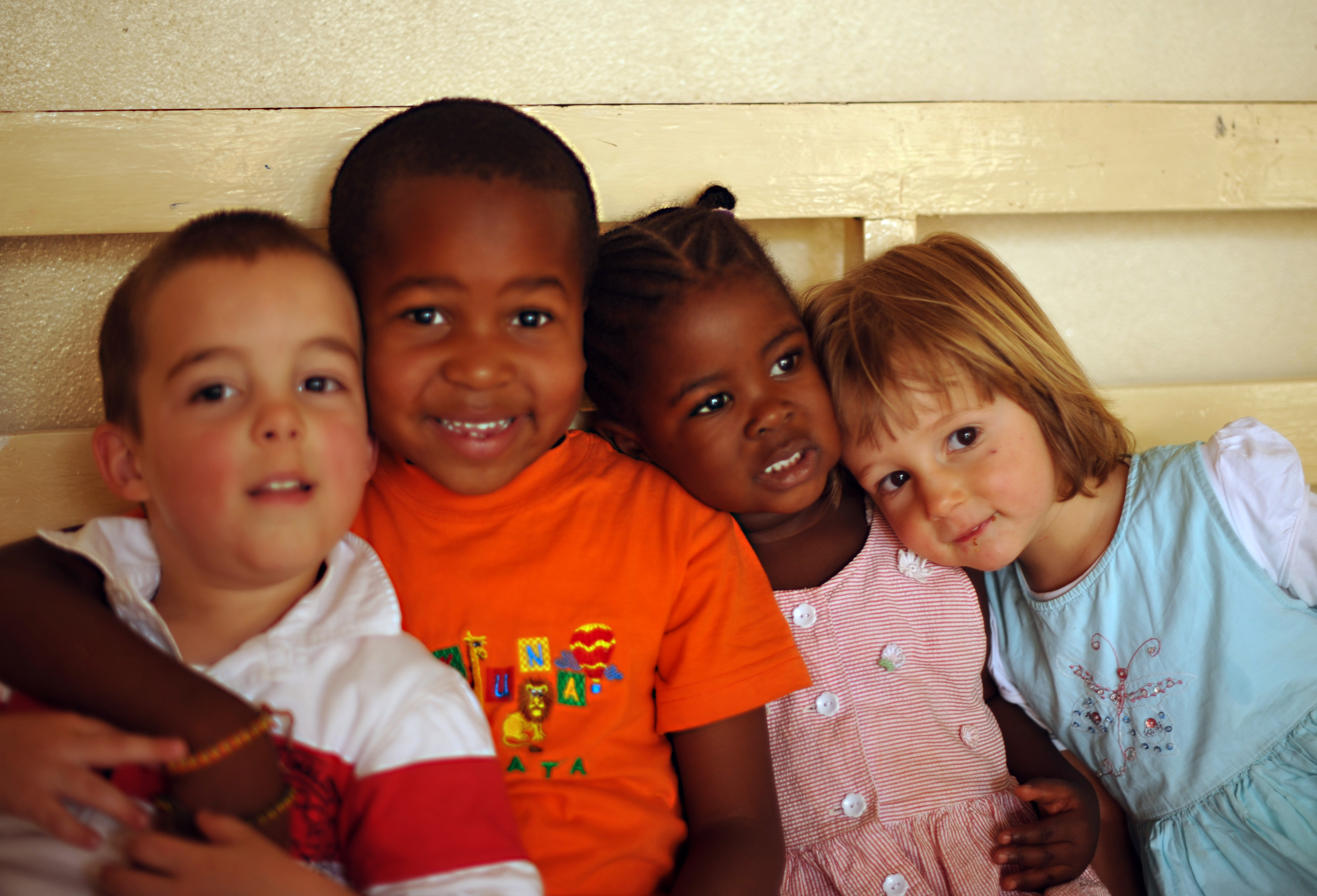
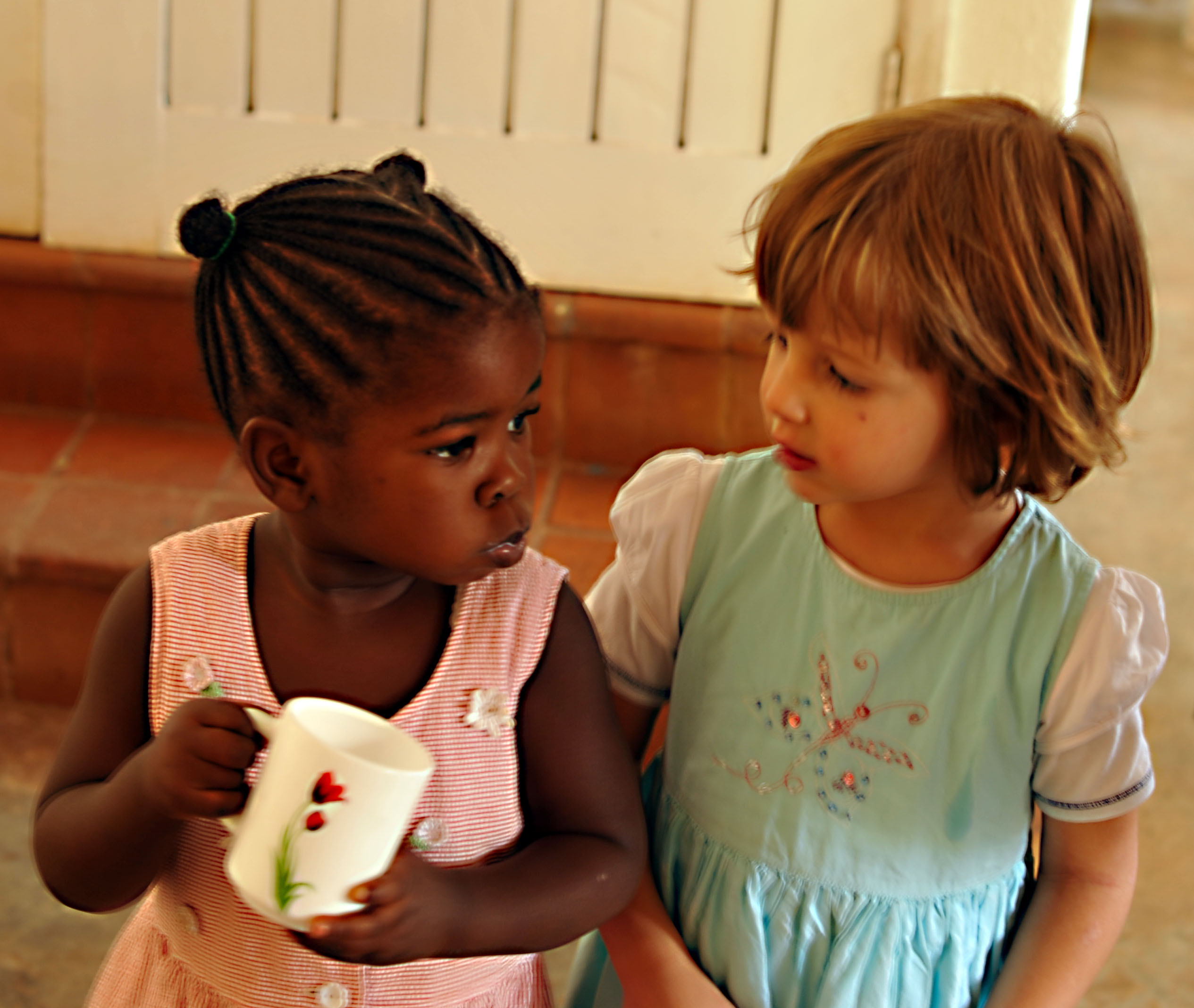
Children of the Nyumbani Board Members in a sweet moment
The Nyumbani children did some extra singing and dancing during the mass as well as entertainment scheduled prior to a lunch in honor of the Board members. The entertainment included the preschoolers form the St. Paul Miki School through the “elementary school” age children.
Following the entertainment there were presentations to all the Form One students who will be leaving for boarding school and many heartfelt words from staff, children and others thanking the Board members for all that they do to keep Nyumbani going. There was, of course, frequent reference to Father D”Agostino who founded Nyumbani and acknowledgement of January as his birthday month. After many rounds of “sharing a few words” it was time for a special lunch. I was delighted to have a child, John, a toddler who had crawled up into my lap and fallen asleep during the presentations.
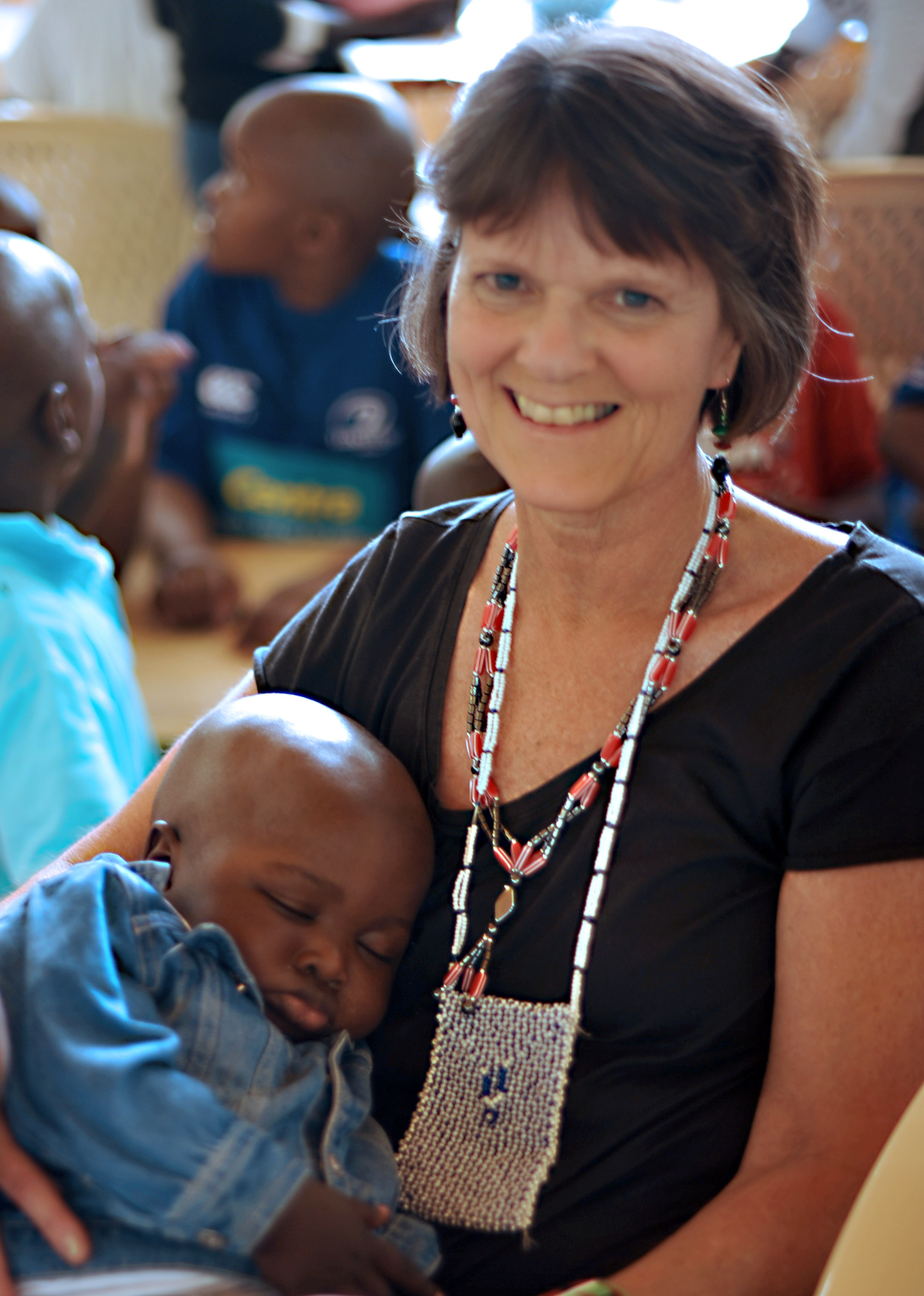
Sleepy John taking a nap in my lap
The KEST volunteers ate lunch at the tables with our host cottages and promised we would be back next Saturday.
Following the time at the Children’s Home it was time to hit the local Nakumat to stock up on water and a few other things to bring to The Village tomorrow. Also Lloydie, Justun and I, armed with the recipe ingredients for the porridge for the PCDA program set out to buy those ingredients (in great bulk requiring 3 shopping carts) with donation money that I had received earmarked for that purpose. We also pooled our donation money and discovered that we had quite a lot such that Lloydie could not zip it into the folder she usually uses—a very good problem to have! That will enable us to pay for the mattresses needed for the latest new people at the Village and to buy lots of much needed sheets. We will go shopping once we are in Kitui near the Village. THANK YOU DONORS!!!!!!
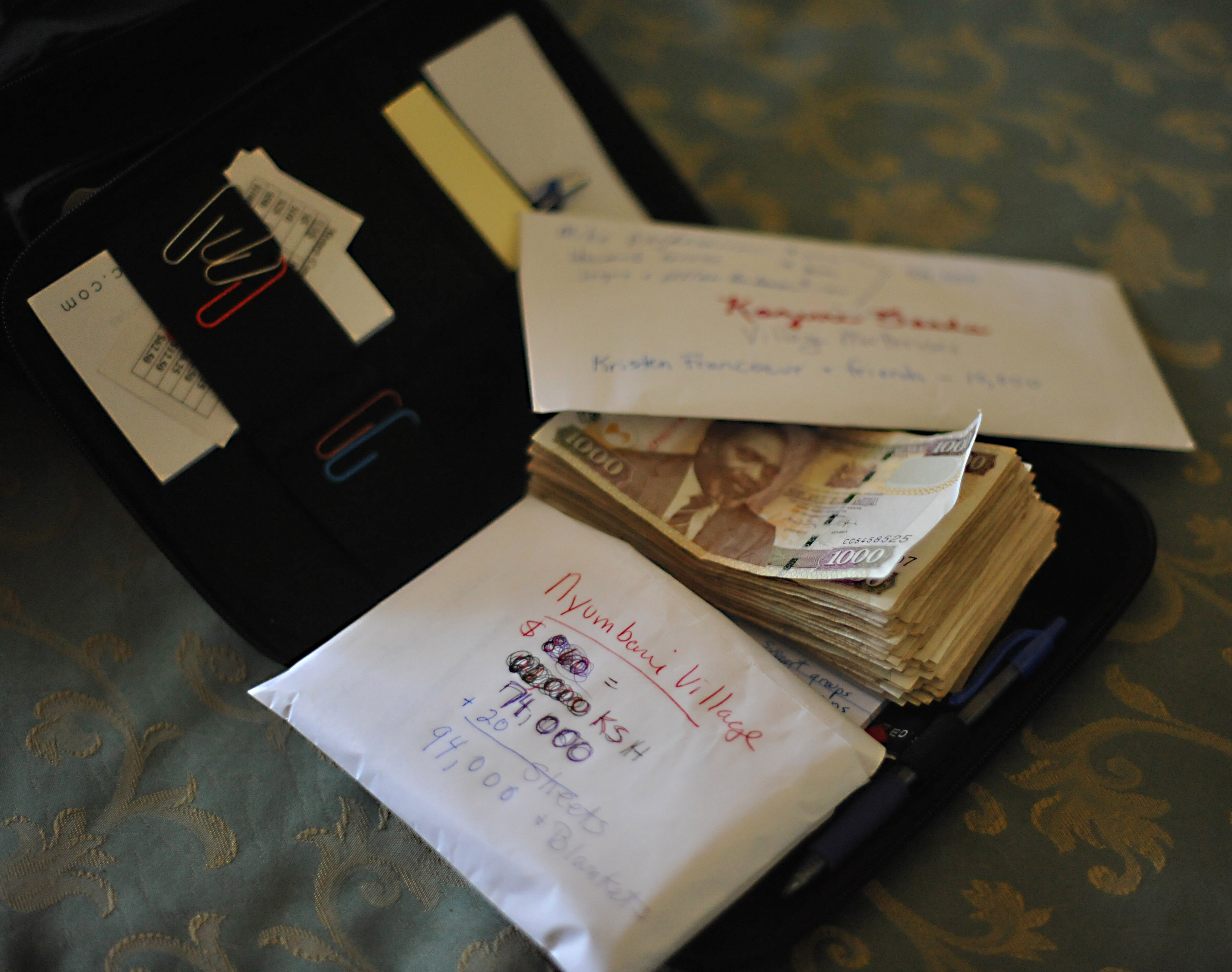
Donations for mattresses for the Village!!
We went out to dinner at Karen Blixen’s house this evening—a good meal before we are off to the Village. Tomorrow morning there will be a good long shower too! The days are very full but very wonderful. As I write this post somewhat sleepy eyed at midnight here, I can say that no day yet has gone by yet been without having deeply inspiring and touching moments. Off to the Village tomorrow……………
Pastoral Community Development Association
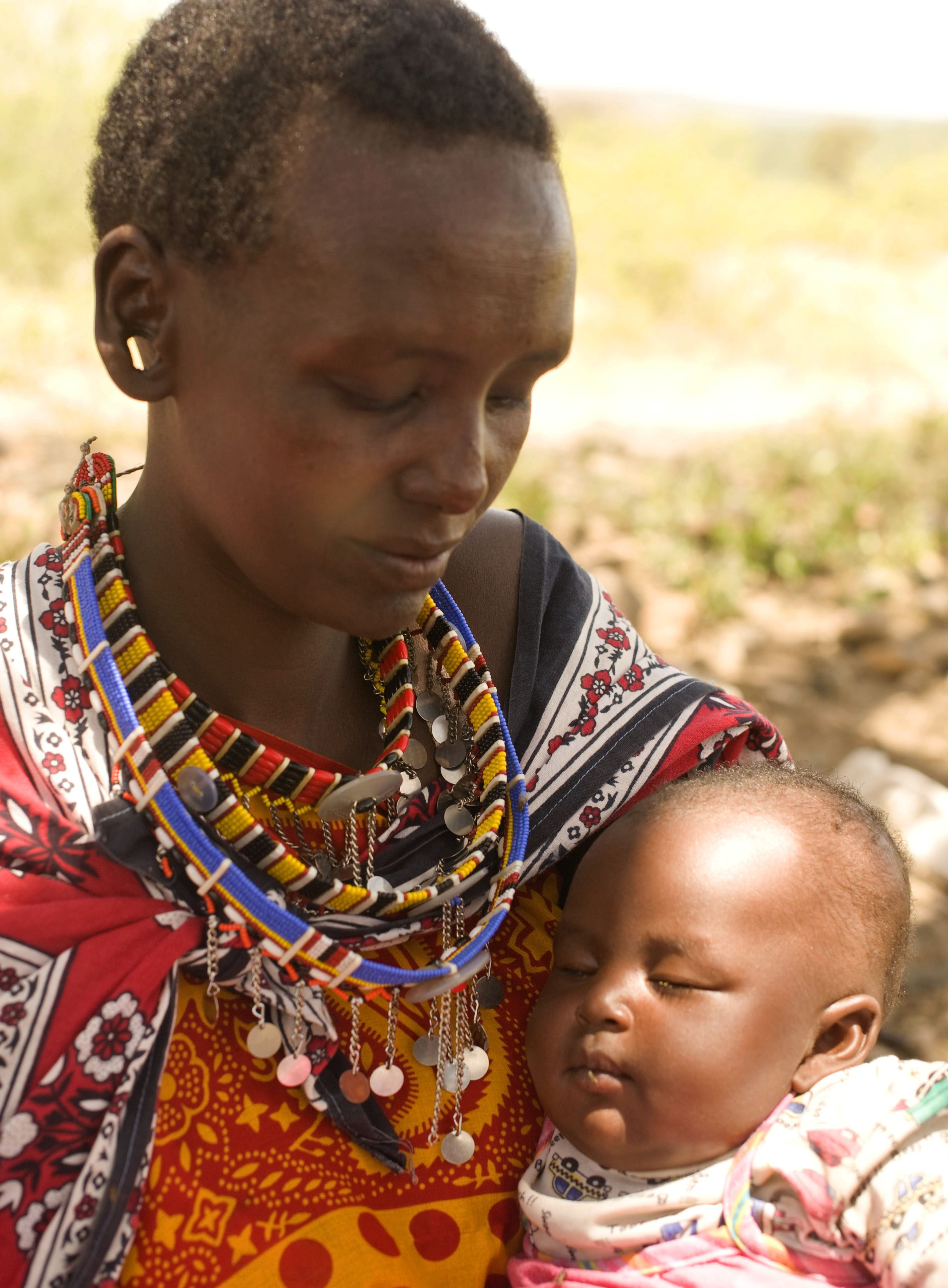
Maasai woman and her baby
This trip just keeps on being amazing! We have spent much of the last 2 days in a Maasai Village working with the PCDA (Pastoral Community Development Association). The drive there was quite beautiful as we drove beside the Ngong Hills and down into the Rift Valley. KEST became involved with this program rather serendipitously when Lloydie and Karen who was a fellow KEST volunteer with me in 2010 sat beside Philip the director on a long flight a year or so ago. Maasai communities are struggling to maintain their traditional culture of being semi nomadic despite pressures from the government to be more sedentary and obstacles from the environment such as drought. It is a male dominated culture in which the males are herdsmen and the women build the houses, cook, take care of the children, etc. Houses are made of sticks thatching and mud and cow dung covered walls. All children going to school such as the one that we visited in this village is a relatively modern phenomenon which is not a usual part of all Maasai culture. The goal of KEST’s involvement is to help with the school program development, to support the school lunch program (which may provide the only daily meal for some of the children) and to assist the women in selling their crafts through the Women4Women Initiative.
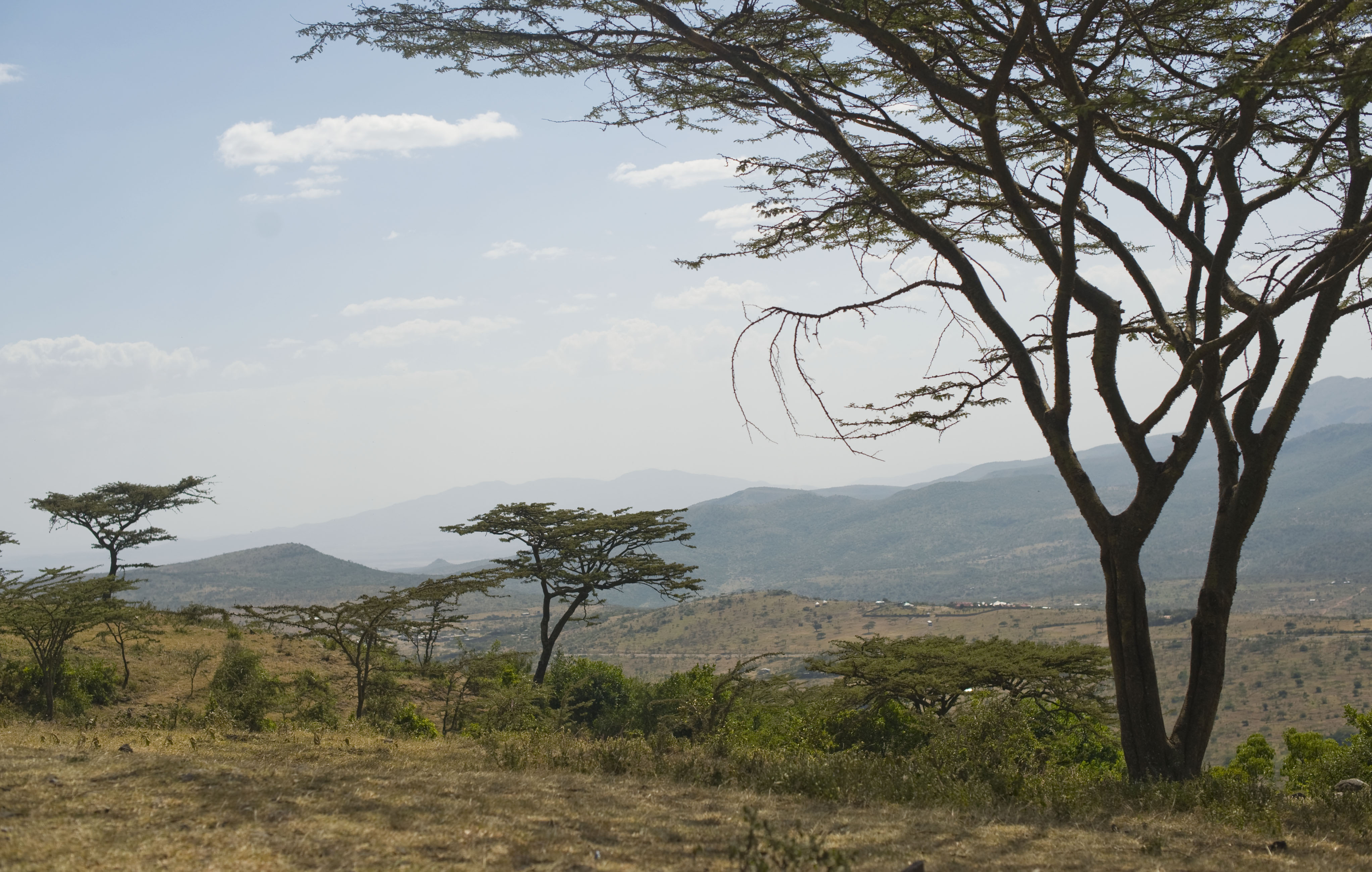
View of the Great Rift Valley
Friday we were at the school in the Maasai village and focused our time with the children. They were unbelievably cute! This involved singing, reading books, and crafts projects some of which built on previous lessons that they had learned from other KEST volunteers. As my assigned job, I got to rove back and forth between the two classrooms and help the children where help was needed and to take photos (much more fun than work). After the classroom work was done we went outside where the children got temporary tattoos from Kristen and face paint from Deb and me. Since there were so many children we were aiming to just paint one thing on one cheek and did butterflies, flowers and such on the girls and birds, turtles and oops….snakes on the boys. We learned that the snakes were a really bad idea when we discovered them wiping them off because they are quite afraid of snakes—a cultural faux pas which we rectified with “do-over’s”. The children were very enthusiastic learners, very well behaved, and seemed to really enjoy having us around. For those of you who gave me monetary donations, some will go to help with purchasing food to keep the stock of supplies (maize flour, oil, powdered milk and sugar) necessary to make daily porridge for the school lunch program.
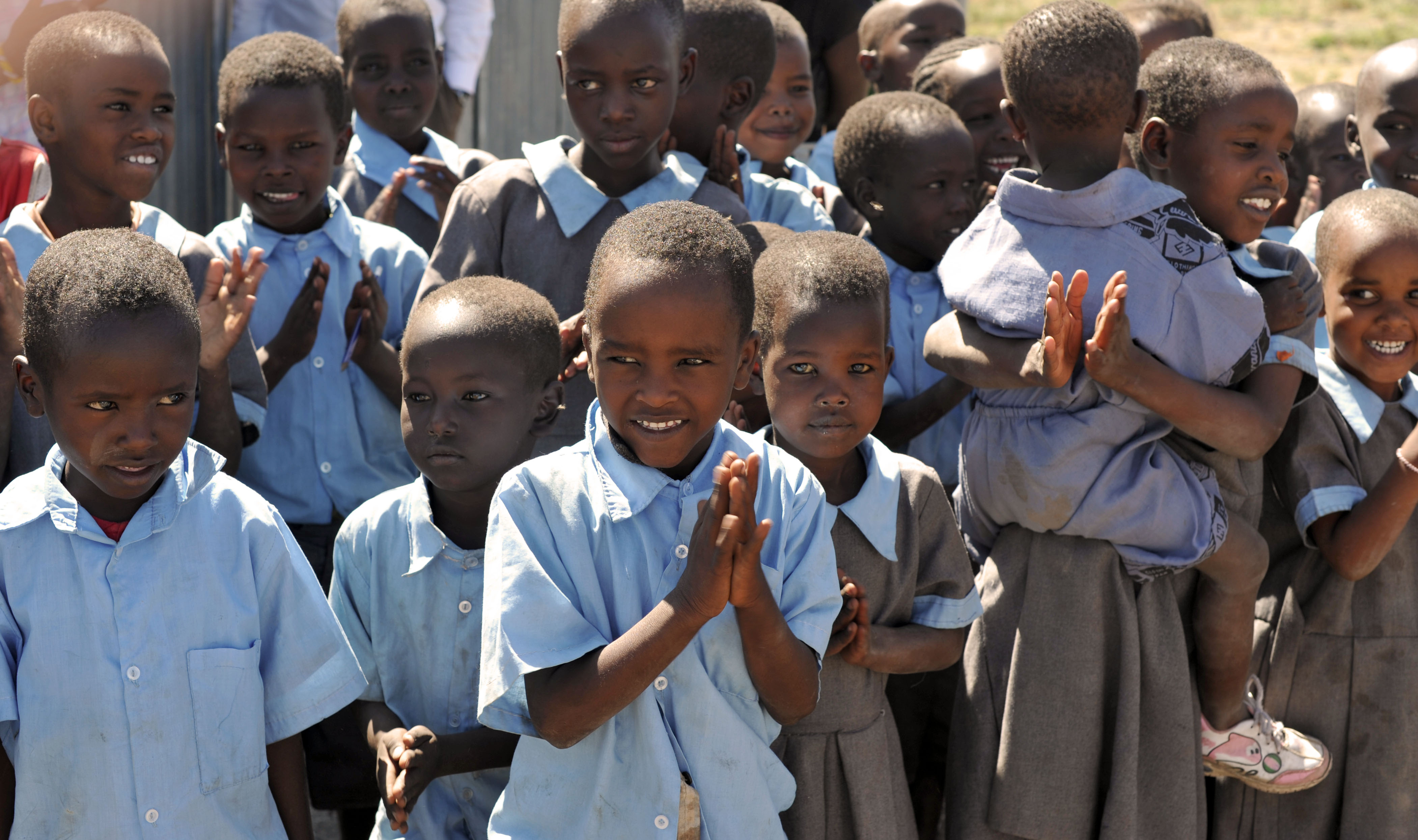
Maasai Children in the School yard

Maasai Children at school
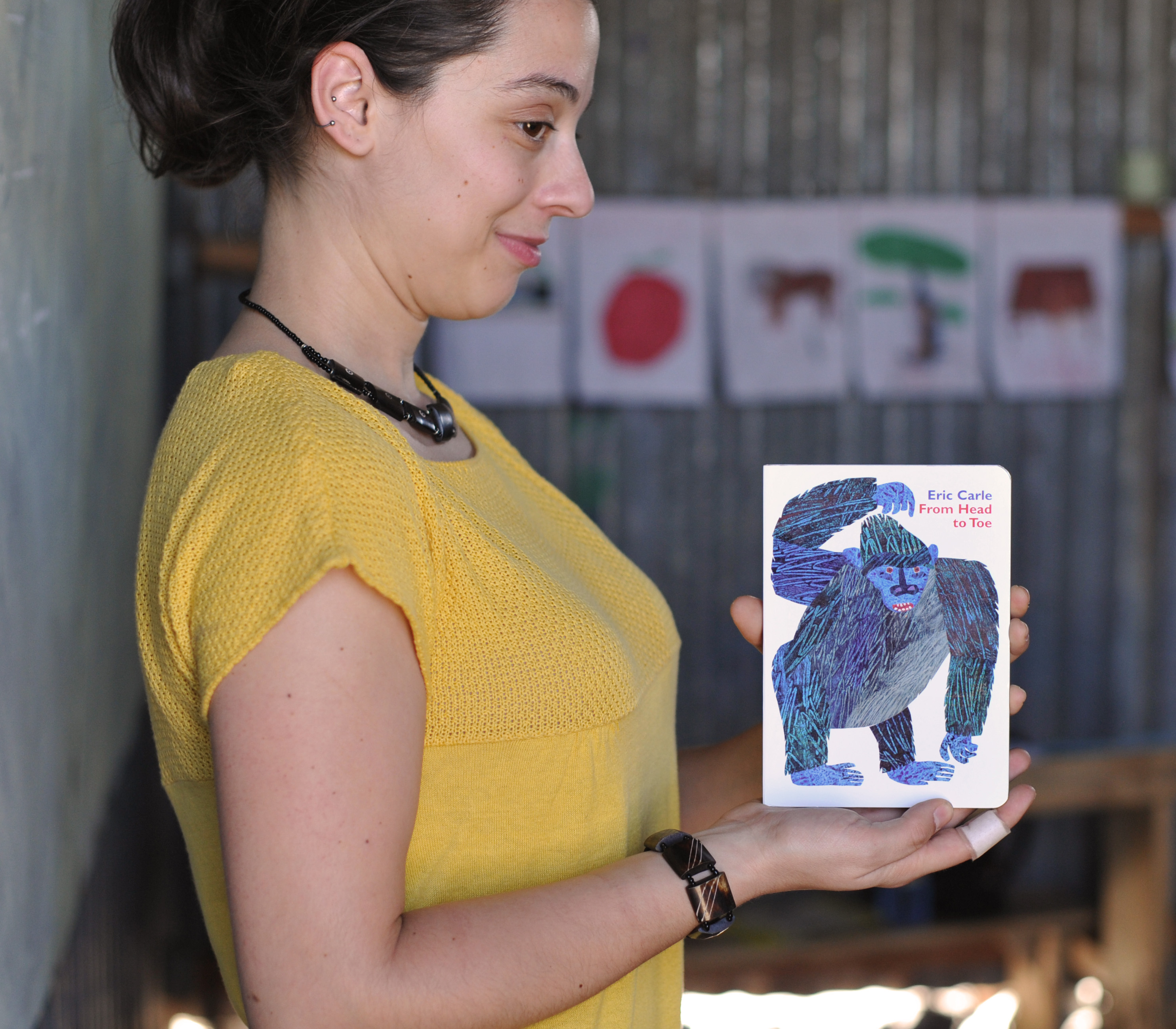
Kristen reading an Eric Carle book to the children
Watch and hear the children sing BELOW:
On Saturday we went to the homes of the families and each was assigned to help a Momma with the daily chores (except for Walter who got to sharpen his herding skills!) I went off with Jane and was assisted by Helen a lovely 13 year old who could speak English very well. After going inside the very hot and dark hut we made a fire and made chai from milk, sugar and loose tea. We talked a lot over tea and translations and Jane gave me a Maasai name that I have no idea how to spell and it took me many tries to learn how to say. It sounds like this—Nasorrrwah with the r’s being rolled a bit and it means “one who gives” in Maa (Maasai language) I thought it was rather a sweet name though in the course of my practicing my emphasis was bit off…and so was my pronunciation which had Jane’s nine year old Joy rolling with laughter and together we all had a fun time with it. Helen, who I actually the daughter of Jane’s neighbor loved to take pictures and did quite a good job, she took pictures of me doing the dishes and then she took me outside to see the baby goats,. She said to me “You catch a kid and I will take your photo.” Well, they are not that easy to catch and they move a lot faster than you might think, so she had to catch one for me (SHE made it look easy). That was good for quite a few laughs. Finally she did take my picture with the baby goat and the little boy Morris looking on.
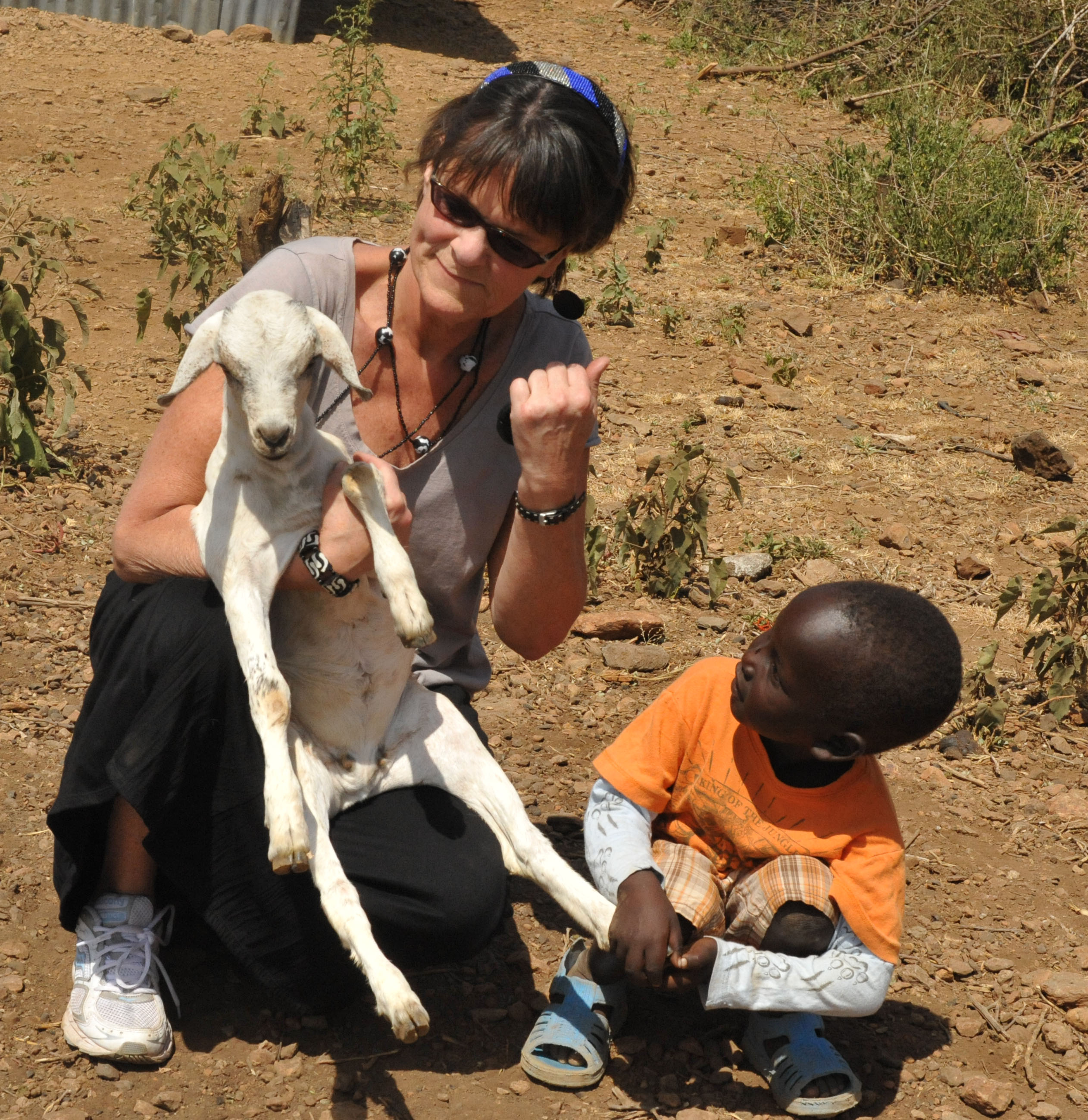
The babyy goat and Morris and me
She then took some pictures with Jane and me and her mother with beautiful Maasai jewelry on. When it came time to leave Jane actually gave me a bracelet and a beautiful necklace which I will treasure.
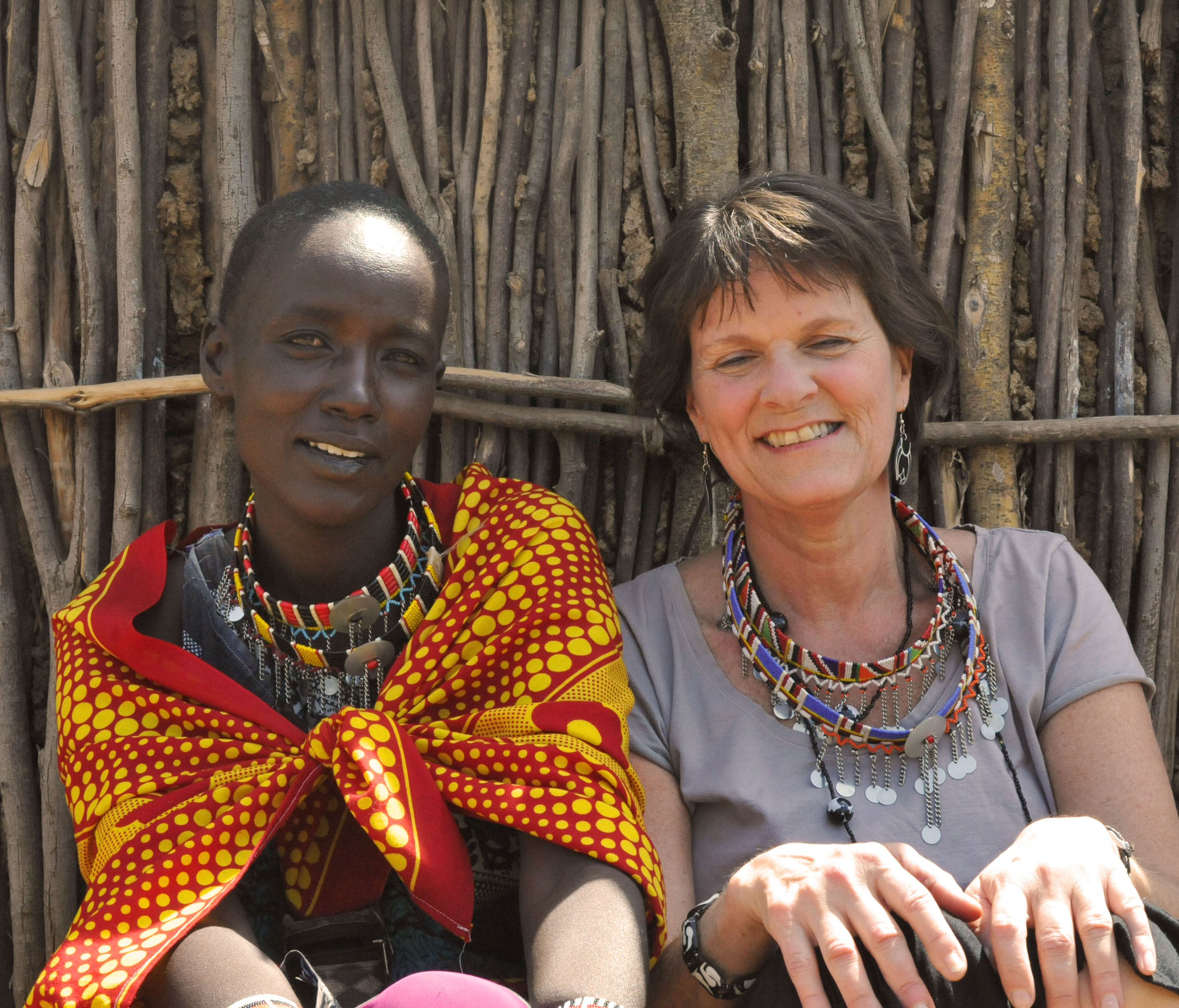
Jane and me
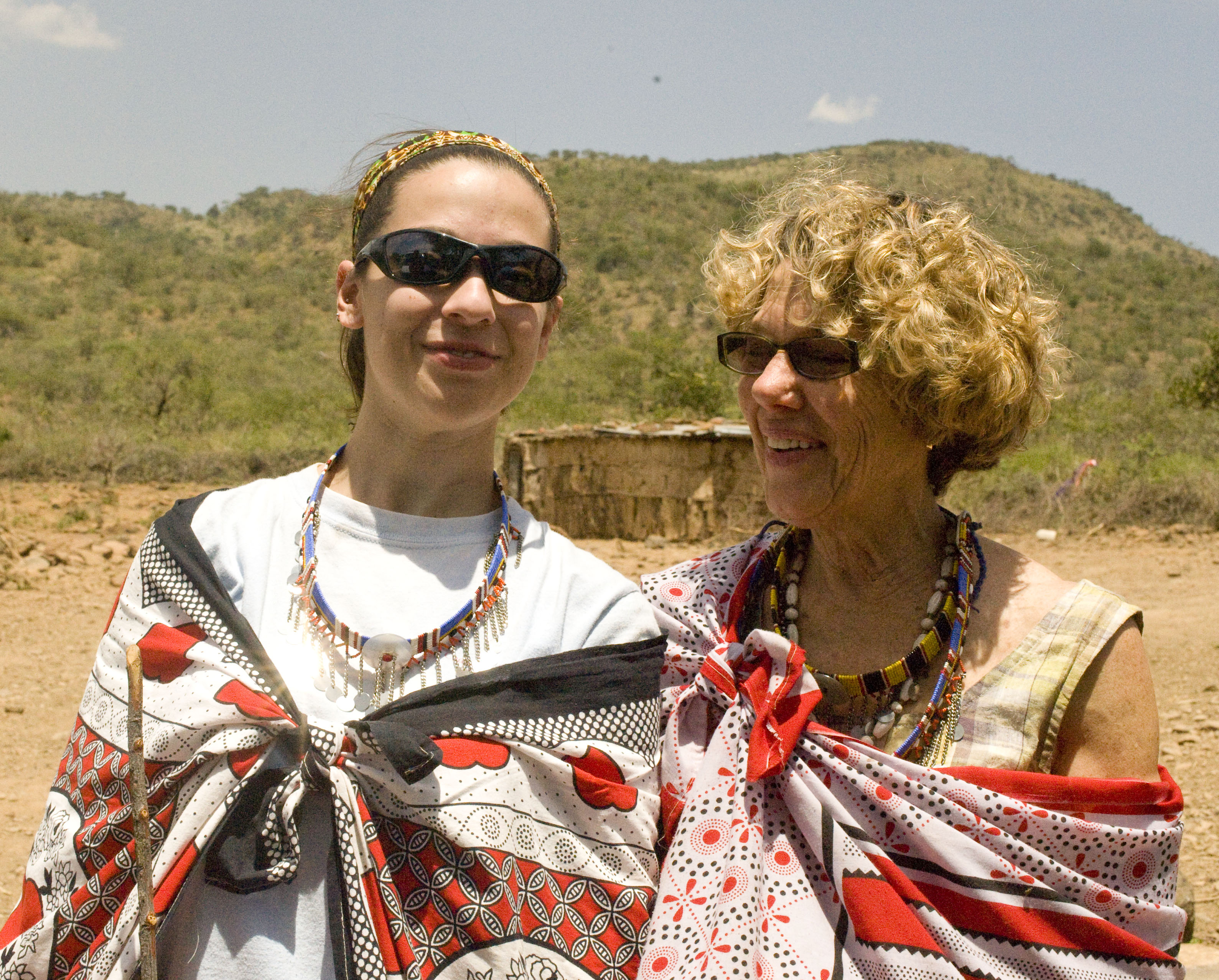
Kristen and Lynne, Mzungu Maasais
In the afternoon we met with the women who do crafts which largely involve some kind of very fine beading. They were seated beside the road under a tree; all dressed in beautiful brightly colored clothing and traditional jewelry with their ware spread out on beautiful cloth. It was like this spectacular patch of bright colors in an otherwise nearly monochromatic sea of muted green.
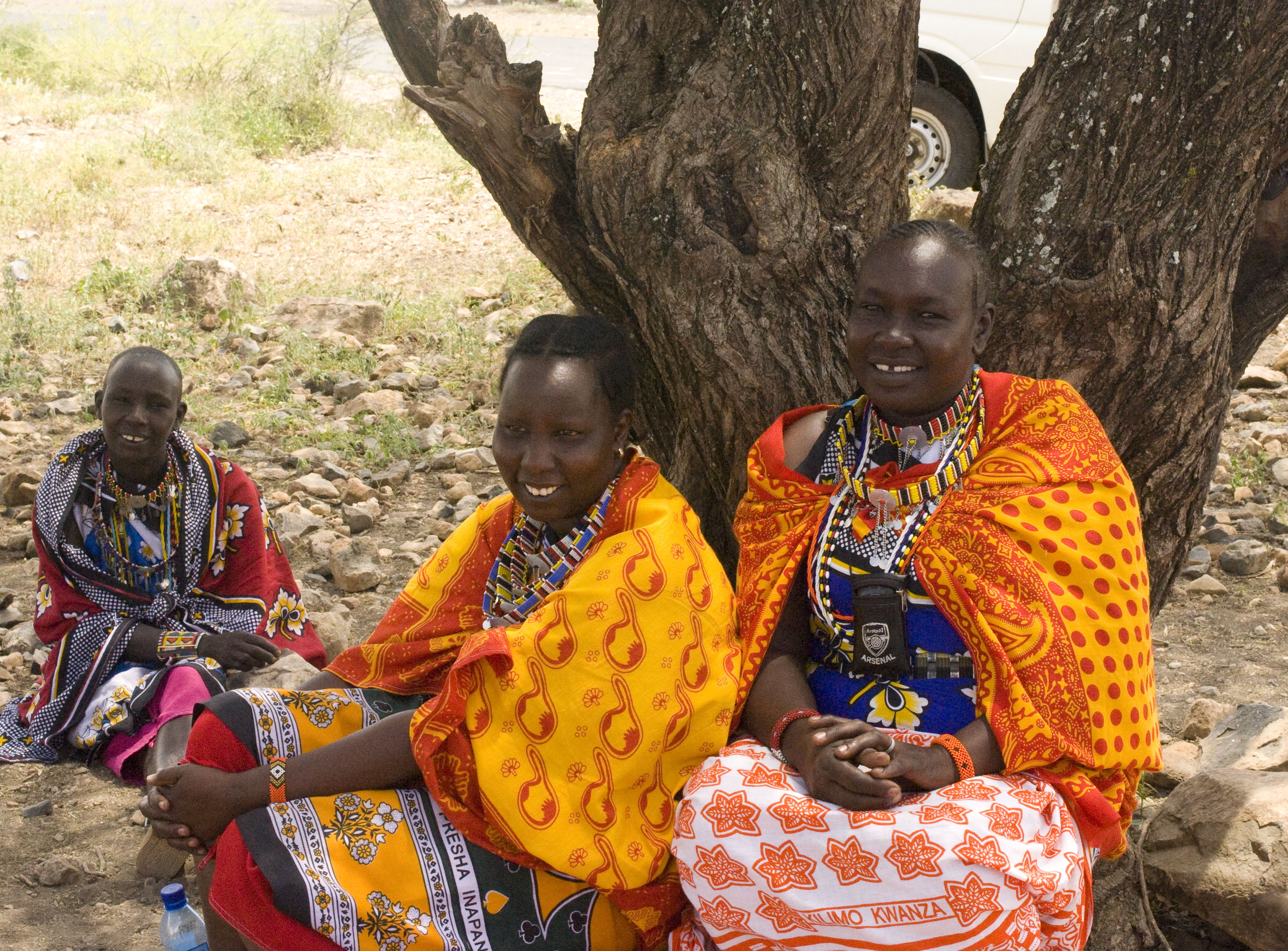
PCDA Craft Women
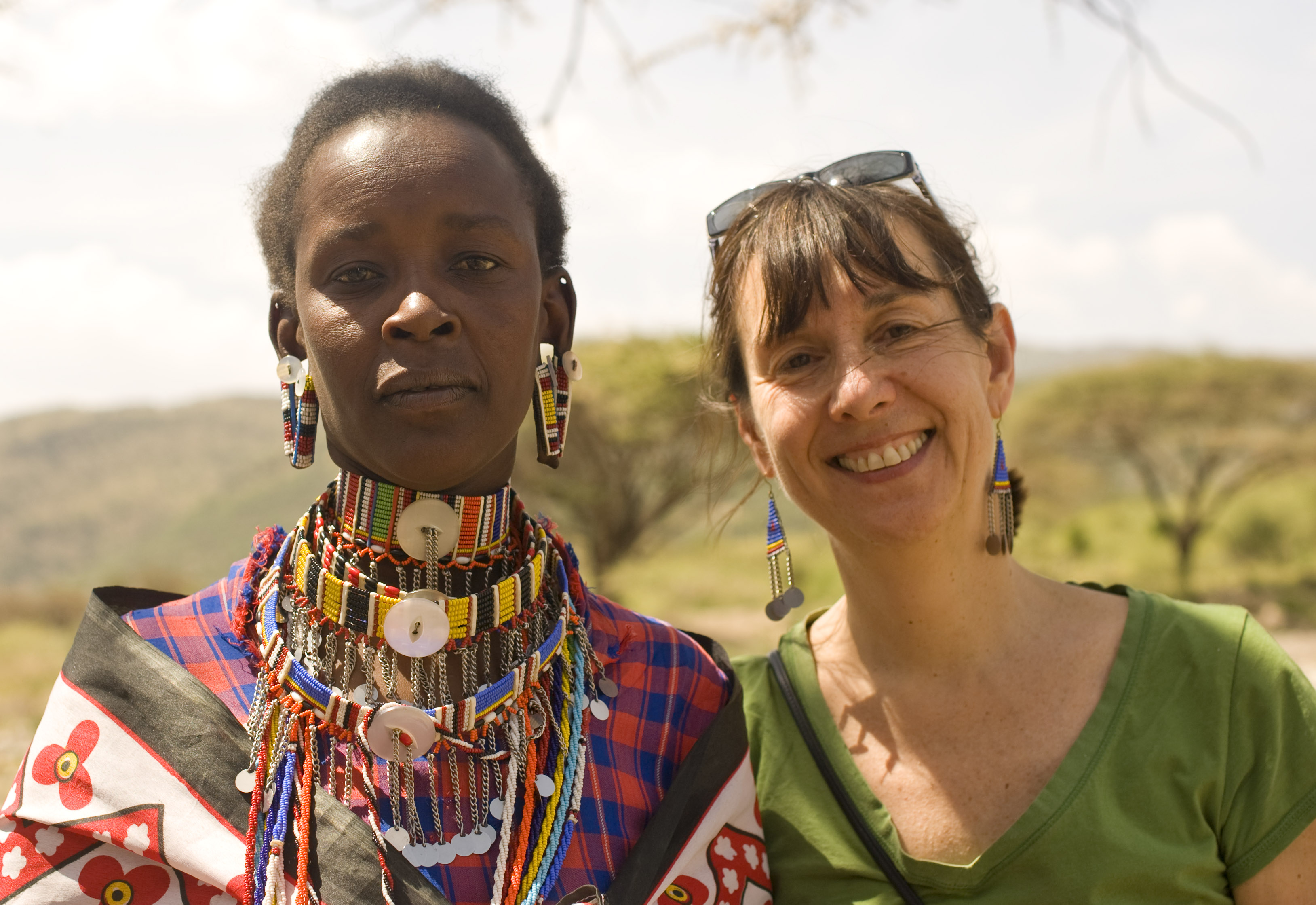
Deb and her Maasai Friend
Lloydie explained the Women4Women Initiative with help of Philip as translator. We talked about their crafts and mingled and enjoyed seeing the work that they had done which had many reflections of the culture contained within it. Before our departure they sang us a song….of course. It was a great couple of days of cultural exchange, building relationships, and making a committment to help this struggling community in an ongoing way.
Kibera Paper and so much more……….
Wednesday and Thursday were two really packed days such that when I arrived back at our lodging on Thursday night after 10 I was too exhausted to get a blog post done.They were as usual two incredible days filled with new experiences, inspiration, dancing and singing and yes once again tears from being touched by the experience. You go through a lot of tissues here!
We spent the better part of two days at Kibera Paper. I blogged in an earlier post, before I departed, about how Kibera Paper employs women from the Kibera slum and enables them to earn income to support their families when they would otherwise not be able to afford the basic necessities of life. We had two incredible days working with the women at Kibera Paper, getting to know them, working alongside them , learning their craft, exchanging ideas with the 2 young male artists who create many of the designs and really touching each other’s hearts. The KEST volunteers learned from the women how to make cards from beginning to end—that included “processing” the recycled paper (squishing it by hand in the water) into mush and then making it into sheets.
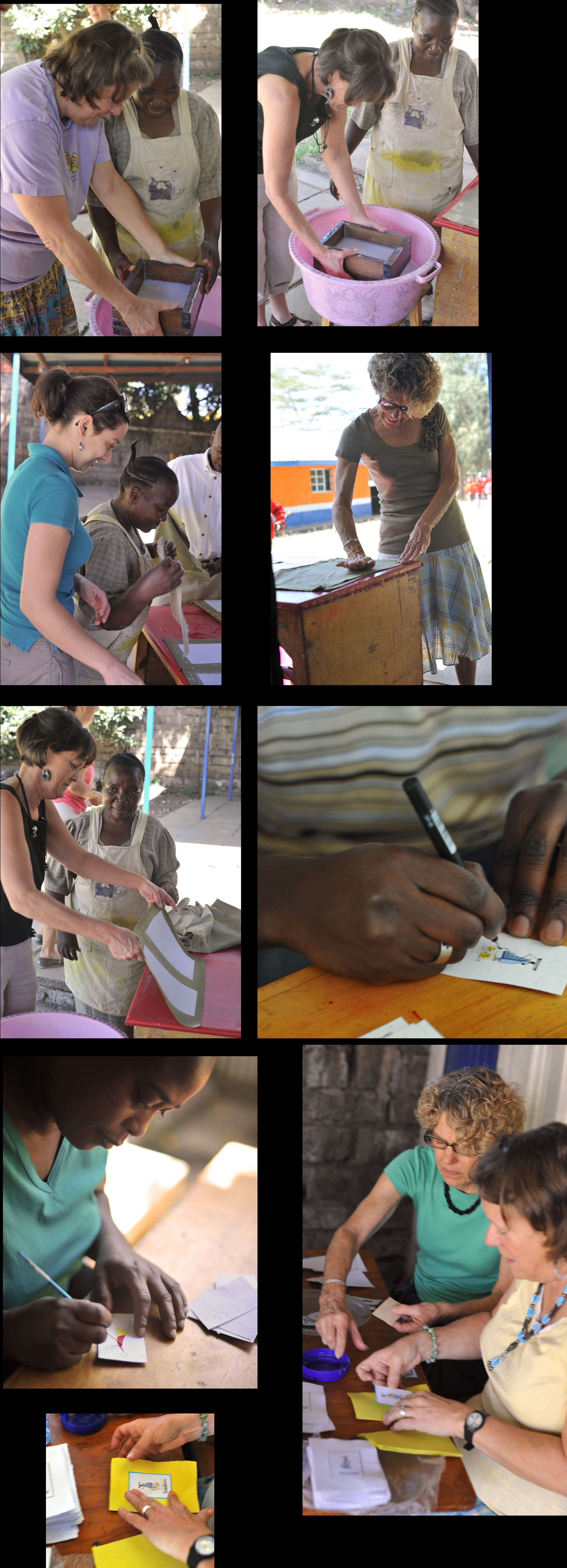
Learning to make Kibera cards-- Start to finish!
We also painted, beaded and threaded some designs and glued them together, folded and threaded the cards, put the Kibera Paper logo and description on the bag and even signed some of them. Since they were in the process of making more of my favorite mother and baby cards I was especially delighted that we got to participate in the making of those. We really learned how time consuming and intricate a process it is to make Kibera cards since they are handmade every single step of the way in the finest detail.
Bothe Deb and I worked with the Mommas to help them create cards with a technique that we use. Deb brought a lot of materials to make valentines since we are coming upon that holiday and that is recognized in Kenya.
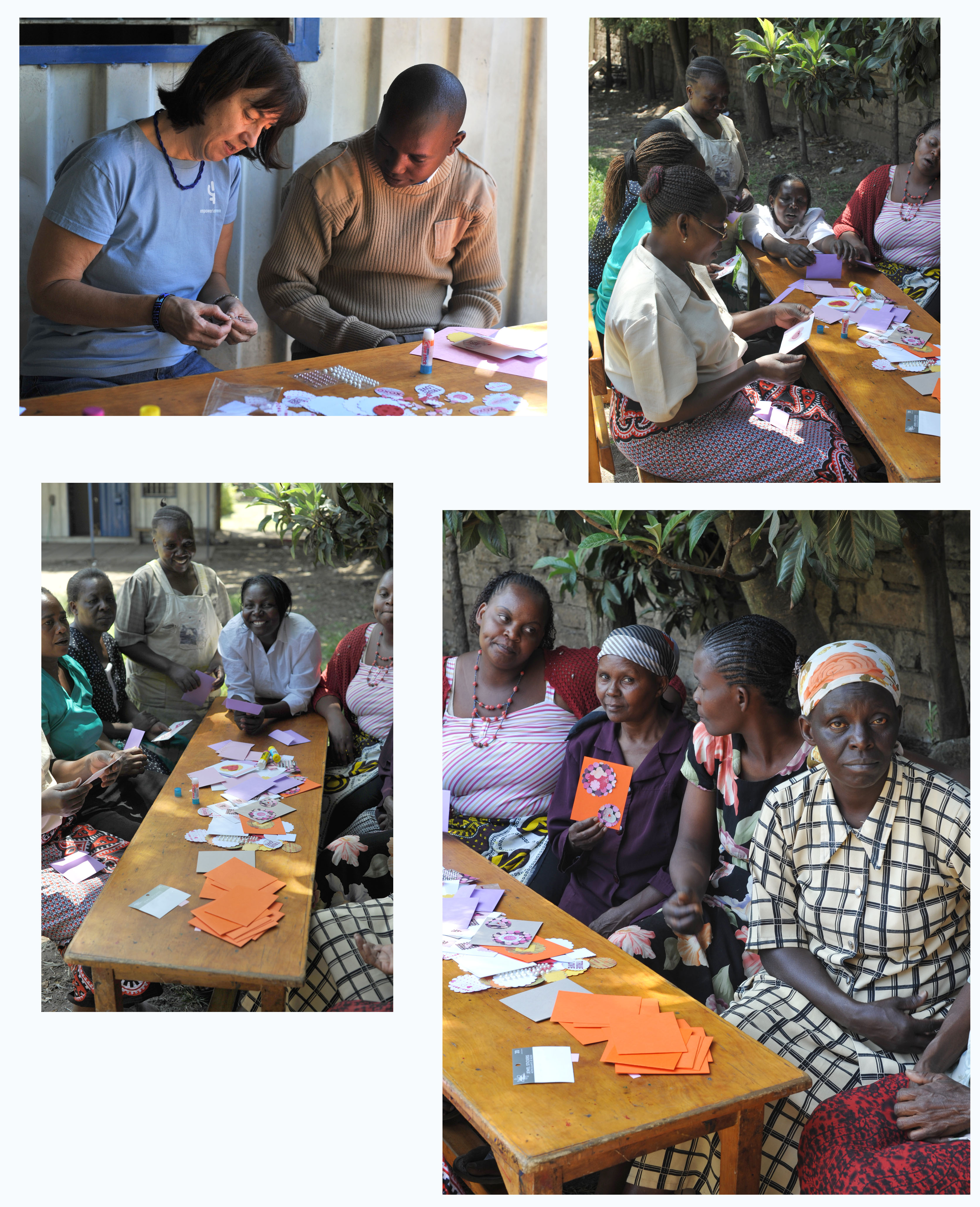
Deb's valentine project with the Kibera Paper women (even Justice helped out with this)
I really wanted to work with the woman to teach them a technique that they might be able to incorporate into their production and might be both fun by introducing something new, but also sustainable if I brought extra materials. I decided to teach them how to make small block prints with softcut linoleum and lino cutters and how to print them. If they liked the process and the designs, they would then be able to print the same blocks over and over again since I brought a lot of extra ink, printing paper and other materials to keep them going for a quite awhile. Wel, l I have to say that this was very exciting to me. They started out being very hesitant and unsure of themselves and by the end they were so proud of the work they had done that it just warmed my heart to see this unfold. I felt so happy to tell them what a wonderful job they had done and how proud I felt to have taught them. And they were profusely grateful for the lesson and the materials.
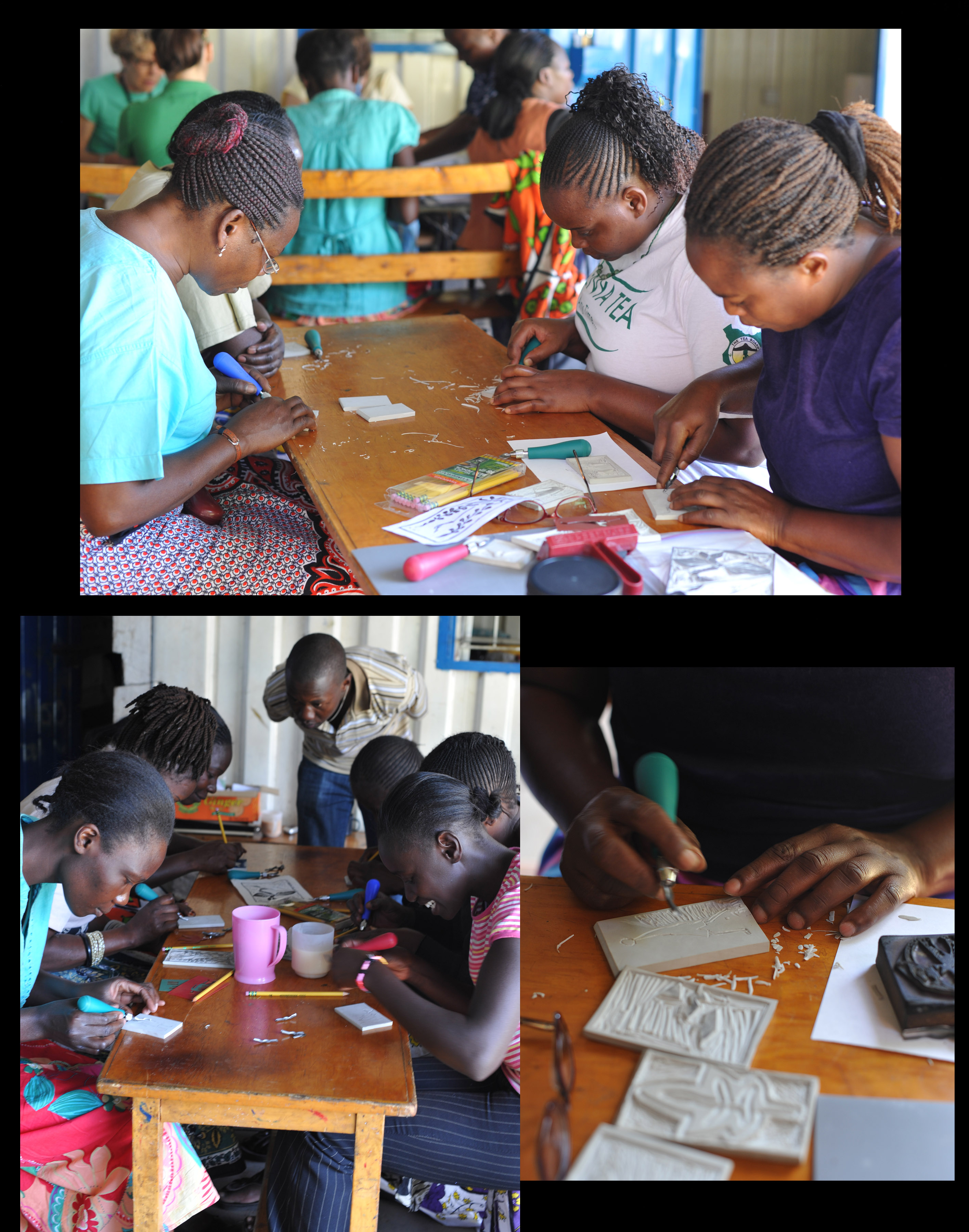
Kibera Paper women making block prints
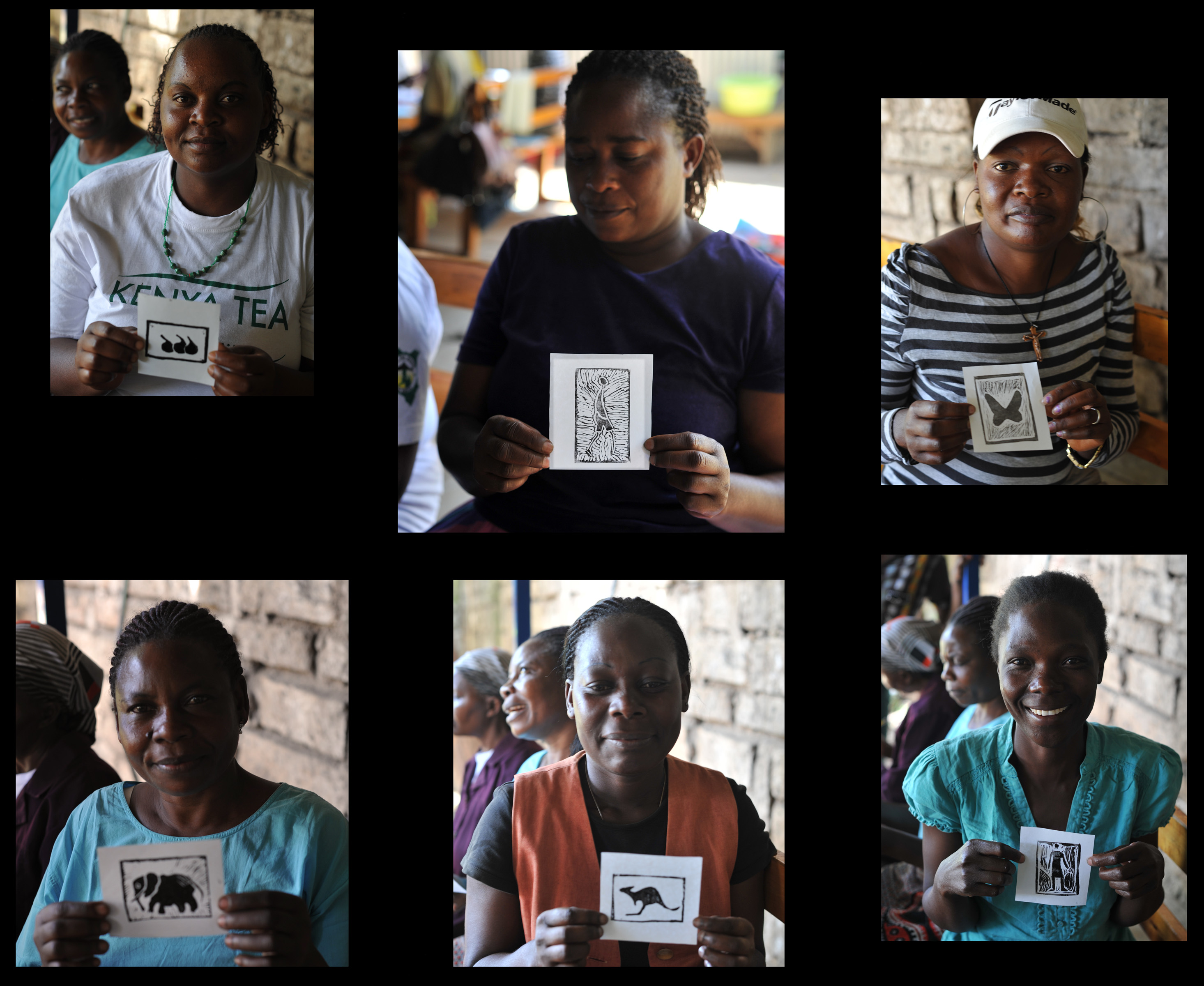
Proud of their work!
Both days we enjoyed chai and biscuits together and shared a genuine exchange of warmth and affection. Lloydie explained the mission of the Women4Women Program and how it would work and its intention to increase their sales in the U.S. We also shopped heartily form their stock of cards which are just beautiful.
When it came time to leave there was a lot of singing and dancing, the most joyous of which you can see in these videos.
There were also blessings in song and words shared in the Kenyan way which is to speak from the heart without being shy in a way that we don’t tend to do in the U.S. and when you experience it in Kenya it is so profoundly touching—well, that is why we always end up in tears. They are not shy about acknowledging that our hearts have been touched by each other and doing it in the loveliest of ways. And Kenyan goodbyes—well everyone gets hugs and you are escorted to your vehicle and hands are held, and more hugs and people are still waving as you drive away……
Since Kibera Cards are made on the property of a church and school where space is rented to allow for making and storing the cards , there are sometimes school children around as was the case when we were there. Since they were so adorable and I can never pass up an opportunity to photograph a child, I thought I would give you a peek and these children looking especially “smart” (Kenyan term for sharp, stylish) in their red school uniforms.
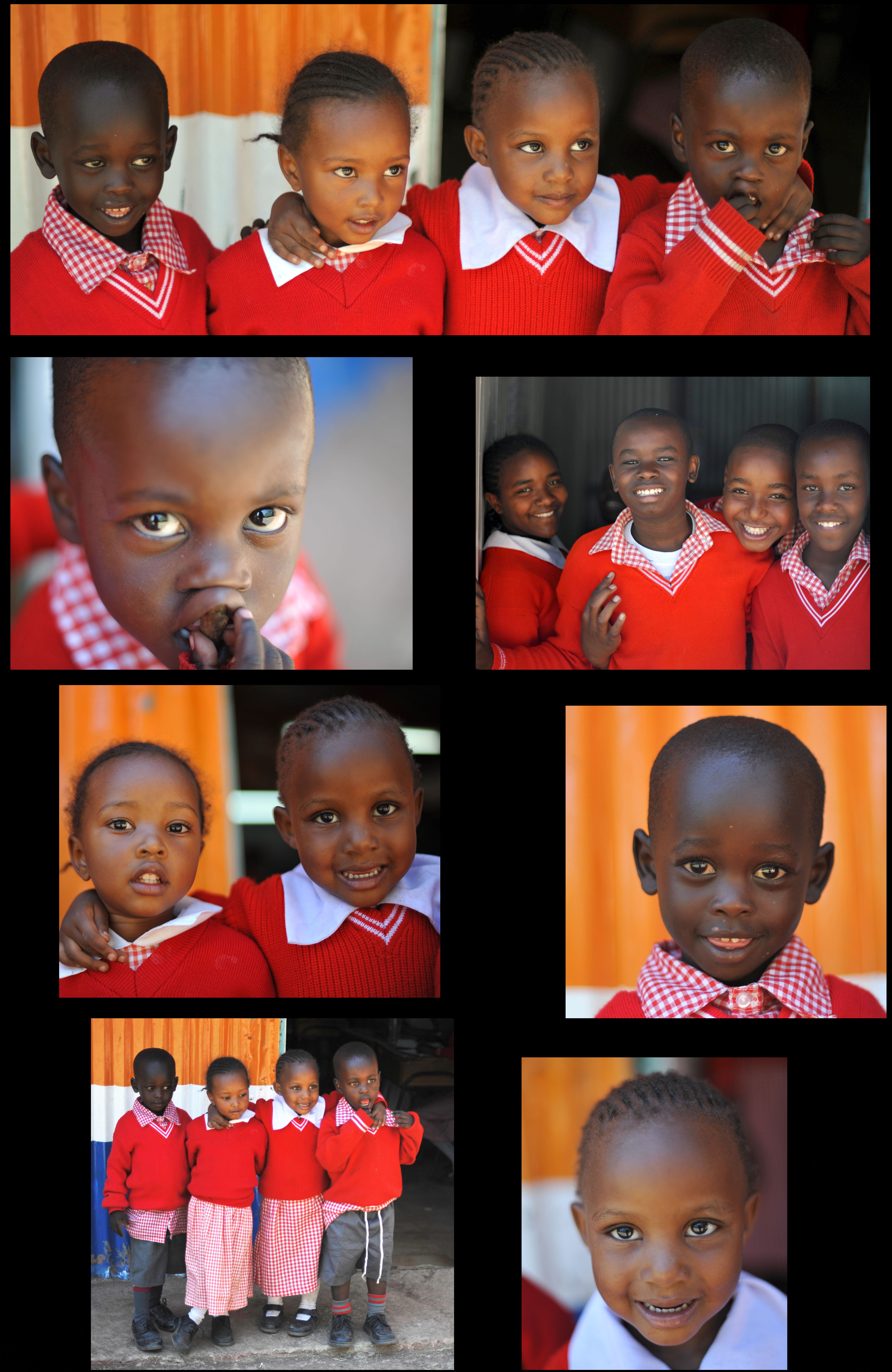
School children at Kibera Paper
Included in our two packed days were also some other activities, we drove into Kibera and stopped at a storefront that is run by one of the longest established Self Help Groups. They call themselves Power Women. Although not one of the groups for KEST’s Women4Women Initiative we did want to meet with them and to hear their story since they have a long history of success. And of course we came upon some other children and the usual chorus of children shouting after us “How are you?” which is what they do whenever they see white people (Mzungus) in Kibera.
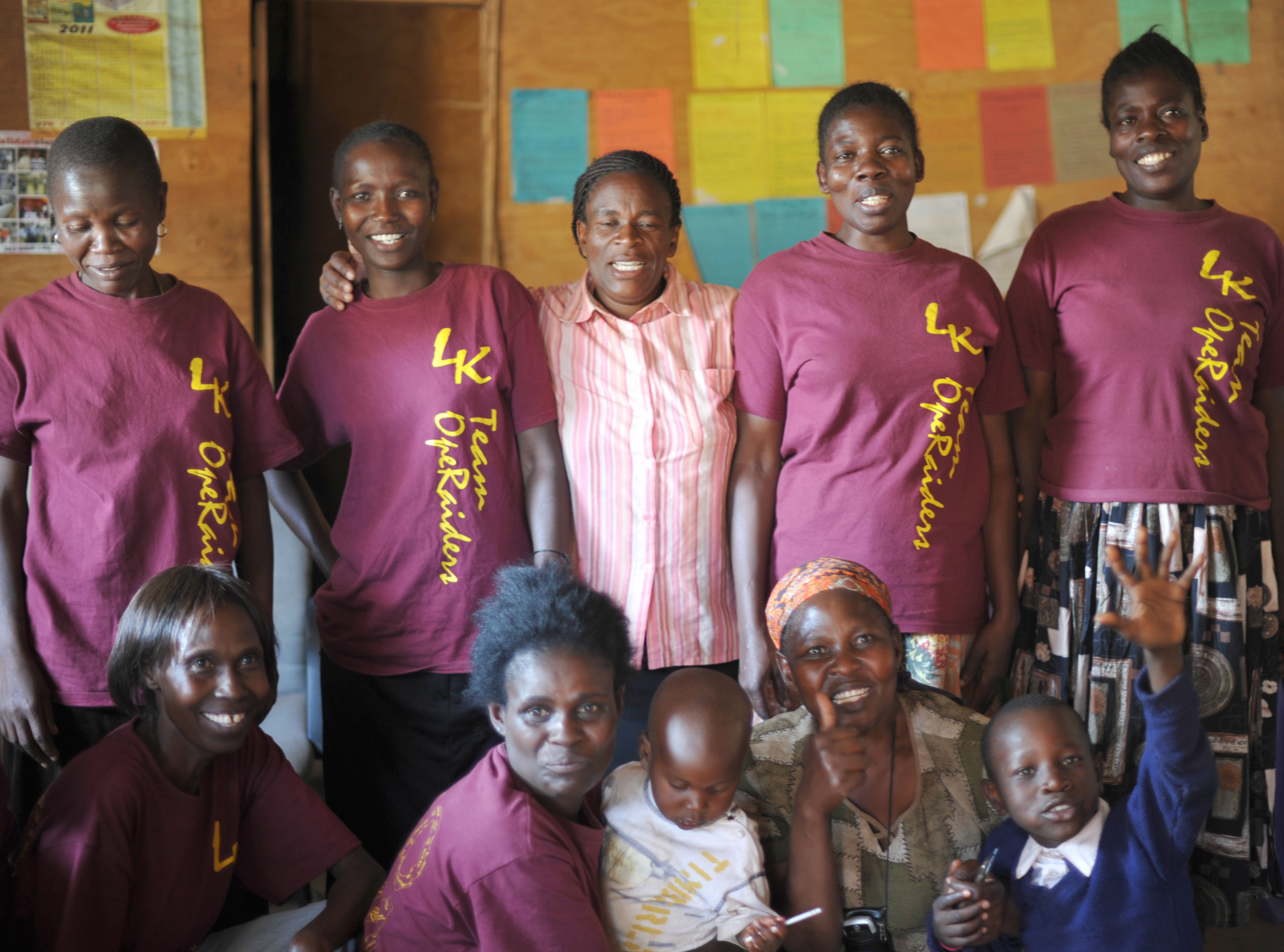
Power Women in their Kibera store front
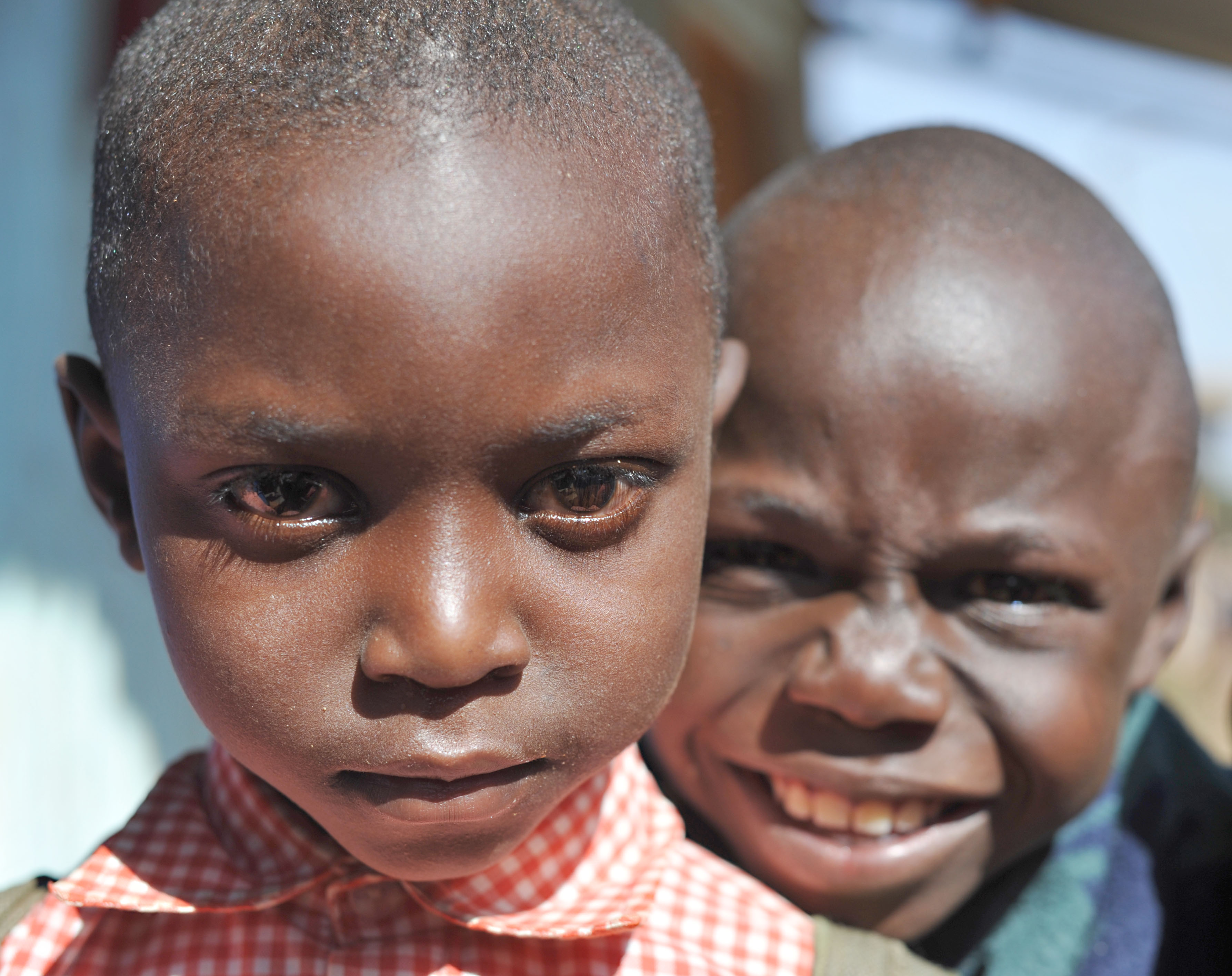
Kibera Kids
We also took a trip to Amani ya Juu (Higher Peace in Swahili), a women’s sewing and training program based in Nairobi for marginalized women and women refugees from many African Nations and cultures. The focus is on mentoring women, holistic development, producing quality environmentally friendly goods, peaceful existence and self sustainability. We had a lovely meal there and then browsed and purchased some of their goods.
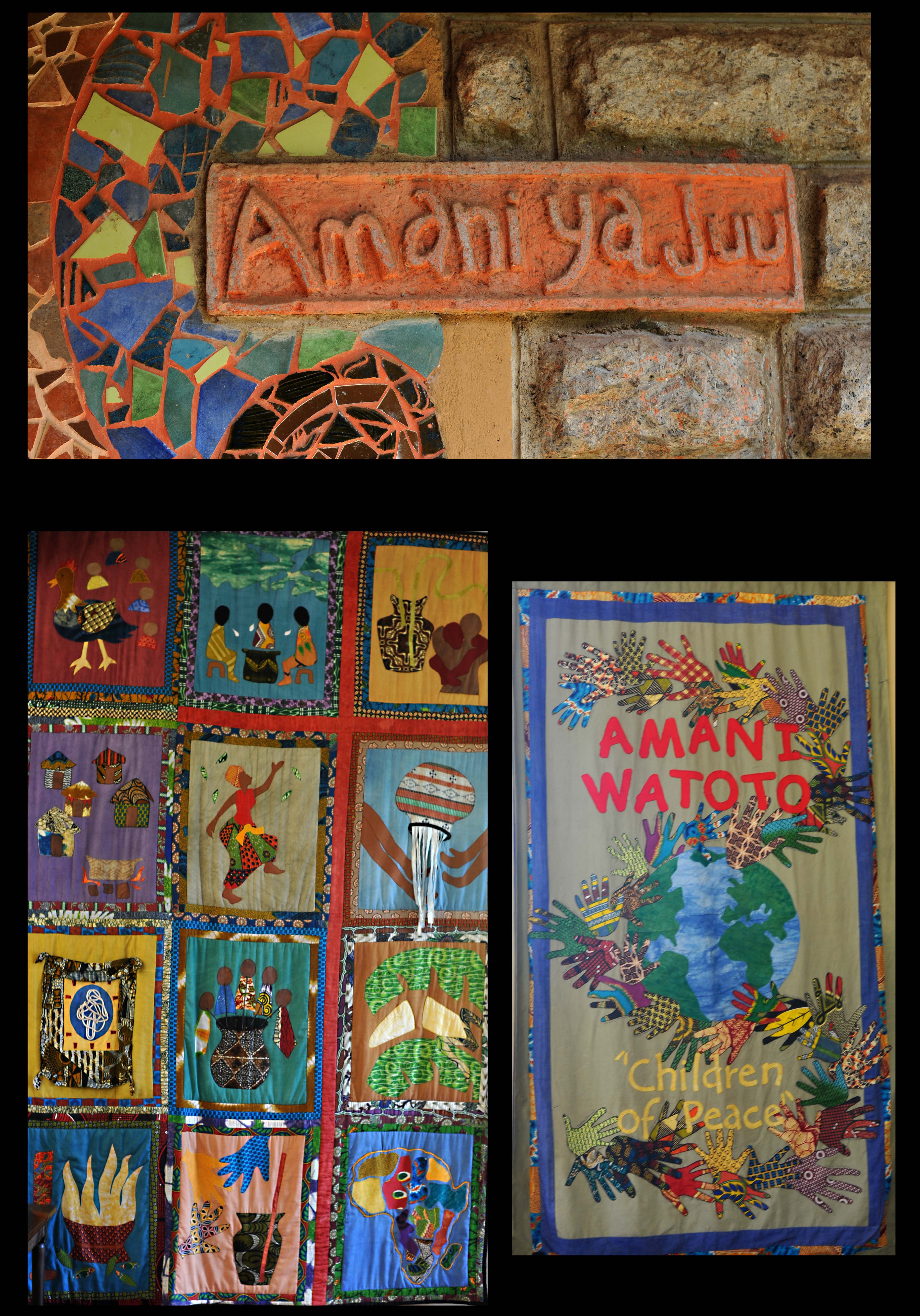
Amani: the Peace Quilt and The Children's Peace Quilt
Finally, we actually managed to fit something more into these two days—on Thursday evening we took the adolescents who will be going away from the Nyumbani Children’s Home to begin high school Form 1 or fist year of high school) out for a celebratory evening. In Kenya, after eighth grade children take standardized exams and only are accepted into high school if they pass and get adequate scores. All high schools require tuition and are boarding schools and acceptance is based entirely on test scores. This is all very anxiety provoking. All 14 students from Nyumbani Children’s Home will be going on to high school and will be leaving in the early part of February. We took them to a “nyama choma” (literal translation=grilled meat) and had a meal, hired a DJ for dancing and they had a wonderful evening. We road on the bus with them and KEST volunteers danced under the disco ball with them! I had the pleasure of sitting next to Thomas, a very bright young man who is very articulate and we had some wonderful conversation. Lloydie gave them all a bag of catsup, peanut butter, and hot chocolate—apparently the most missed food items when away at boarding school. Sitting back, looking at all of them having a wonderful time, dancing up a storm, well, it’s something to marvel at considering that many of them were so sick when they arrived at Nyumbani Children’s Home that they weren’t expected to live. Now that truly is something to celebrate!
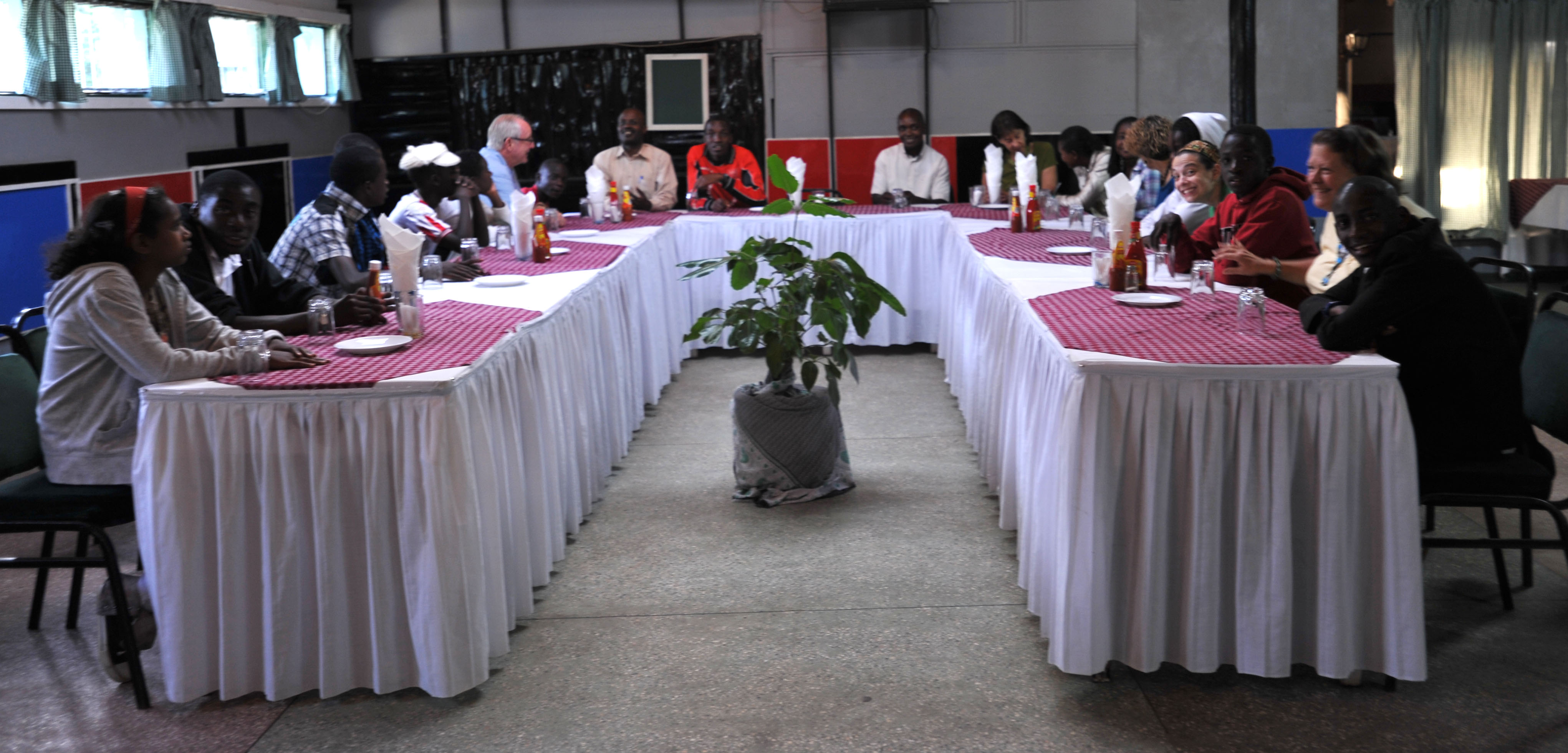
Nyumbani Children's Home Form One Students "Send Off" Dinner
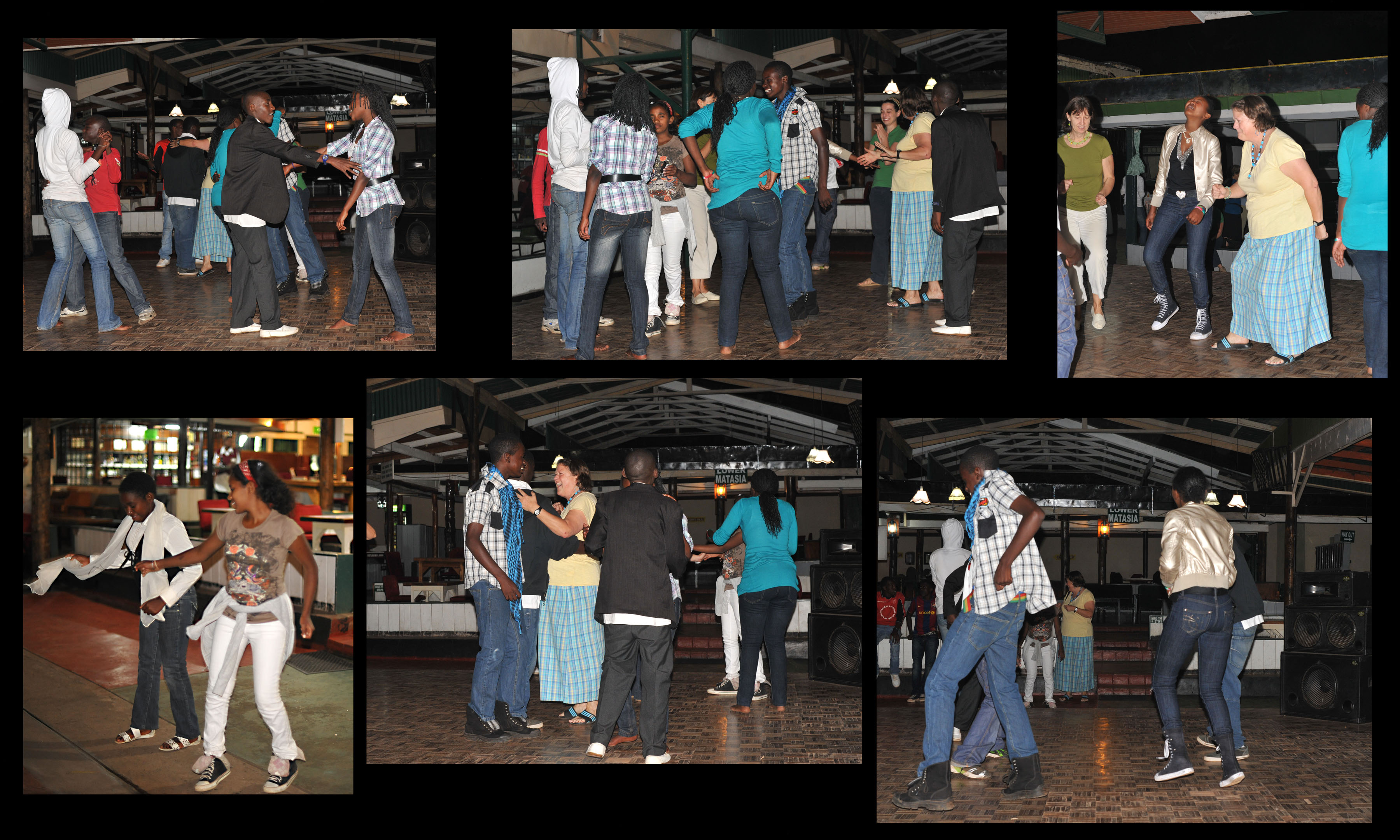
NCH Form One students and KEST volunteers dance the night away
Next stop PCDA (Pastoral Community Development Alliance) in the Maasai community and some of the most adorable children…stay tuned. LLala Salama! (Goodnight)
Video clips from Kenya as Promised
We had the day at Kibera Paper and will be going back there tomorrow when I will once again be blogging about another incredible experience. In the meantime, I think I have conquered some of my technical issues and can upload a few videoclips to share–I have taken alot of video so will have more. But here are a few to wet your appetite.
My little friend Dolo in cottage E at the Nyumbani Children’s Home is quite an energetic 3 year aold with a big personality and drives the point home that these children are thriving with HIV under the care that they are receiving. Here is Dolo in action:
All of the children at the orphanage are thriving. Going to mass there is a joyous experience with a choir of child singers and child drummers and musicians and dancers. Everyone joins in the celebration. Here is a sneak preview of the children– I say a preview because I know that next Sunday when the international summit members are at the Children’s Home they will have a whole program of entertainment prepared.
This is Boniface and his wife from the Program for the Deaf singing for us:
I will have a post tomorrow about our experinence with the women at Kibera Paper….and more
Two Extraordinary Days in the Slums of Nairobi

Meet the group: Justice, our driver and Kenyan guide extrordinaire and Lloydie, Deb (center), Kristen (lower right), Walter and Lynne
Now I have the impossible task of trying to put into words the past two days—days in which we have laughed, sang (even in sign language), danced, hugged and been hugged too many times to count, cried for being touched by the stories of tremendous resilience and grace, been humbled by the strength of character and generosity of people and were profusely thanked often by people with whom we felt honored to be able to share some time together. These have been the two days in the slums of Dandora, Kangemi, and Kawangware in the clinics of the Lea Toto programs, the Dandora Program for the Deaf and meeting with the Self Help Groups.
In each of the three sites we visited we talked with various different staff members of the programs—the Directors of the Eastern and Western divisions of the Lea Toto programs, a medical officer, a nurse, counselors, social workers and community health workers. This gave an opportunity for those who haven’t come to lea Toto before to get an overview and for others who have to get a chance to be updated. When a parent or guardian brings a child whom is suspected of being HIV+ to the clinic, they first meet with a counselor and testing is done at the same time along with counseling. If the results are positive the child receives a medical evaluation, nutritional assessment and begins on ARVs. The entire family receives nutritional support for the first year during which time they are expected to save the resources not spent on food to develop some independence from the food support. The caregivers are provided with extensive counseling and the child is given emotional support, support for school fees if needed, etc. Social workers do home visits on a regular basis and community support worker are volunteers who receive extensive and ongoing training and do home visits as well. When we met with community support workers, many of them were former or current clients in the Lea Toto Programs who felt that they were grateful for what they had received that they wanted to give back to others. The dedication of this staff, the workload that they carry is phenomenal and hearing them talk about why they do the work and what it means to them was so inspiring that when it came our time to speak we could hardly talk—Kristen and I were first and we were just passing the tissues back and forth. Paul, the Director at Dandora, and the Director of the western division of the Lea Toto Programs, was a very thoughtful and well spoken man, who told us to remember that every little bit of help matters, no matter how small, and that it can be overwhelming to look at the overall larger picture, but when you help the person who is there in front of you, that help is enormous. He also told us that people often have many needs, but what they need most from you is “heart” and the rest follows. We did do several home visits with the social worker and the community support worker at Kangemi . In fact we found that often the several of the women of the self help groups also worked as community support worker.
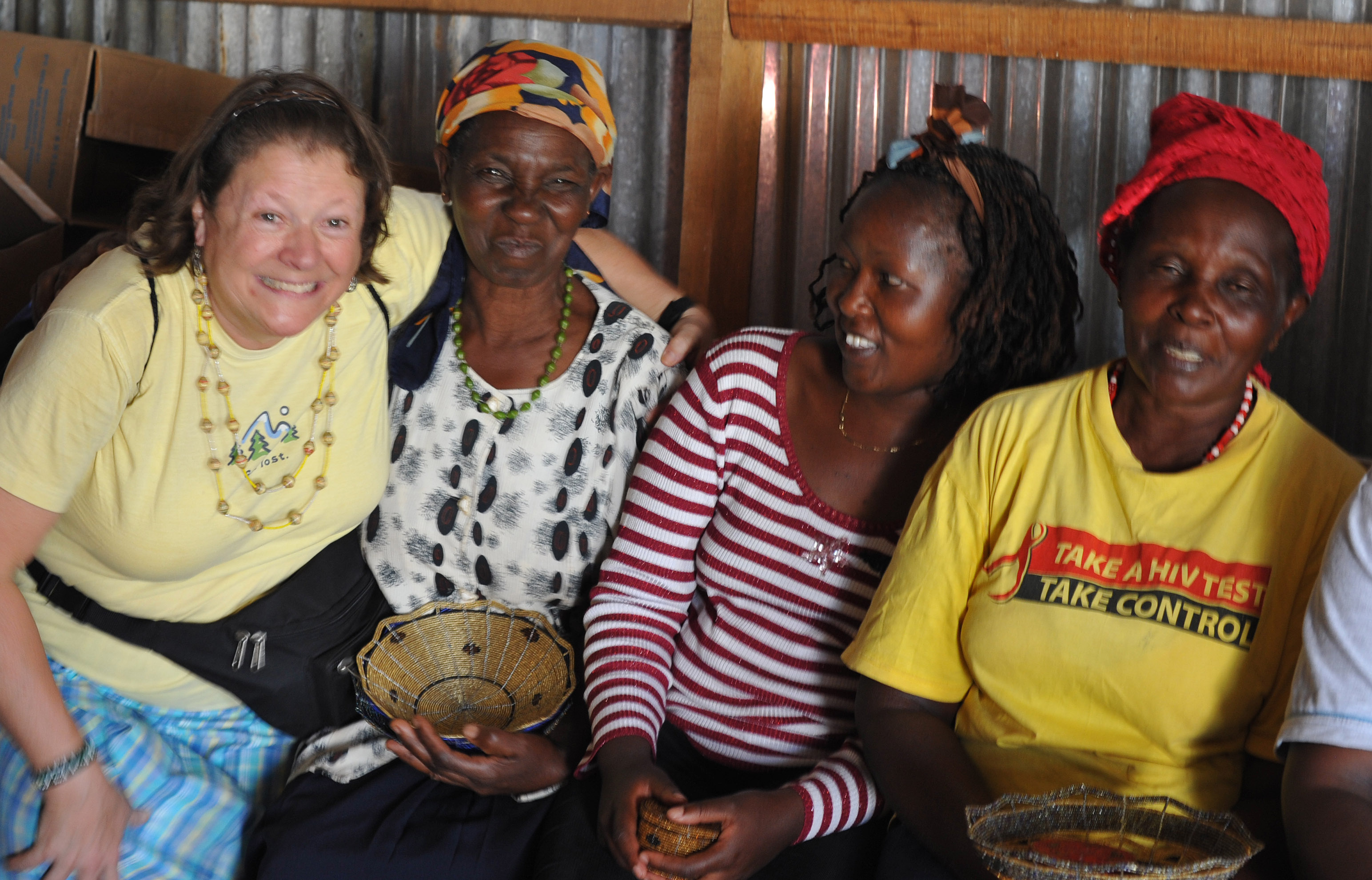
Lloydie with Good Hope Self Help Group members
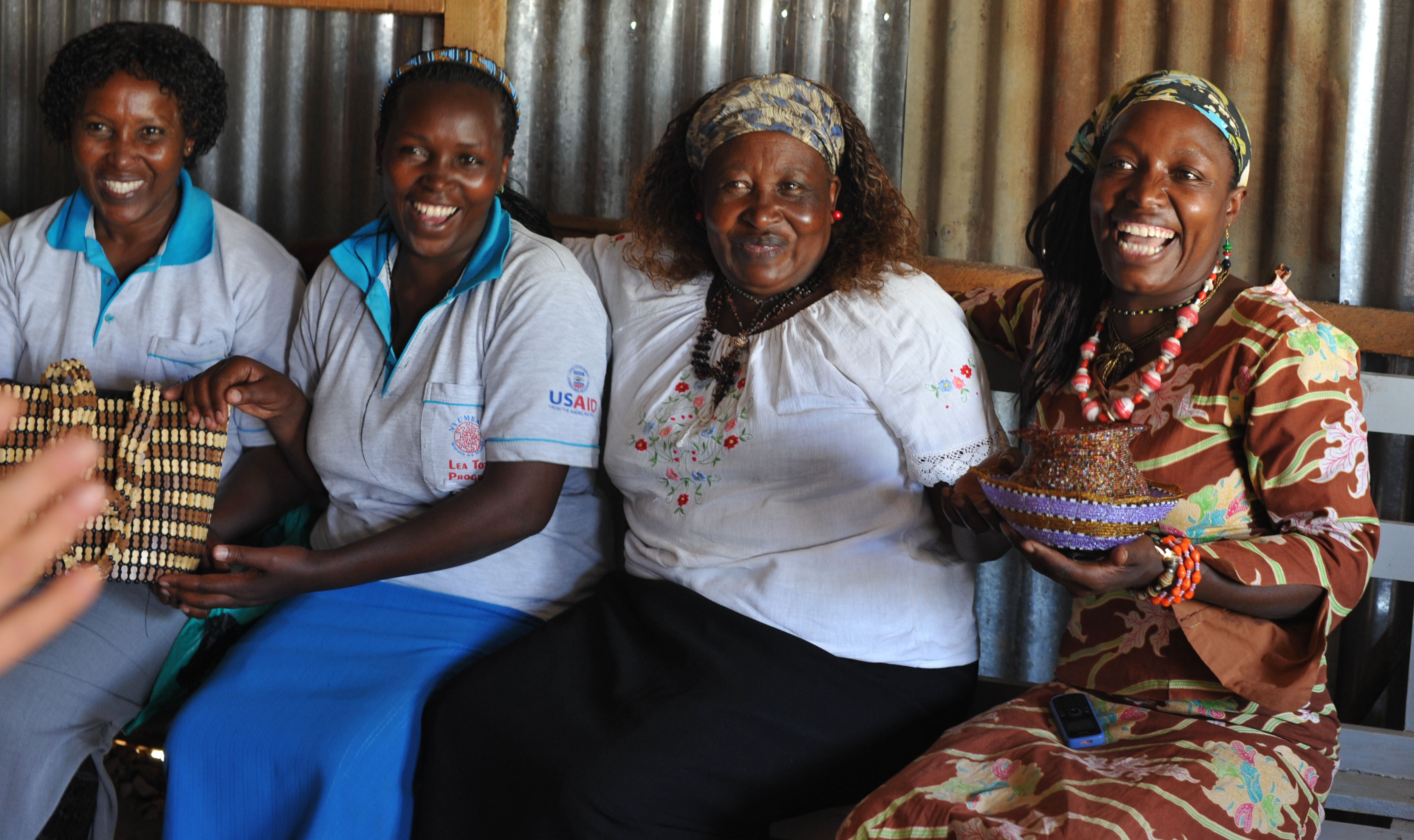
Other members of the Good Hope Self Help Group
We also met with the Self Help Groups to share time with them continuing to build relationships and to shop from their crafts. This included groups at all three sites including the Vision Self Help Group whom I had previously met in Dandora 2 years ago. These are wonderful groups of very lively vibrant women who each have incredible stories to tell. Every story is captivating but I have to say that Sally of the Vision Self Help Group had the most powerful story because she has been HIV+ since 1991 and has a daughter who is HIV+ as well. She has a strong powerful voice and is incredibly articulate about living positively with HIV and a powerful commitment to bringing that message to others. (I made a deal with her that next time I come to Kenya I will do a video interview because she has a voice and a story that really should be heard and can speak for many others).
We also had the mission of meeting with representative Self Help Groups in the three sites where Lloydie explained that it has often felt difficult for volunteers to feel like they are really able to be helpful in the Lea Toto sites and that KEST has taken on a new initiative to support those communities by supporting the Mommas of these groups. She explained the plan to select from their crafts items to be considered for sales in the US and that when she returns in June she will place a larger order for these items and pay fair market value when she gets them in August. Then KEST volunteers will sell them in the US and the additional profit will be brought to them next January and the cycle will repeat and hopefully grow. This plan was met with overwhelming enthusiasm and gratitude.
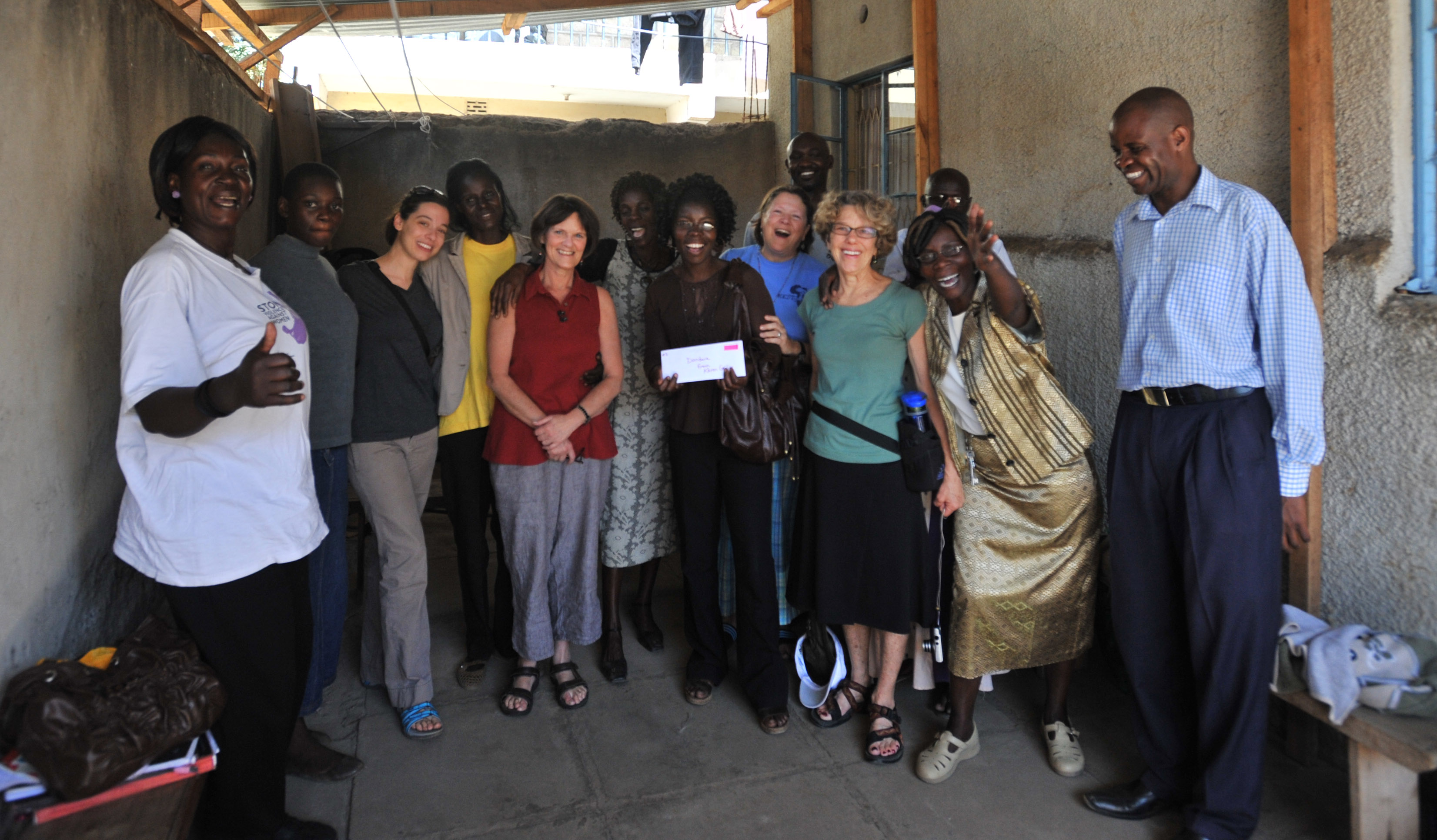
"Thumbs up!" from the Vision Self Help Group
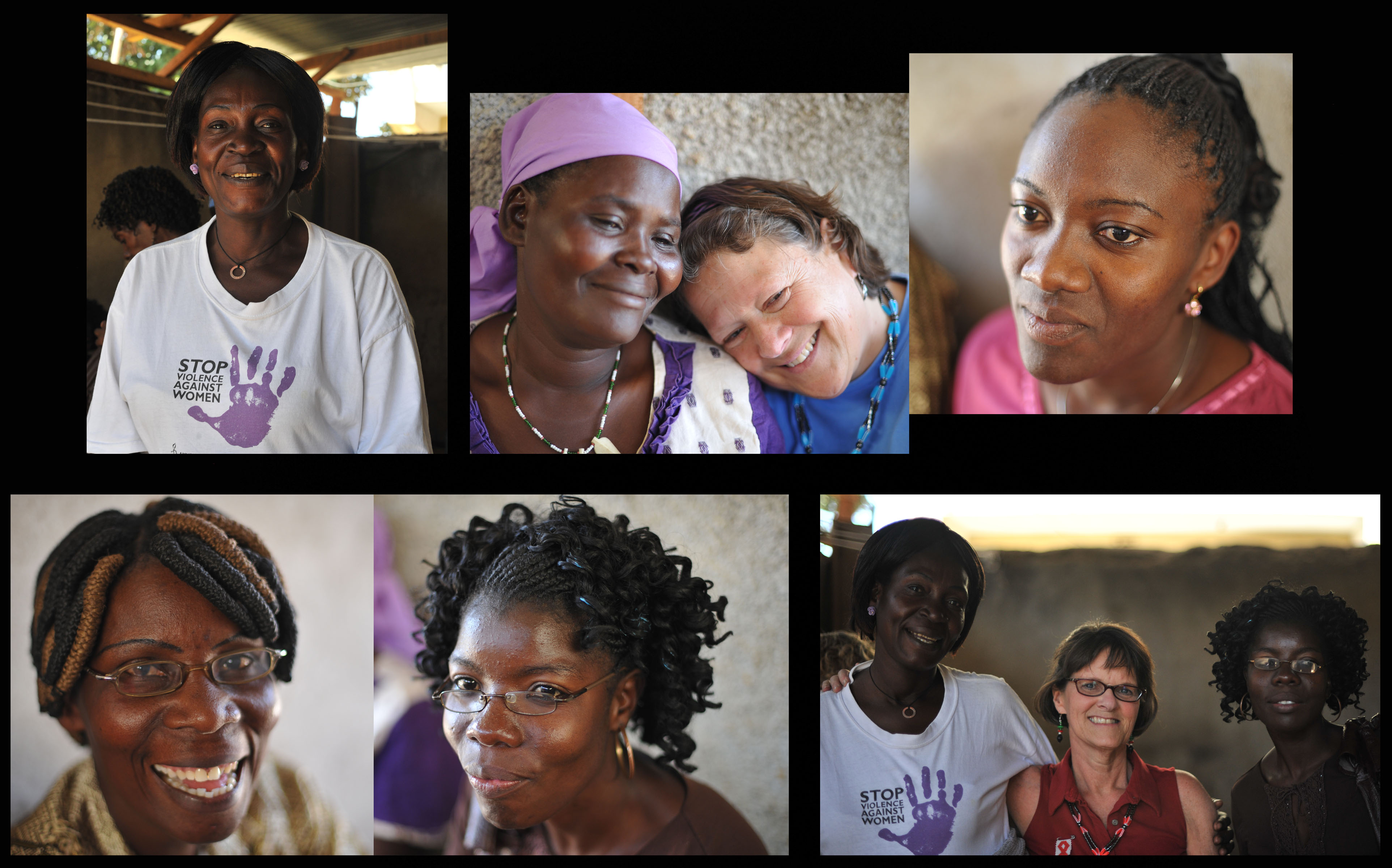
Meeting with the Vision Self Help Group
Finally we spent the afternoon today meeting with Boniface, who has a “ministry for the deaf”. We met with him and his wife, both of whom are deaf as well as 3 other deaf people with whom he works. Boniface is a sign language teacher and he and the others in the group spoke to us through William, an interpreter. We learned that there are schools for the deaf in Kenya but not a lot of other support and that they really have come together to support each other. Although Boniface and his wife are employed the other are currently without work though have skills. One fact that really struck me was that all five of the deaf people with whom we met (and this is largely true for Kenyans) were born hearing and became deaf as a result of illness in childhood, often common illnesses like mumps or measles for which we get vaccinated in the U.S. I can’t quite describe what it was like to spend time with them—they may not have been able to speak, but they could certainly communicate in a phenomenally moving way that was deeply touching. I had heard through Lloydie that Boniface really needed a digital camera for work with his students and it warmed my heart to be able to give him. They say to us in sign language, taught us to sing by signing…..and more tears. I have a wonderful videotape of this that I hope to be able to upload (after 3 failed attmpts have to try again later–aaah the joys of technology…)
As always, there is so much more I could say, so many more words I could use, but words can’t capture this…..
It’s after midnight here, please pardon my typos, no more energy to proofread and a busy day tomorrow….kwaheri from Kenya!
The Weekend at Nyumbani Children’s Home
We spent our first weekend in Kenya at Nyumbani Children’s Home, the orphanage for children who are HIV+. We began the weekend by meeting with Sister Mary, the Executive Director of Nyumbani , who updated us on the Children’s Home as well as the other Nyumbani Programs, Lea Toto clinics in the impoverished communities around Nairobi and Nyumbani Village in Kitui. We learned that the programs now serve over 4000 children and in the case of Lea Toto, their families are receiving services as well. The children in the Children’s Home continue to thrive although 2 children had developed resistance to antiretroviral medications (ARV’s). In the past these children would have died but she was able to petition to get special permission to purchase the drugs for these children from outside the country as only first and second line drugs are available in Kenya. The major happening in the orphanage now is that there are 14 children looking for acceptance in to high schools. All are tuition based boarding schools in Kenya and acceptance is based solely on standardized test scores. Since some of the children have had periods of being unhealthy or difficult starts they don’t all score very well, so this is a time of high anxiety for them. We also toured the Nyumbani Diagnostic Laboratory which is a new freestanding facility and much larger than the small laboratory which Nyumbani previously had. There they do the most advanced HIV testing in all the country and provide services to a wide range of other organizations and facilities. BTW, Nyumbani was the first site of HIV testing in Kenya and the first AIDS orphanage in Kenya. I could say a lot more but on to the children………
The children greeted us with squeals and smiles and hugs and magnificent welcomes that were so heartwarming!
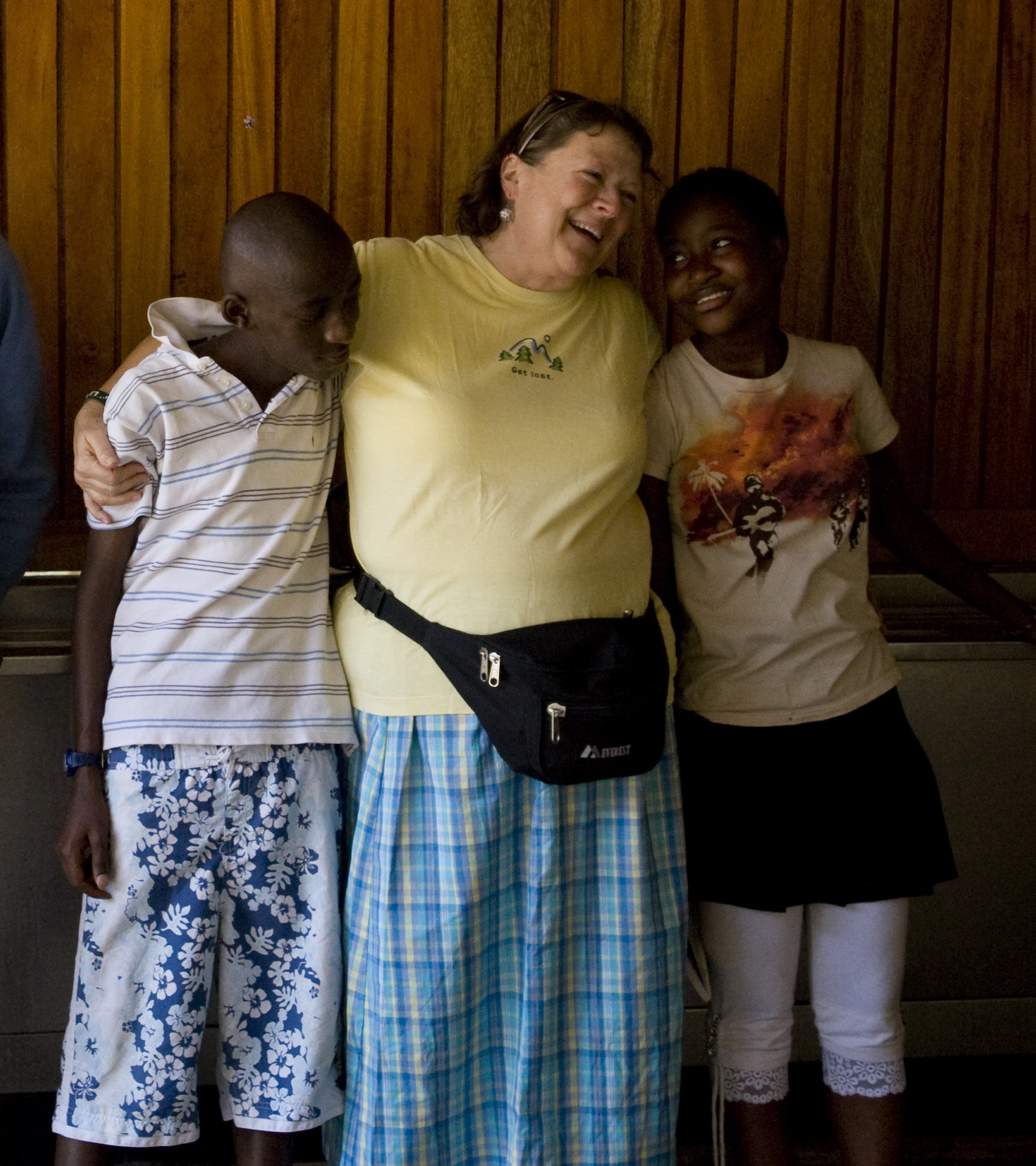
Lloydie with 2 Nyumbani kids
I have not been here for two years so one thing I really noticed was how some of the children have really grown! There are lots of names and faces to remember so I couldn’t remember them all, but was particularly surprised to see the growth in the little ones—some of whom you will recognize from my blog posts in 2010. I was amazed when one little boy who was in the ST Paul Miki Preschool the last time I was here remembered that I had taken his picture. And there are some new little ones as well.
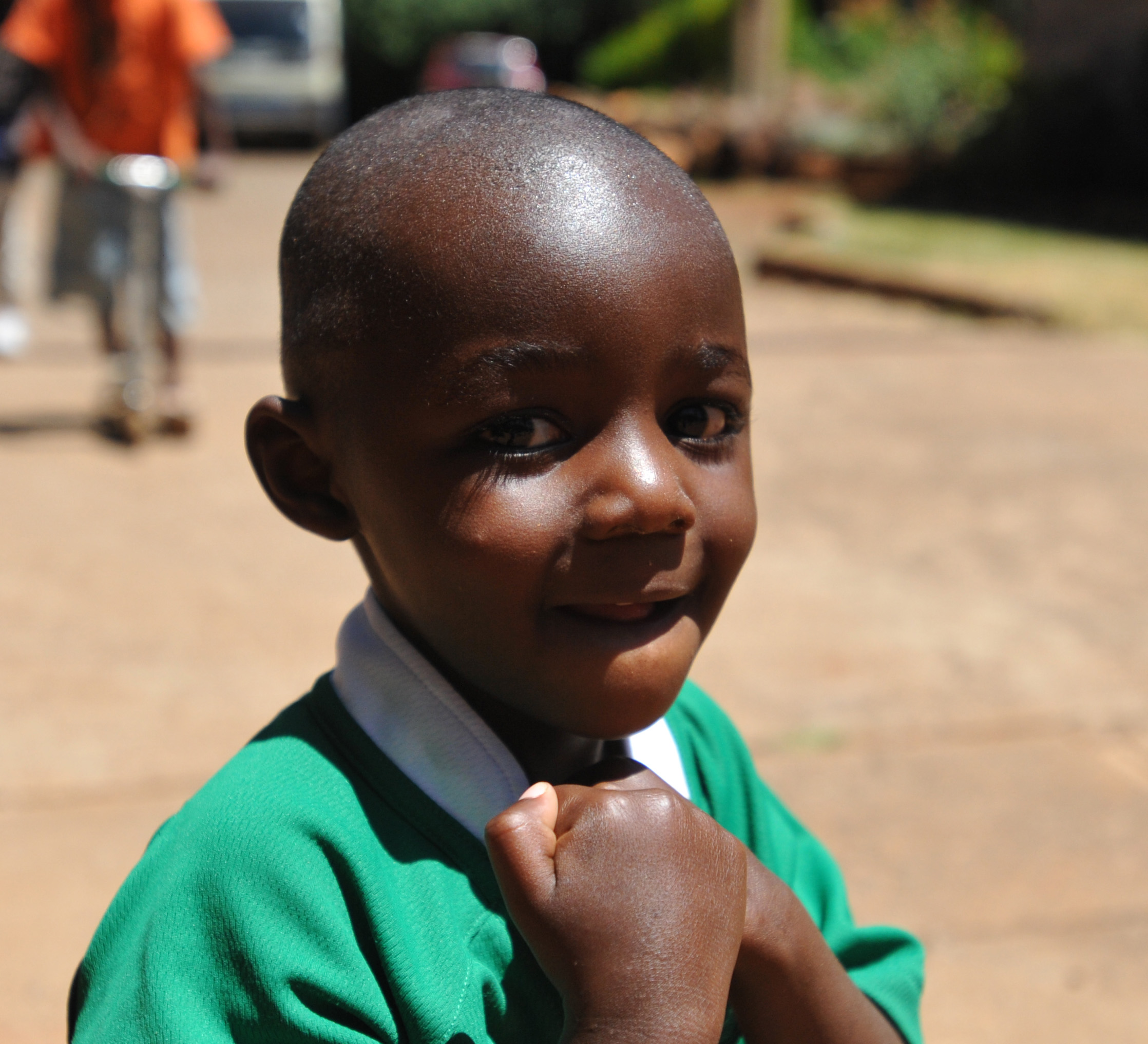
Dolo, the little charnmer from cottage E

Baby Sharon

Innocent--remember him?!
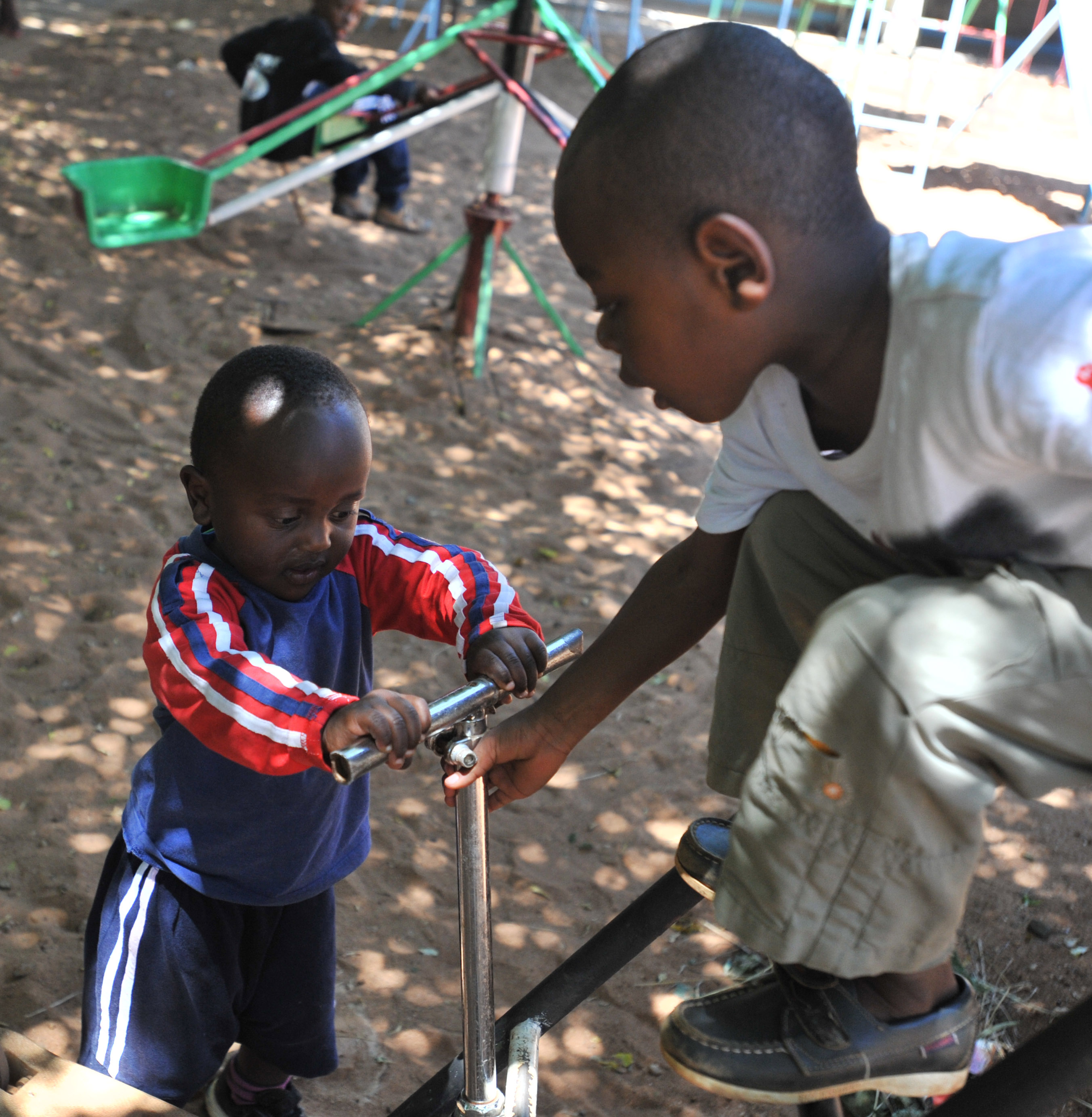
The older children are genuinely kind and helpful to the younger ones.
Each of the volunteers was assigned a host cottage to spend time with including the children and the cottage mother. This meant hanging out with the children and seeing how the “family” (14 children and 2 Mommas) runs, having lunch with them, spending play time and getting to know them. I was particularly charmed by a spunky pint sized 3 year old, the youngest in my cottage, with a big personality, named Dolo. We will be back next weekend to spend some more time with them. And by popular demand I did another round of face painting which was so much fun! We also went to church with them on Sunday—Kenyan style with joyous drumming, singing, clapping and dancing. We also heard stories from the cottage mothers as well as other staff about some of the newer children and how sick they were when they arrived – some could not walk or talk and now they are racing around on scooters in the playground. You can’t help but think every once in a while that all of these beautiful children who are lively, thriving, very affectionate, little people would have died if it were not for the care they are receiving here. When you stand back and watch all this life around you it can move you to tears.

Lloydie and one of the boys from her cottage
I have some great video–you can get a peek at Dolo’s personality, experience mass at the Children’s Home and more, but I’m having some technical problems posting it. Check back later. Kwaheri marafiki!
Getting to Kenya, via Rwanda, and just a few traveling snafus!!
FINALLY……in Kenya!!
Well, my fellow travelers have kidded me that they couldn’t wait to hear what I would have to say about making our way here. I have to say that it was QUITE THE TRIP! I started out on Thursday morning the 19th at 9 AM and headed to Boston where I met up with Kristin and we flew off to D.C. together. We surpassed the first snag of having to check in and out security to recollect my 2 checked bags (100 lbs of luggage) that were only checked as far as DC instead of all the way to Kenya, all while toting our additional 4 carry-ons like an Abbott and Costello routine getting acquainted with a good many laughs about toppling luggage and how we already needed to” freshen up” after only the shortest flight of the trip. We connected up with the rest of the travelers at out gate to head to Brussels; that was when we first realized that our flight to Nairobi was to get there by way of Kigali, Rwanda….oh well, a little extra time added, we could handle that.
Then we learned that there was a problem with our plane. And time was passing… passing…and passing. And then came the announcements, one, then another, and another—about technical and electrical problems…and groans about the fact that that might be just “a little TOO much information to be giving everyone about the delay!” Then there was announcement that they were loading some additional software that the captain felt confident would fix it; then, well that didn’t work. Then an announcement that “well, they didn’t really know what the plan would be……” Yikes!! Now it’s about 3 hours AFTER departure time and there’s only one connecting flight to Nairobi per day. So our fearless leader Lloydie began making alternative contingency plans with the United rep: fly to London and spend a lovely day in London before the daily connecting flight to Nairobi (or not so lovely each our 2 stuffed carry ons and collective 600+ lbs of duffels), fly to Zurich and definitely miss the connecting flight, fly to Dubai for 15 hours and then get a flight to directly to Kenya…the next day. During the course of discussing our options, an announcement was made that we needed to go a new gate and we were shuffled off to a new plane where we were quickly issued new boarding passes and were about to board 4 hours late with a small hope and a prayer for reaching our connecting flight—but were told that there was no hope that our bags would arrive with us. So we took off!
The captain came over the loud speaker and said that he was going to do his best to make up time and get everyone to connecting flights…..Hmm, after taking off 4 hours late?! But we got to Brussels and were part of small mob racing to other gates and barely made it, but did succeed in getting to our connecting flight. After many, many hours of flying we landed in Kigali and got a glimpse of Rwanda, deposited some of the passengers there, picked up some others who were headed back to Brussels via Kenya. After about 2 and ½ hours of this process, refueling, etc) we took off for Nairobi. We were flying with 40 Swedish students going from Brussels to Nairobi and when we landed in Kenya, we joined in their clapping. Now about 32 hours from the original departure from home, we were finally in Kenya. And miracle of miracles (we were due for one) ALL of our baggage had arrived too!! Our driver Justice was waiting with a huge smile and a very exuberant Kenyan welcome (Justice has a very big and happy personality) even though it was well after midnight. And the 6 of the travelers—Lloydie, Deb, Kirsten, Lynne, Walter and myself—were exhausted, but brimming with excitement and had managed to do some pretty good bonding, laughing, storytelling and listening of prior experiences in Kenya, and getting to know each over the trials and tribulations of getting here. Finally, in Kenya, headed to Bed at 2AM and ready to go to Nyumbani Children’s Home the next morning.
Since getting online has been a bit of a challenge—I won’t bore—I started writing my blog entries but couldn’t post them. Much more to come……….
One more day, one more post, one more duffel…then we’re off!
We are off to Kenya on Thursday so this will be my last post before I leave home. Tomorrow will be a busy day since I will be working until the afternoon , then finishing up many things to prepare to be away, packing my last duffel and heading out on Thursday morning. I will first fly to D.C. where I will meet up with my fellow travelers and we will all fly together to Kenya. I received a lovely email from Lilian, the counselor at Nyumbani Village, wishing me safe travels and letting me know that she can’t wait to see me. We have also had several e-mails back and forth from the women at Kibera Paper making plans for our time together for a sharing of creative ideas.
More people have come by with donations making the packing a little trickier, but the bounty more plentiful and I’m very grateful to have these to bring with me. The monetary donations have really added up and I am very grateful for those as well since they will help us contribute to the nutritional needs of the Maasai children and to buy mattresses for Nyumbani Village. They are also very light weight and don’t take any packing space and at this point I’m particularly appreciative for that! I really want to thank everyone who has made the effort to donate to this cause– every little bit adds up, every little bit makes a significant difference, everything is received with such grace and gratitude. I wish all of you could have the opportunity to experience what I will when giving to the Kenyan people who I will encounter– it’s quite beyond words.
Finally, I would like to introduce you to another artisan group with whom we will work to discuss fair trade practices for selling their ware in the states. You have, however, actually been introduced previously though not from this perspective. These are the grandmothers or shosho’s (sho sho’s , su su’s, nobody can actually really say how you spell this Kikombe word in English) at Nyumbani Village. This is a very spirited, lively, dancing and singing group of grannies who are prone to grabbing you at any moment and pulling you into an impromptu dance, who have a special 3 part Kikombe hand shake that they teach everyone, and who also greet you with gigantic smiles and Kikombe greetings with the expectation that you somehow know the correct response–if you don’t, they teach you on the spot with great gesticulation and broad smiles and laughter until you get it. They also weave very beautiful baskets out of Sissel and yarn and make it look incredibly easy. They sell these though do not have a well established market and really need to expand that since the baskets are quite beautiful and so well made.
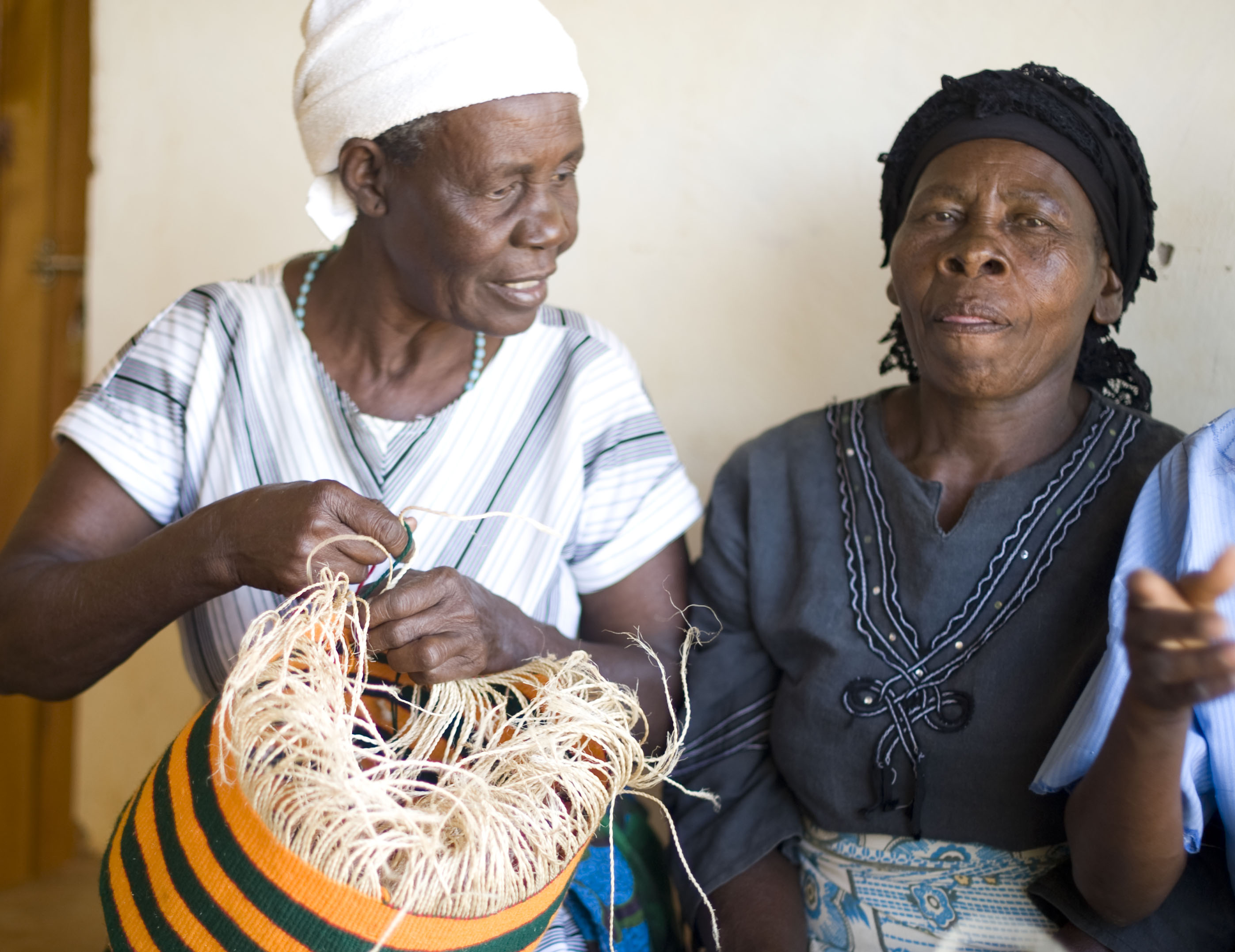
Nyumbani Village Sho Sho's weaving Baskets
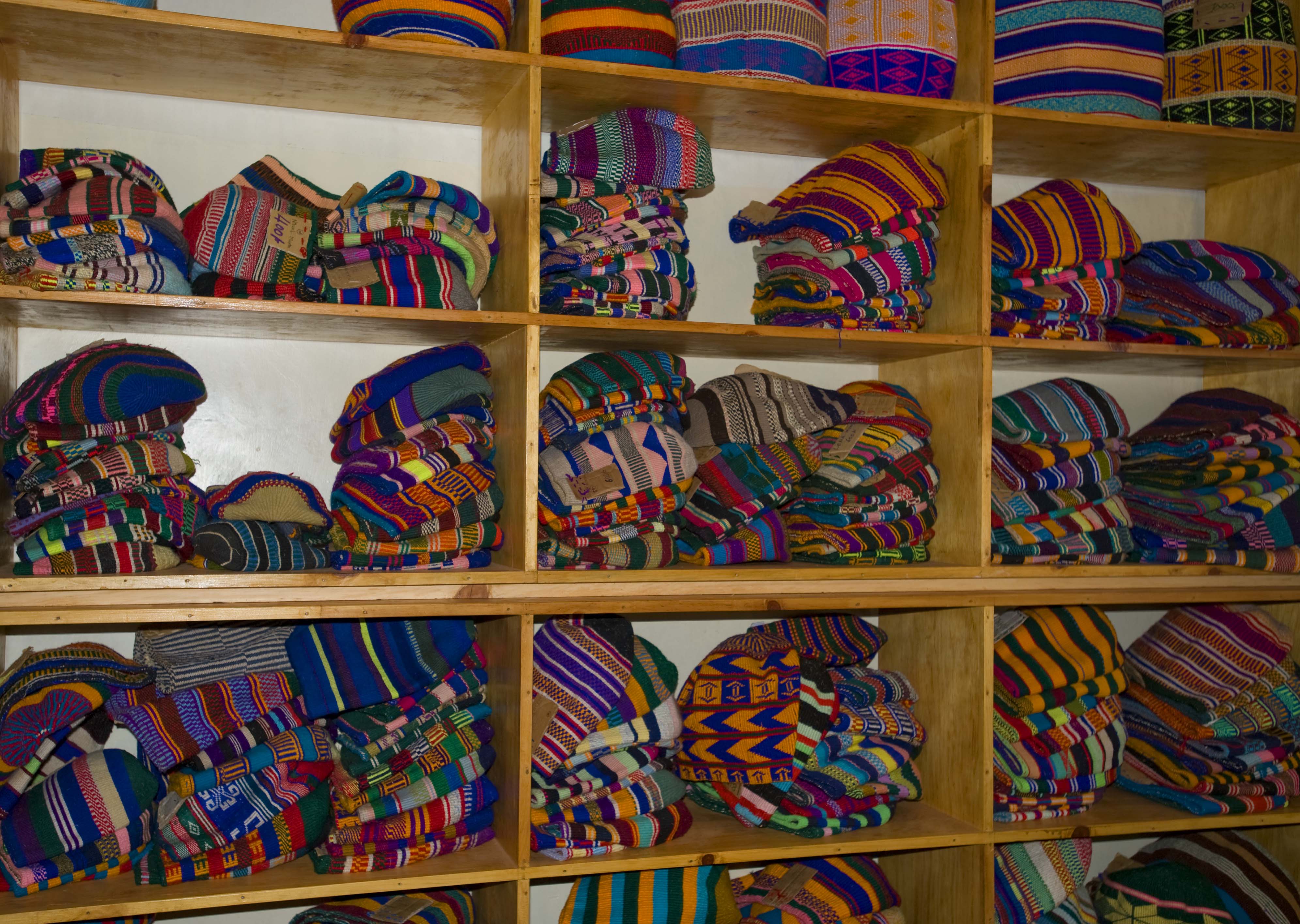
The storage room for baskets at Nyumbani Village
As you can see the baskets are as “colorful” as the sho sho’s!
So we leave on Thursday and arrive in Kenya late (midnight) on Friday night. Our first stop after a night’s sleep will be the Nyumbani Children’s Home on Saturday. Imagine being surrounded by excited, squealing children with smiling faces who you know are healthy and thriving, who you know are alive and have a future literally because Nyumbani exists to care for them–it’s a very powerful and a very wonderful feeling. What could be better than that?!
Next time I write…..I’ll be in warm and sunny Kenya.
The Vision Self Help Group Of Dandora
I have introduced you to one of the women’s artisan’s groups with whom we will be working in Kenya in the Women 4 Women Initiative. I thought I would take a break from my packing frenzy having accomplished the mission of having one duffel packed at a weight of 48 lbs (just under the 50 lb limit) and no longer sitting in a sea of medical and art supplies, children’s socks and underwear, etc. I want to introduce another group, the Vision Self Help Group of Dandora. Dandora is another of the impoverished slum areas around Nairobi similar to Kibera. This group began almost ten years ago with the inspiration of Sister Little from Nyumbani Children’s Home. Sister Little who I had the pleasure of spending some time with during our last trip, including going to the slum with her, is like her name, little, but she is otherwise, despite not at all being a youngster, quite big on spunk and determination.Though she is supposed to be retired now, I hear she still shows up in Kibera to check out the Lea Toto Programs since they are her biggest devotion.
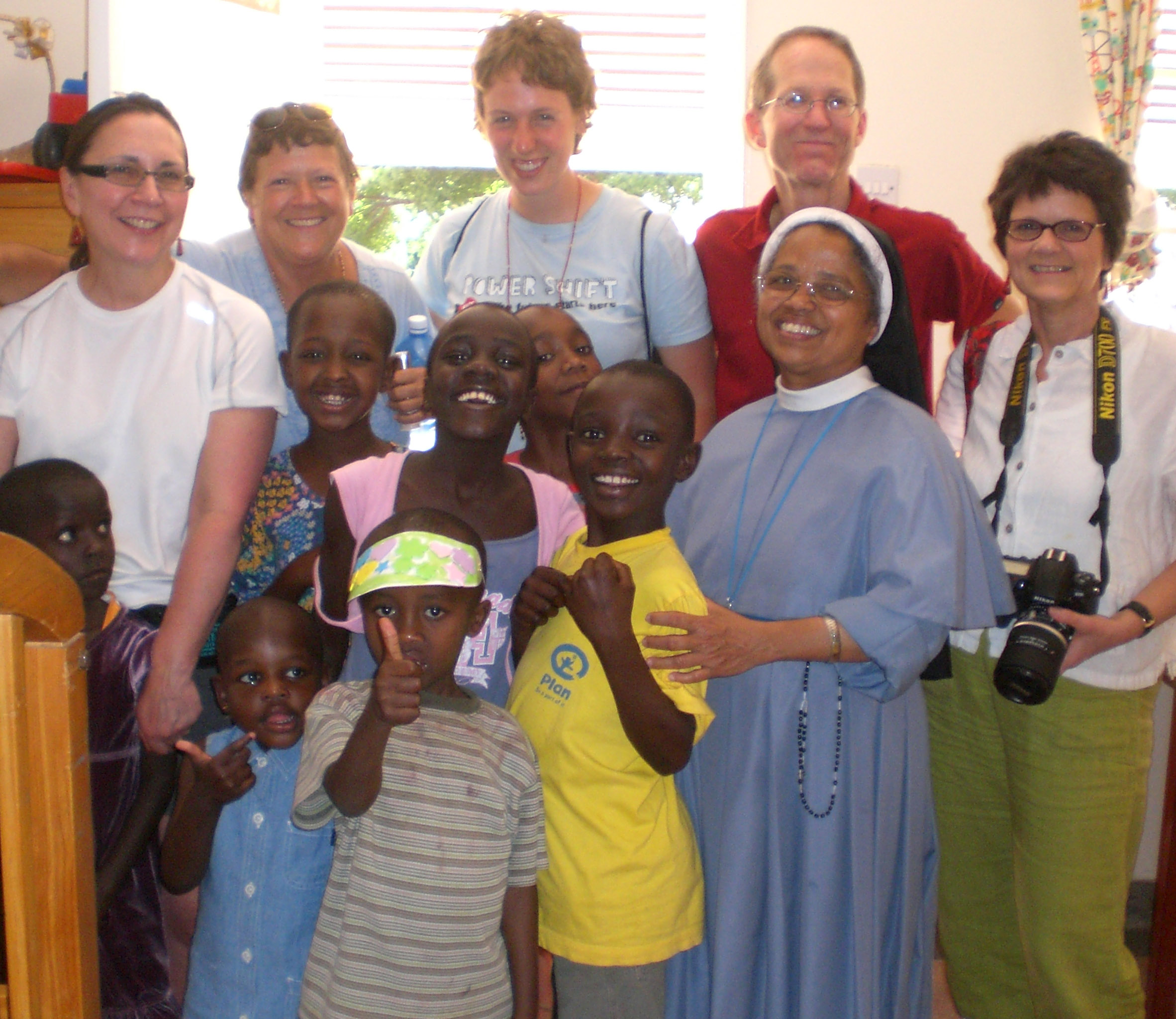
Sister Little with The 2010 KEST Adult Group and Nyumbani Children (anyone who makes me look tall has to be little!)
It was her idea to help this group of women, many of whom are HIV+, all of whom have HIV+ children getting care from the Lea Toto Clinic of Dandora by assisting them in developing a skill which would lead them to be self sufficient and able to earn enough income to support thier families. She brought them together to support each other and helped them to learn the art of jewelry making, particularly beading. They work together, create together, have developed a tremendous sense of comraderie and share the income that they produce. When we met with them last time I was struck by the support that they give to each other and how much they value creating together and felt a powerful connection because that process of creating together reminded me of my own women’s art group. As they each individually told us their own stories I was incredibly moved by their strenth, resiliency, devotion to their families and how they have taken their own hardship and used it to help others by doing such things as becoming AIDS advocates and community leaders. They were clearly a part of the inspiration for my poem about Kenyan women. They make lovely jewely and have increased the breadth of their ware by expanding into other items as well–I’ll be sure to take photos when we see them this time. And they, like many groups whom we met welcomed us with lovely song and dance which Im so looking forward to experiencing again.
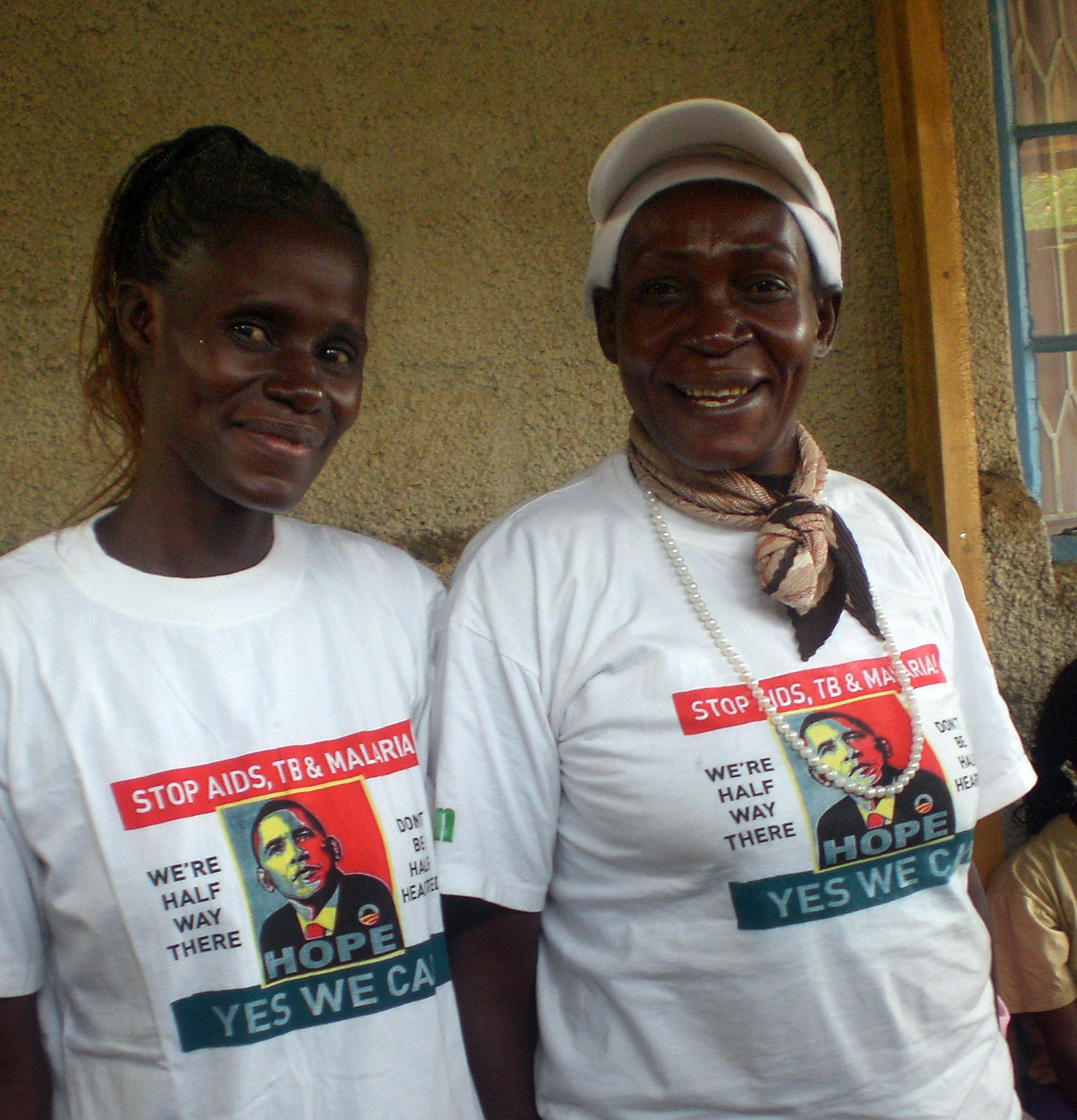
Vision Self Help Project Women in their Stop AIDS, Malaria and TB.......and Obama Tees!
WE leave in JUST 4 more days!!
Across the years, across the country, across the world…..
“So how did you first hear about Nyumbani?”
This is a question that I have been asked several times in the past week and in the course of answering it I have realized that I delight in telling the story, so I thought I would tell it here. As we live in the town where Bowdoin College is located and my husband, Tom, is an alumnus, we had a connection to the college when we first moved here. From very early on we began participating in the Host Family Program in which local families provide support and a local connection to Bowdoin College students who are international students and thus far away from home. We began being a host family when our sons, now about to turn 21, were still babies. It was a wonderful opportunity for our family to learn about other cultures and get exposed to some ethnic diversity which is very limited in Brunswick. We had particularly close relationships to the students whom we hosted for all 4 years and who we watched graduate along with their own parents who traveled across the world to do so. One such student was Stanley from Kenya. I don’t know if I ever told him this, but of our sons who was quite young at the time, but not very familiar with people from Africa or even African-Americans, when he was told that Stanley was coming for a visit, referred to him as “that really tall guy with curly black hair and the pink fingernails” –Stanley IS very tall. His mother and sister stayed with us at graduation time and we took them on their first ever trip to the beach and had a wonderful time getting to know them. We later visited Stanley when he was working at a job in Washington D.C. A number of years later we heard from him that he was doing a fund-raiser bicycle trek ACROSS the US to raise money for an AIDS Orphanage back in Kenya named Nyumbani and asking if we would like to be a sponsor. So it was through Stanley that we learned of Nyumbani.
He completed his bike trek and raised a lot of money……
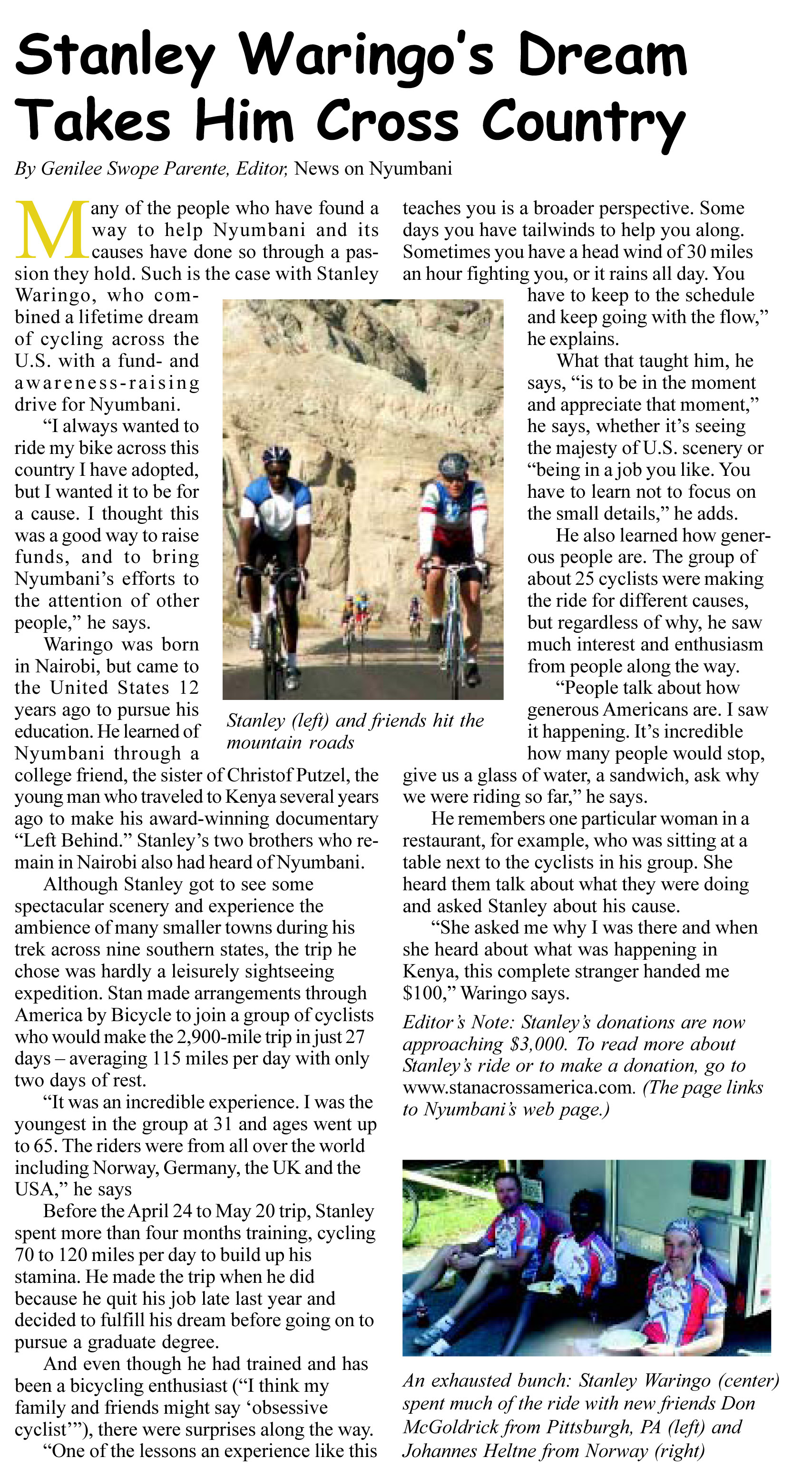
Fall 2006 Nyumbani Newsletter
And we found ourselves on the mailing list for Nyumbani……
As our children grew up and it became more possible for us to do some volunteer work that would take us away from home we looked more closely at what opportunities might exist there and that’s how we became acquainted with Lloydie and KEST….and once you meet Lloydie you go to Kenya to volunteer for Nyumbani.
When we took the trip 2 years ago we let Stanley know that we were going and how excited we were. I know that I MUST have shared with him and his mother in he host family days that I had been dreaming about going to Africa since I was a child. He connected with my blog to learn more about the trip (and even complimented me on my very rudimentary Swahili.) I have just connected with him again– he and his wife Joy live in Texas and are expecting their first child in April. It was wonderful to reconnect and share their happy news and to let him know that I am off to Nyumbani again. These connections from Kenya to the US and back again which span over 15 years have been incredible and do really make the world seem like a much smaller place. We are fortunate to have had Stanley to share a little bit of Kenya with us years ago and to start the process which was to grow into much more of a connection to Kenya than we ever imagined.
Preparations, Donations, and Communications……
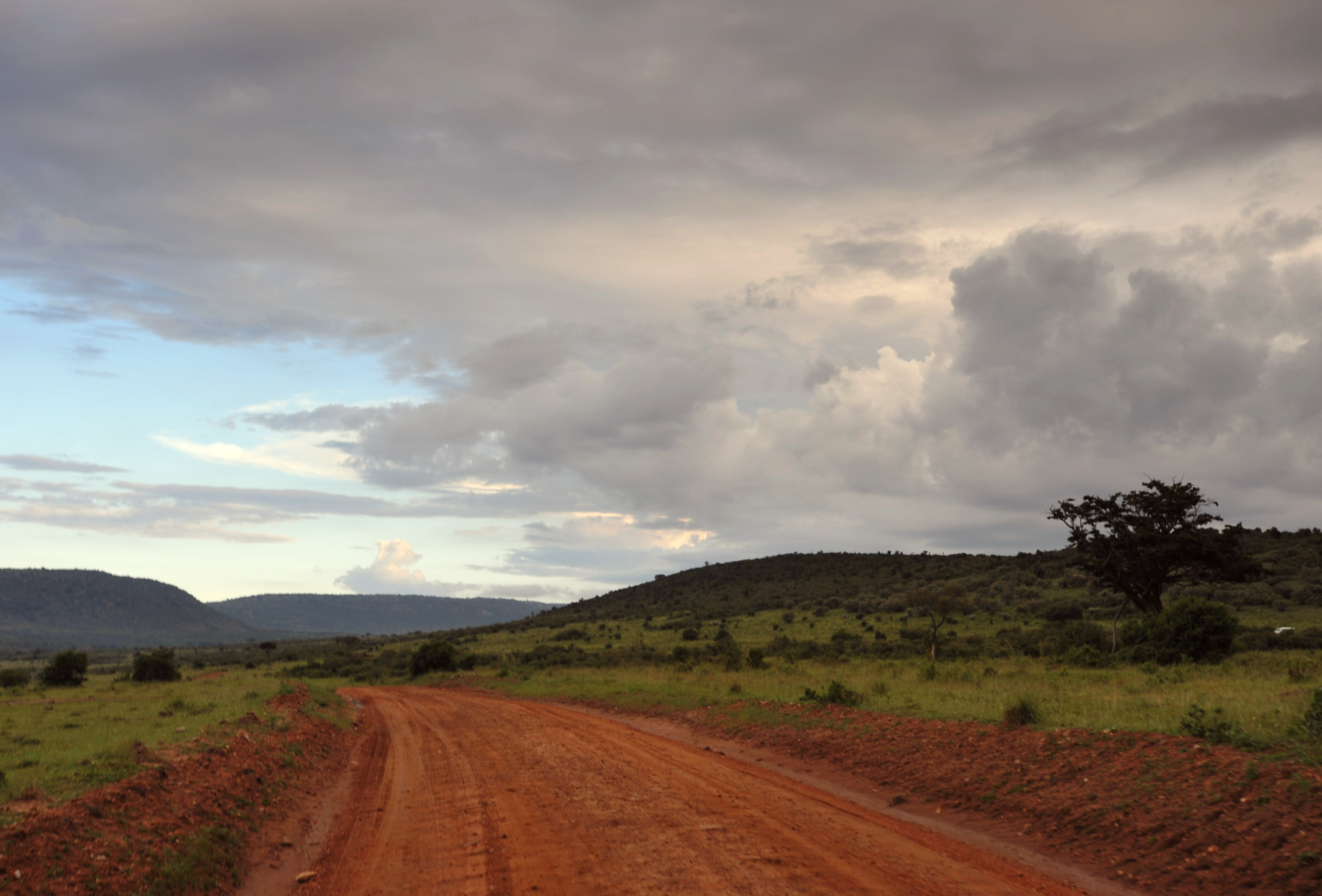
On the road in Kenya
Well, it’s only 10 days before we leave and the excitement is mounting… and so is the pressure to get everything done before departure. I have to say that it’s hard to concentrate on all that needs to be done here when my thoughts keep drifting to Kenya and the email communications about planning are flying fast and furiously through cyberspace. This post will be a potpourri of things to share that may not seem necessarily that connected, but that is a reflection of my whirling brain……
- Amongst the email communications was one that just came from Jen and the group of KEST travelers who are currently in Nyumbani Village with the “translation” provided by Lloydie:
“it’s HOT, and the water taps keep going out (and the showers at the convent don’t work anymore). Pack lots of sunscreen, bug spray, and baby wipes. Oh, and some locks for the doors – we all have singles in the guest house, and John (the cook) didn’t have enough to go around.”
Translation… “it’s HOT, water is questionable so take a long shower before we leave for the village, we will have drinking water with us, bring the recommended items above , and ESPECIALLY a pad lock just in case it is needed. Plan to leave the lock behind so they will have enough for future visitors. We do not have our lodging assignment yet. It will either be in the convent or the guest house but either way, it seems like there are NO showers… pole sana, TIA… This IS Africa!“ - These e-mails made me smile. You have to have a sense of humor about such things and no where else on earth would I voluntarily put up with HOT and no showers! Aaah life in Nyumbani Village!! There’s nothing like it to make you appreciate the smallest creature comforts like a shower, not to mention cold water to drink, a way to cool off in the heat… And though water may be in short supply I’m sure that there is plenty of ugali that staple food of maize made porridge that sits like a brick in your belly (your favorite, right Lloydie?!) However, there will also be ample Kenyan hospitality seeped in Kikombe culture with singing and dancing and smiling from children and grandmothers alike since the village, with its simple ways, is a very magical place. And at the end of the day, you get to be mesmerized by the most star filled sky you’ll ever see.
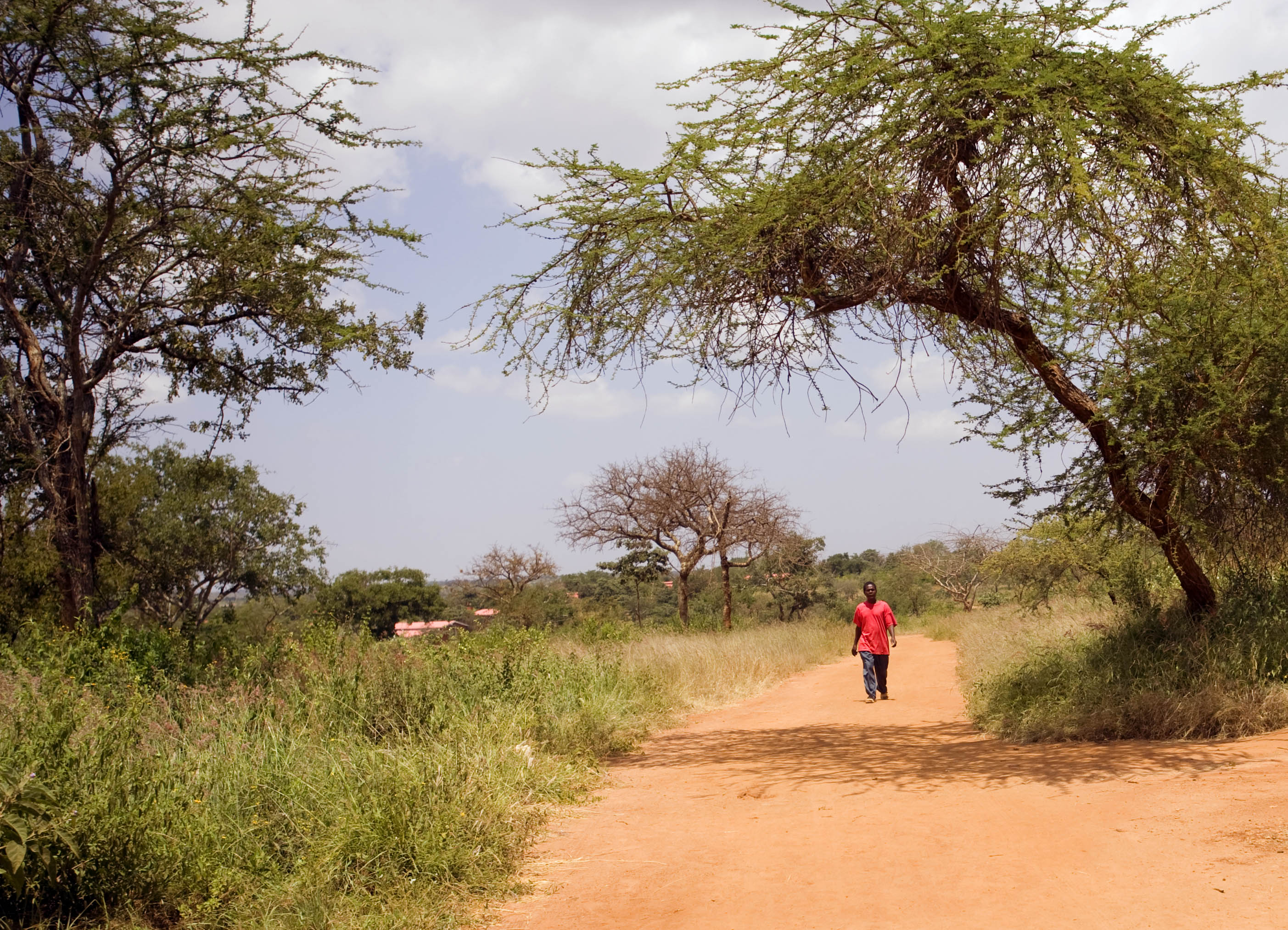
Under the tree canopy in Nyumbani Village
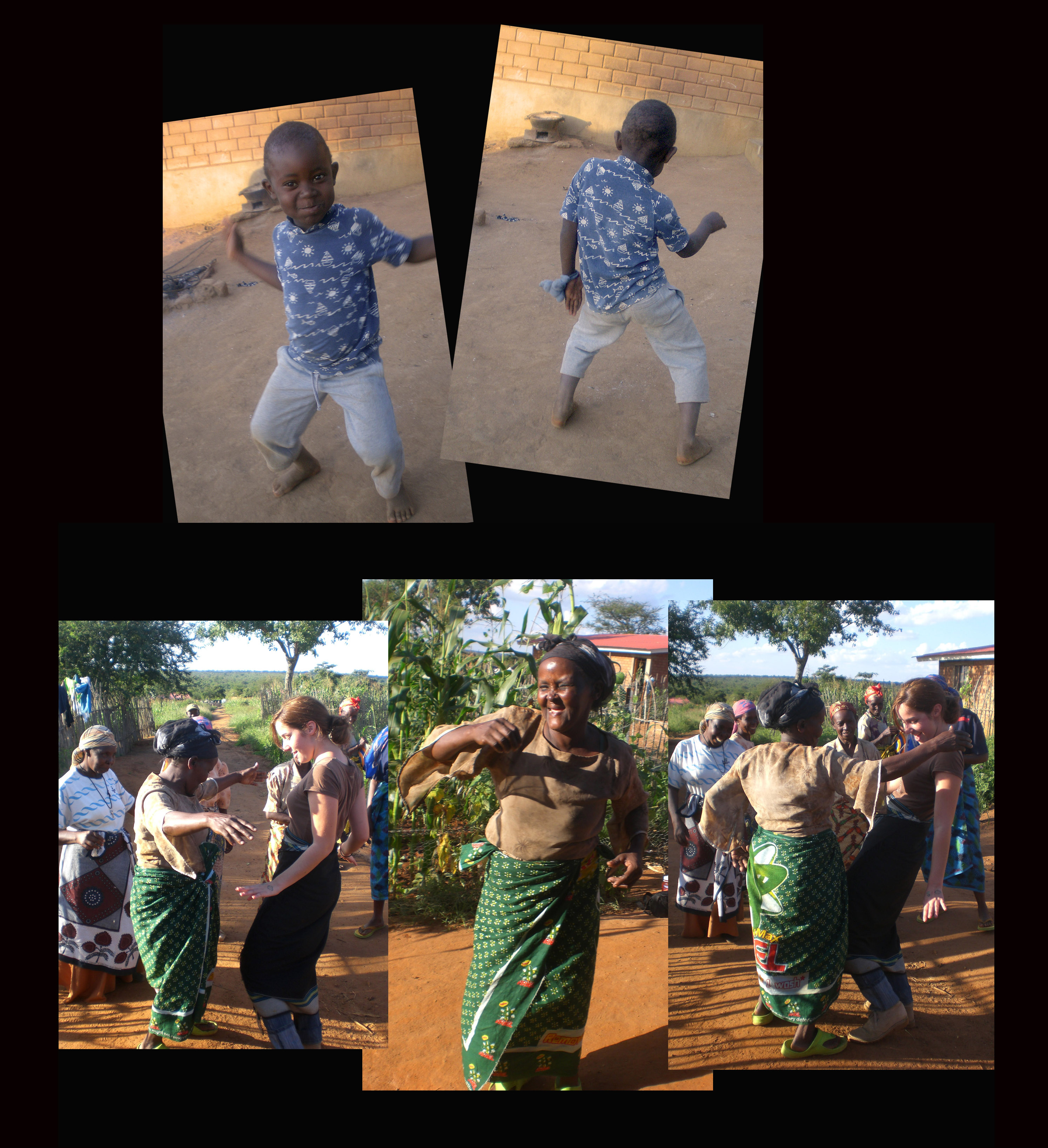
Dancers--from children to grandmothers--of Nyumbani Village Photos by Karen Orrick
- One of my donors was also asking about whether or not she could specifically give to the Women 4 Women Initiative, but that is in the early stages of development and not quite ready for specific donations yet. Lloydie’s reply as an alternative was “ I think the best plan is for you to decide which community you want to help… Nyumbani Village for mattresses (they just admitted 36 new orphaned grandchildren and 4 orphaned grandparents in December), or the Maasai for the school food program (porridge every day at school for lunch, for some their only meal)”. Although I am very much aware of the need in Kenya the thought of the school food program providing the Maasai children with their only meal of the day is a very sobering thought. And the fact that 36 new children and 4 new grandparents have been admitted to Nyumbani Village is a reminder of the increasing need and number of AIDs orphans and the elderly who have lost their children upon whom they would have relied to care for them. The village has really grown–the last figure I heard was close to 800 orphans are living there. I’m not sure what the current count is, but I will find out.
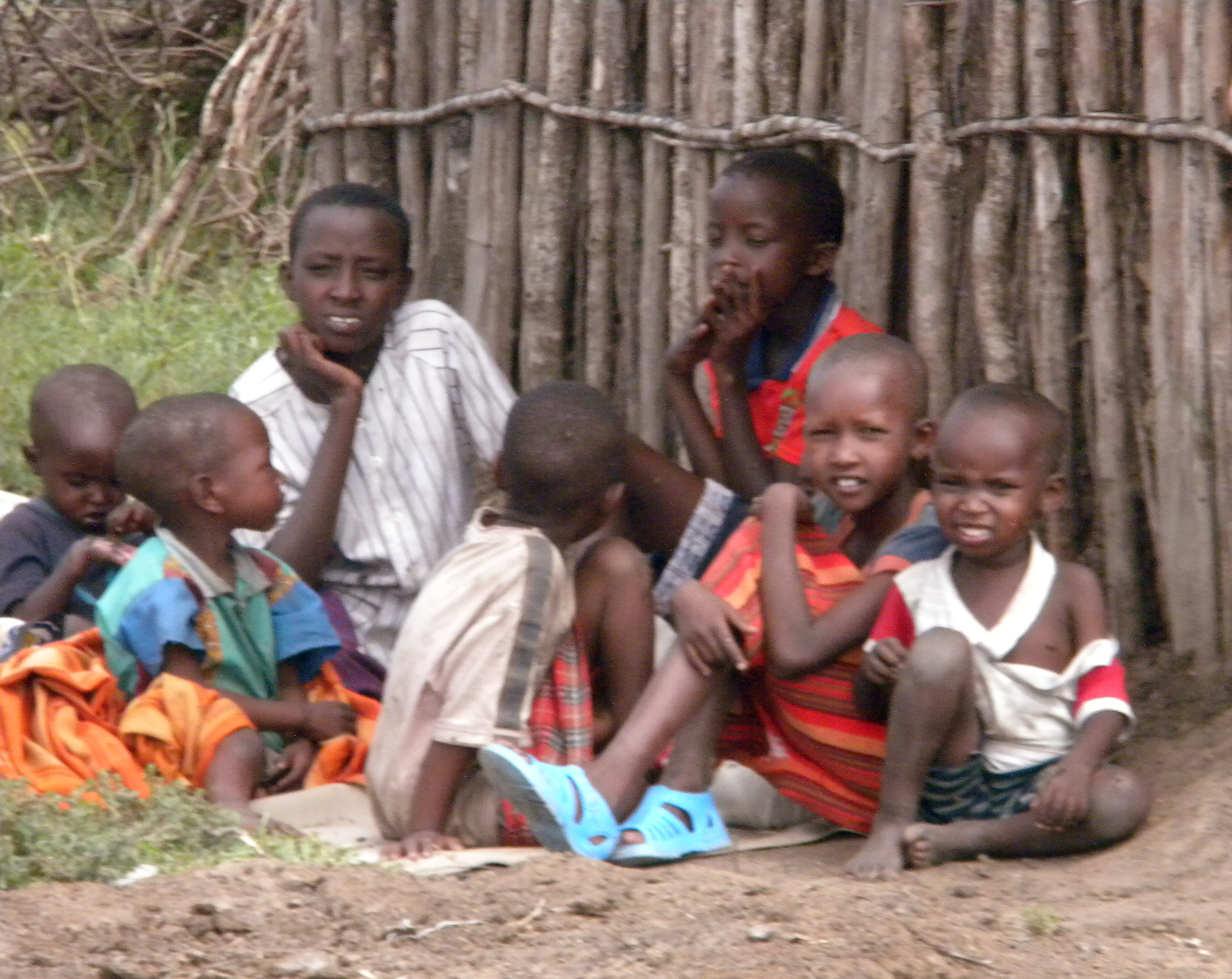
Maasai Children
- About donations–these are the things I’m bringing to Kenya to donate guided by a list of needed items and anything that is not monetary has to fit in duffels to go onboard the airplane with me. Somethings like underwaer and socks and medical supplies are always needed. Other things, like matresses, not to be stuffed into duffels, but rather purchased once there, are new on the list. Having reached out to family and friends and done some special purchases of my own, the gathering seems to be going quite nicely. I also had the opportunity to go to the warehouse for Mid Coast Hospital last week where supplies and goods are stored that are no longer being used at the hospital, but are ready for anyone wishing to take them to third world countries. I met a very nice young man there who was traveling to the Dominican and also gathering supplies. As we looked through all the storage areas and came across things that would suit our purposes we both got increasingly excited and started to say “This is just like Christmas!” I gathered gauze and band aids and wound cleaner and ace bandages and slings and …… Now I have to get all the donations in one place–from my office, the car, my son’s car, various places in the house–and pack them in 2 duffels that weigh each less than 50 lbs. A Houdini-like task even without the mattresses–this is the magic that begins before you leave for Kenya–well a piece of it anyway!
Kibera, Lea Toto, and Kibera Paper
Somewhere between a half and a million people live in Kibera, Kenya’s largest slum. No one knows for sure what the population is there, but it is estimated that 20% of Nairobi’s inhabitants live there at a population density of about 750, 000 people per square mile. It is one of the most crowded places on earth. It is hard to describe in words but photos and video give a better sense.
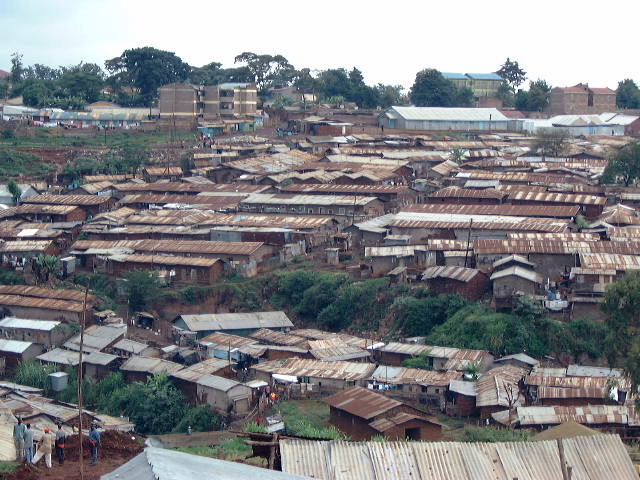
Kibera is the site of great poverty, overcrowding, unsanitary living conditions, and a high crime rate. It is also a location with a very high incidence of HIV/AIDs. This is the reason that The Lea Toto program of Nyumbani began—to provide outreach services and home based care to families with children who have HIV/AIDS. In addition to having a clinic in Kibera Lea Toto now has 8 other satellite clinics in the slum areas surrounding Nairobi. We visited these clinics in Kibera, Kariobongi and Dandora during our last trip to Kenya and will be visiting them again.
This time we will also be paying some special attention to a couple of women’s artisans groups which have developed out of the need for these women of poverty to to have an income to support their families. One of these groups is Kibera paper. We have been working on a plan for our visit to Kibera paper to work with the women there who make the cards from recycled paper. In addition to talking with them about ideas to market and sell more of their cards in the US, since 2 of us make our own cards, we are planning an interactive card making workshop with a sharing of ideas and new media.
Here is an article from CNNWorld about Kibera Paper:
Greeting card project helps slum women
Share this on:
FacebookTwitterDiggdeliciousredditMySpaceStumbleUponLinkedIn
// // December 22, 2010|From David McKenzie, CNN
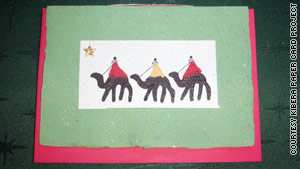
In the largest slum in Nairobi, Kenya, some of the community’s poorest women are taking part in project that is spreading the true meaning of the holiday season. In 2001, an Anglican missionary from Australia started the Kibera Paper Card Project to help disadvantaged women in the sprawling Kibera slum.
The initiative began with a group of six women making greeting cards from recycled paper. Nine years later and it has expanded to employ 26 local women.
“It’s for women who are widowed, some of them are orphaned, some of them are abandoned by their husbands, so they make cards to meet their needs,” said Kibera Paper Card Project coordinator Emma Wathura.
Wathura said the project focuses on helping women because “women are the ones who care for the family.”
Agnes Awour is one of those benefiting from the project. She used to struggle to put food on the table, but joining the group has helped, she said.
“It enables me to buy food and clothes and pay school fees,” she said. “Even my children are happy about it.”
The women involved in the project see the card making process through from beginning to end. They collect scrap paper from Nairobi businesses and soak and dye the paper, turning the waste into pulp and then the pulp into new paper.
The paper is then dried before the women’s creativity transforms what was once rubbish into beautiful greeting cards.
“Yeah there is money,” said Wathura. “For one thing, we don’t spend a lot. Because the recycled paper we are given is free.”
At the Nairobi Christmas Fair, where thousands descend every holiday season, the cards are proving popular.
In a business where message is key, the Kibera Paper Card project offers its customers much more than just a greeting: Shoppers know that by buying these cards, they’re changing lives.
This is a great video that focuses on Kibera and the Kibera Paper Project
The slogan for Kibera Paper has become “Buy a card, change a life.” If you watched the video you know how that is literally true. You can learn more about Kibera paper at www.kiberapaper.com and I’m sure I’ll have lots more to say when I am actually there sharing the experience with these women. This is just one example of a truly hopeful project that has arisen from the slums; there are more, including of course the Lea Toto clinics. Despite the enormity of the horrendous conditions and poverty, there is hope too.
 Lynn Ouellette
 Watoto Wote Wazuri
leave a comment