The Women’s Workshop, Micro Finance, and Team Lucy
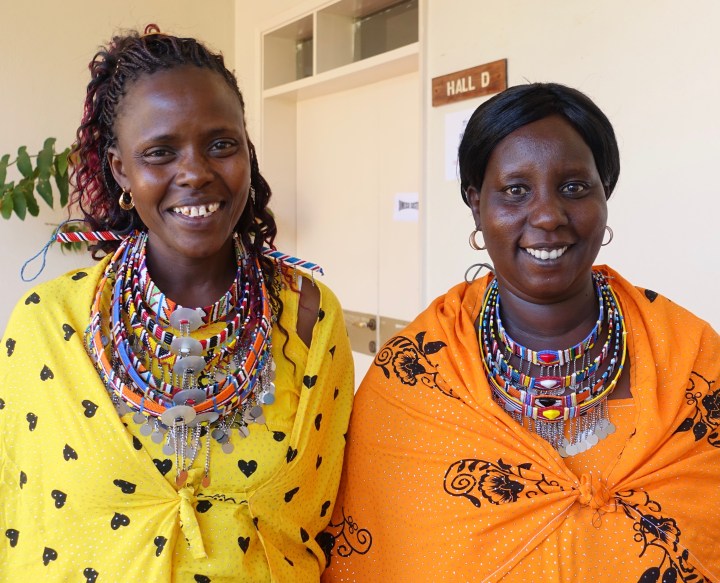 Saturday was the Fourth Annual Women’s, a day of learning, collaborating and bonding for the women of Tuko Pamoja. Every year we think it can’t go any better and somehow it does. We came together in the morning at Dimesse Sister’s Retreat Center where the sisters had prepared chai and mandazis (yummy Kenyan “doughnuts”) to start the morning. The women started arriving and signing in, looking lovely in their best clothes. They had an opportunity to socialize a bit and then we had opening remarks about the goals and the agenda for the day.


We then all headed off to Kazuri Beads where they were to get some training from the staff there. Kazuri Beads is a place we visit every year and is a model example of a socially responsible business. From their website:
OUR MISSION: “THE MISSON OF KAZURI IS TO PROVIDE AND SUSTAIN EMPLOYMENT OPPORTUNITIES FOR DISADVANTAGED MEMBERS OF KENYAN SOCIETY”
KAZURI, which means “small and beautiful” in Swahili, began in 1975 as a tiny workshop experimenting on making ceramic beads made by hand.
At Kazuri Beads they are also committed to opening their factory for tours and sharing some of their training, marketing and other tips. Not only are disadvantaged women from the slums bussed there, but they also have on site daycare and a medical clinic. The owner is very dedicated to his workers and keeps all of them employed during lulls in the business. The goal of bringing the Tuko Pamoja women there was to have them meet with the production team and with the marketing staff in the on site retail shop. The staff were VERY generous with their time and teaching, and the women were enraptured with the business and very inquisitive with their questions. One woman remarked at the end of the day “I never knew something so beautiful could come from the ground I walk on!” The production team emphasized the dire importance of several levels of quality control and the ongoing need for new product design—both concepts which we had been working on in the individual groups all week.


Touring the factory and learning about quality control


Learning about marketing customer service form the store staff and the owner, himself


Discussion at Kazuri Beads
Following a very successful visit to Kazuri Beads, we all headed back to Dimesse retreat where the staff had prepared a very plentiful traditional Kenyan meal and the women all ate very heartily. Then we headed to Kibera.


Places and people in Kibera
After lunch we left for Kibera to visit the Power Women’s Self Help Grou. We selected this location because this is an example of a self help group who have made a lot progress in establishing themselves. We drove into Kibera so were able to see more of life within the area. Children always flock to greet us with waves and choruses of “How are you? I am fine!” Once inside the Power Women’s workshop the women were given a presentation of the history of the group which began as a simple self help group doing crafts. The women were able to save enough money to rent a shop and then went on to develop a beauty parlor (“saloon” :))with the help of generous benefactor and finally a daycare. They were able to provide the women of TP tips about further success emphasizing the concepts of saving and working towards a goal. And the women had an opportunity to see the daycare and beauty parlor.


At The Power Women’s shop
We then went to a meeting area in the Lea Toto site of Kibera to carry on the program. Karen presented to the women how to keep a ledger of income and expenses and to save a little money on a regular basis. The concept of keeping a record was entirely new to the women and they were glued to the presentation and each followed along filling in the ledger beginning with the 3000 KS there had been given as a bonus.
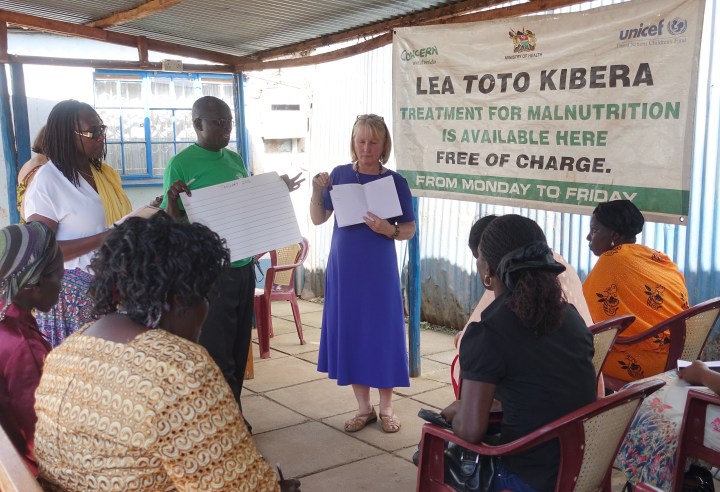
Karen, Susan and Simon doing the financial skills presentation
Then Lilian and I took the lead and talked with the women about the effects of stress, stress management and techniques for dealing with it. We led an exercise on deep breathing and the women were quite enthralled with the idea that they could actually do something to decrease their own stress levels. Sometimes the simplest things make the biggest difference in Kenya. After the program was finished, we asked the women to give their feedback on what they had learned during the day and we were thrilled with their comments as we felt that we had succeeded in really helping them to learn some crucial skills. They remarked about each site visit, the financial skills presentation, managing stress and more. One women from PCDA spoke eloquently to thank us for traveling so far, leaving our work and our families at home to come to Kenya to create this workshop for them and for working with them to help them become more successful.
Maggie, our Board member from Amani led the closing remarks which were truly inspired and focused on working together, sharing and supporting each other, the real concept of “Tuko Pamoja” (we are together in Swahili).
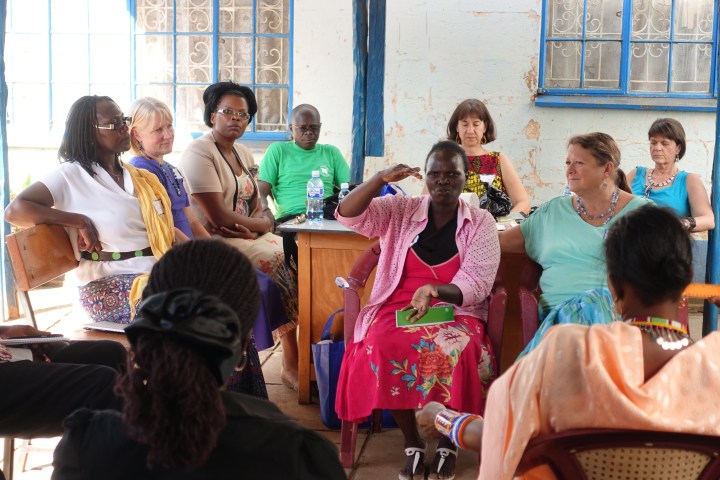
Maggie addressing the group
We thanked all of the site administrators for each group and the Kenyan Board and all of the Board Members joined together to thank the women for all of the hard work they do and to reinforce that we are all bonded and working together.

The Board of Tuko Pamoja
Then each of the members were given a formal certificate of attendance, congratulated and presented with a gift bag of basic necessities: maize flour, sugar, oil and salt.


Gift Bags
We ended our day in a large circle holding hands and singing a beautiful song taught and led by Lilian who always does a laudable job in the capacity of celebration with song. Then she instructed us that we could not leave the group without hugging at least five other people. That wasn’t at all a challenge, and some of us likely hugged over 30 other people. It was a heartwarming ending to a day that felt like it had gone perfectly.
Lucy joined us for the day and her brother Charles came later as he was in a Red Cross training all day. You may recall that both Lucy and Charles grew up in Nyumbani Village. Currently Lloydie is sponsoring Charles in his education as a hotelier. Lucy is attending Kenyatta University, sponsored by Team Lucy, which includes Deb, Karen, and me along with two other women from the states, Carla and Marguerite. Lucy and Charles returned to Dimesse Retreat to have dinner with us and to spend the night. We had a wonderful time catching up during dinner. Lucy is a very bright responsible and sweet young women, who despite being on a tight budget, always brings a gift for each member of the team. This year she brought us each an envelope with a picture and a bracelet beaded with each of our names.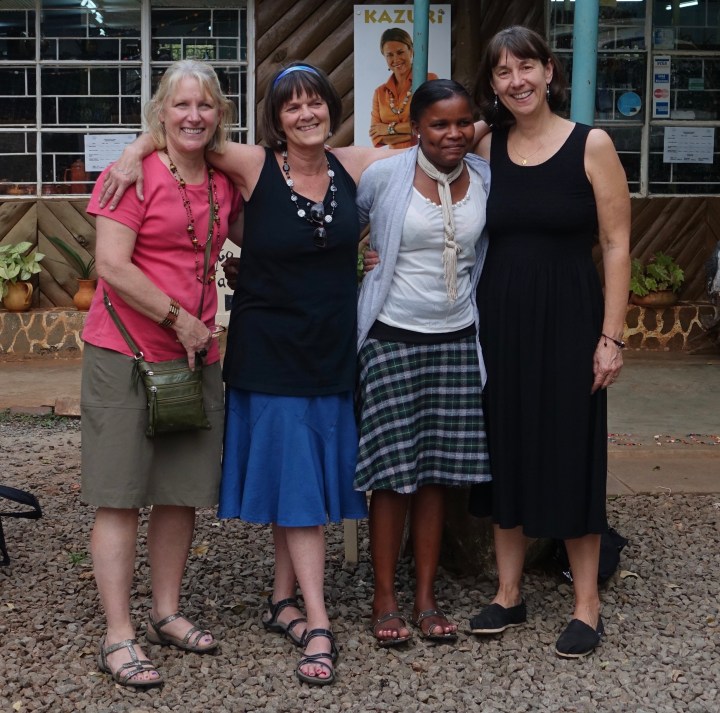
Team Lucy
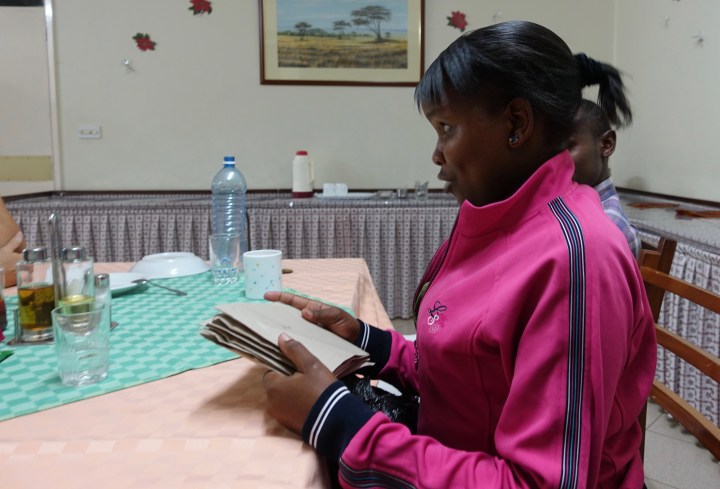
Lucy came bearing gifts
The following day was Sunday, and if we are in Karen, we always head over to Nyumbani Children’s Home to go to church with the children and this time Lucy and Charles went with us. We met Protus, the Director of the Children’s Home who returned from being away because of a death in the family. We talked with him, as we had talked with Sister Mary, about the difficulties which we had encountered in Customs and tried to brainstorm some solutions. Following the always jubilant, singing, drumming, dancing mass which is very much directed towards speaking to and interacting with the children, we went off to tea with Sister Mary. That gave us an opportunity to discuss some other issues about the Nyumbani programs. We had a really delicious lunch at Spurwing travel which is next door to the Children’s Home and is where Justus is employed. We all savored having some delicious home cooked food, especially being able to eat a salad, all of which we really miss while we are here in Kenya.
Right after lunch we had the pleasure of meeting with Michael who is the son of the Spurwing owners and is a very successful attorney and business owner at only 23. He was extremely helpful and very generous with his time in offering the history of developing his businesses and some information about micro finance loans as that is one of his businesses. All week Karen has been meeting with various people within the Numbani Programs toward the goal of creating micro finance opportunities for the young people served in the Lea Toto programs. Becoming self sustaining with a reliable income is an extreme challenge for them and beginning small businesses is a much greater possibility than a actually finding a job. Michael offered some excellent insights. Meeting with him as well as people art Nyumbani has helped Karen to come up with a preliminary plan to help with a program in this area. This would could make a difference in many people lives if it can move forward. Michael was also helpful to Lucy since she will graduate with a business degree and he offered to facilitate the process of her finding a suitable attachment (i.e. internship).
Our other tasks for this welcomed low-key day were to purchase the necessary items for students who are going into high school. This is always a boarding school in Kenya and requires school fees as well as supplies to live in a dormitory. We brought one of the new Form I students ( a freshman) with us as we went off the the local Nakumatt (the Kenyan equivalent of Walmart) to get the supplies. The list included many things, among them was a pillow and mattress, bedding and other daily necessities. All of us remember this student as a little girl so its hard to believe that she is now moving on to high school. The school year begins in January in Kenya.
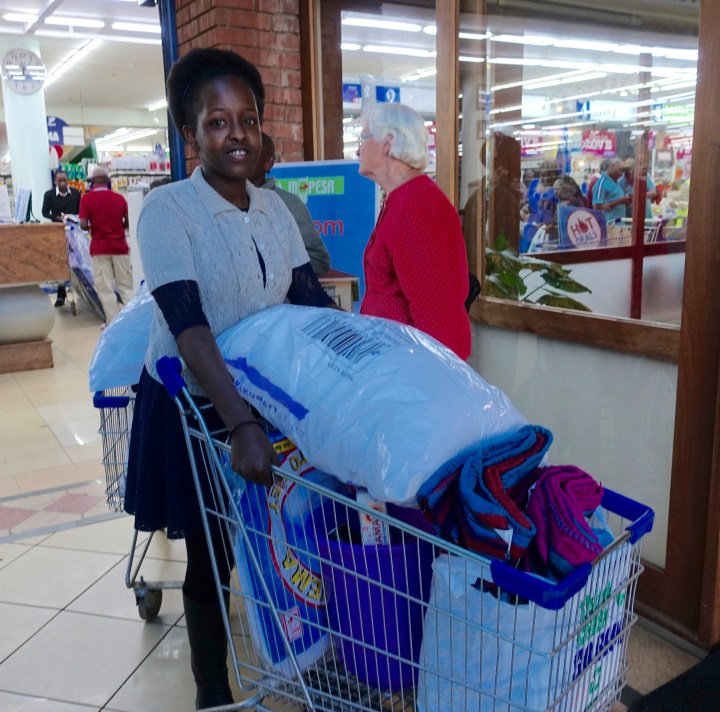
Once finished we went back to Kazuri beads, this time to do a little shopping, but not until after we had to say goodbye to Lucy and Charles who, for most of us, it will be a year before we see them again. It is ALWAYS so hard to say goodbye in Kenya, even when it is “See you next year.” At the end of the day we were reorganizing and repacking to head to Numbani Village the next day after a planned meeting with the self help group in Mukuru in the morning. These low key days are always relative; they are easier than the days with events like the Women’s Workshop, but still packed with more things than I can put into this blog. We always go to bed tired, most often too late, but with a true feeling of satisfaction. I will explain more later, but it has also been a day of much intense laughter as well as sorrow and tears as we encountered more loss among our Kenyan Family, loss that resonated very much with my own experience.

And the sun finally came out so we could enjoy much outside in the backyard at Spurwing!
Three busy days for Tuko Pamoja
We have had exciting full few days since I last blogged. There are so many stories that I would love to tell that I could write a book, but I can’t possibly include everything. The major focus of this whole week is to visit the sites of the women’s self help groups with whom we collaborate in Tuko Pamoja (swahili for “we are together”). We began on Monday by visiting 2 groups located in the different compromised communities (i.e. slums) surrounding Nairobi. Our first stop was in Kawangware where we received a warm and affectionate greeting at all the women with lots of hugging and wishing of “Happy New Year!” The agenda for each site visit is the same: to remind people of the mission and philosophy of Tuko Pamoja, to update the women on the progress of the year and give out bonuses, to share the feedback which we receive about the women and their crafts, to pick up the order for the next round of events in the states and to see what new crafts they have made and which we might promote in the future.

The women of the Kawangware Self Help Group


One issue that we have particularly emphasized this year is making sure that all the women within each group teach each other how to make all the crafts and that the work, and therefore the income earned, is equally distributed. The philosophy of TP is that everyone works together, shares, and by doing so strengthens the group. We want to discourage competition within and between the groups and promote working together.


Looking for new product designs
In addition, Karen has also been working with the women on their finances: opening a bank account, showing them how to balance their account, how to budget, and how to save. It is a requirement to have a group bank account to be part of Tuko Pamoja, but we also encourage the women to have individual bank accounts. Karen has been working with each group of women and she has had a captive audience as they listened to everything she said and practiced keeping a financial ledger.

Karen teaching about finances
One of the highlights of the meeting, in addition to bonuses of course, is when we share with the women the wonderful feedback which we receive from people attending Tuko Pamoja events and writing comments in the guest book.
Bonuses always bring a round of applause
Comments from the guest book are well received
I always tell the women that at my event one of my favorite parts is to have a presentation in which I explain the history of Tuko Pamoja, talk about the women’s lives, and talk about the rich and meaningful bond which develops between us. I cannot help getting choked up every time I say that I am very proud and honored to represent them. We also tell them that hearing about them, their stories, their lives, impresses people so much that they want to buy more of their goods. At the end of every meeting is a prayer and a round of joyful singing.
Singing with the group at Dagoretti
While at Dagoretti we got a chance to catch up with Bernard, a young man who grew up at Nyumbani Children’s home and is now employed by Nyumbani as the IT expert in the Lea Toto clinic at Dagoretti. Bernard is an exceptionally nice young man who provides a powerful example to the younger people of Nyumbani with his success and work ethic and his desire to give back to the community in forming a Nyumbani graduates self help group. However, the best part of catching up with Bernard was learning that he has become engaged to marry Grace. They both brought us to their home right near the Lea Toto Clinic and showed us their rabbits. Bernard received a microfinance loan to get the training and loan to begin raising rabbits which he can sell to others. It’s a little difficult to think to think of those sweet bunnies entering the food chain, but this is Kenya and sources of protein are not plentiful.


Bernard, Grace and the youngest member of the bunny family
We had a very full day on Monday and felt good about the work and our connections with the women. We went to bed tired and early knowing that the next day would also be a very busy one.
On Tuesday we headed to Kiserian to visit the Maasai community of PCDA. The ride was on a road with the largest, deepest and most incredibly plentiful potholes that it was beyond anything we have experienced in Kenya before…..and Kenya has such a reputation for potholes that “potholes” is one of the words in my rather limited Swahili vocabulary. It was also along some of the most beautiful scenery as we drove past the Great Rift Valley.
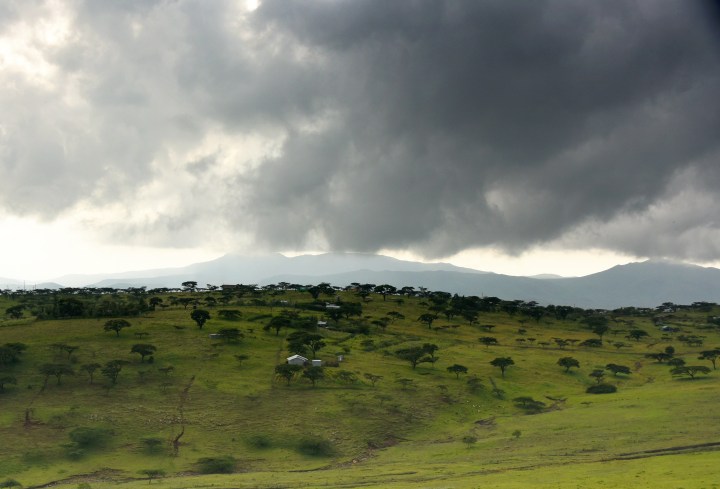
Before arriving at the community we picked up Philip, the director, along the way so that we could go shopping for the supplies for the school lunch program: maize meal, beans, powdered milk, oil and sugar. We had even more of an adventure because it has rained for part of every day since we have been here and there is an enormous amount of mud everywhere, especially on the streets of Kisersian. During this time we also had an opportunity to get an update from Philip. The structure of the school was holding up well since the roof had been replaced and there is a project in motion to get water into Maasai homes. This would be huge as water is such a commodity and during the dry season is in really scarce supply. The mud was to become an even greater issue when we arrived at PCDA and got very stuck in it! However, the determination of Justus, our driver, and Phillip along with a helpful passerby eventually got us out of the mud, but not without some some serious strategy, a lot of muscle and nearly swallowing up some shoes.


The mud! Our van was in deeper than this car!
All of that was soon forgotten when we arrived at the school to be greeted by all of the Maasai children who were very excited to see us. The first order of business was to unload all of the food supplies and then we got to spend some time with the children.


Unloading the school food supplies


Our greeters!
We often do enrichment projects with the children, but this visit more time was taken in getting there, buying the food and getting extracted from the mud, that we didn’t have as much time as usual. However there was time for visiting the different classrooms, rounds of singing and the older children showing off their progress in learning English.We sang with the children and the children sang for us.We could tell simply by observation that the children needed new uniforms and especially shoes.
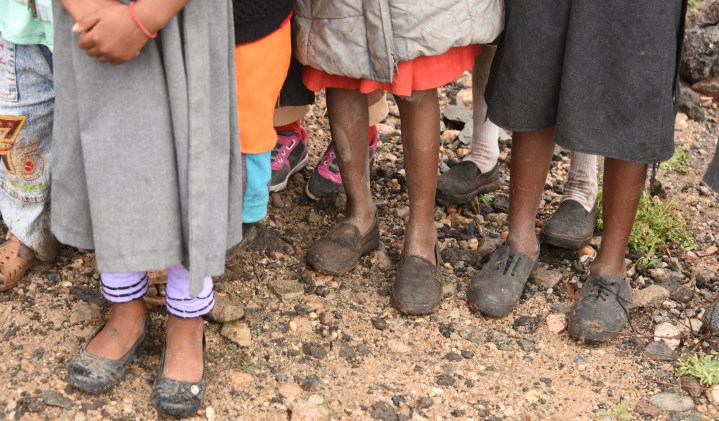
Time for new uniforms and shoes


“Eensy Weensy Spider”
And the children sang for us!
Following our fun with the children, we left the school to meet with their Mommas, the PCDA self Help Group of Tuko Pamoja. Last year when we were there we helped them to paint their workshop which donation funds help to build. They were extremely proud of the now finished and furnished workshop and excited too share it with us.


Meeting in the work shop
We had a Tuka Pamoja meeting in the workshop and were very impressed by the space and how organized the women were with their orders. We were very surprised at the end of the time to learn that the women had cooked a full meal for us as large pots and pans of stew and chapatis came trailing down from the houses. It was a time to enjoy a meal together, to see some of the children who were now out of school and to visit with the women. We finished the day feeling very gratified as the relationship with this community has come a long way from the first year when the women seemed unsure about trusting us to now being very warm, grateful and seeing us a part of their family.


Enjoying the Maasai women and children
We drove home along the Great Rift Valley once again and another round of rain held off until after we did our traditional photo of “flying over the Rift Valley.” We also stopped to see “Jane the soap lady” who used to wave to us and say “Happy New Year!” as we drove past her each year. Last year we actually stopped to see her as she sat in her wheelchair by the side of the road selling soap. Now that is a tradition too and and she is always overwhelmed and touched when we stop. 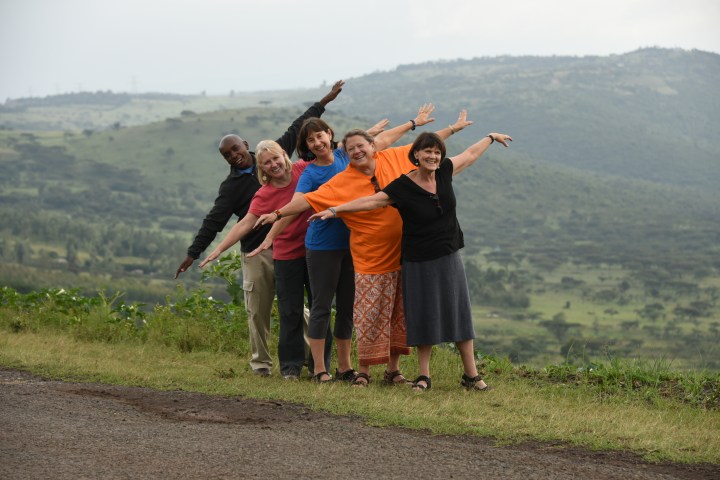
Flying over the Rift Valley


Stopping to see Jane the soap lady
Today we visited two different places in Kangemi; one stop was to meet with the women’s self help grump and the other was to catch up with an old friend, a nun who was formerly stationed at Dimesse Sister’s Retreat and to see the work that she is doing in a new facility bordering Kangemi. We were also to meet with her about the possibility of adding another women’s group to Tuko Pamoja. We weren’t sure what to expect from the facility in which she now works, but were sure that any time spent with Sister Rhoda would be quite spirited!
We toured the facility of St. Joseph and learned about the programs that they offer and some possible ways that there could be some sharing of experience and knowledge between the polytechnic school there and at Nyumbani Village. One of the parts that impressed me the most is that they have a program especially focused on women from the Kangemi slum which included a maternity unit that offers both prenatal and postpartum care. This is much better care than what most pregnant women get in poor ares of Kenya. They also offer HIV testing and HIV preventative medication during pregnancy for HIV+ women to prevent mother to child transmission. What impressed me even more than all of this however, was that they have a good understanding of and intervention for postpartum depression and pregnancy loss. They could use a much better infant incubator and we had a discussion about that, but even if we could find one to be donated, getting it there and paying taxes and tariffs would be very challenging. Its something I would like to pursue trying though…


The Maternity Unit
In addition to maternity care they have another medical clinic, primary and secondary school and a polytechnic school. Their biggest claim to fame, however, is that the vestments worn by Pope Francis were made there and he came to see who made them and to visit Kangemi. In fact he drove into the slum and did a church service there and Sister Rhoda was very proud to share the details with us. She described him as saying that he was “not there for the Catholics, but there for humanity, ” and that he stopped and touched and blessed each disabled person when he came into the church. I wish I could convey Sister Rhoda’s sparky personality. The best way I can think of giving you a glimpse is by quoting her when she wanted some of us who will go unnamed who were holding up the group by still talking: “People of God! Lets move it!”


A visit from Pope Francis


The streets of Kangemi


Sister Rhoda and meeting people in Kangemi
We also met Sister Ida, an older nun, originally from Italy, while we were there. She told us that she wrote a long letter to the Pope before he came to Kenya and she only just wanted to see him. She made a connection with the security people who were in Kangemi to provide protection for him. They kept her informed about how she might get close enough to see him and eventually relayed the message that she was the nun who had written the very long letter. She ultimately got to meet him and described herself as shaking as they had a warm embrace. And she “didn’t know how I got up the courage but I asked him if I could give a kiss.” And he replied that she could as long she didn’t bite him” and so she did. I could never convey in my words how wonderfully she relayed the story with her spirited animation and Italian accent, but it was quite entertaining!

Sister Ida who kissed the Pope!
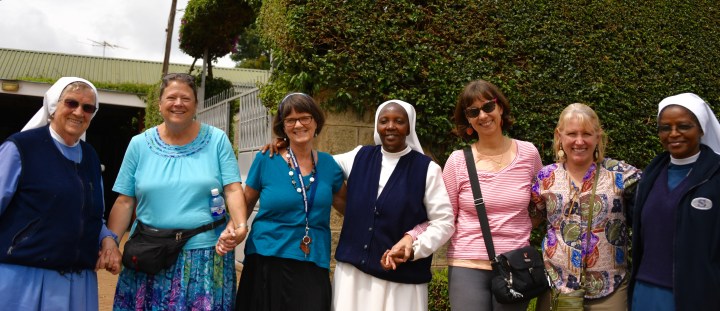
The St Joseph’s sisters and the KEST volunteers


The Lea Toto Kangemi Self Help Group
We ended the work of the day on a very good note and headed home from Kangemi as it started to rain once again. It has been a gratifying few days with the women of Tuko Pamoja and an opportunity to meet some interesting people, dare I say characters, doing very good work in the slums of Nairobi. I have countless other pictures that I could post and many more stories than I could possibly tell, but I am finishing this post in the wee hours of the morning, hoping I didn’t miss too many typos and in serious need of some sleep before we start another busy day.
The Women’s Workshop and so much more…..
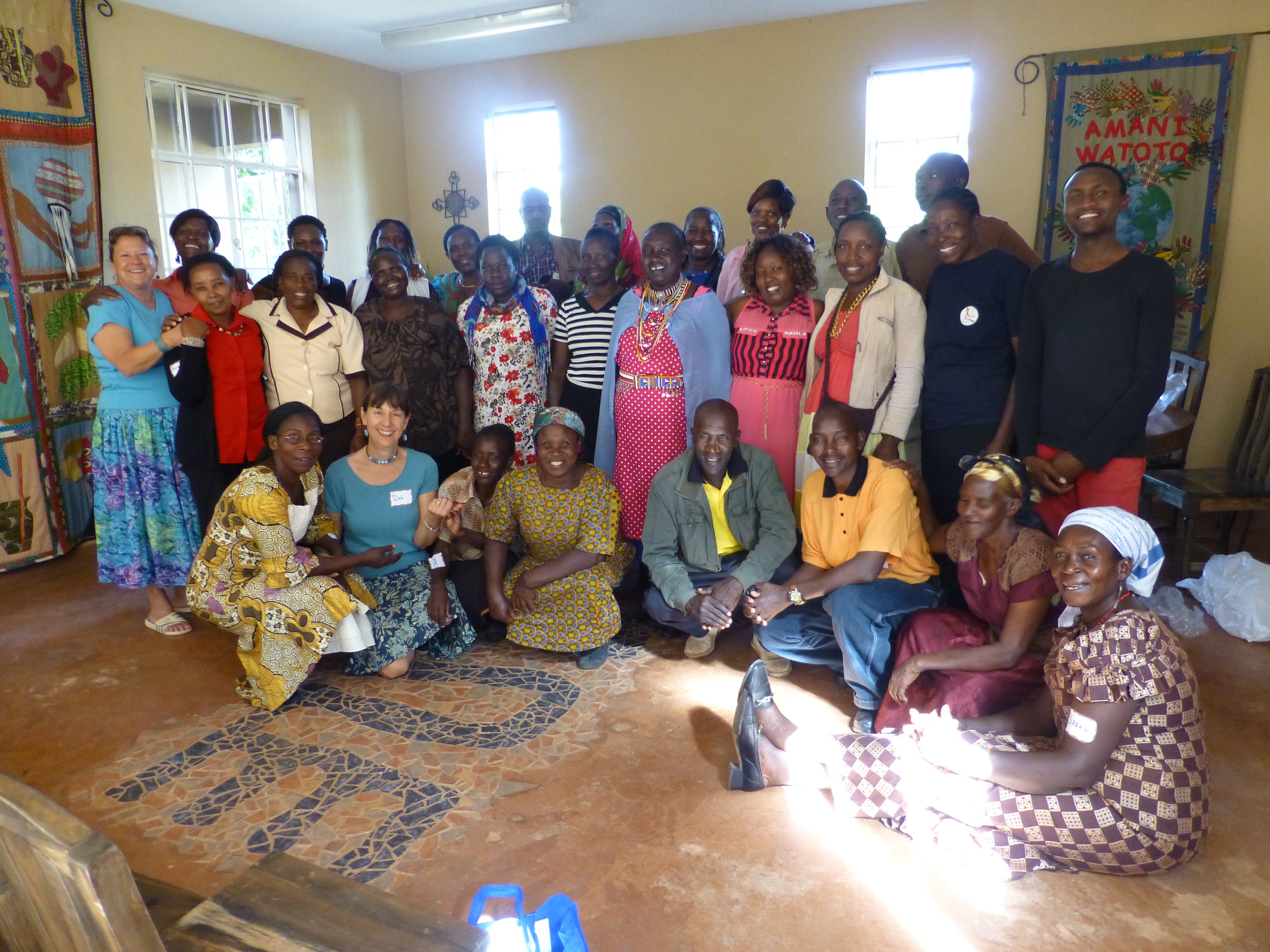
Group photo from the Women’s Workshop
So much has happened since I last posted! I have had to rely on photos and stories from the others for much of this post and was so disappointed to have missed out on so much. I was really sick for three days (high fever, headache and GI disturbance) so had to stay back completely for 2 days and one day when I tried to make the trip I spent most of the time like this:
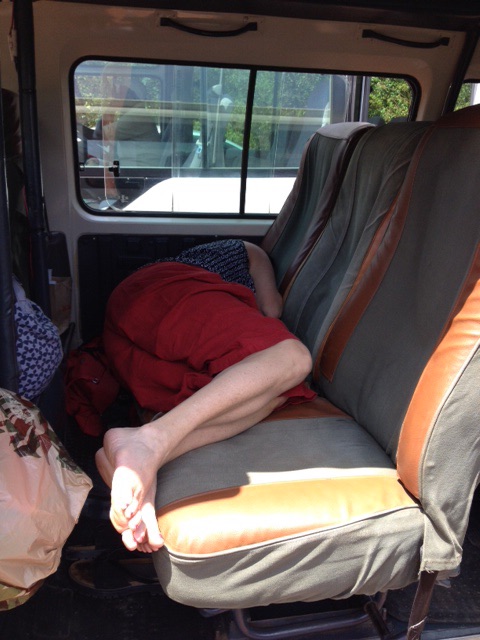
No fun to be sick and miss everything!
I want to say however that I have never in all my prior trips to Kenya been sick before and I think I did my own self in by temporary stupidity with how I processed a grapefruit for eating, so don’t be discouraged by coming to Kenya by my experience.
On Friday we went to Kazuri Beads, stopped at lunchtime at the Elephant Orphanage, and then moved on to Kibera Paper for another Tuko Pamoja Event. The trip to Kazuri Beads had a threefold purpose: to confirm the plans for participating the Women’s Workshop; to learn about and tour an example of a very socially responsible, community and family focused business; and to do some “socially responsible” and delightful shopping from their beautiful collection of bead items. Kazuri beads has been in existence for decades, employs and busses to the location 100’s of women from the Kibera slums, and provides on site child care and medical care. The women get higher wages than at most businesses and are treated extremely well. The newbies got a full tour and the retreads spent time in the two largest workshop areas handing out sweets and enjoying the joyous experience of an extremely warm welcome with song and dance.
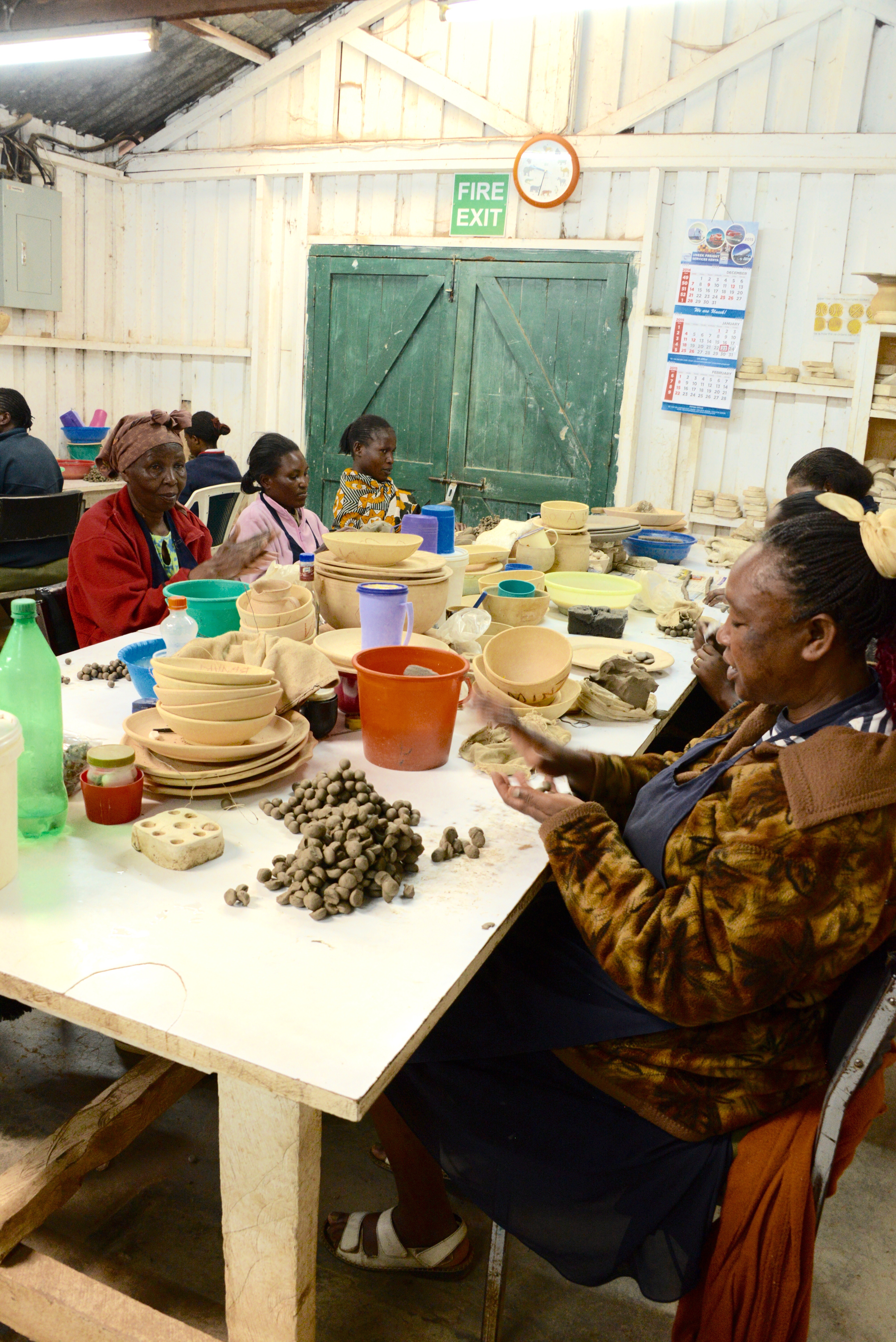
Workers at Kazuri Beads

The “monkey feeder” at Kazuri Beads
The longest employed woman at Kazuri Beads has worked there for FORTY years! And in case you are wondering, Kazuri means “small and beautiful” a perfect description of all their beads.
From 11AM to noon each day, visitors are welcome at the David Sheldrick Elephant Orphanage where the rescued baby elephants cared for there are brought out for feeding. Most of the elephants have lost their mothers to death by poachers in pursuit of ivory. The young elephants are rescued, nursed (really, with giant baby bottles and formula!) and fed, and then later released back to the wild. For all of us it is an opportunity to see prime wildlife conservation in action as well as to have the heart melting experience of truly being up close and personal with these adorable babies.
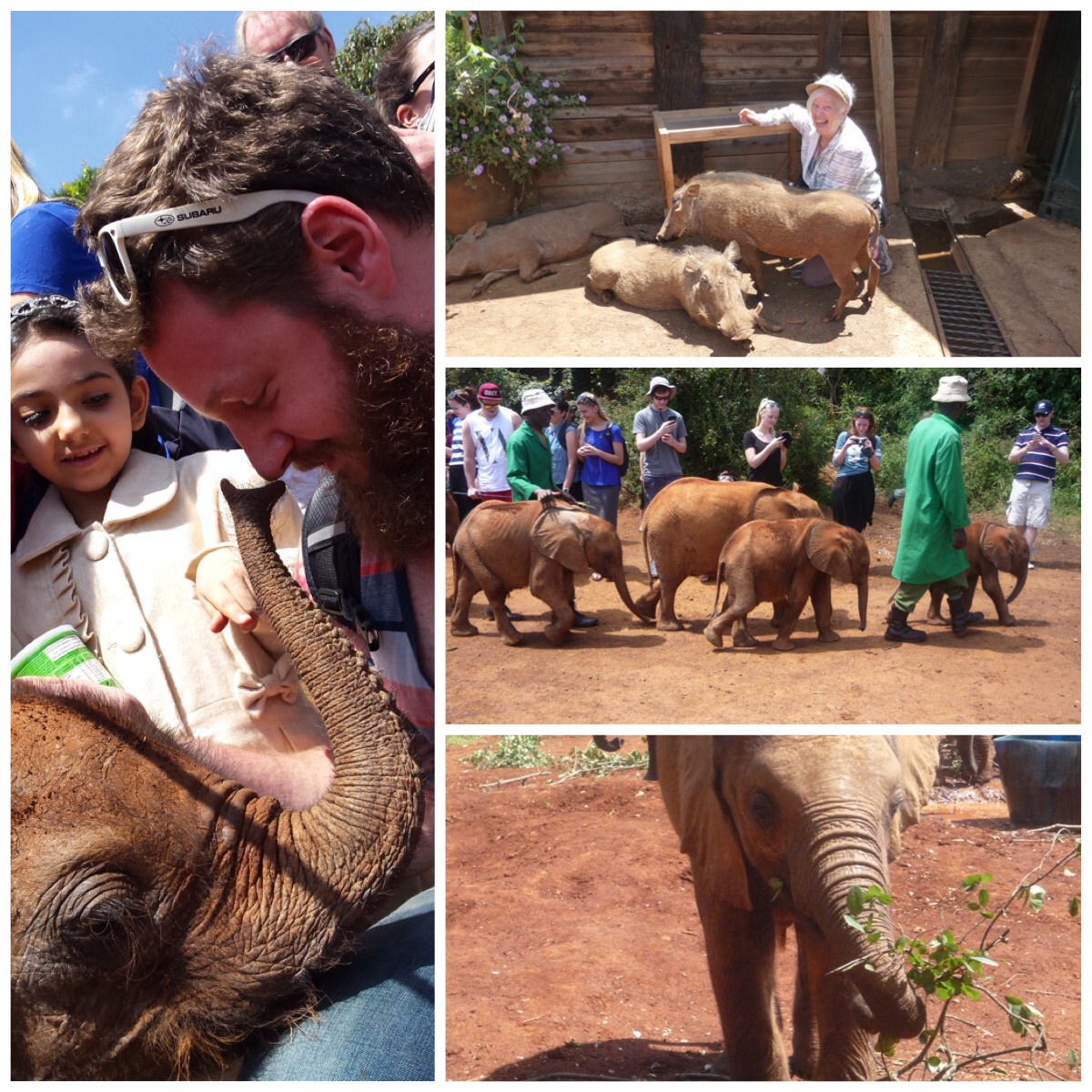
Baby elephants AND warthogs at the Elephant Orphanage
Following “lunch with the elephants” we set off to Kibera Paper to have the Tuko Pamoja meeting and to see this business on the edge of the Kibera slums which employs over 20 women and a couple of men from Kibera and who make beautiful cards, each a handmade work of art, on homemade paper recycled from paper discarded by businesses. As in each of the prior sites we had the TP meeting reporting the year’s success and giving out scarves and bonuses. Last year, not only were the women given individual bonuses, but each TP group was also given a 5000 ksh bonus to start a bank account. We learned that the group made a commitment to growing their bank accounts by each women contributing 100 ksh ( about $1.10) per month such that their account is now over 2900 ksh! As n all the other sites I filmed a demonstration of products made– the beginning to end process of making the paper and creating a card which involves so much work! And, all the volunteers were able to learn how to make paper and help in making cards. This is a wonderful group of warm women to be amongst, they welcome us heartily and it is always so hard to leave! Kibera paper is located at a church where they rent space and beside a school so we always get to enjoy the children when they come out for recess.
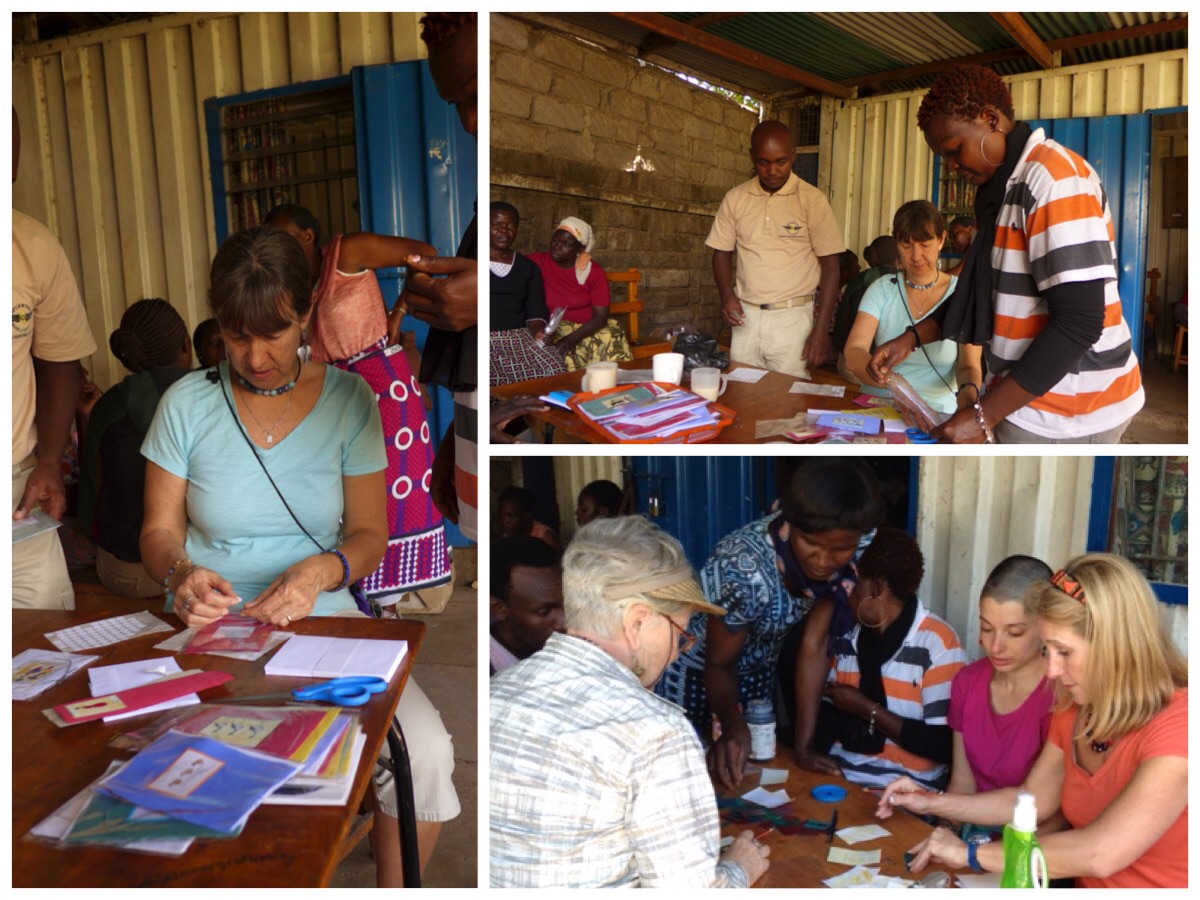
Making cards at Kibera Paper
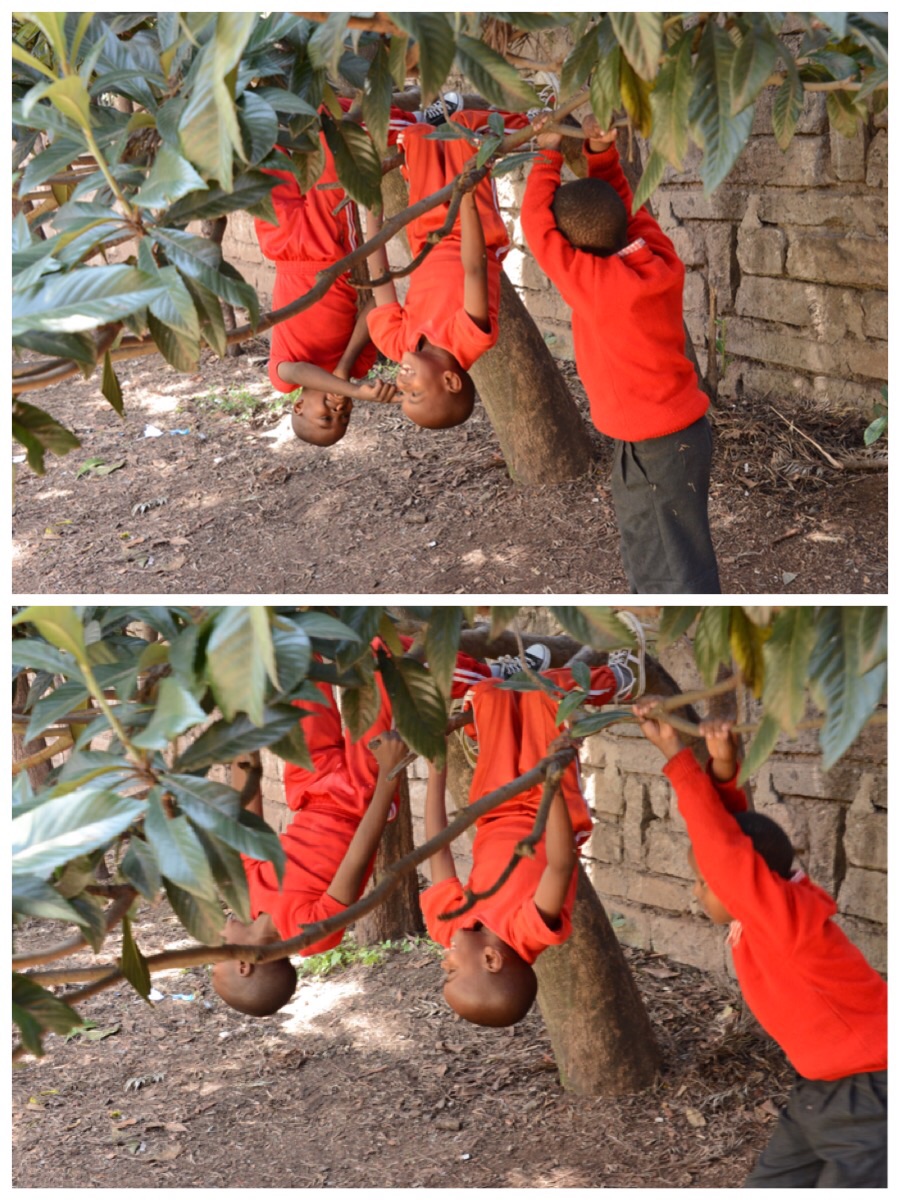
Some little Kibera school “monkeys”
The following day was a packed one, which I sadly missed completely, but was dazzled by reports and stories later. New volunteers spent the day at the Children’s Home in various activities with the children in their cottages and outside, and Judy and Valerie also returned to their much-needed counseling roles. Visiting the children in their cottages and playing with them outside serves several purposes: providing enrichment lessons, some one on one attention, a lot of physical affection, a much-needed break for the cottage Mommas…..and, of course, good fun all around.
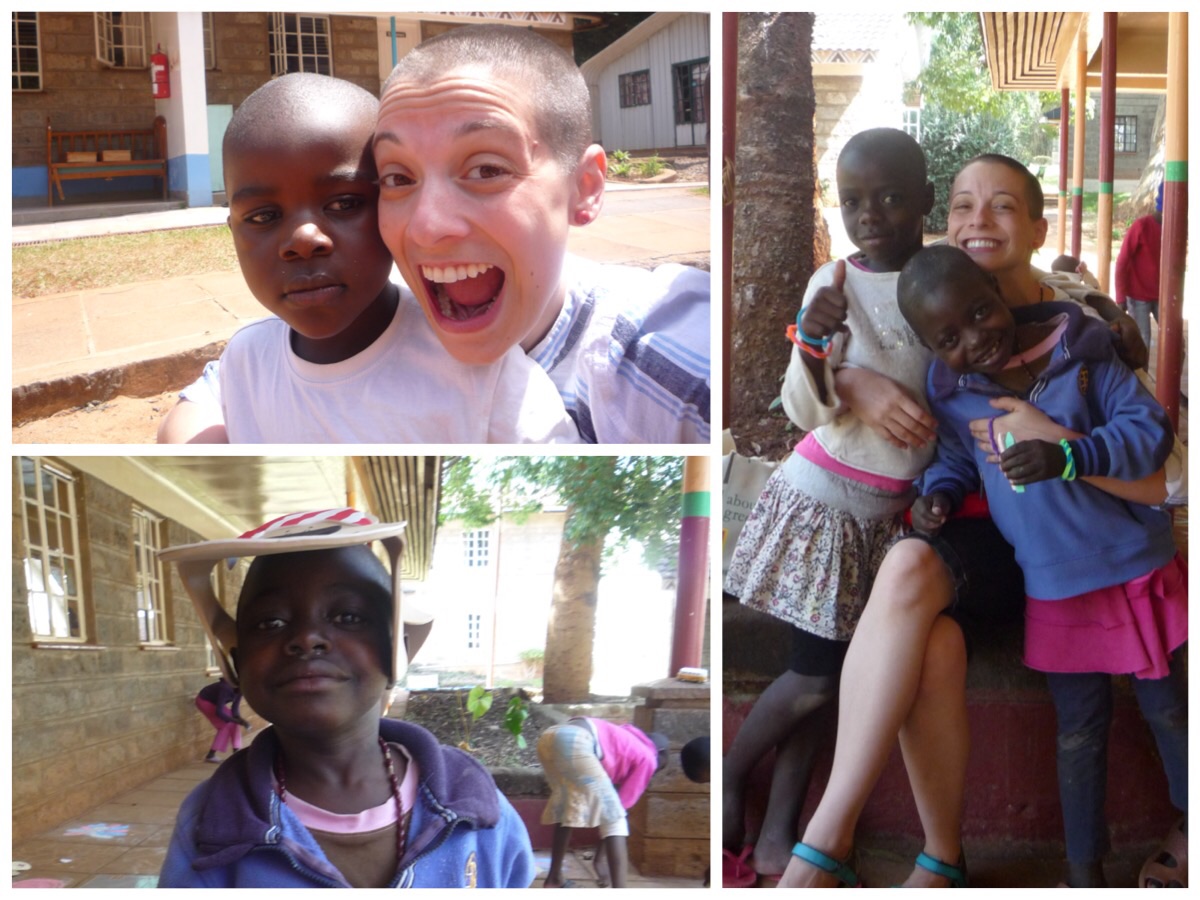
Kristen and th children at NCH
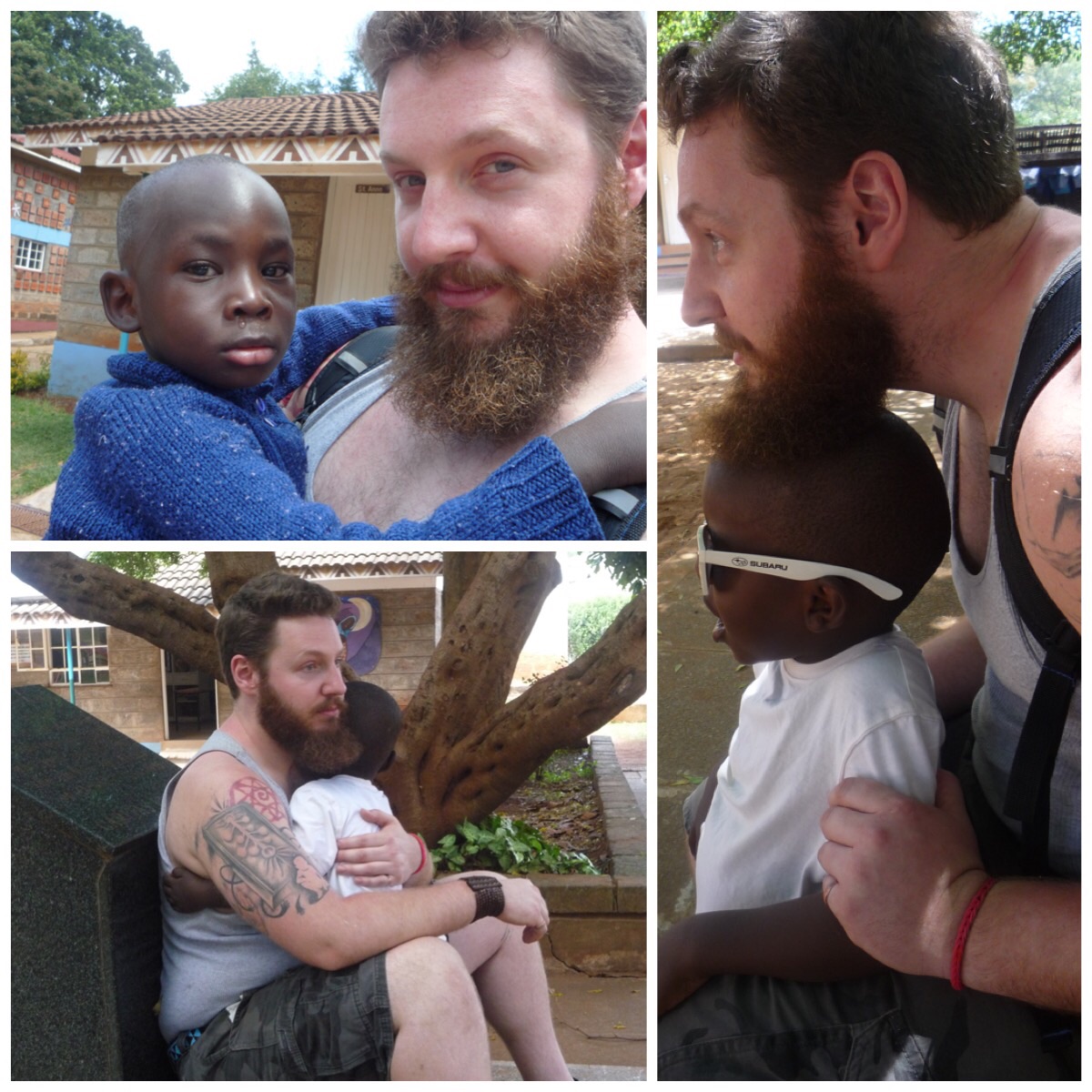
Jon with the children at NCH
At dinner we all were treated to some very heartwarming and FUNNY stories by Jon about his time with the children; Jon is the quintessential story-teller, complete with animated voices, humor and endless anecdotes so you can just imagine how much fun the children had with him. Irma and Megan also had fun in their cottages and Judy and Valerie had some intense counseling experiences. Also while at NCH, Kristen continued the process of giving out the scrubs to all the medical and respite workers who were thrilled to receive them.
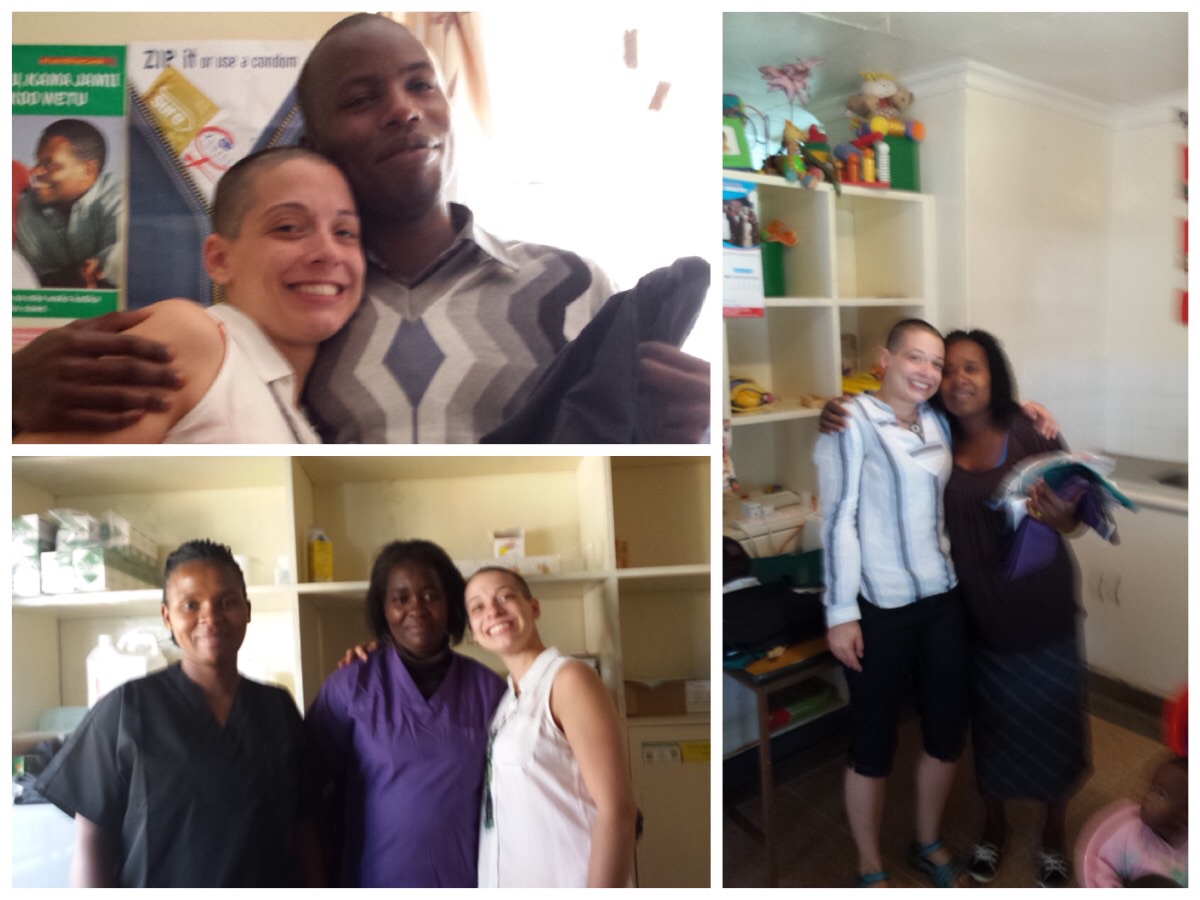
Giving out the scrubs
While the others were at the Children’s Home, Lloydie and Deb were at the Third Annual Women’s Workshop. When they returned at the end of the day and told me the story of how amazing the day was, I was teary for being sad to have missed it, for being touched by how much the women were engaged and learned, and laughing in tears for a near food mishap (a midday report that all the food was “spoiled” and we still don’t know what that meant since it was fine.) The workshop was different this year. Two people from all of the Tuko Pamoja groups attended and went to three successful business sites to learn from their success. First in the morning they met at Dimesse Sisters for mandazis and chai and then headed off to Kazuri Beads. There they toured, but also learned valuable lessons from the manager about the importance of quality control and from the staff in the retail shop about displaying items and customer service. They ALL asked lots of questions. When Lloydie was reporting about this she said very excitedly, “It was as if I had scripted it to emphasize everything we have been trying to teach!”
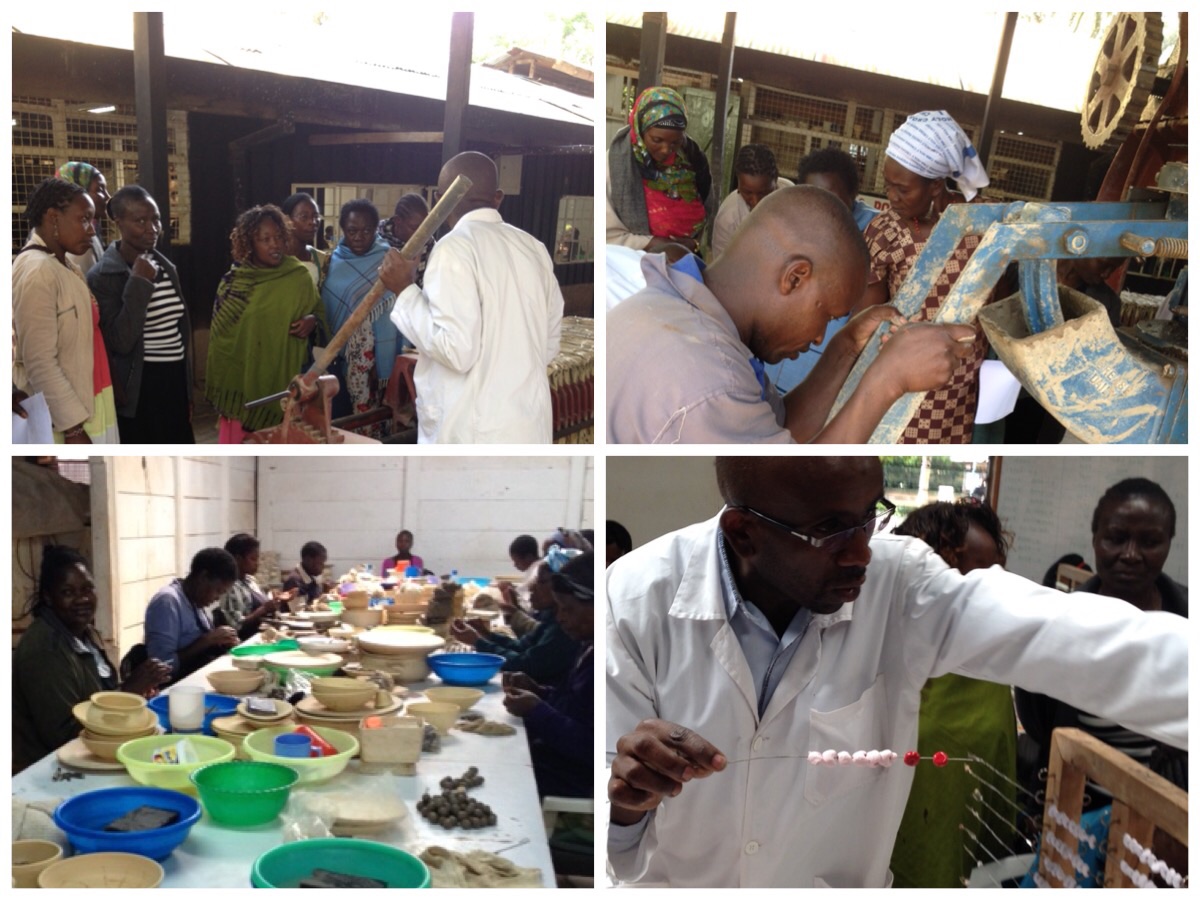
Workshop participants at Kazuri Beads
Following the time at Kazuri Beads, the group travelled to the Power Women’s workshop in Kibera and were very inquisitive and mesmerized by seeing this successful business which grew from another self-help group that began in very similar way to all the other Tuko Pamoja groups. Evelyne, who is the president, and also a TP board member, described the history of the group, challenges and successes, and also gave a tour of their shop, beauty salon, and day care center. The women enthusiastically asked many questions and were very inspired.
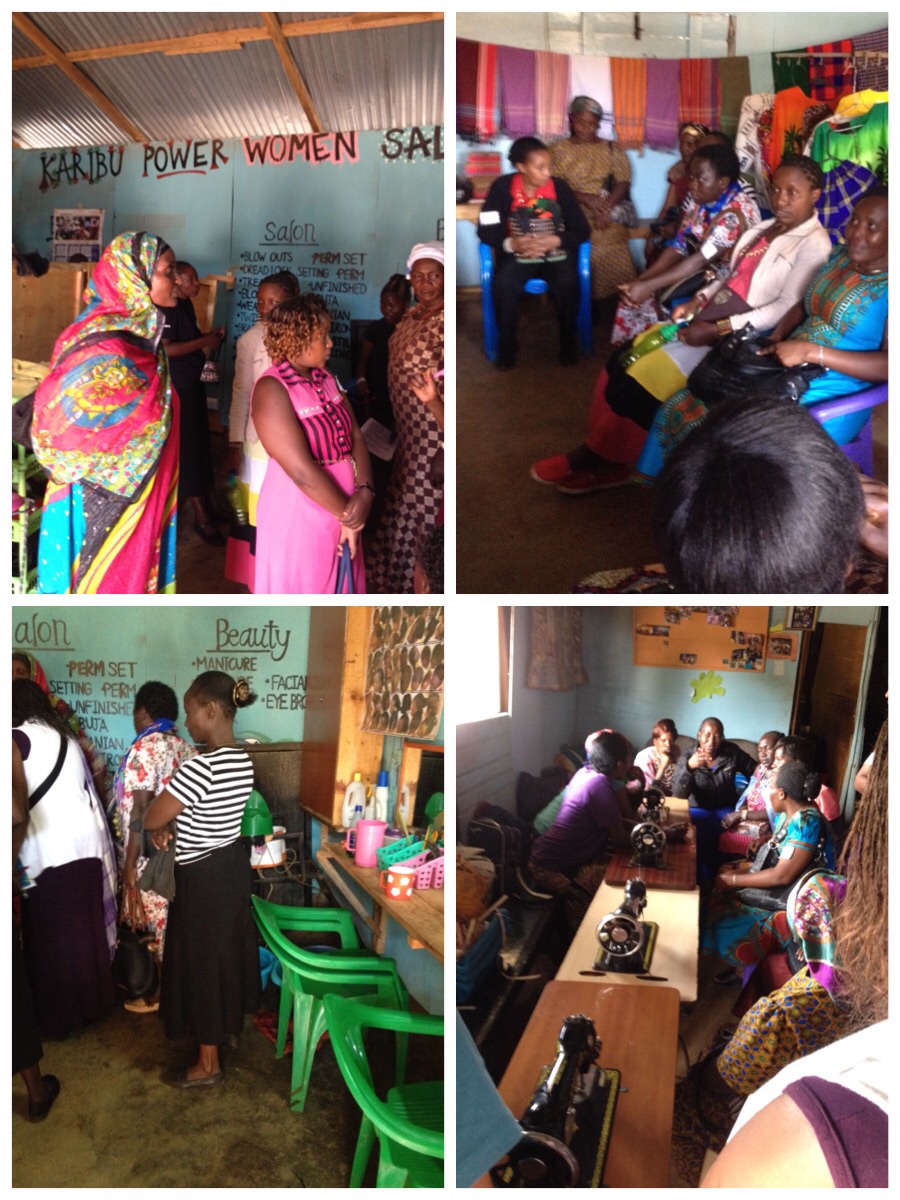
At the Power Women’s Shop
The final destination was Amani Ya Jou, where Maggie, also one of the Tuko Pamoja board members, is employed. She also gave the story of the group, a cooperative of women refugees, all with horrendous hardships, who were “rescued” by their experiences of being trained there and of being together. One of the messages that she emphasized was that if you have “something inside of you” (difficult or good) you should never hold back, you should always share; that can only help others and help you. Talk about a message that was perfectly delivered! Following the tour and talk at Amani everyone sat down for lunch there. It was an “American lunch” of tomato soup, grilled cheeses and more, typically on the menu at the Amani Cafe and enjoyed by all.
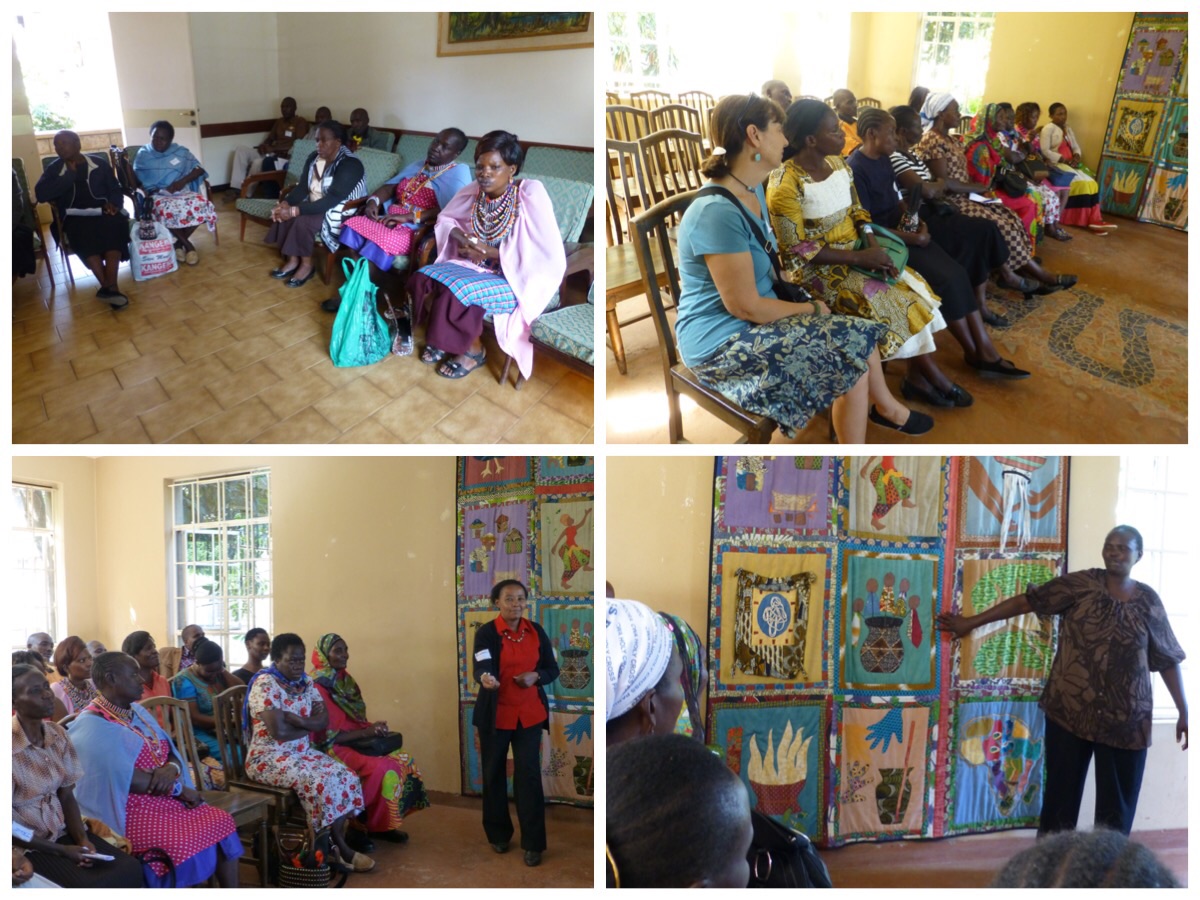
Time at Amani
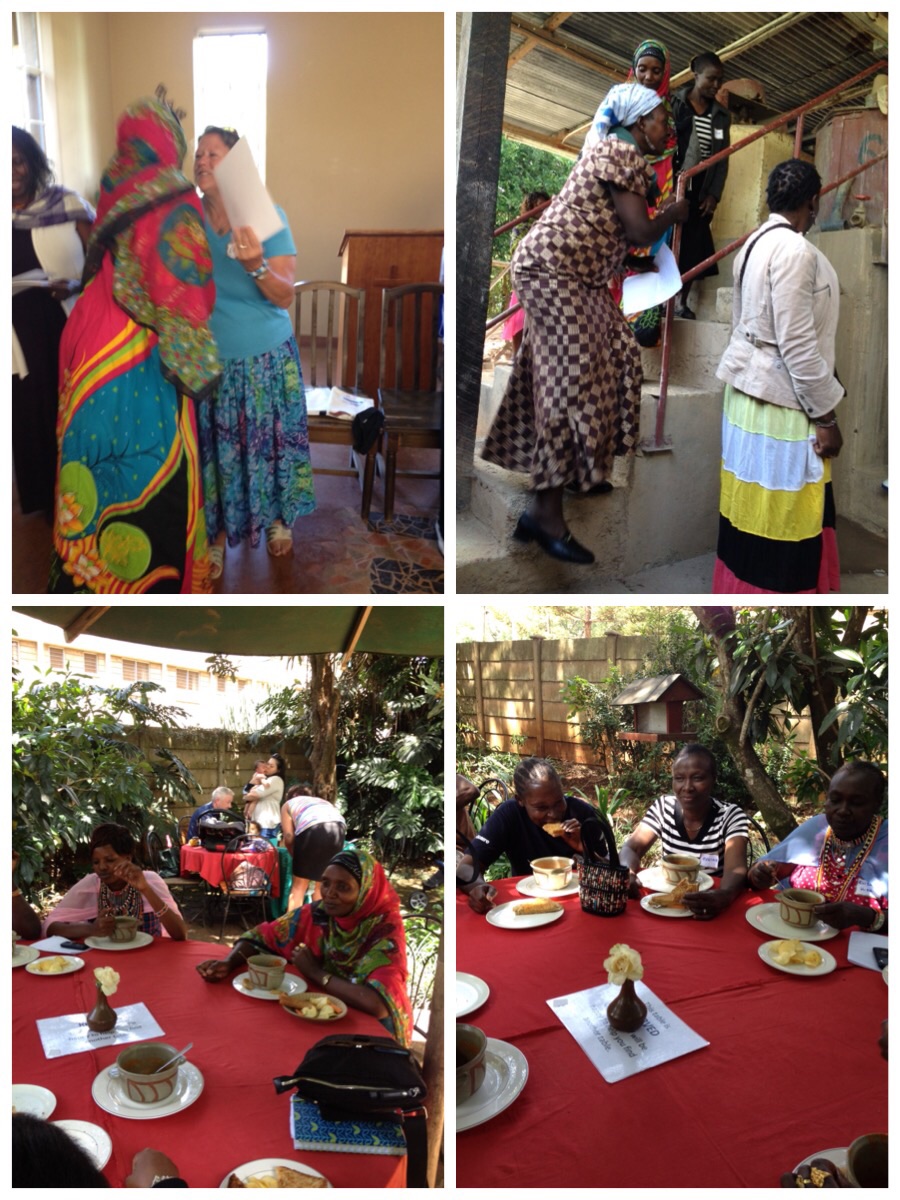
Time at Amani
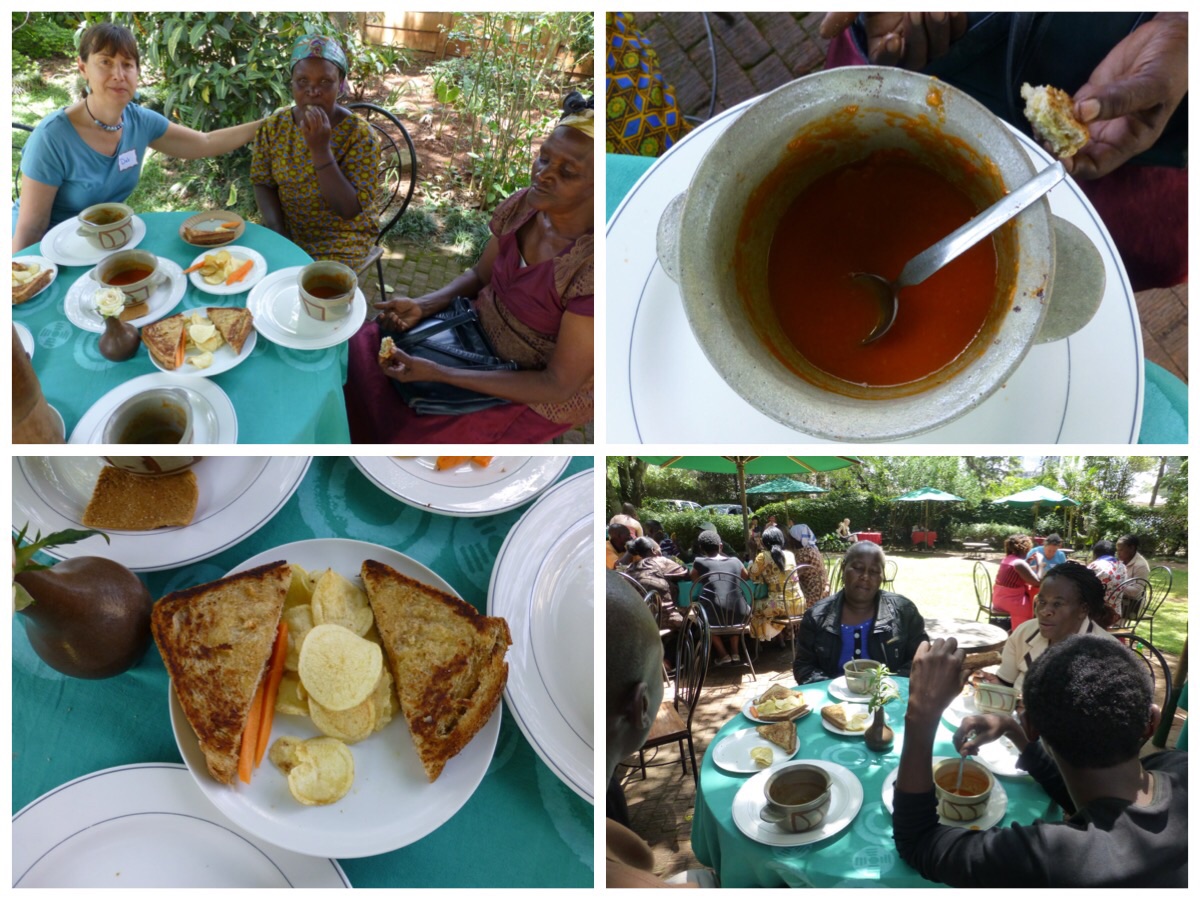
Lunch at Amani
Following lunch it was time for the women to give feedback, get certificates, and get goody bags. I am told by Lloydie and Deb that they were “blown away” by the women’s feedback and cried, even sobbed through some of this. Jacqueline from Dandora stood up with both hands to her forehead and exclaimed, “From this day forward, I am changed!” She went on to talk about how she learned she could be a much better leader for her group, could be much more vigilant about quality control and how she felt that the group needed to display their products differently. One after one, the women gave feedback which echoed that and more, and went FAR beyond the expectations of the day!
The workshop wound down with the giving of certificates and goody bags ( basic food items like flour, sugar, lard, etc) and the women oohed and aahed at each item pulled from the bags.
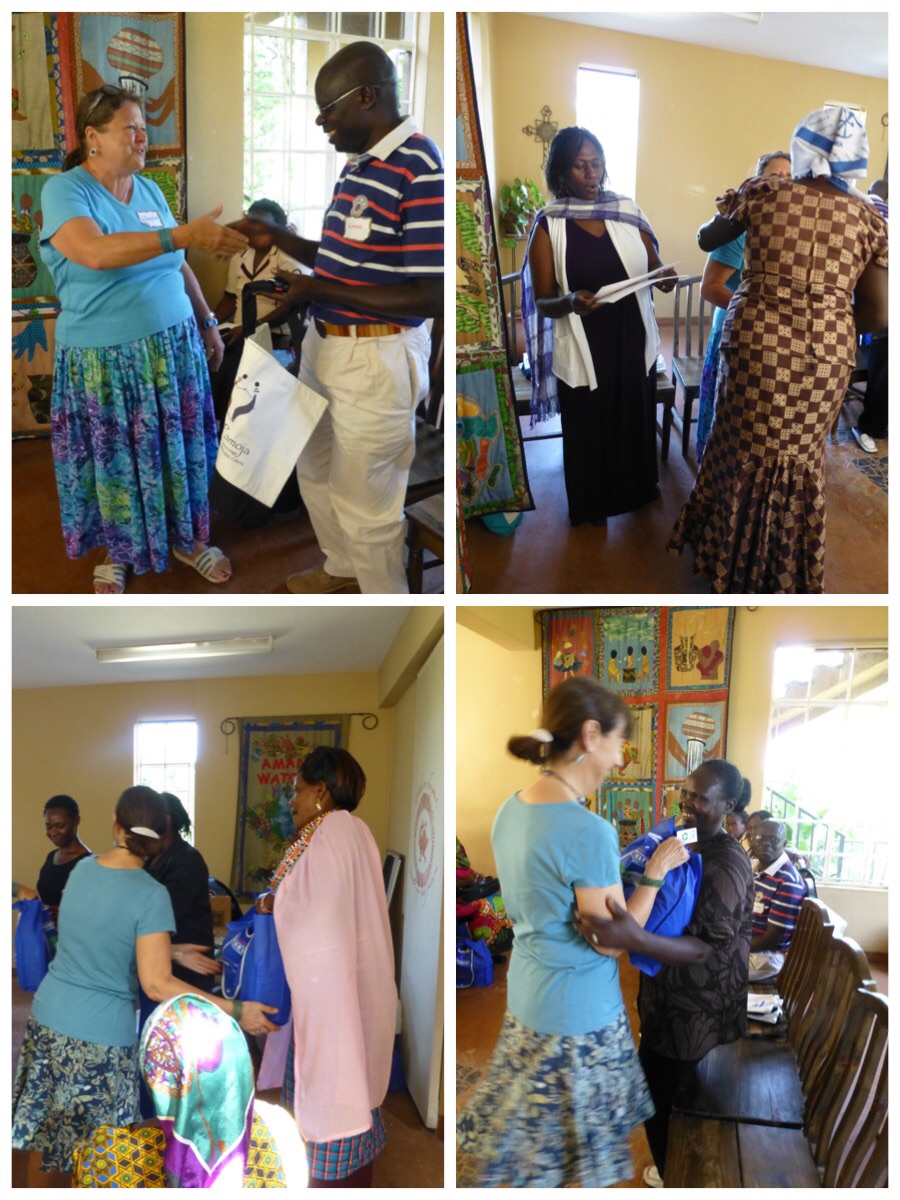
Giving goody bags and certificates
The day ended with a group photo and, as all events end in Kenya, with a prayer and a song, actually several of both. Most especially however, it ended with the powerful sense of the smallness of the world, the way in which we are all connected as human beings, and the true spirit of Tuko Pamoja, “We are together!”
Group photo of Women’s Workshop
We Are All One Family
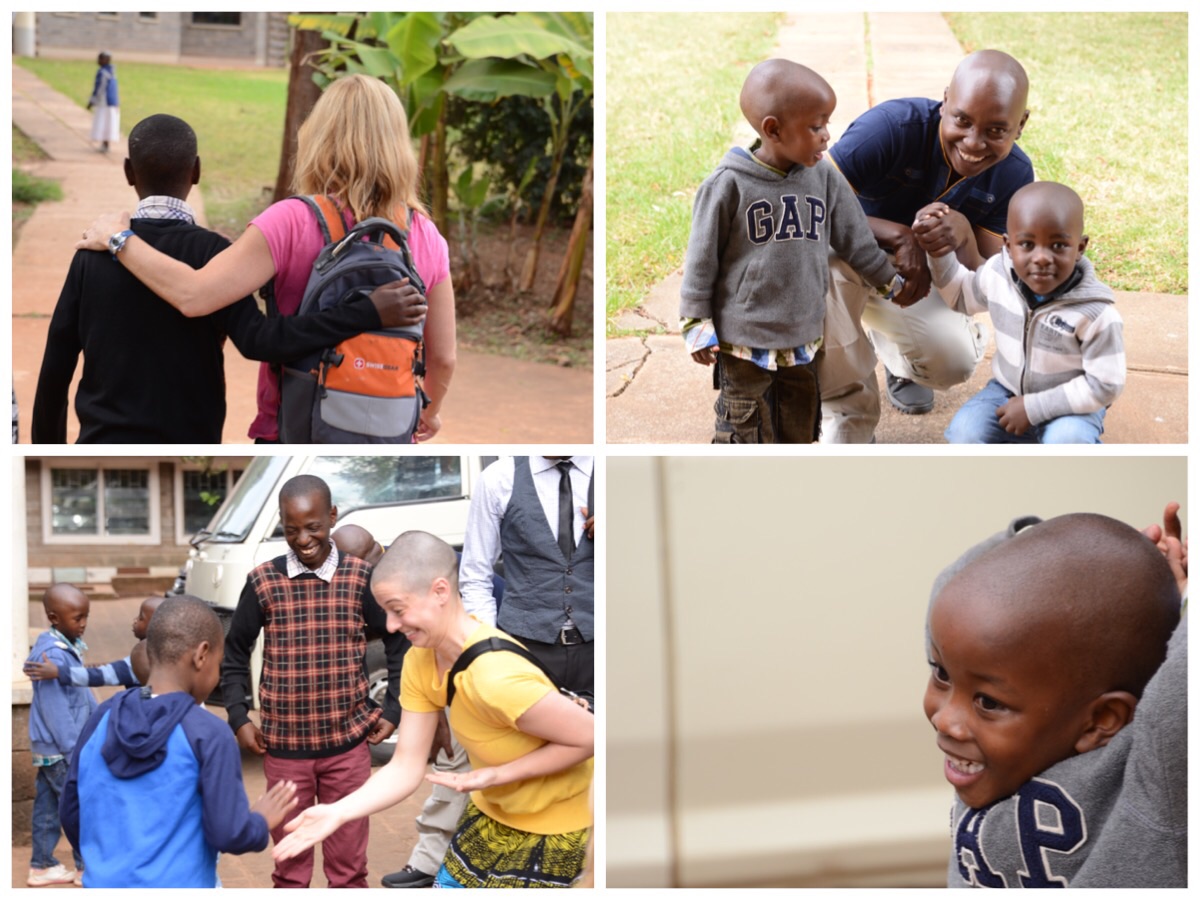
Time with the children at Nyumbani Childen’s Home
It has been an incredibly full two days since my last post. It often very difficult to find words that truly convey the experience of being here in Kenya. Every day, many times day, there are so many things that touch our hearts so deeply that we are moved to tears again and again. The last two days have certainly been no exception.
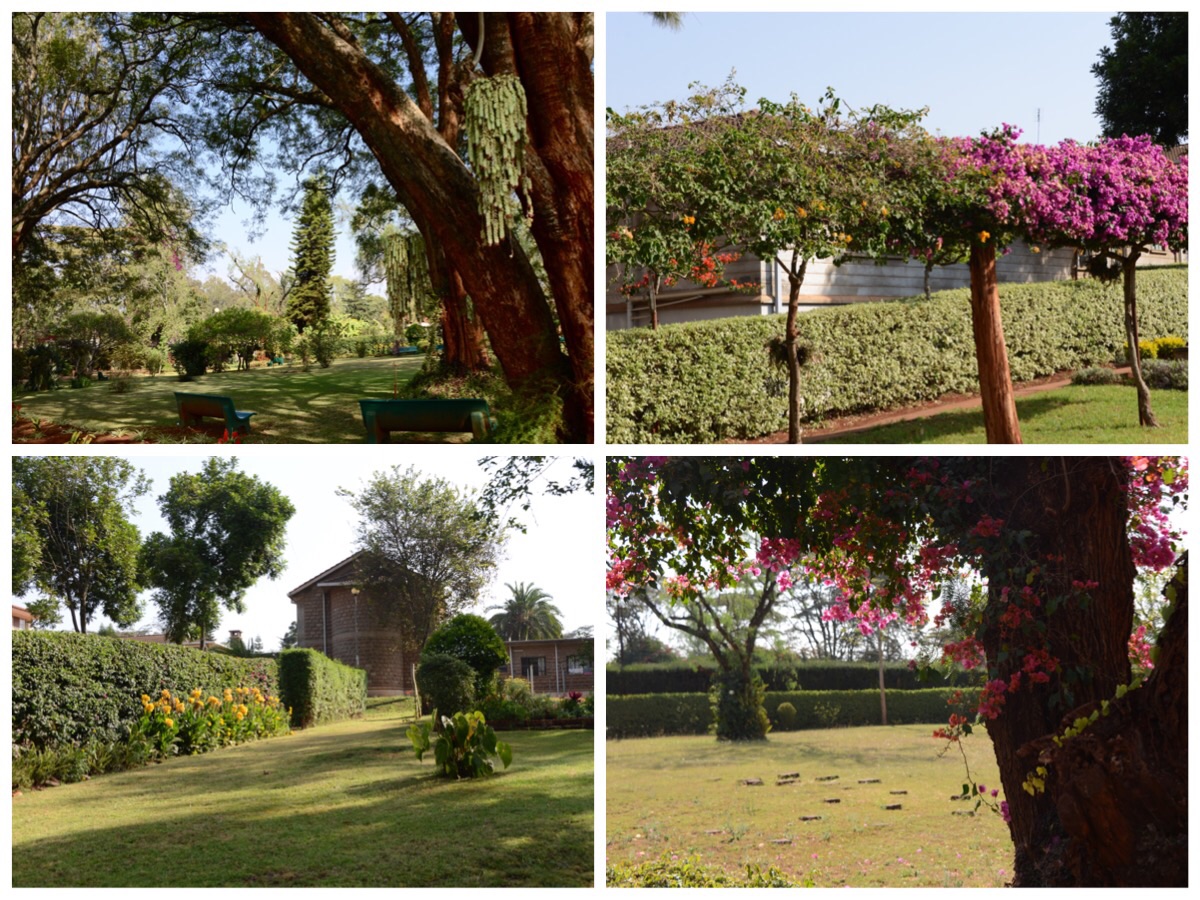
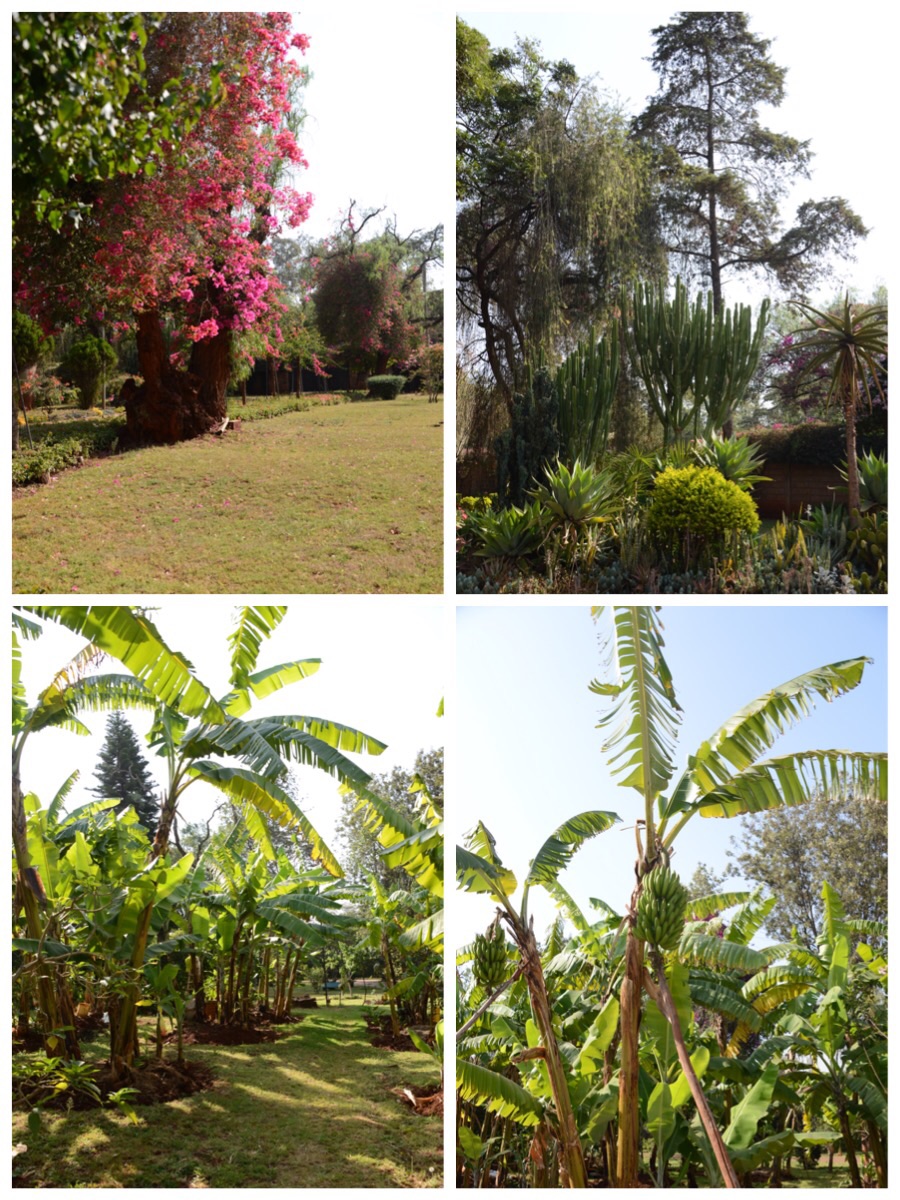
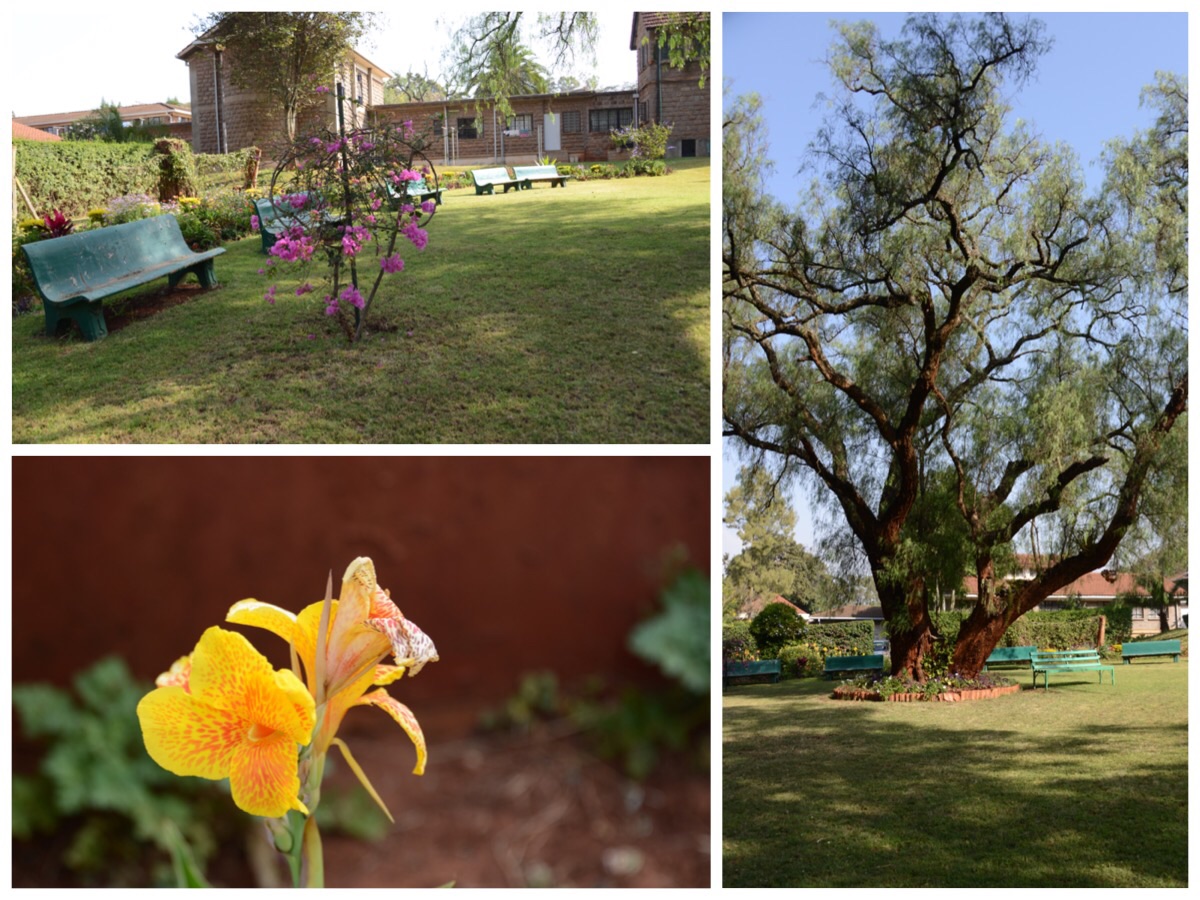
I want to give people a glimpse at the Dimesse Sister’s Retreat Center where we stay for a week as well as to introduce the volunteers. The interior lodging at Dimesse is very simple, but the exterior grounds are extremely beautiful, like being in the middle of our own private botanical garden when much of the world nearby is som ugh different. If there is time in the morning before we depart I like to take a brief walk and take it all in.

Dimesse Retreat grounds
We all meet together in the morning before we depart which is a time for reuniting with Justus, talking about plans for the day, and often sharing some fun moments or stories from the day before. We also meet up with Charles, a former child of Nyumbani Village who is in college and doing an internship with KEST.
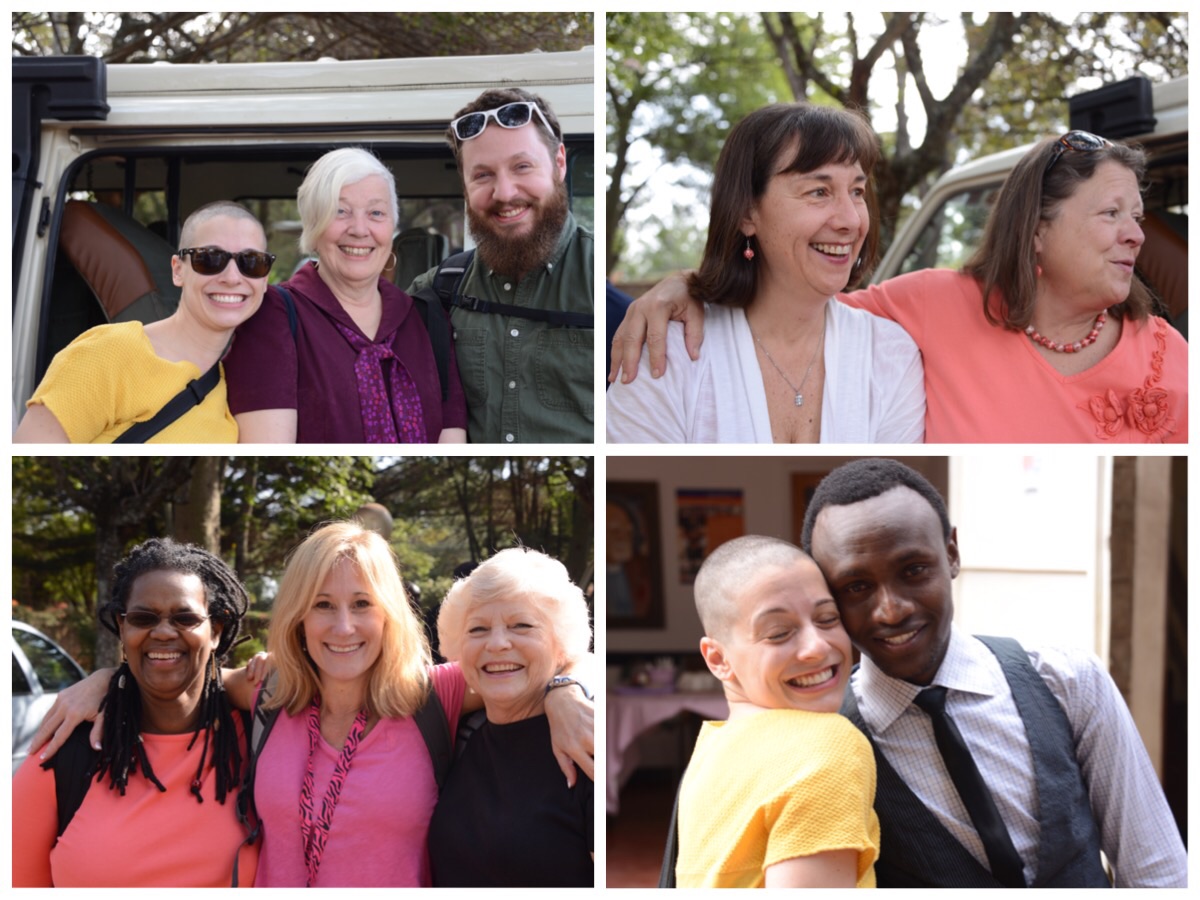
KEST group: Kristen, Irma Jon, Deb, Lloyde, Valerie, Judy, Megan and the KEST intern, Charles
We returned to Nyumbani Children’s Home on Sunday and began the day by going to church with the children and staff. The mass is a jubilant, joyous, singing, dancing and clapping experience when the volunteers, staff, cottage parents and most especially the children come together. The children were dressed in their “Sunday best” with the girls in skirts and dresses and fancy shoes, often with something sparkling in quite unique combinations, and the boys in ties, vests, and dress up clothes. All except the babies came, with the younger ones sitting in the front and the littlest on people’s laps, perhaps yours if you are a lucky volunteer. It’s always very interactive with priest speaking to the children, drawing them in with questions, and teaching them a valuable lesson. The children form a beautiful choir accompanied by drums and instruments and there are young dancers for every song. You will get a sense of the adorable young girls with the gift of rhythm from this video clip.
At the end of the mass, Protus Lumiti, the Director, always goes up to the front and thanks EVERYONE (the singers, choir, drummers, speakers….) each followed by a hefty round of applause with musical accompaniment. The volunteers always are thanked and this time we were all called to front along with Lloydie and we were introduced including the number of years we have been coming. As Lloydie talked about the return volunteers and why we come back, she explained that being here in Kenya, being with the children, has so opened our hearts and changed our lives such that, by the end, many of us stood there in tears.
After the church service, we had an opportunity to have tea with Sister Mary and the staff which was also a time to catch up on what’s happening within the Children’s Home, the successes and the challenges. We then all went off to various activities. Judy and Valerie continued their group counseling and will return next weekend to do some individual counseling. We also visited the cottages where the children live, each retread and newbie volunteer together with an assigned cottage. We were able to see the children in their homes and speak with the cottage parents. Judy and I were in Cottage E visiting the children, but also talking with Mom Jane who has been working as a house parent for 15 years. She has raised four children of her own and now she is raising a second family of fourteen. It is opportunity for us to interact and provide the house parents with support and to learn about them. The children are happy and spirited, but also very well behaved, affectionate with each other and very responsible in doing chores such as cleaning up after the tea and snack, without even being asked.
We were also able to visit children in the Respite Program. The children cared for there are children referred from the Lea Toto clinics providing outreach care to children with HIV. They come to Respite Care because they are too ill to be cared for in their families and require inpatient care. The most frequent reason for admission is malnutrition and the children come for intensive nutritional intervention. Most return to their families in the slums, but some who are too sick, become residents of Nyumbani Village.
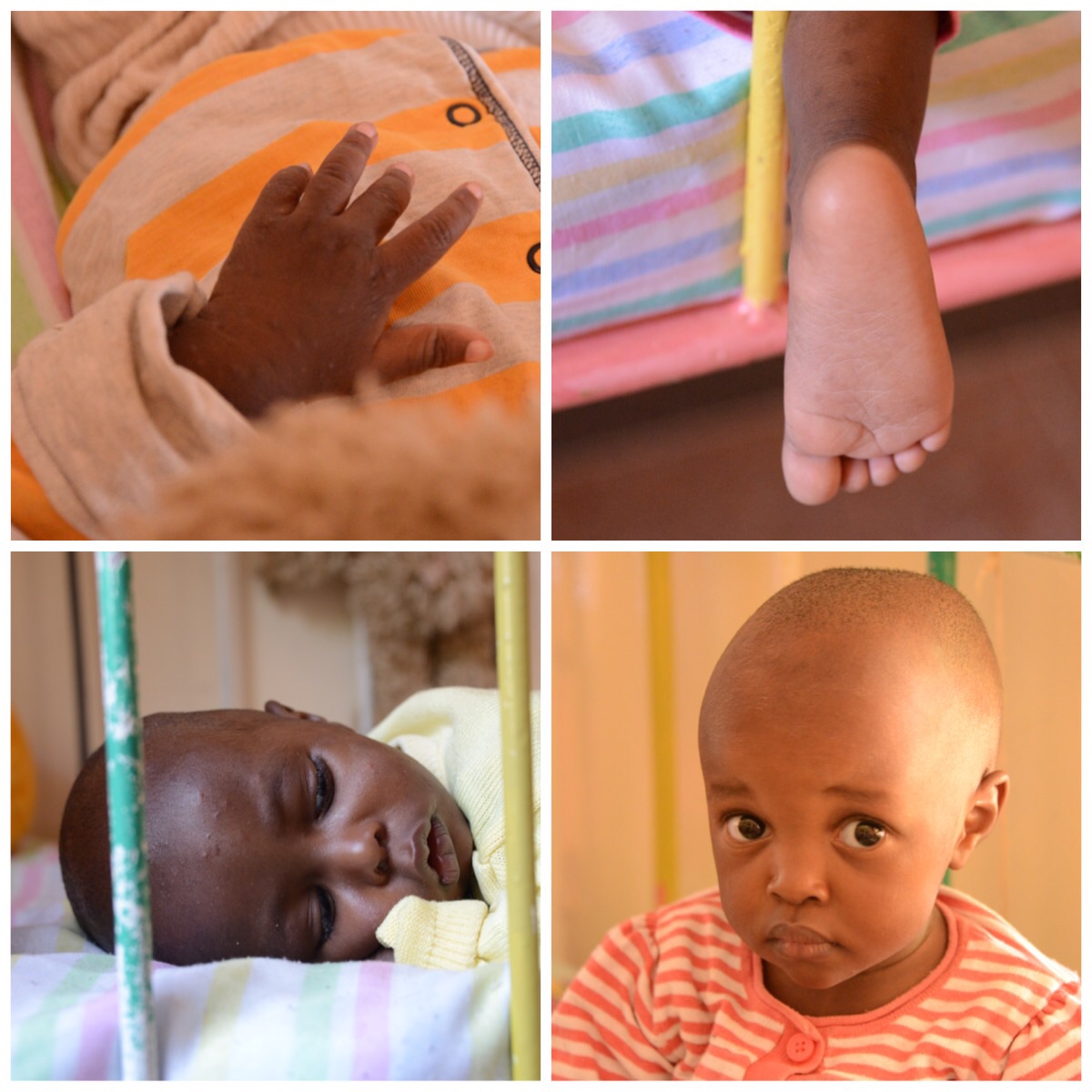
Children of the Nyumbani Respite Program
By the end of the day at the Children’s Home, we were all dragging, feeling the effects of jet lag, too little sleep, and two days full of emotion. We returned to Dimesse Sister’s retreat long enough to freshen up, take a brief walk, or organize donations and then set off on the evening plans. We had a planned dinner out as an entire group with our guests being Lucy and her friend Anne from Kenyatta Univrsity. Some of us have a very special relationship to Lucy who grew up in Nyumbani Village in the same “family” as Charles. Lucy is a very delightful young woman whom we got to know at Nyumbani Village as she helped with the Memory Book project and in other ways. She was a very good student, scored high on the national exams, was assured acceptance at the university, but had no way to fund her attendance. With belief in her capabilities and affection for her as a person, and with Lloydie’s assistance, we formed “Team Lucy”, a group of five women (Deb, Karen, Carla, Marguerita and me) who committed to financing Lucy through 4 years at the university. Although Lucy feels very fortunate, we all feel honored to support her and that we are having a wonderful and heart warming experience doing so because she is a very special young woman. We keep in touch through the year and Deb, Lloydie and I were thrilled to have her and her friend Anne join the KEST group for dinner. We enjoyed talking with both of them about their future plans and goals and we were very surprised and extremely touched when Lucy brought out a bag of gifts for “Team Lucy.” In each gift was a tee shirt from Kenyatta University, a photo, and the sweetest, most heartfelt note of gratitude. This brought tears to some of us, which completely overflowed as we turned the shirts over to find “We Are One Family” on the back. At that point even the KEST travelers, who didn’t even know Lucy prior to that night, were in tears.
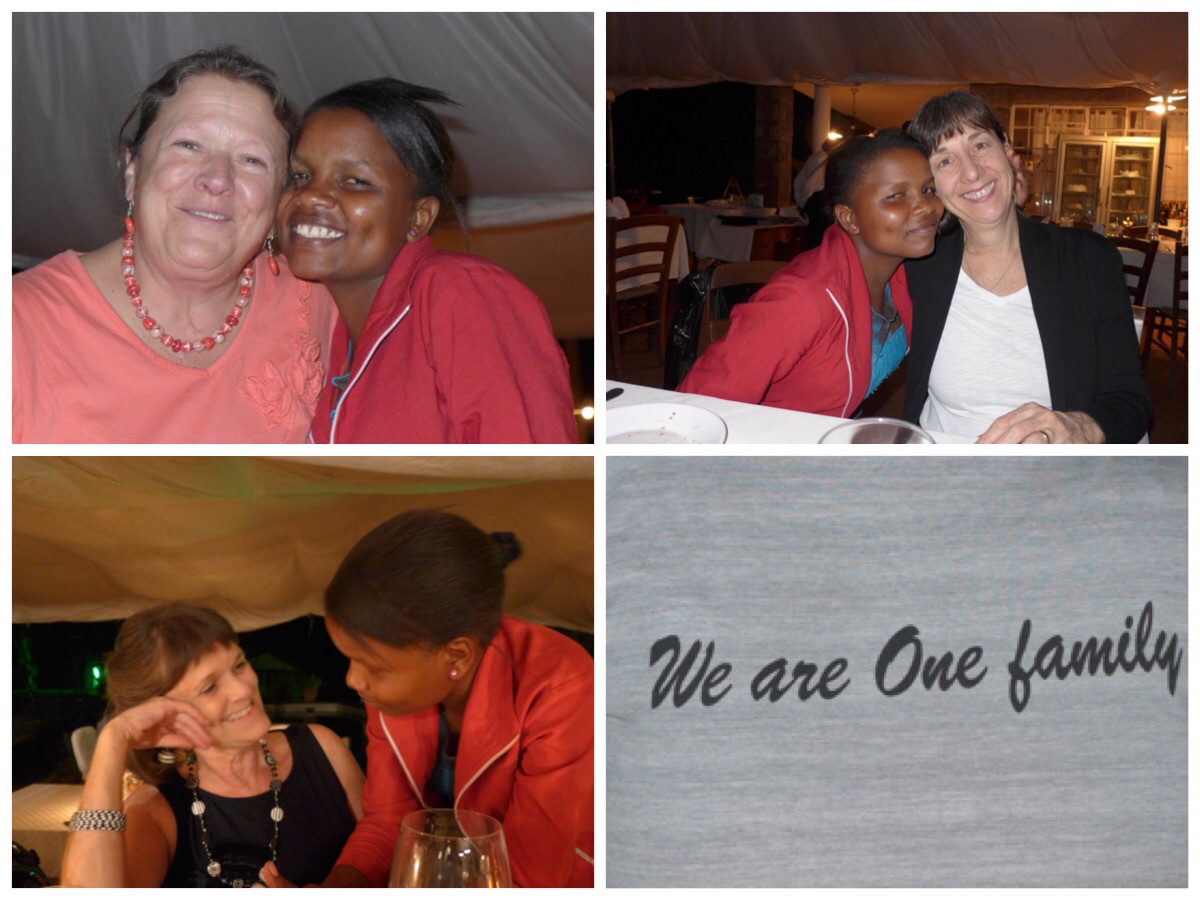
Lucy with Lloydie, Deb, and me.
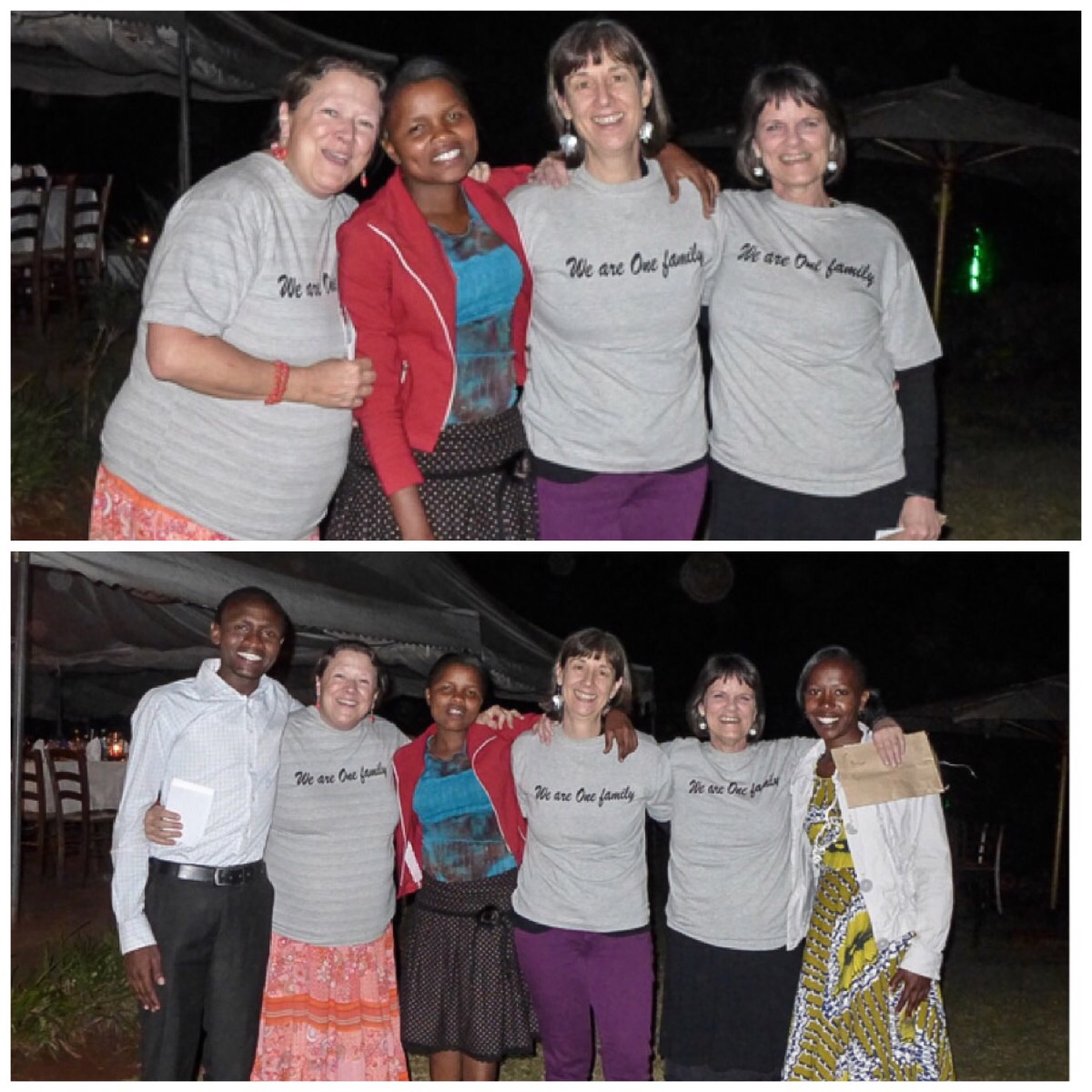
We are One family…..
The entire dinner was a fun time with sharing, humor and much more, but the experience with Lucy was moving in a way that I can’t possibly describe. So we all went to bed very tired, but happy and full from the day, hardly believing that it was only our second day in Kenya!
Today we moved on to different plans at a different site, but since every day in Kenya is rich and full with a yet another amazing experience, this day was no exception. Today we began the series of Lea Toto Clinic visits and Tuko Pamoja “business meetings” with the women’s self-help groups. We traveled to Dandora, one of the slum areas of Nairobi, with Tuko Pamoja Board members (Lloydie, Deb and Lynn) meeting with the women of the self-help group and the others meeting with the clinic staff and going on home visits.
When we arrived, as is always the case, we were greeted with high spirited singing, dancing and hugging to welcome us. This group, the Vision Self Help Group, was the first Lea Toto self help group established and the one with which we have the longest history. All of the women care for HIV+ children, both biological and foster, many live with HIV themselves, and all craft to support their families. These are inspiring, amazing, and persevering women whose strength and grace has overwhelmed me since I first met them in 2010. We shared with them the success of the last year in selling their products, many of the lovely and poignant comments left in the guest book by people in the States who have attended Tuko Pamoja events. We also had the pleasure of handing out bonuses because of the success of sales of the past year. The women are always overwhelmingly grateful and not shy about expressing that.
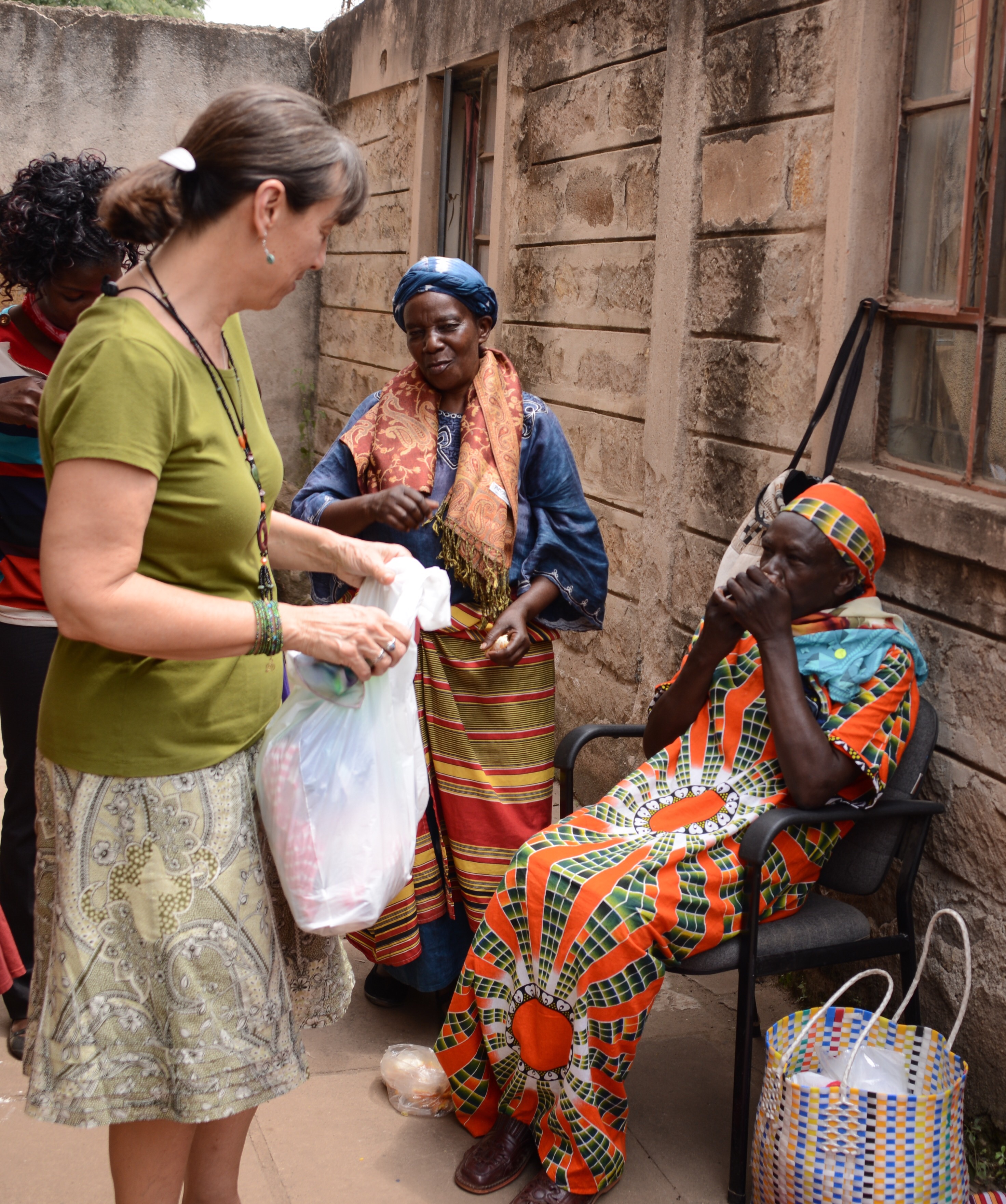
Deb meeting with some of the Vison Self Help Group
One of the other goals of our meeting, and at each Tuko Pamoja meeting to come, was to do video of a demonstration of making one of the products. I had the pleasure of doing that with Margaret who demonstrated how to make a spiral bead bracelet.
At the end of our time there all of the volunteers were able to shop heartily from the women’s crafts. It wasn’t until our usual dinner time debriefing that I heard about the experiences of the new volunteers who did home visits with Lea Toto staff and volunteer community health workers. The purpose of home visits is to do outreach to families who have an HIV+ child receiving care at the clinic. Hearing about their experiences brought me back to my very first visit to Kenya when I did my first home visits. They talked about the extreme poverty and terrible conditions that they saw as they passed through the alleys of Dandora where they found trash and streams of raw sewage. However inside the tiny tin houses, the size of a small bathroom in the States, lived families of many members in miniature living quarters were kept extremely clean. They were welcomed with grace and gratitude and the people shared openly their situations and struggles. Judy told us of visiting household, with a grandmother who has cared for her three grandchildren for many years since her daughter died. The oldest, an adolescent girl, is HIV+ and doing well on ARV treatment, despite the enormous challenges of living in severe poverty.
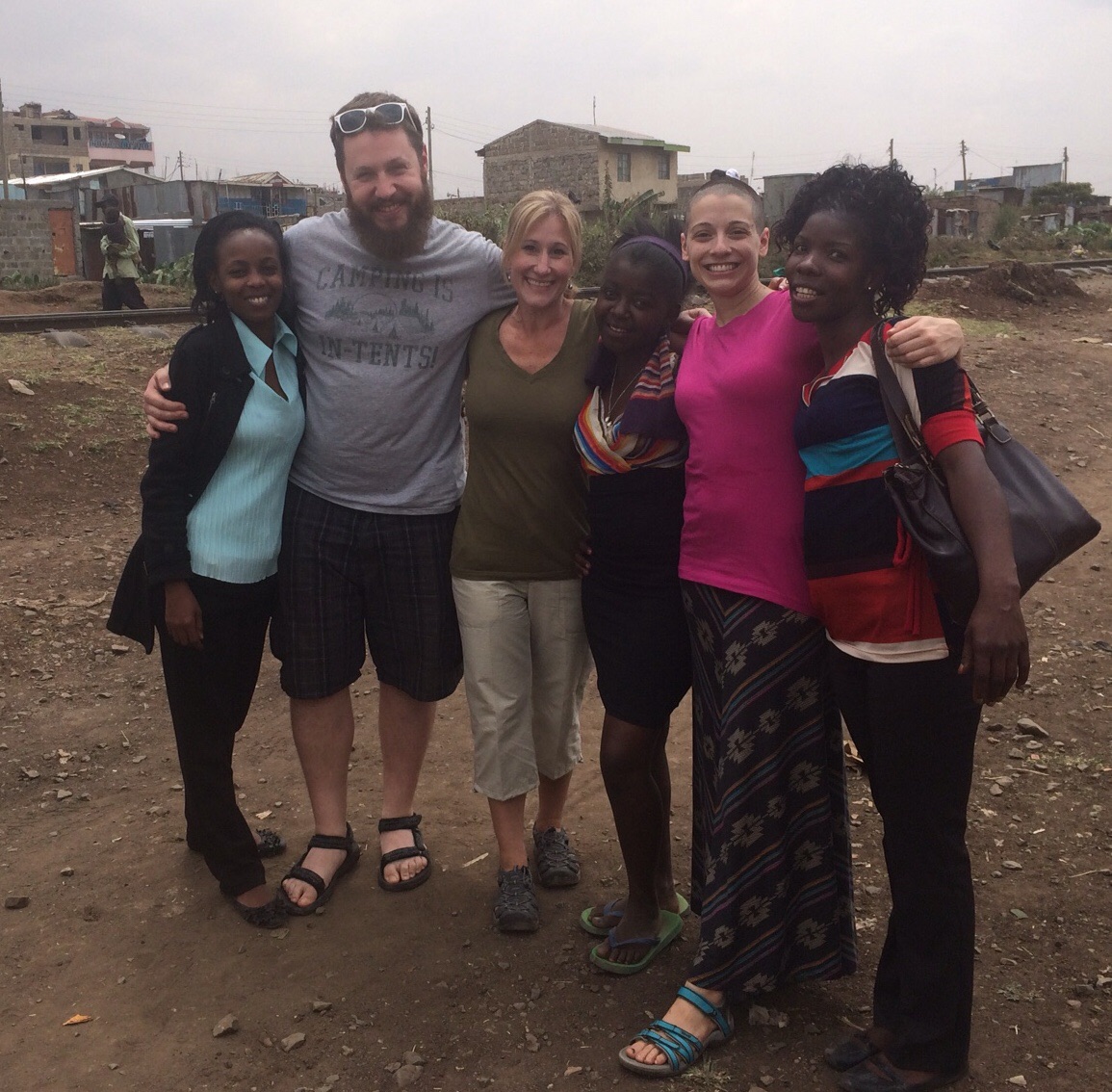
Home visting in Dandora
They talked about the hardships, but also the blessings in life, and shared humor and mutal family experiences. Then while the volunteers were engaged in talking with the grandaughter, her grandmother, in act of gratitude, and with severely limited resources, slipped out and returned having bought each vistor a bottle of soda, a real treat in Kenya. This is the Kenyan way that we have experienced again and again: having very little, but still being grateful, gracious, and wanting to share with others. We often feel that we are the ones being given to in so many ways, that the world becomes smaller although we have traveled long from halfway across the globe and that we are indeed all one family.
Winding down the trip…with good food, good fun and more!
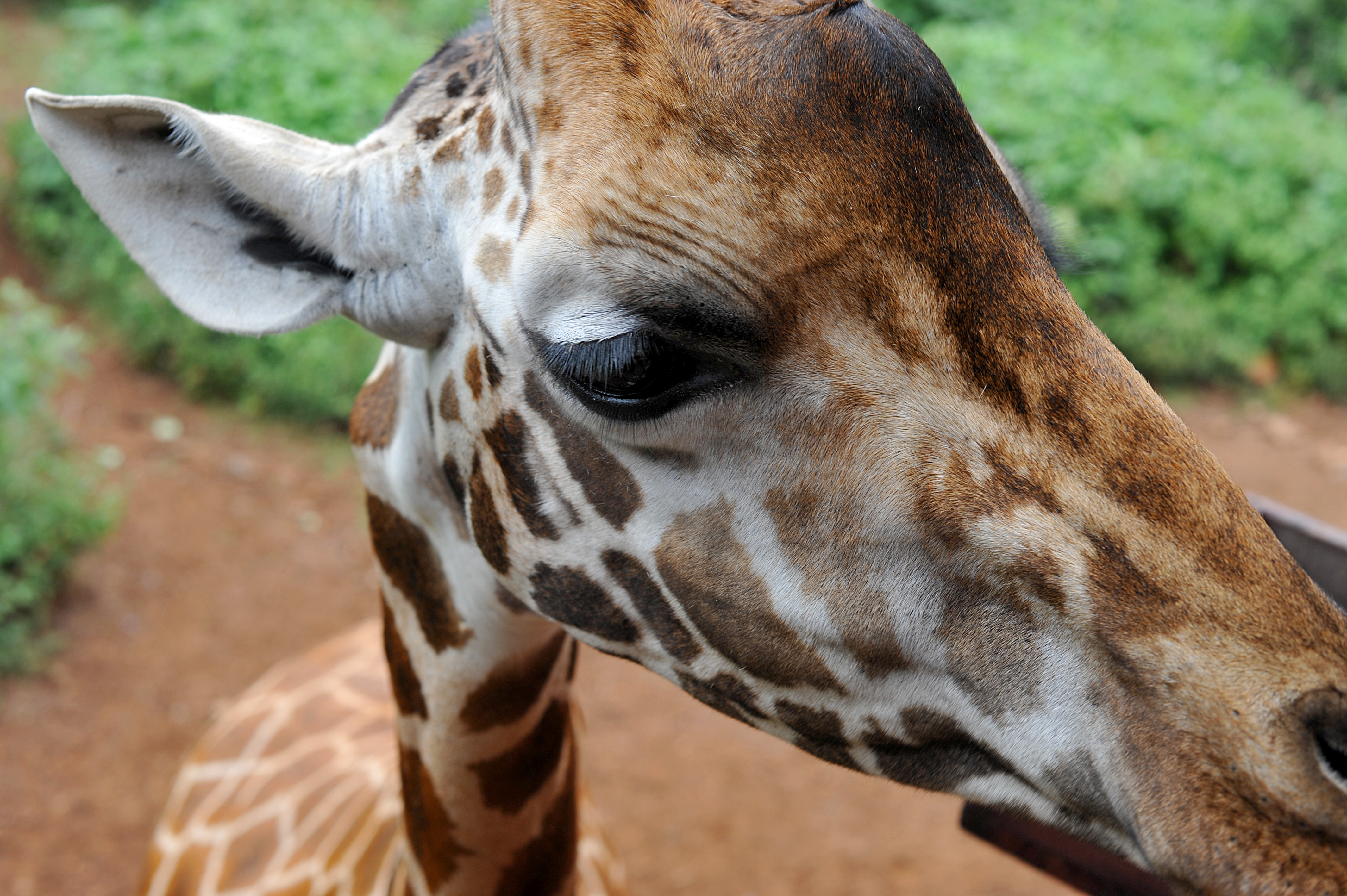
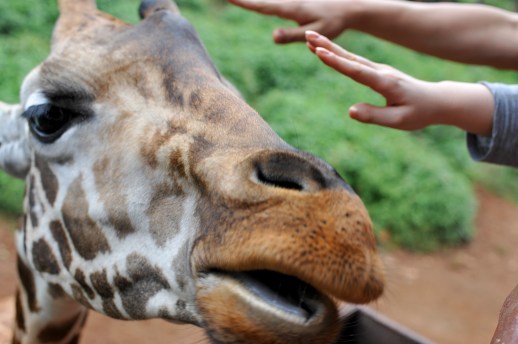
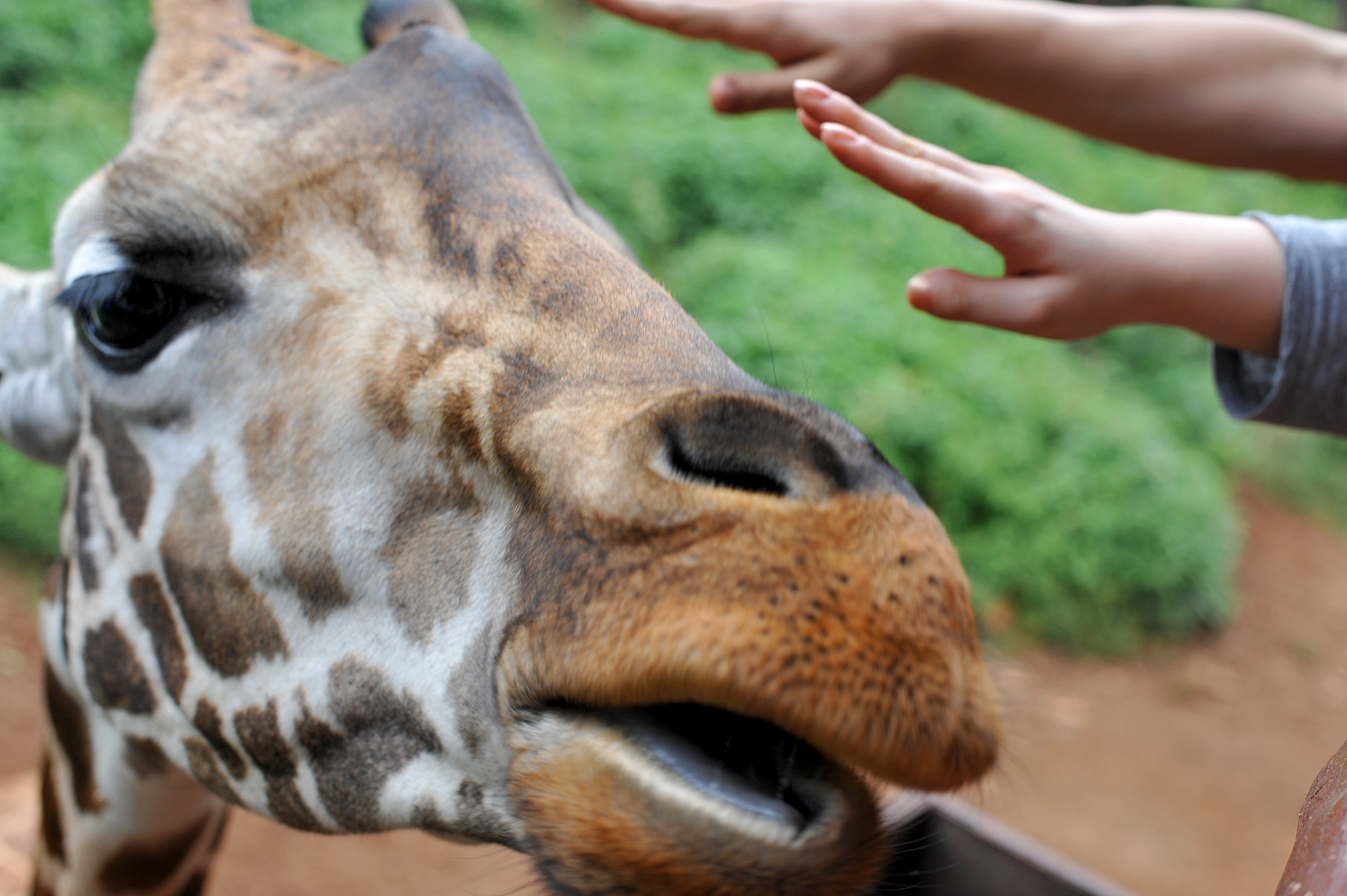
- Up close and personal….
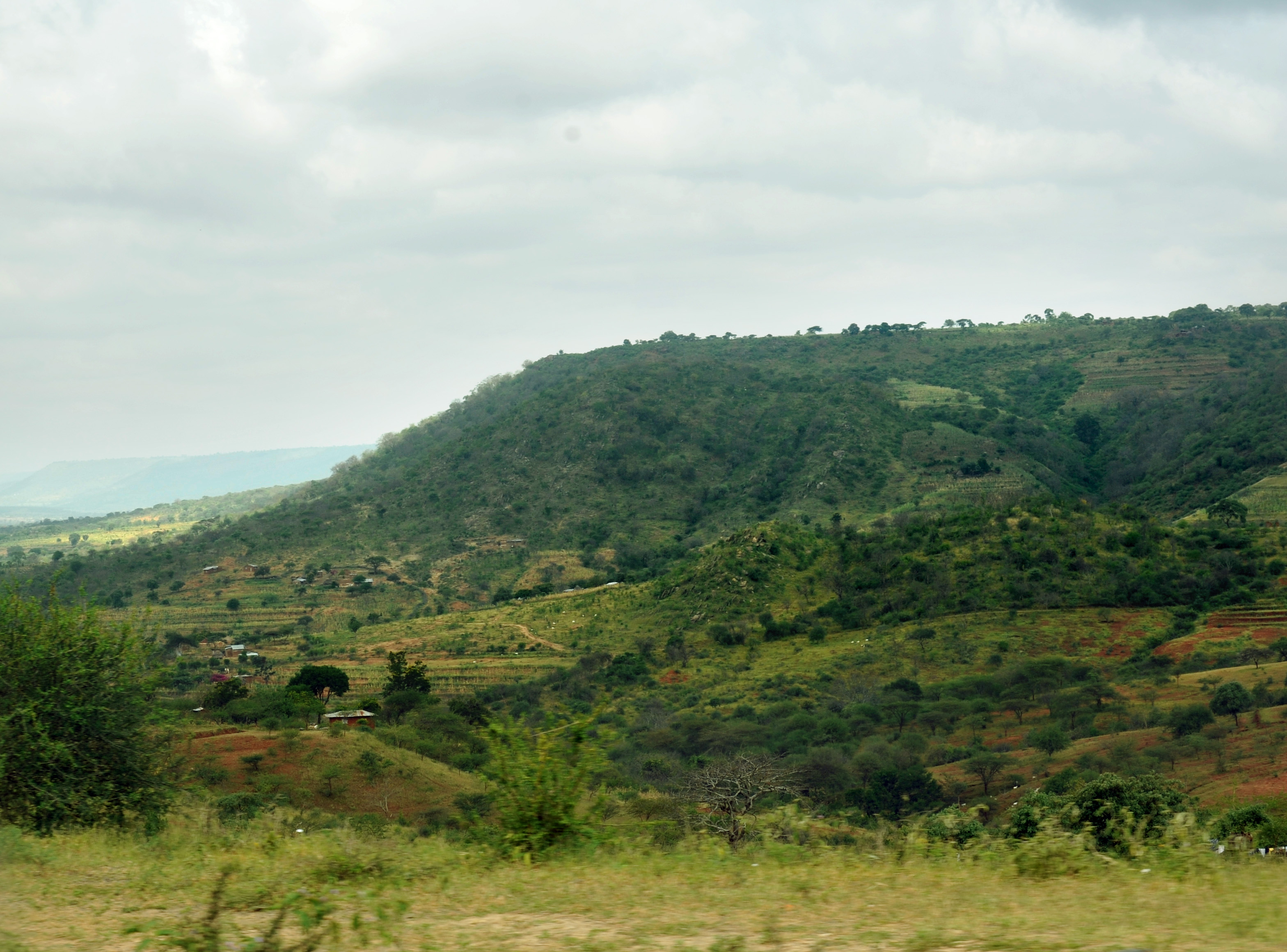
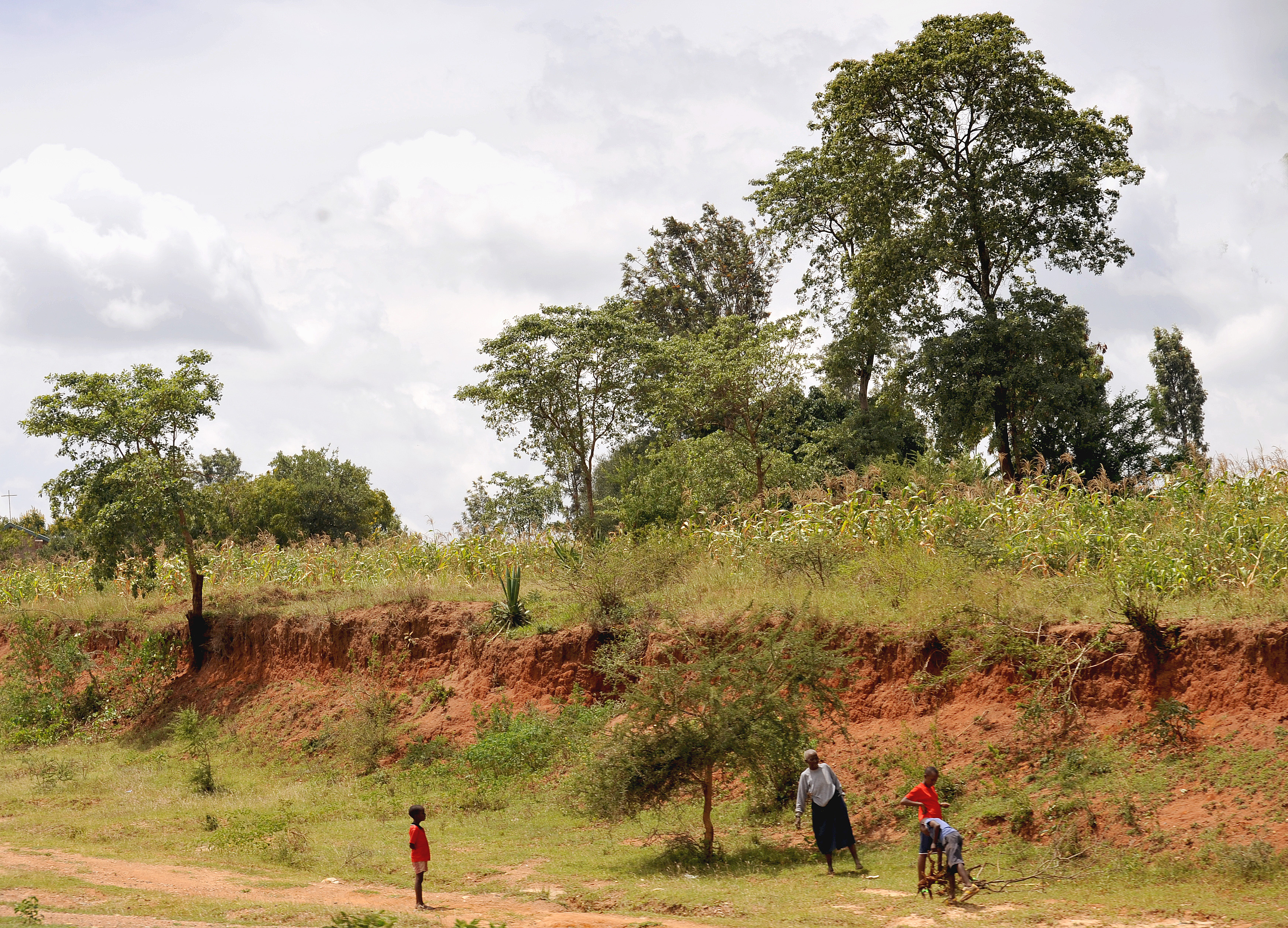
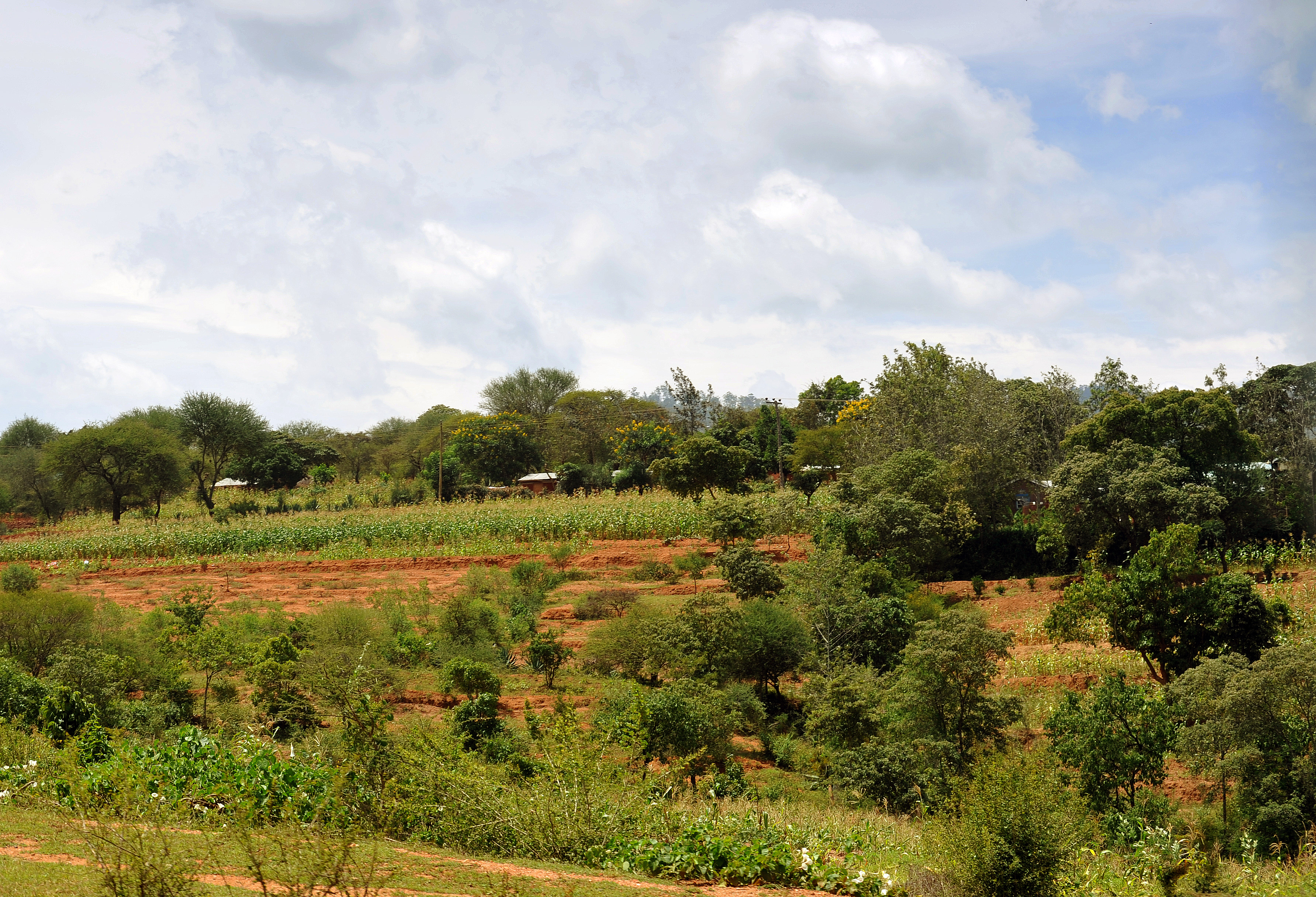
So I am home now but there is still a lot that I want to share about our trip. We worked very hard on the trip, in fact it became a running joke that the definition of free time was having 3 free hours with only 6 hours of work to do in them! I have to say that we accomplished an enormous amount and it all felt tremendous.We did however save a little time for fun and relaxation at the end. The drive back from Nyumbani Village was very scenic and enjoyable as we were once again able to see beautiful countryside with mountains and terraced gardens or just people carrying on with life in Kenya.
However, the best things that we did on the drive back from Nyumbani Village was to stop at Wamunyu Carvers and the Giraffe Park. We had stopped at the carvers last year and I think it will now become a regular tradition. It is a men’s cooperative of gifted carvers who make many things out of wood and are fascinating to watch since many of the tools they use are larger than the delicate animals they carve….and they all start with a log!
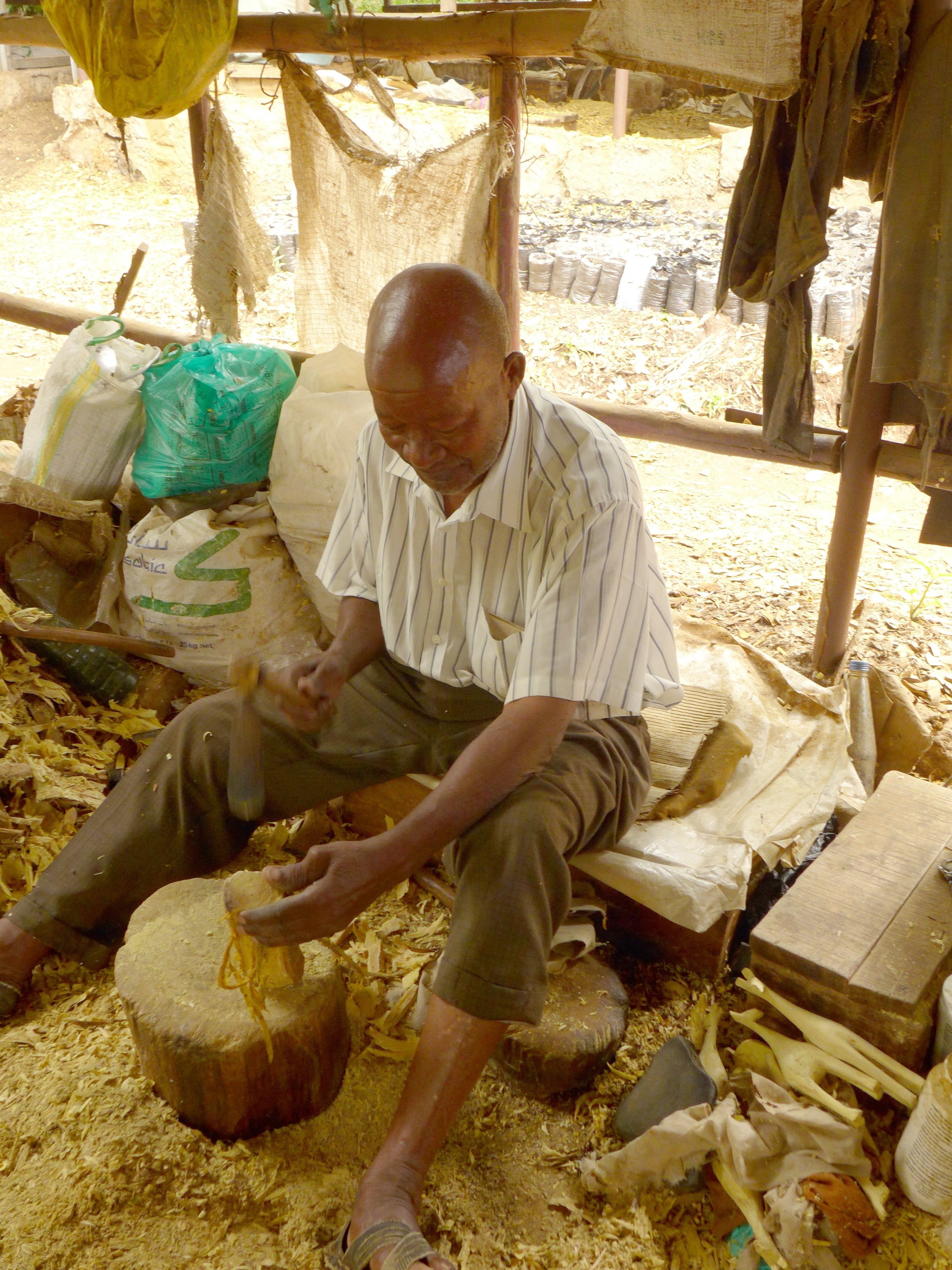
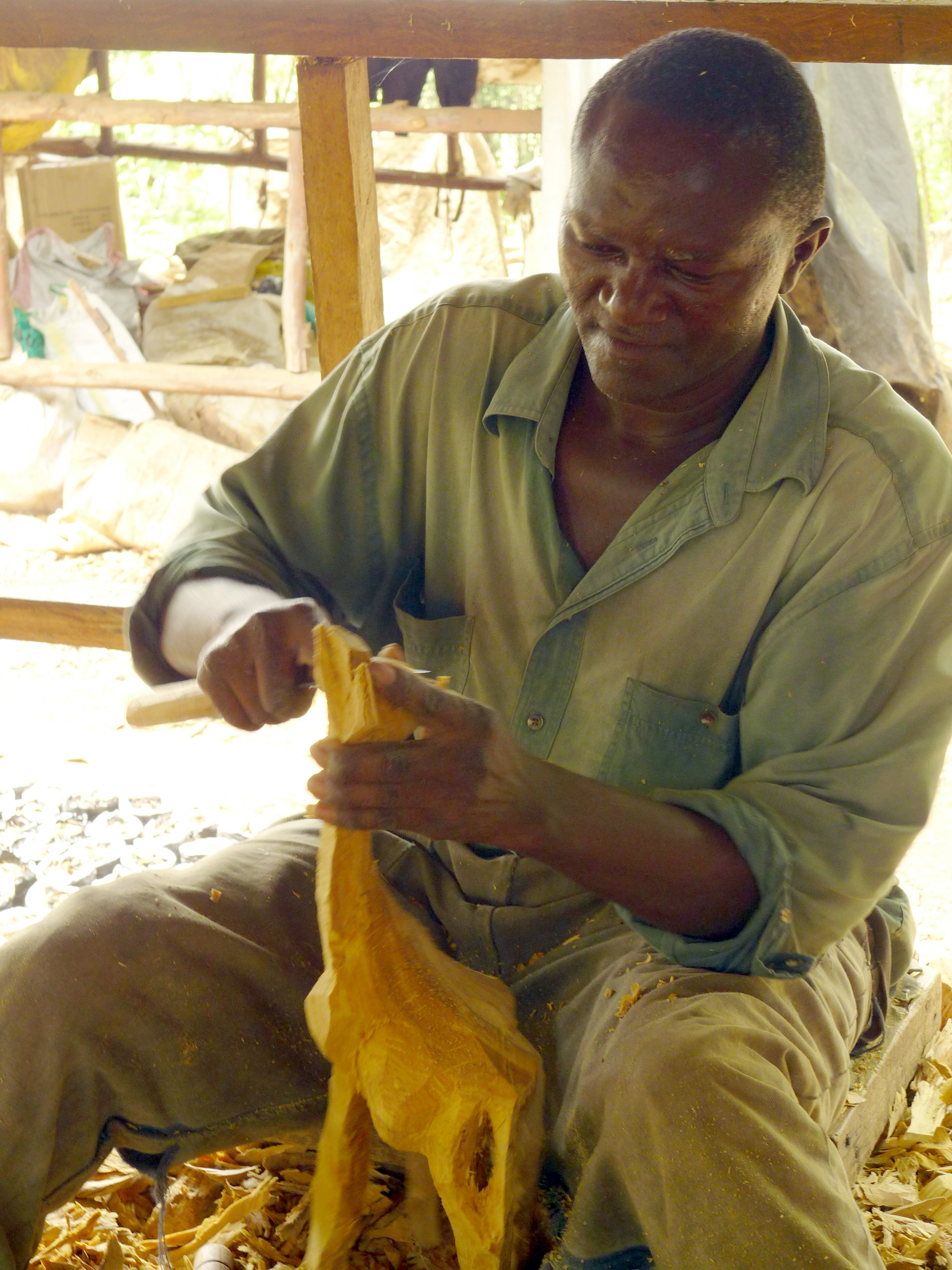
Working on a giraffe
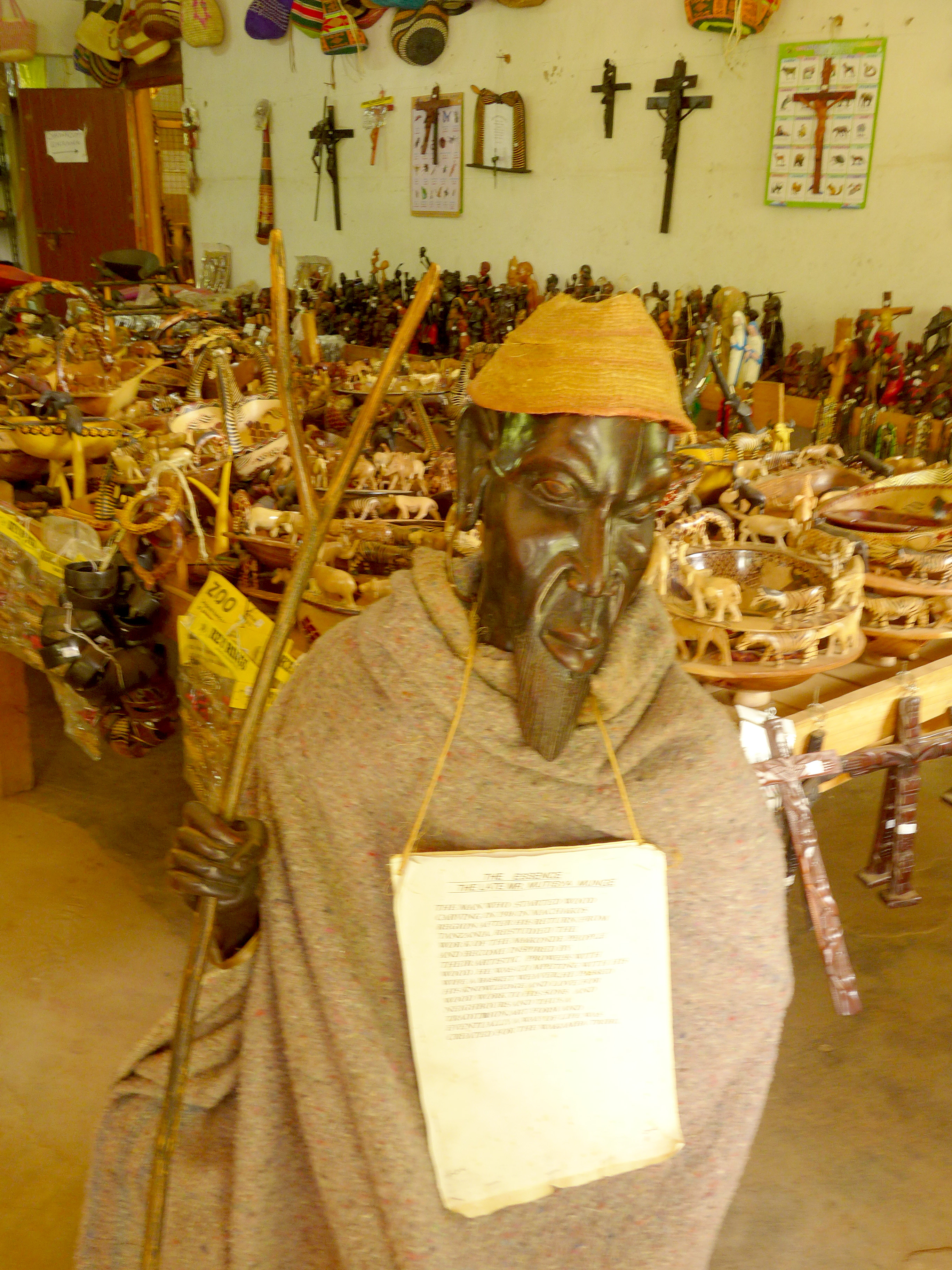
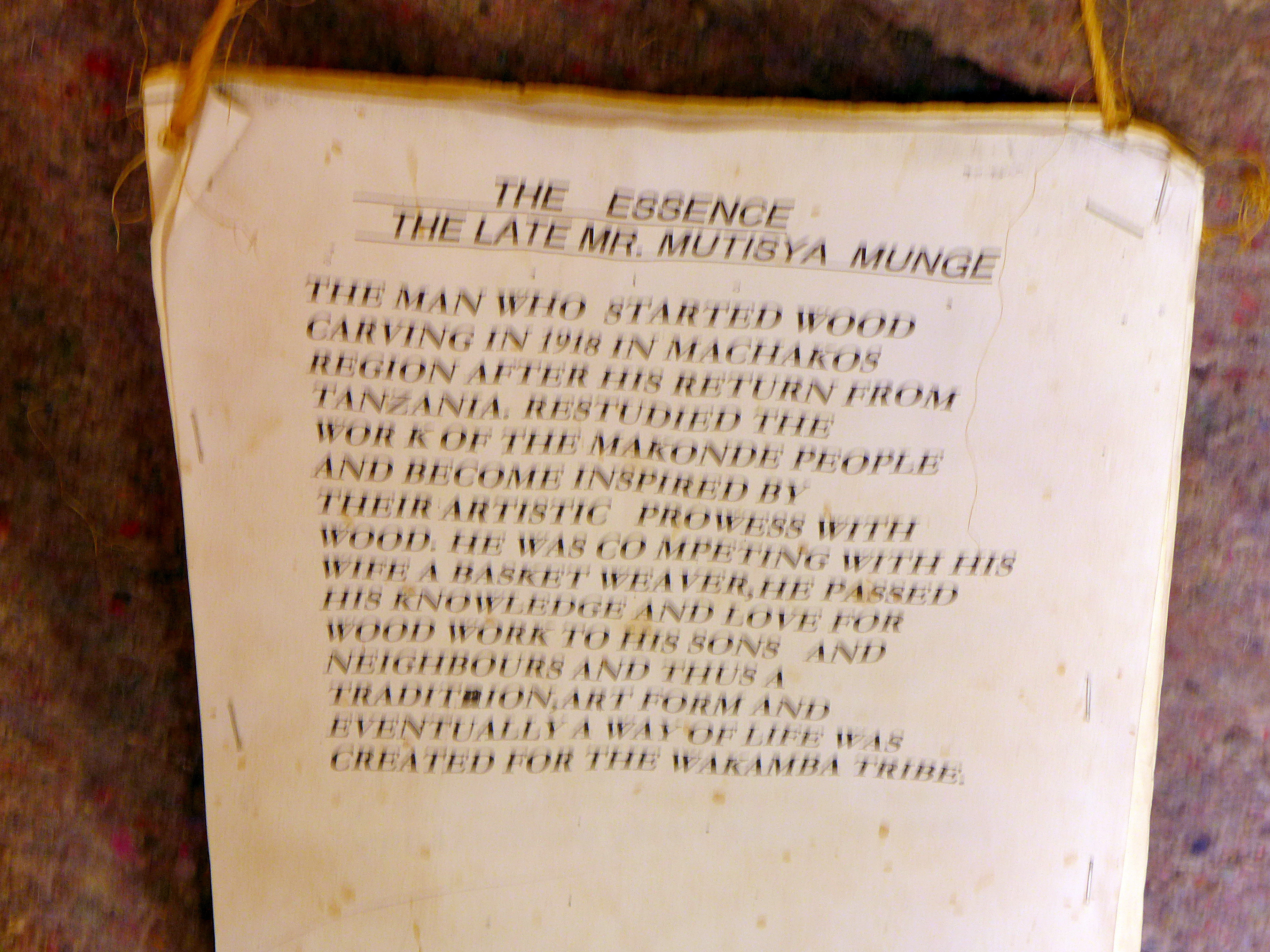
Story of Wamunyu Carvers
Not only do you get a tour and an opportunity to talk to the carvers, but you also get a chance to then shop from the huge store of hand carved wooden goods at far better prices than you will find anywhere else in Kenya. The only problem is deciding what to buy! Wamunyu carvers is not far from Nyumbani Village, but on the other end of the drive in Karen, just outside of Nairobi, is the Giraffe park where they rehabilitate rescued giraffes and are trying to raise more of the endangered Rothchild’s giraffes in captivity. Those are the species that look like they have on white knee socks. Before we could get to the giraffe park we hit the dreaded traffic pile up near Nairobi and it would have taken us about 3 hours to get through the city. So Justus our trusty driver and friend took us on one of his famous short cuts. This was the back way to avoid all the traffic and get what is affectionately known as a free “African Massage.” We had been on bumpy roads before (there are many in Kenya, but none quite like this one with holes capable of swallowing up half a car!) But it truly was a shortcut with a sense of humor and Justus was our hero once again.
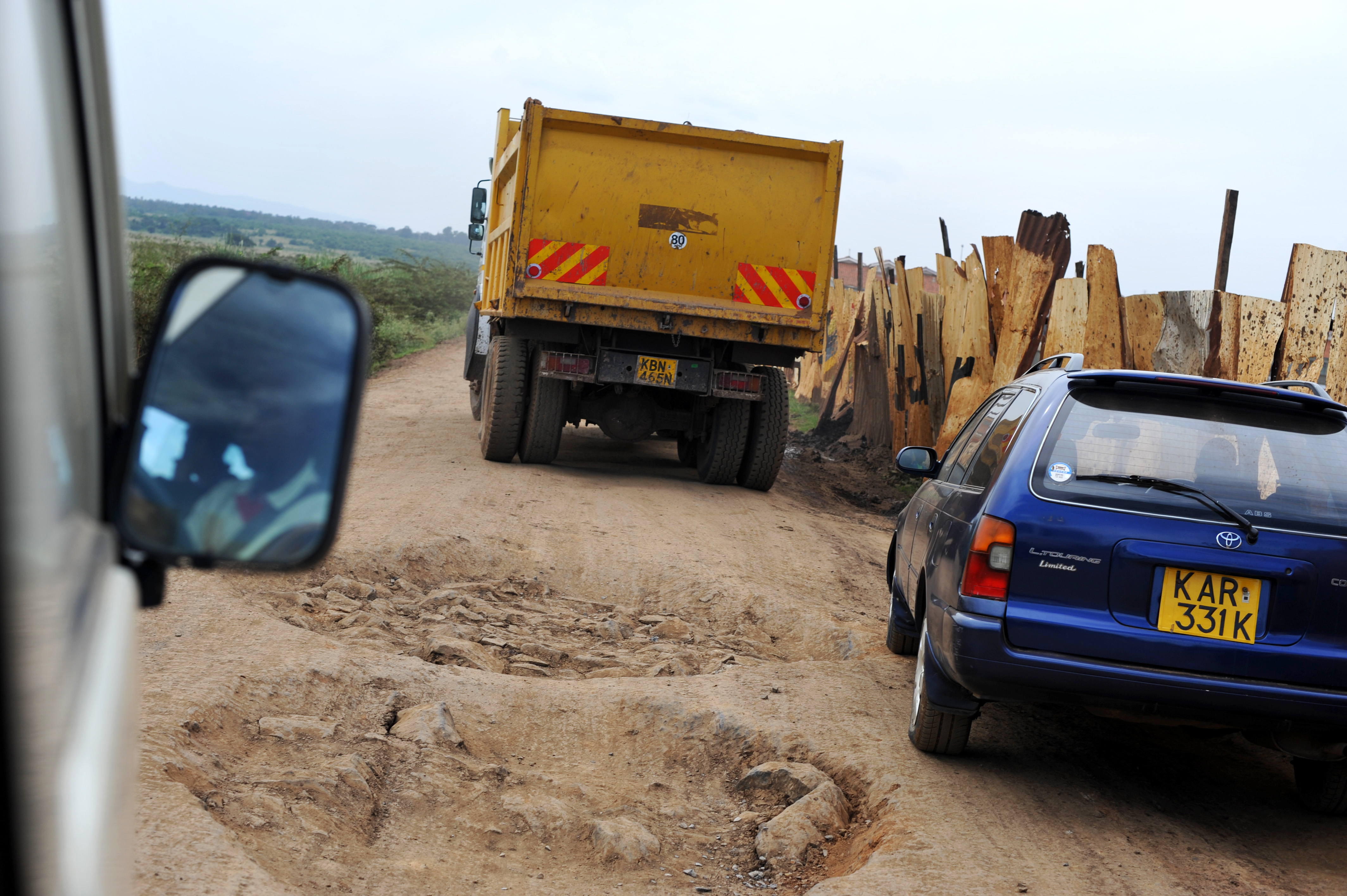
The short cut–this wasn’t the worst part, but a part I could hold the camera still enough to shoot
Once we got to the giraffe park the giraffes were being “called” by the park rangers into visit us and so that we could feed them. They weren’t anywhere in sight at first but they gradually made their way toward the gazebo like stand where we were all waiting with a crowd of other people.
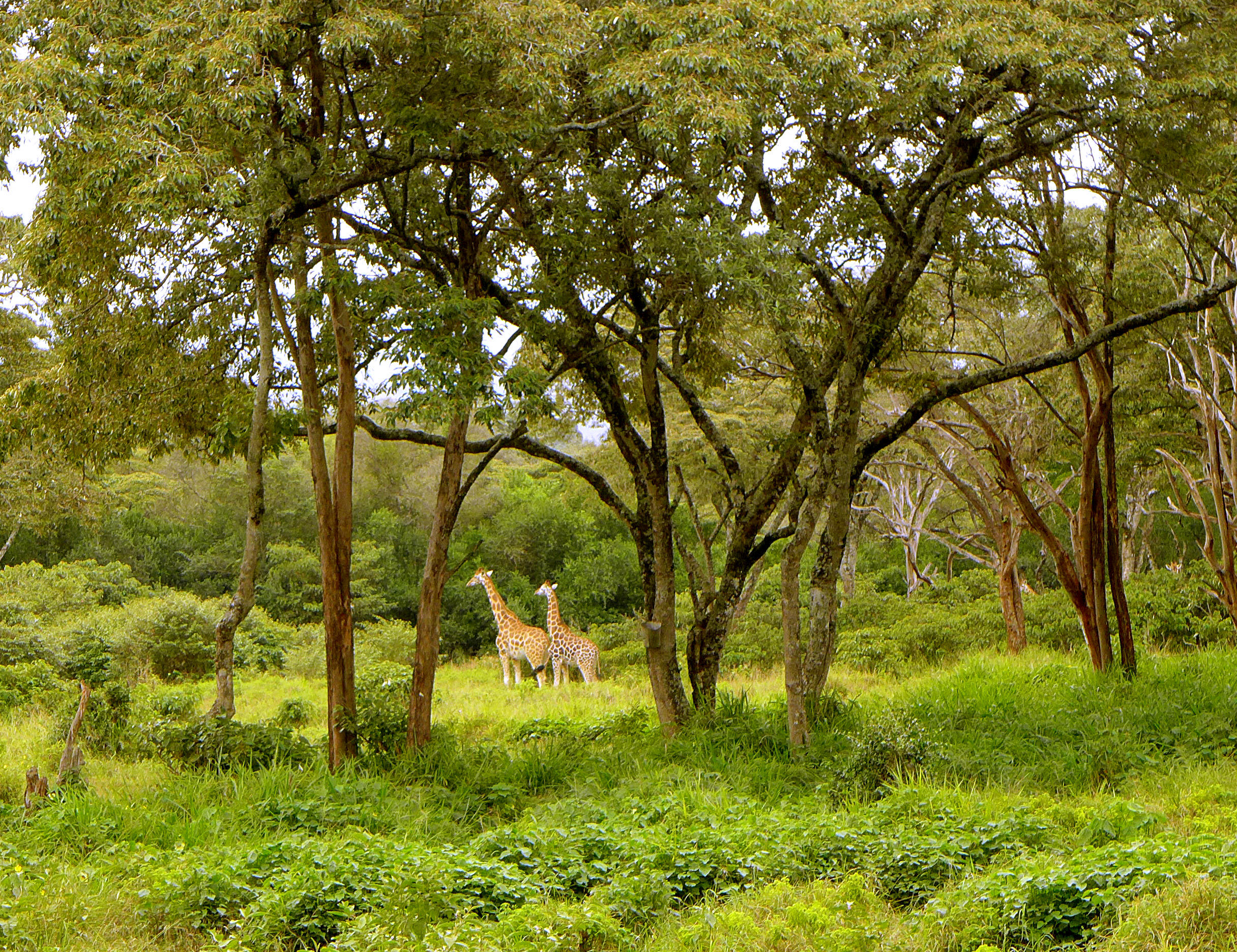
You can barely see them here…
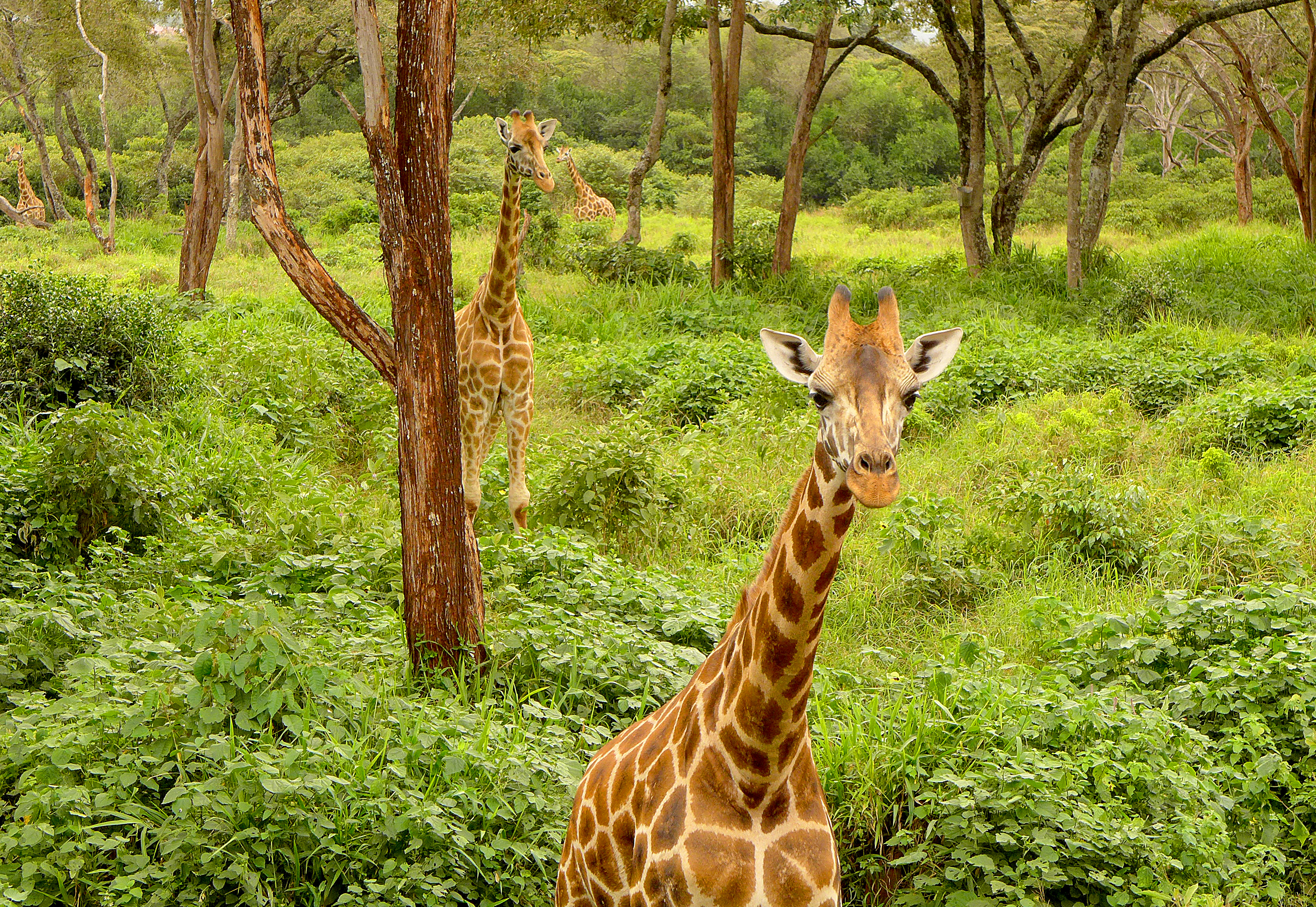
and then they got closer
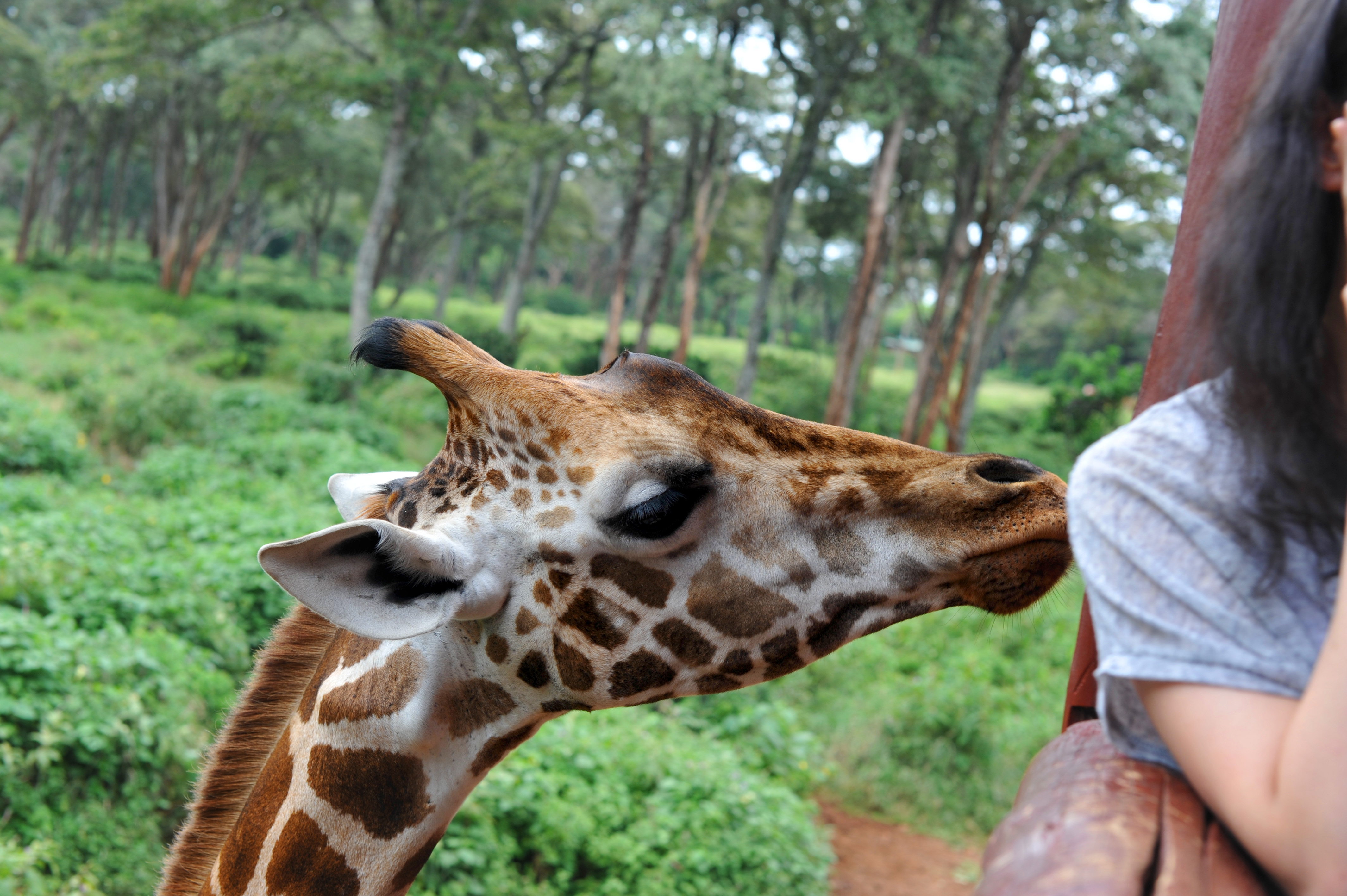
Then closer
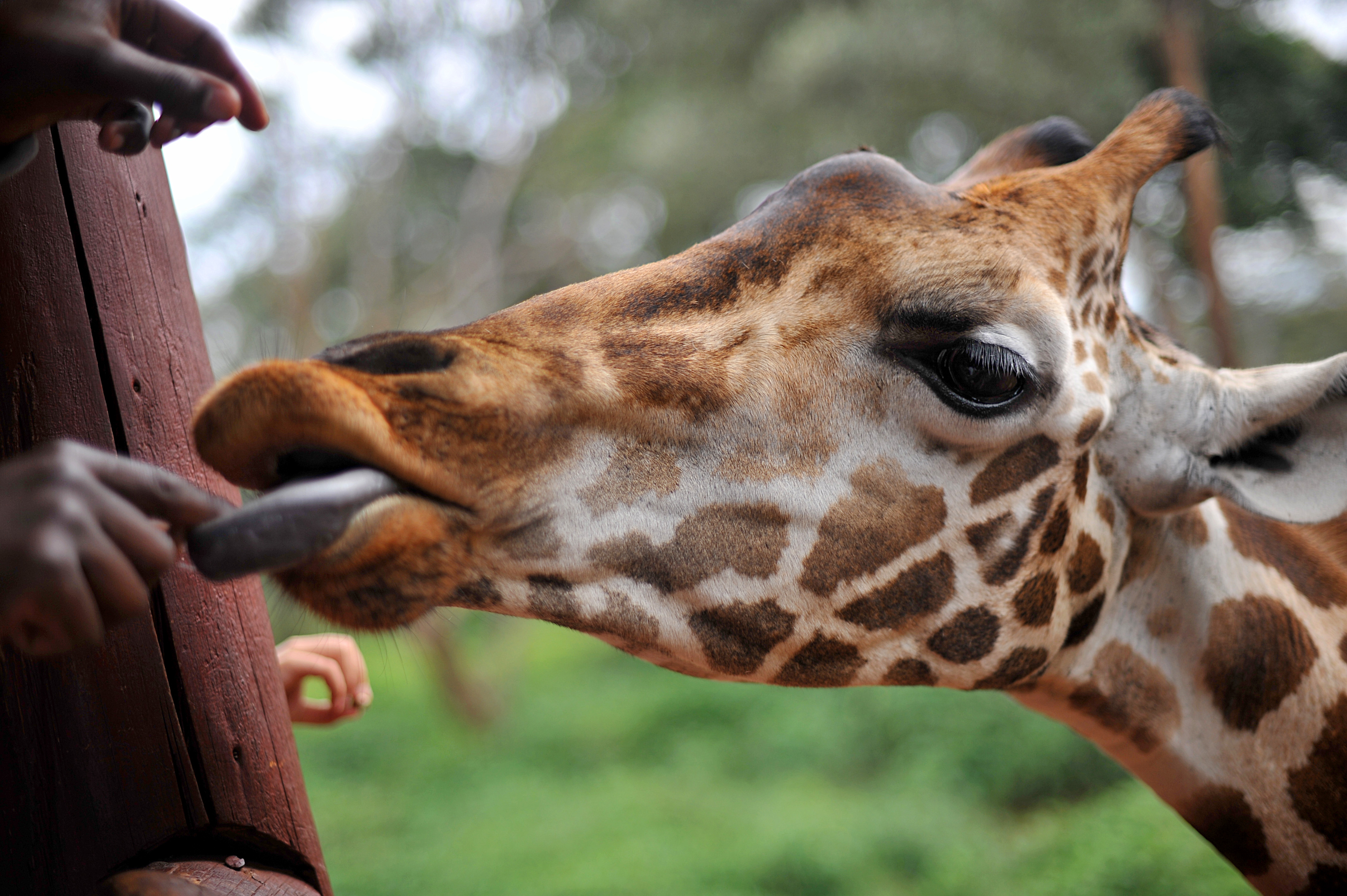
Then much closer!
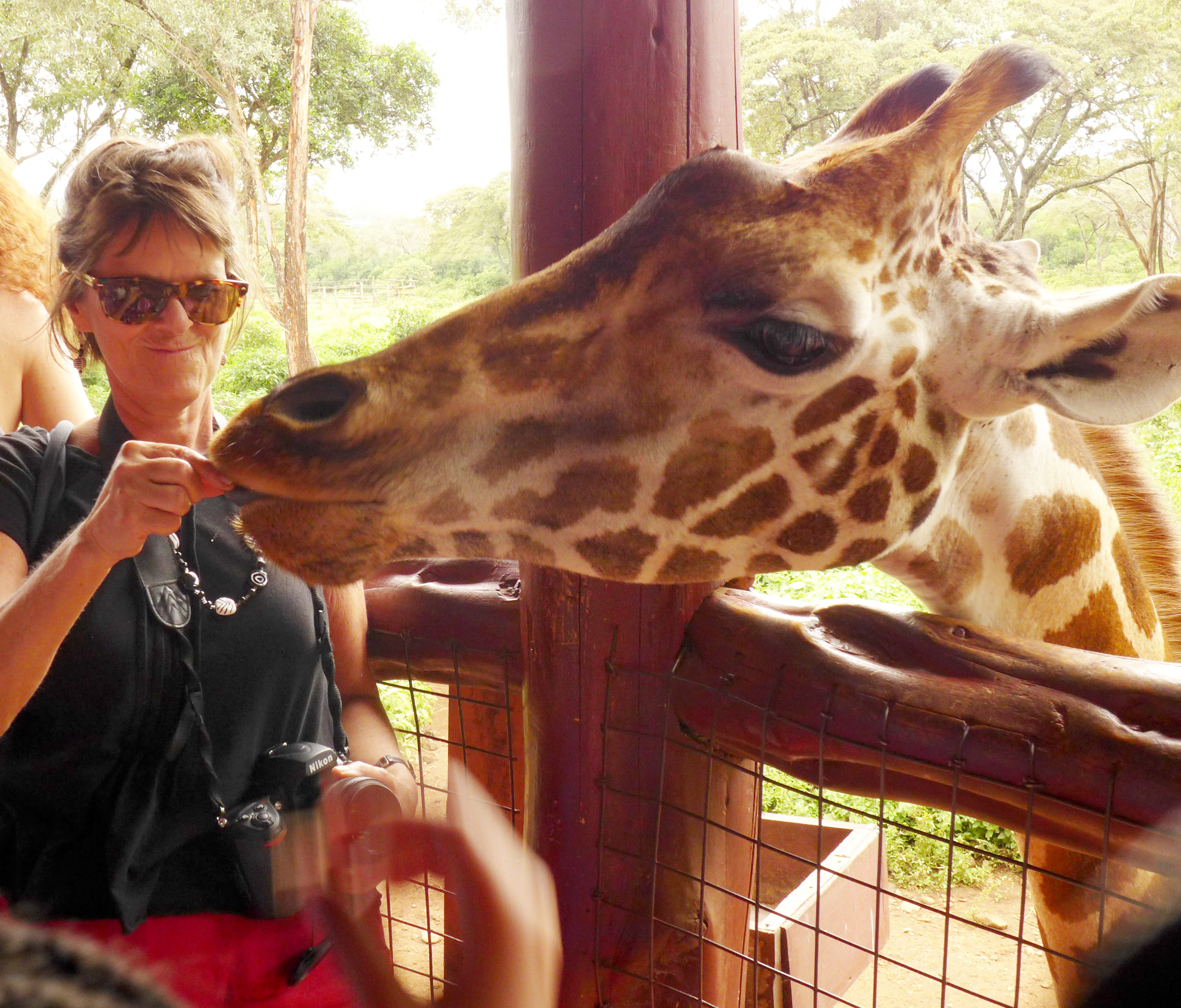
I even got to feed one!
They were not at all shy about getting close; many of us got to feed them and some people even got giraffe kisses! They are quite beautiful animals up close .
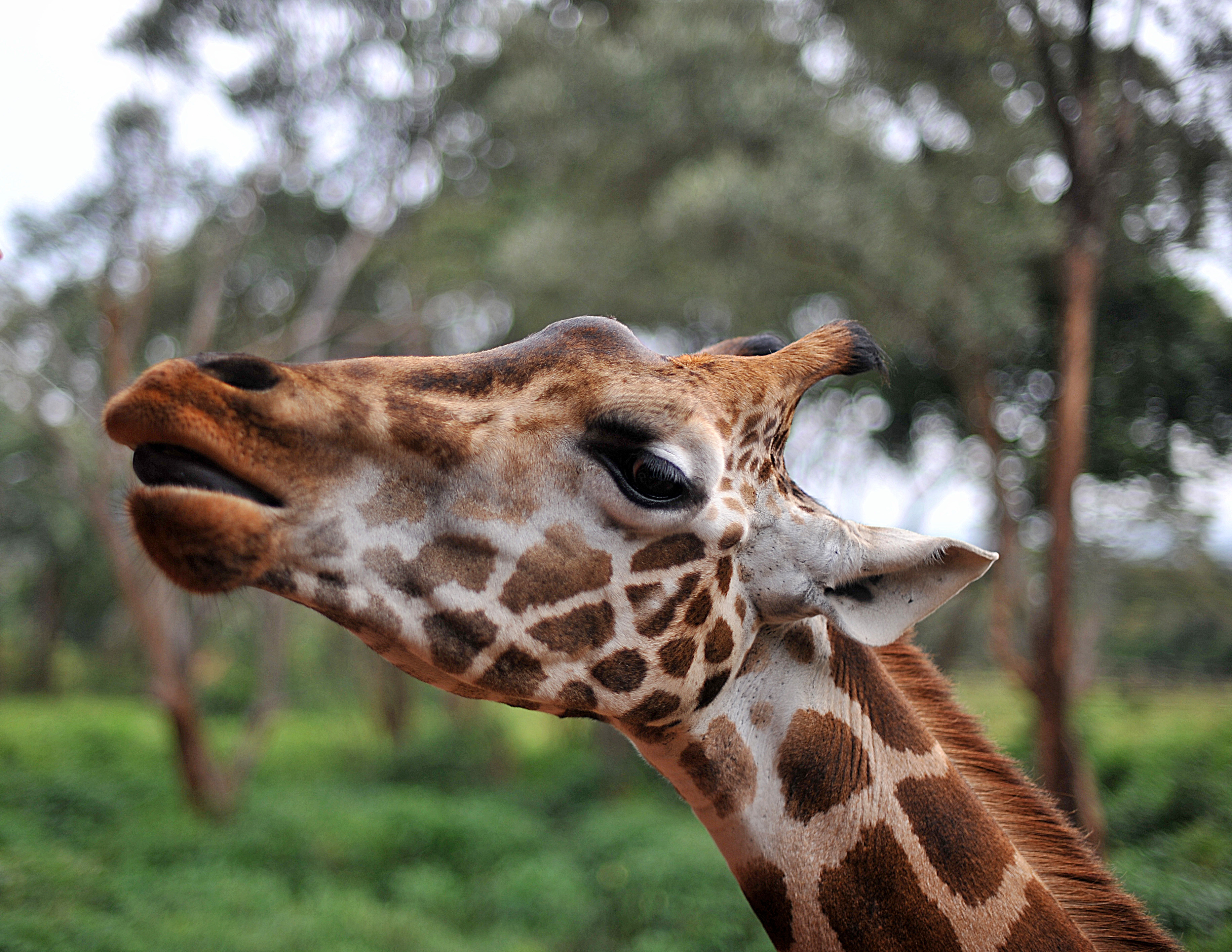
Beautiful animals!
This ended our fun on the way home from Nyumbani Village and everyone had first and foremost on their minds getting to the Spurwing guest house for the night where we knew we could take a long-awaited shower and would have something, anything other than Village food, for dinner. Having stayed in a cluster house with no electricity and no running water under hot conditions and having been running around in the red Kenyan soil for the week too, we were all feeling like a shower would be so heavenly. Having stayed at Spurwing in the past and knowing that they are good friends of Lloyd assured us of a great meal as well so we were in high spirits. We all emerged for dinner a little giddy with joy from being clean again. The following day we had on our agenda–packing–our personal things including all the things we had bought for souvenirs and gifts, finishing the distribution of donated items, and packing up the purchased Tuko Pamoja items to fly home with us all in duffels weighing less than but as close to 50 lbs as possible. We had another stop to make at the Children’s Home and I had a meeting with Lilian to debrief her about all the patients I had seen. We were however also scheduled to do something fun and relaxing that day by visiting the Kiambethu tea farm in Limuru, a wonderful place to learn about growing tea, see the gorgeous tea fields, drink tea, and have a delicious lunch of homemade food.
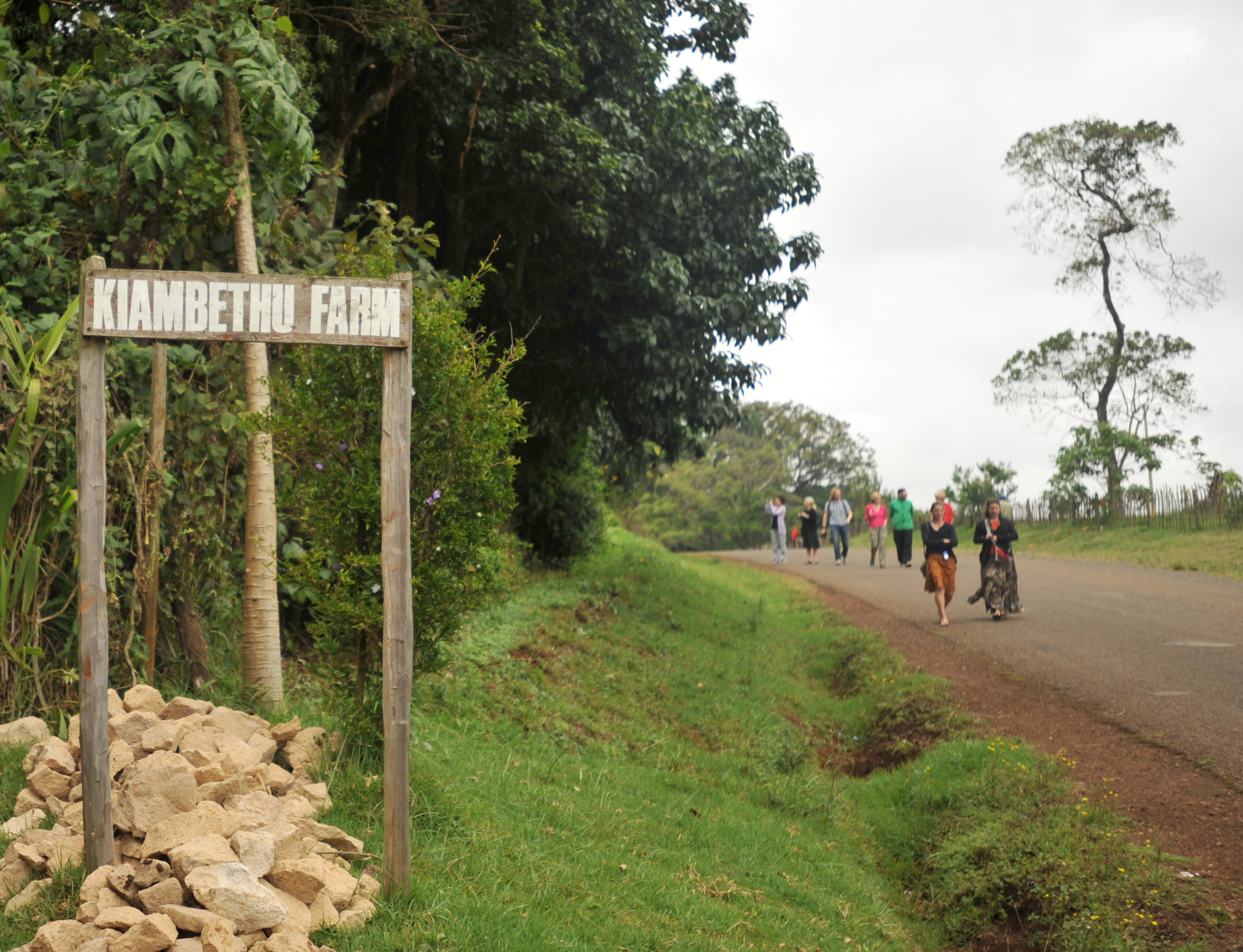
Entrance to the Kiambethu Tea Farm
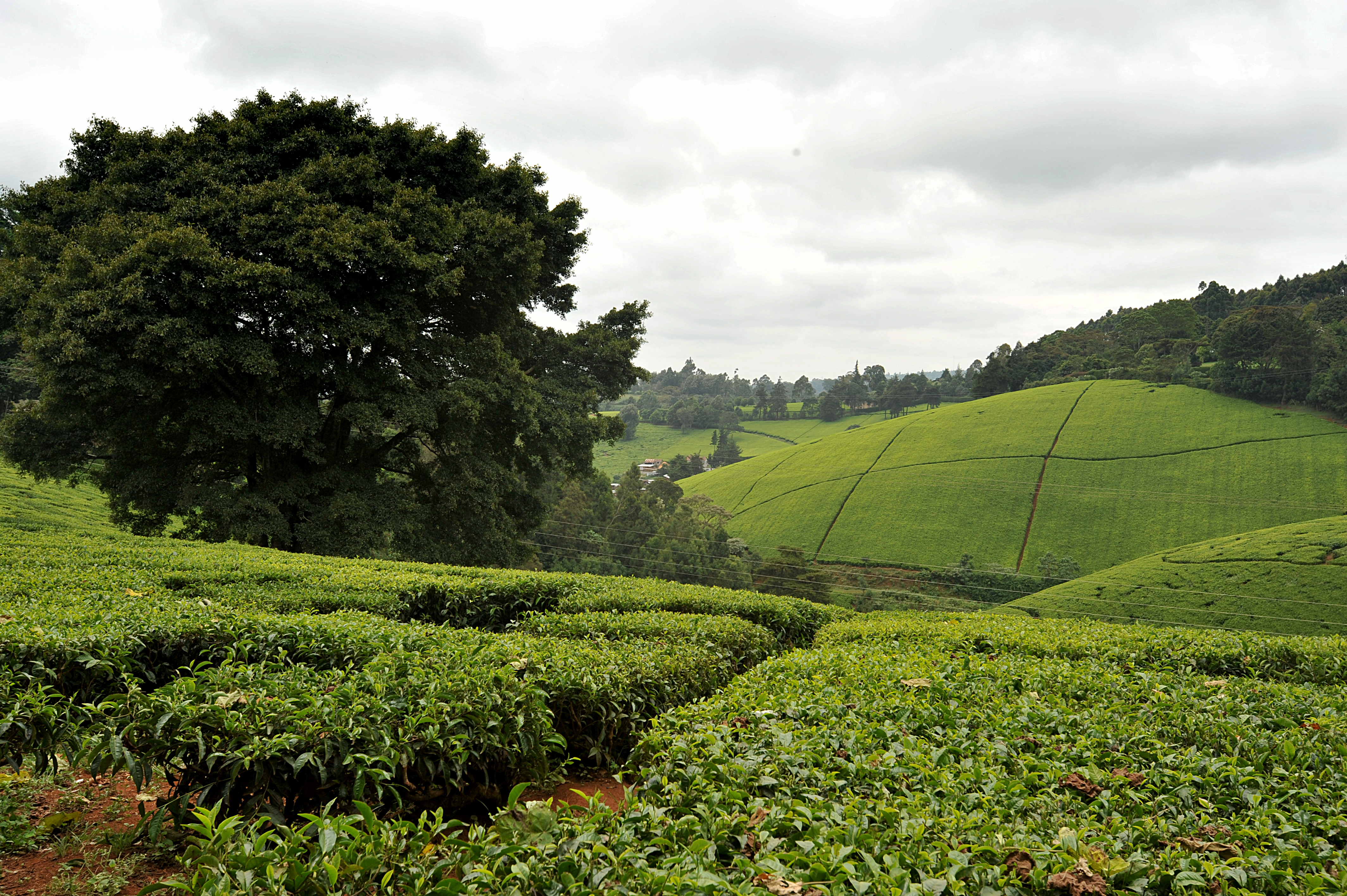
Tea Fields
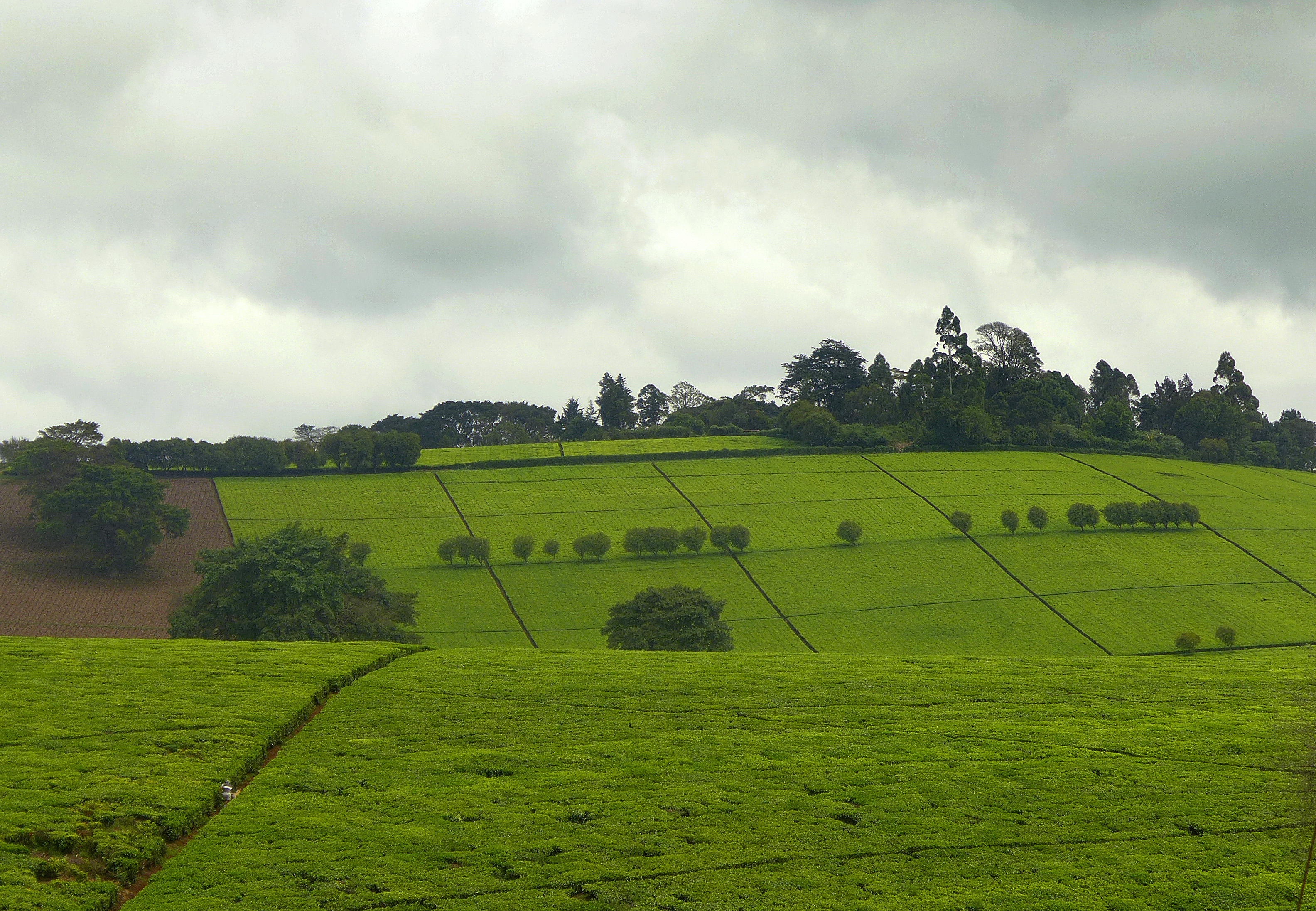
Perfectly sectioned tea fields
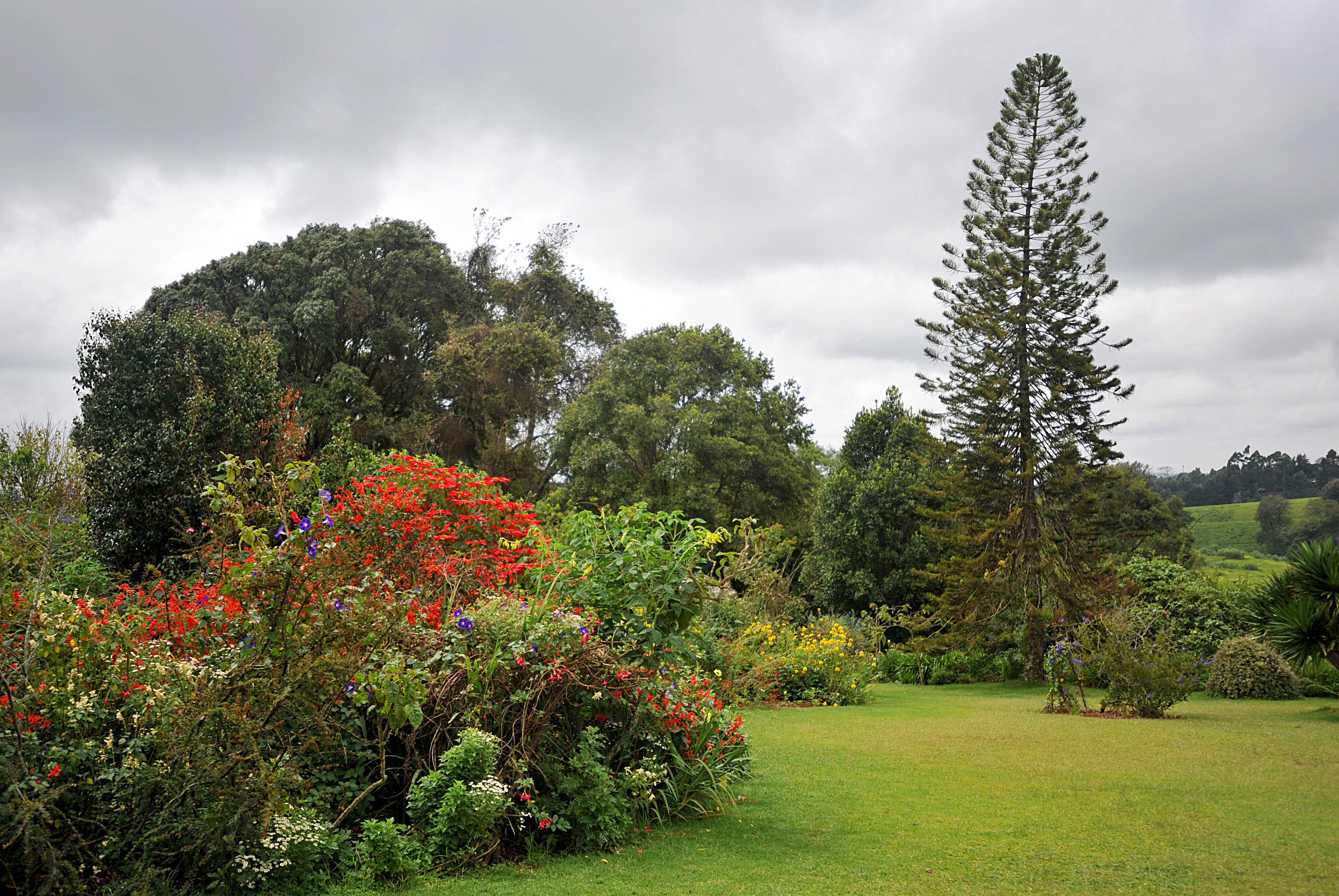
The garden at the Tea Farm
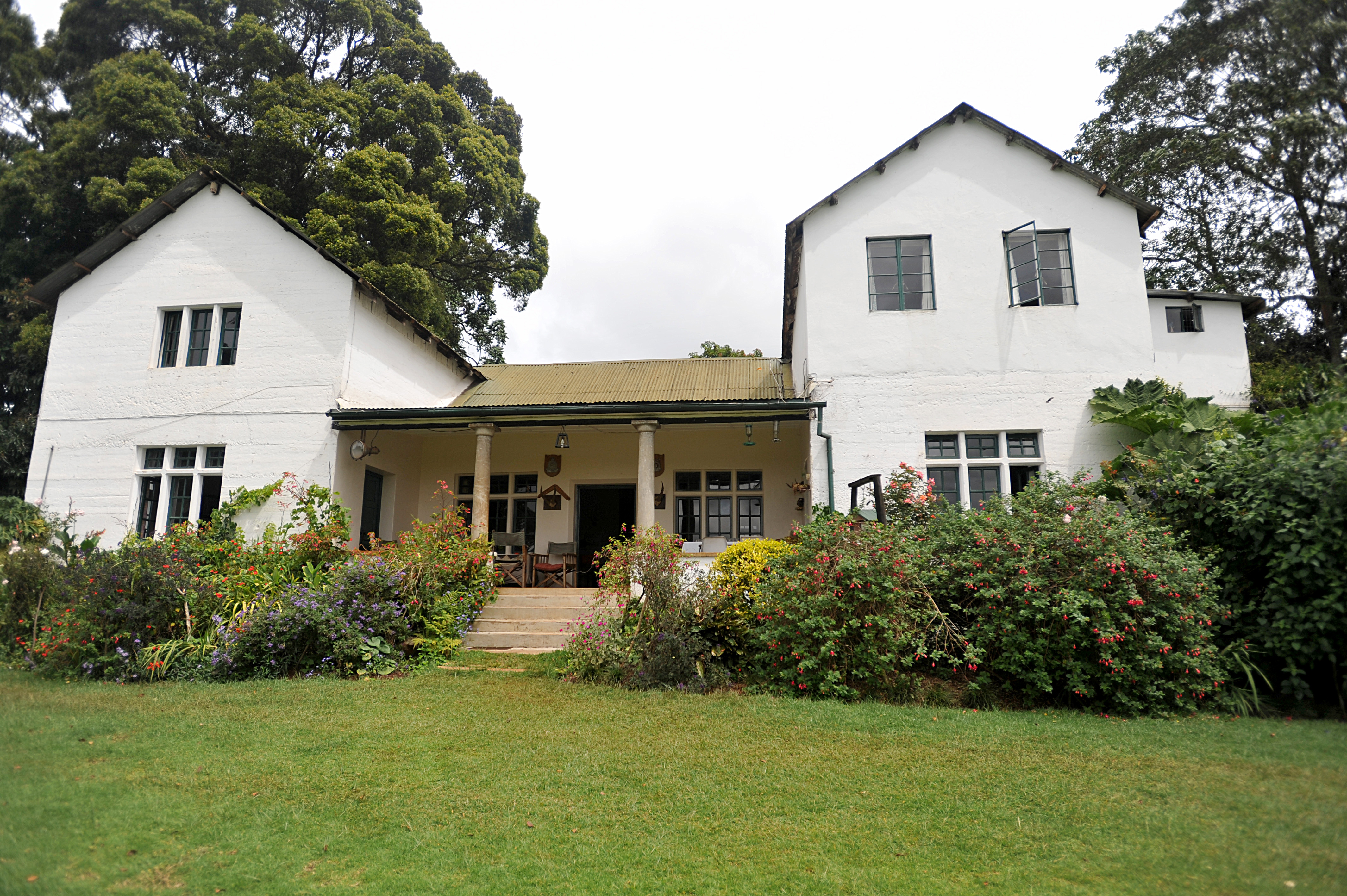
The house at the tea farm
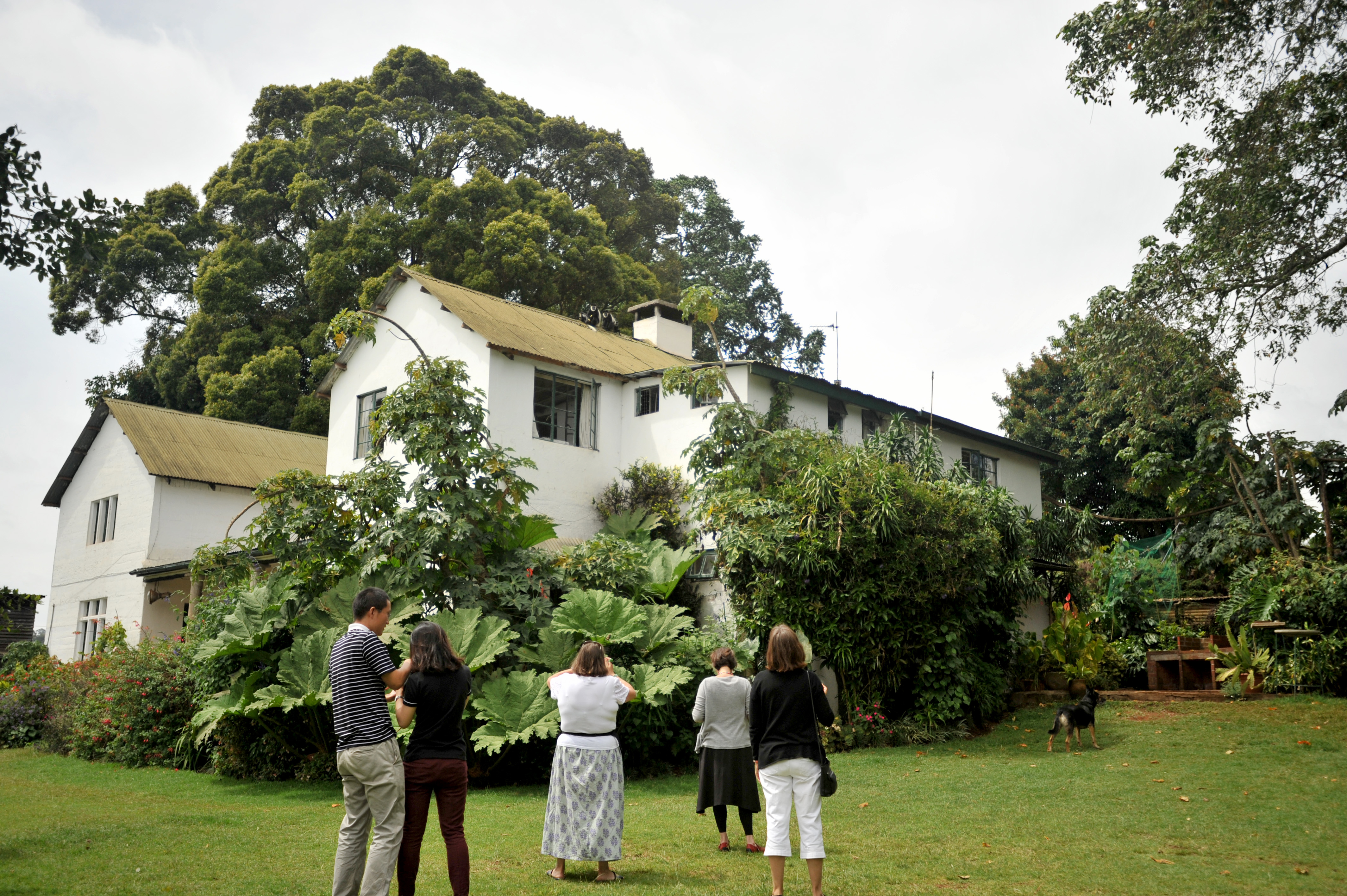
All of us being entertained by the Colobus monkeys on the roof
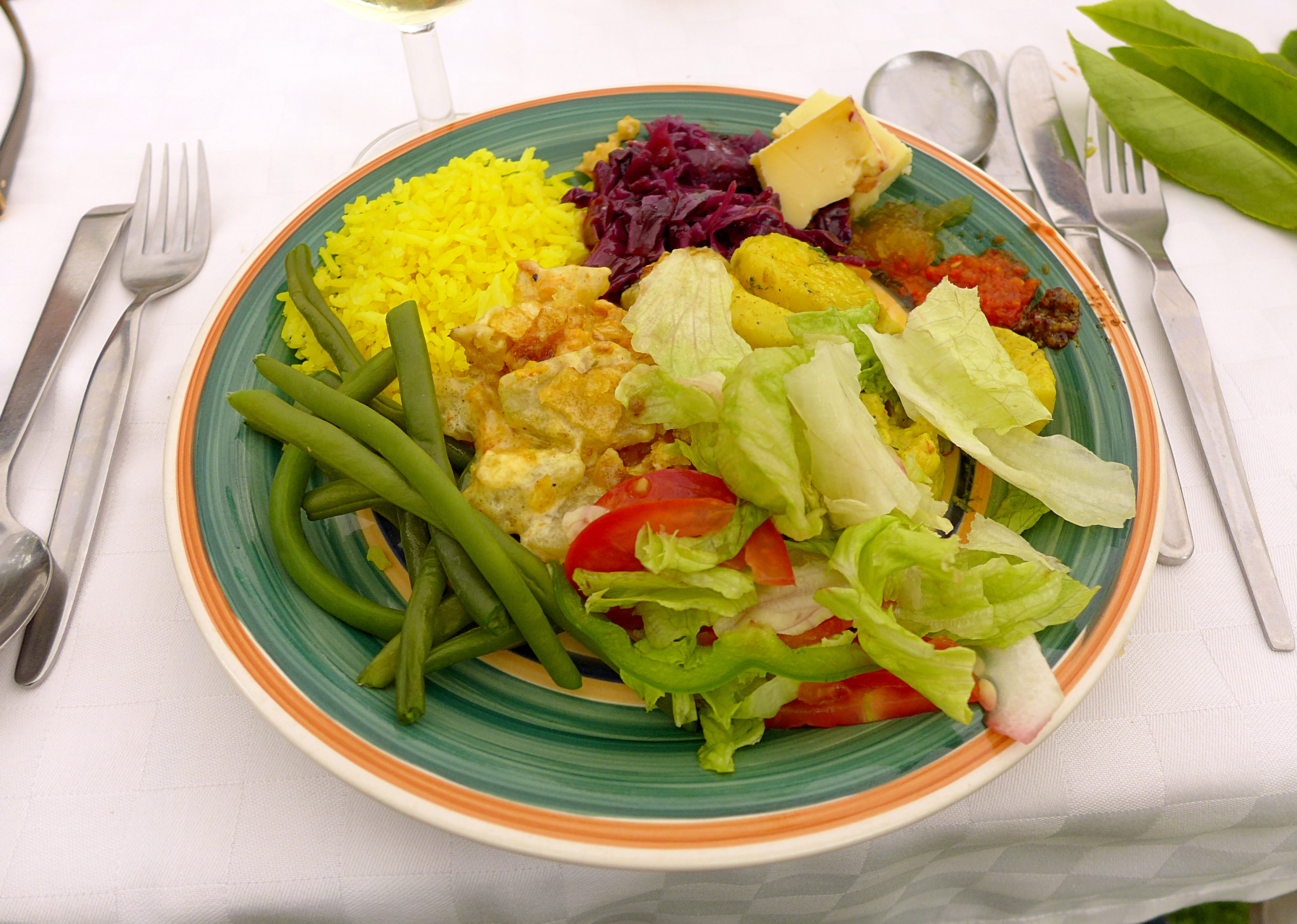
A very welcome lunch at the tea farm
Going to the Kiambethu Tea House is a lovely relaxing experience. Fiona, the owner, gives a talk on the history of the farm and the history of tea growing in Kenya which is the largest exporter of tea in the world. Upon first arrival there are tea and biscuits on the veranda to go with her talk about how tea is grown and processed. Then there is a walk through the neighboring deciduous woods followed by juice wine or cocktails before lunch. Lunch is served outside on the lawn and is wonderful and homemade with lots of fresh garden vegetables especially enjoyable for us vegetarian types. And for dessert ice cream made from milk from the cows they refer to as the “ice cream makers”. And the delicious tea that we were served can also be purchased at a steal to take home.
After the tea farm we went back to finish up a few more things as most of us, all but Lloydie and Deb, would be departing that night. I had made arrangements to meet with Lilian at the Children’s Home for debriefing and still had one very important delivery to do there as well. I had to deliver a letter and more importantly hugs to Hannah from her sponsors Emma and Marie back in my home town. And then, of course it was irresistible to visit the other children who we hadn’t seen since last weekend even if we were interrupting their dinner–we just couldn’t help ourselves!
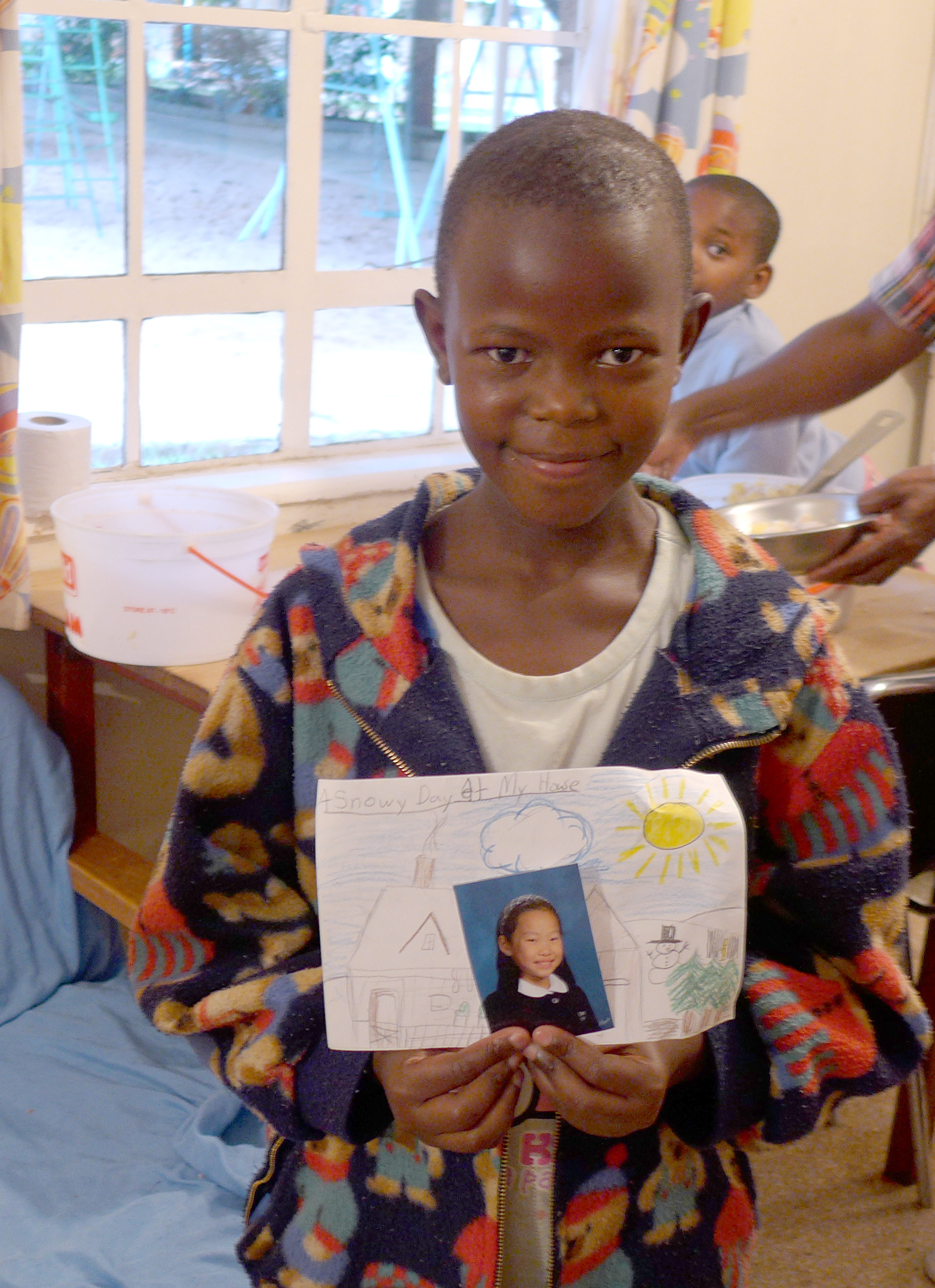
Hannah with a letter and picture from Emma
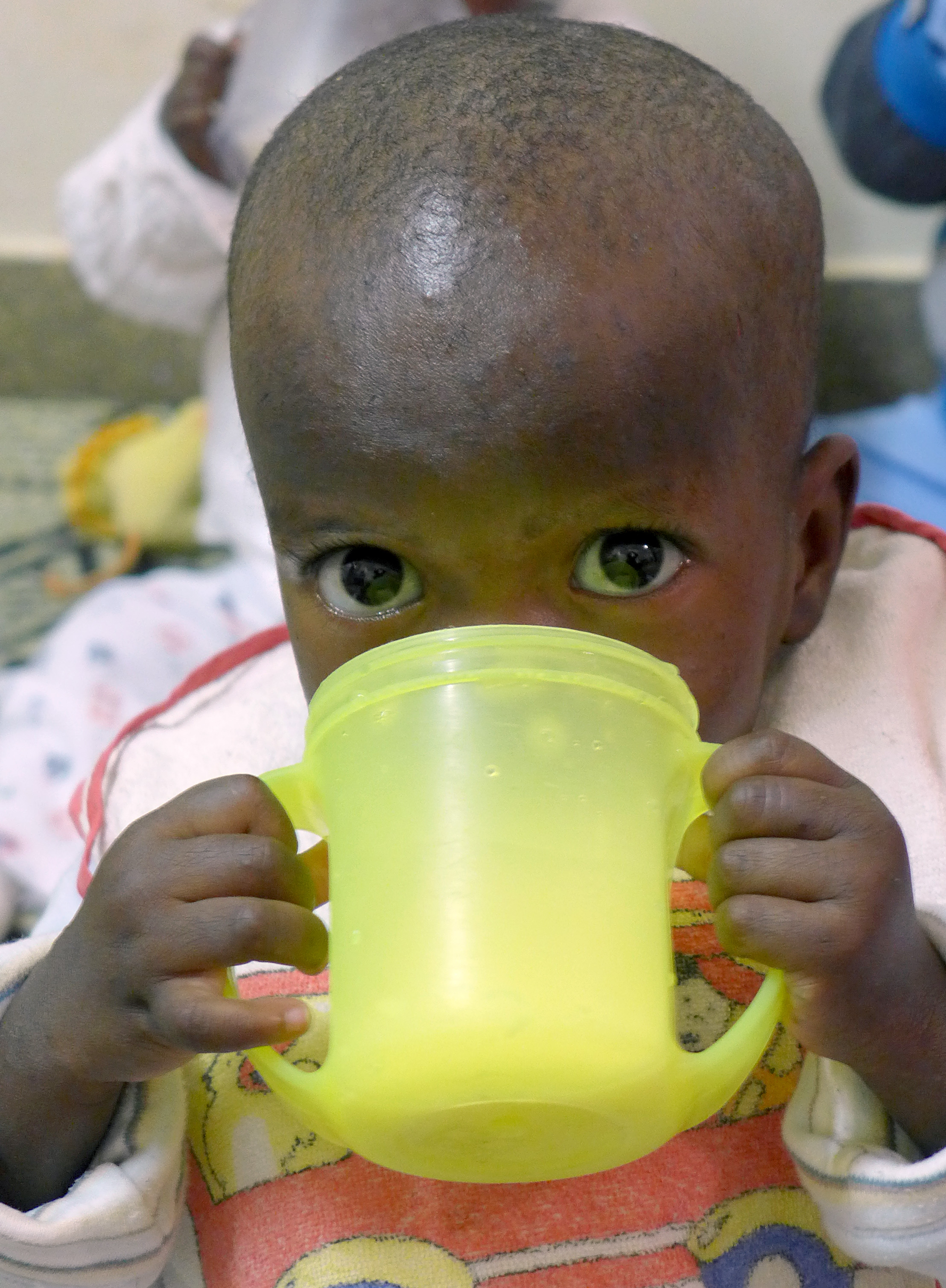
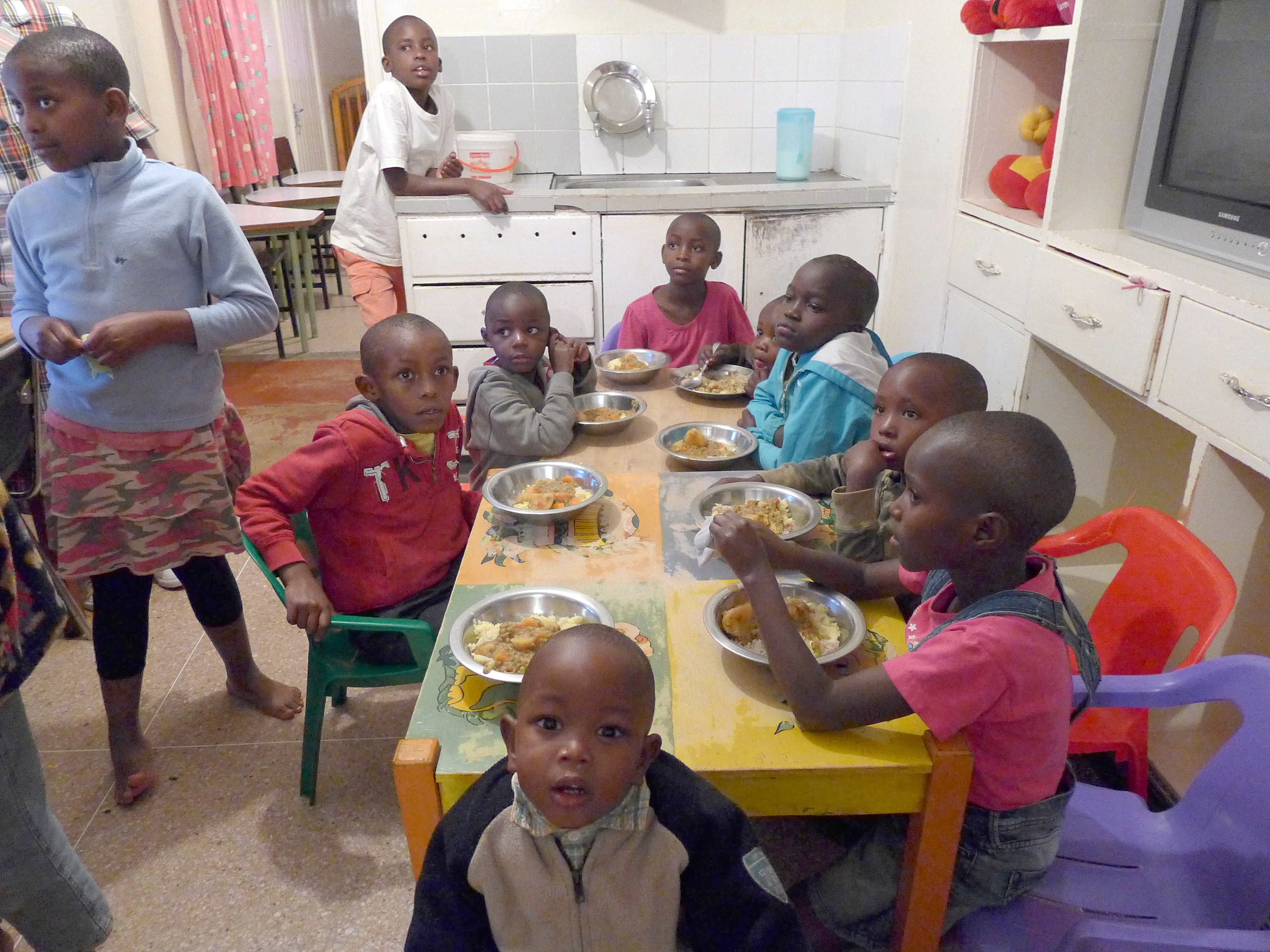
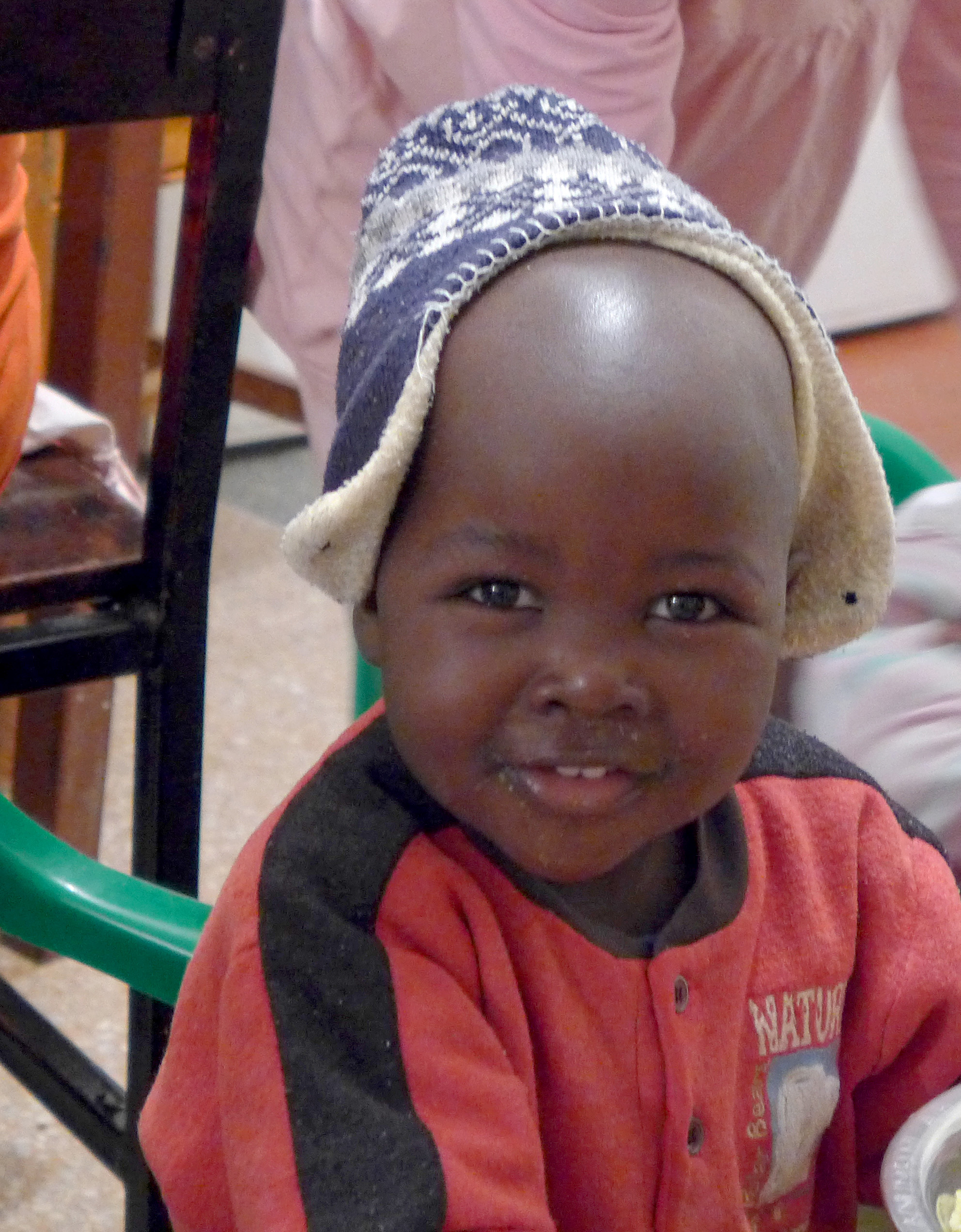
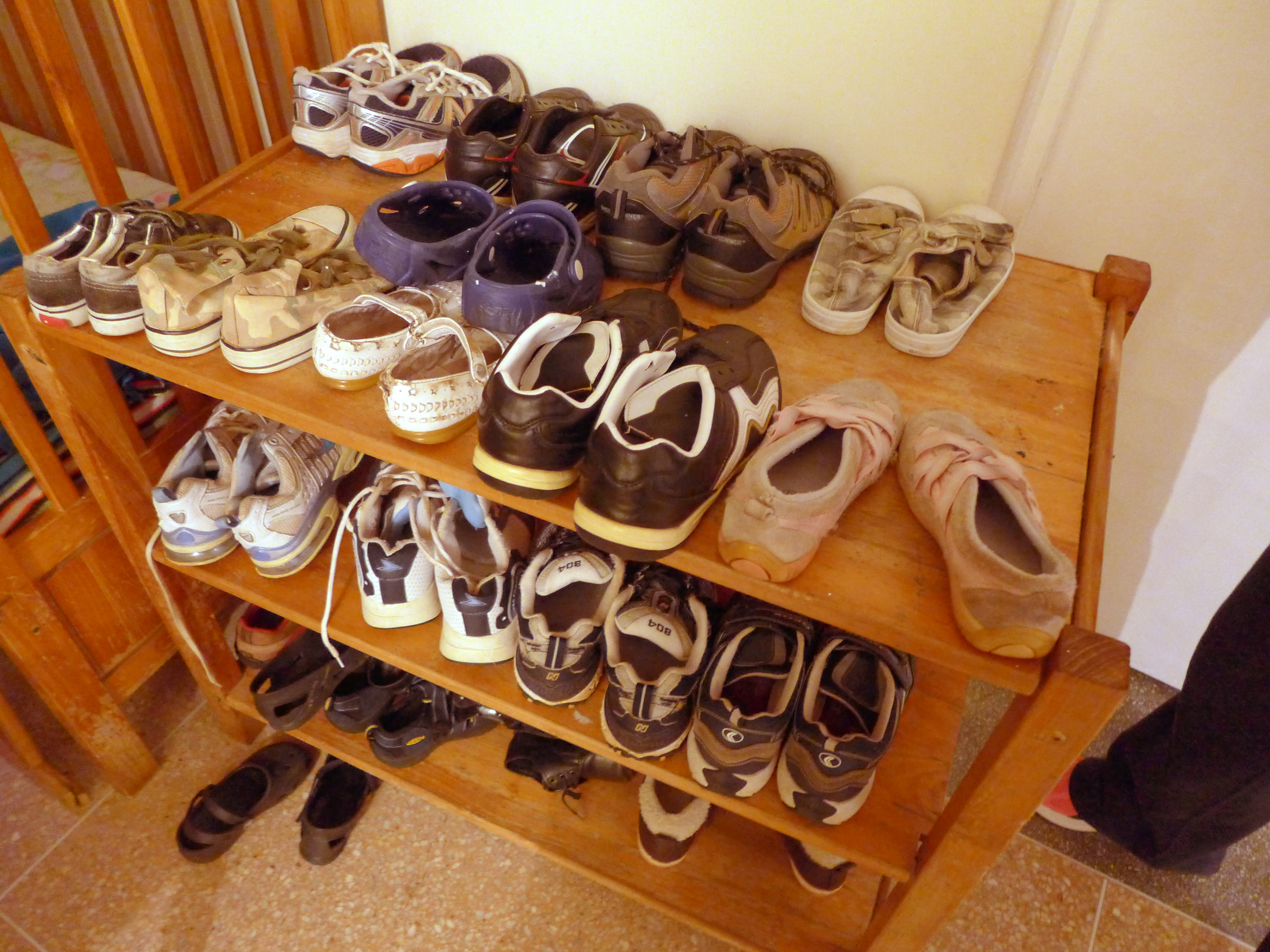
Kid’s shoes of one household
And so this was our last day in Kenya–a day with a little relaxation and lots of beauty to remind us of all of this country has to offer, a day of some hard goodbyes, yet we’ll be back next year, a day of already reminiscing about this amazing trip and work well done and already planning new things for the next one. I’ll keep blogging about this one for a while since I have a couple thousand photos and parts of the trip I haven’t shared yet. Thank you all to my fellow travelers and volunteers and especially the most incredible Lloydie Zaiser, my soul sister (even if she doesn’t know the definition of free time 🙂
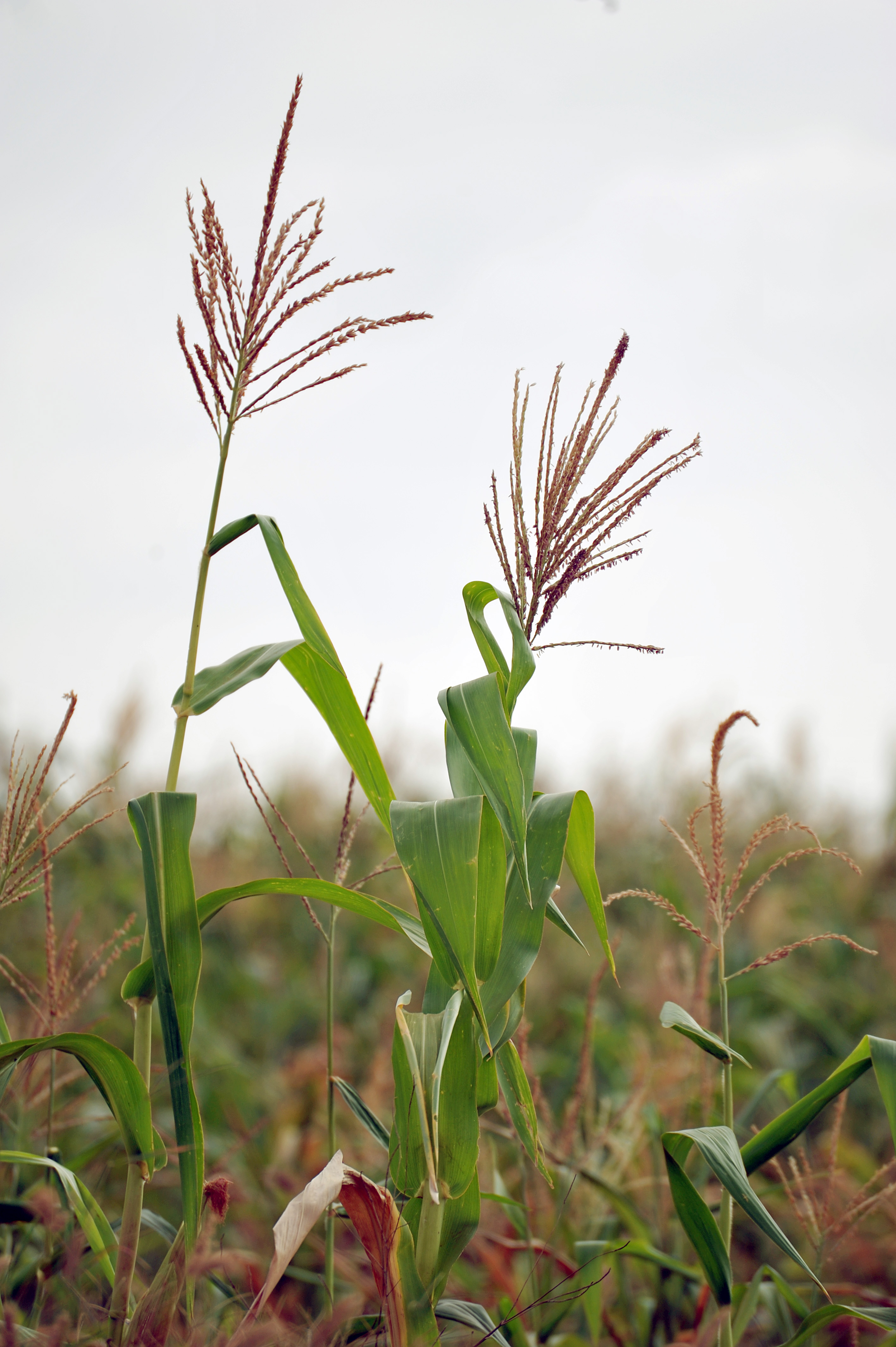
Maize grows everywhere!
Singing, Dancing, and Making It Snow with the Mommas of Kenya
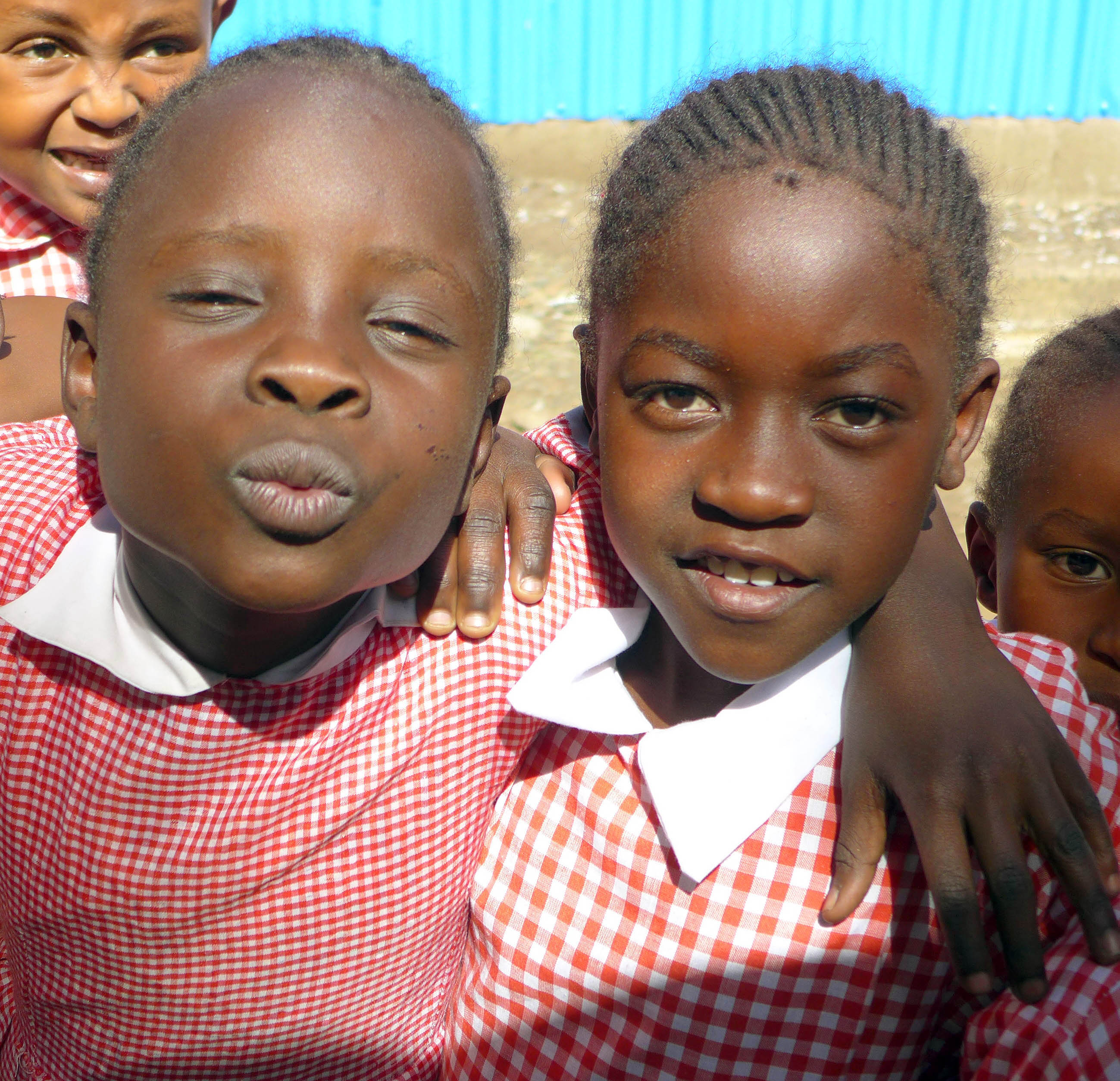
School children at the Kibera Paper location
Wow, we have been incredibly BUSY over the past two days!! I wish that I could blog every day because it seems that each day is so full of moments that are so moving, so profound, so joyful……and there are so many stories to tell. It is in many ways like being in a different world here because the poverty and hardship are so beyond imagination, the impact of AIDS touches everyone here, yet people remain resilient, joyful, and tell their stories with such authenticity from their hearts. We have continued our intensive focus on Tuko Pamoja as that is a very important goal of this trip. Supporting the caregivers of children with HIV or AIDS or the mothers of children living in extreme poverty is the most effective way to support families and communities and is at the heart of the mission of supporting the women artisans of Tuko Pamoja. Before telling you about our recent visits with Tuka Pamoja groups I just want to tell you who the group of travelers is this time. Sarah and Jill are the new travelers–Sarah is a nurse from North Carolina and Jill is an artist and preschool teacher from Arizona. Lloydie is our fearless leader and head honcho of KEST (Kenya Educational and Service Trips) and Jen is the junior head honcho at KEST (sorry I can’t remember your official titles.) Lloydie Jen, Deb, Karen and I are the U.S. Board members of Tuko Pamoja and have all made multiple trips to Kenya with Lloydie leading the pack at 13! Justus is our amazing driver who is always happy (I hear it’s a Kamba tribe trait 🙂 extremely helpful and has nerves of steel to be able to drive in Nairobi where the entire large city seems to have only one traffic light. So you have met the group–on with the experience.
The KEST Group–Deb, Sarah, Jen, LLoydie, Karen, Jill, Me and top center is Justus, our wonderful driver, translater, and friend
Yesterday we went to the final Lea Toto site (Nyumbani outreach clinic for children with HIV living in the slums of Nairobi) supported by Tuka Pamoja in Dandora, called the Vision Self Help Group. This group of women has been together for many years and was the first self-help group that I met. They make jewelry, beaded items and sewn items, all wonderful! Many of them are volunteer community health workers helping other families who have children with HIV and some are themselves HIV+. In fact Sarah, in the elegant peach colored garb above has been living with HIV for over 20 years and nearly died before she knew her HIV status. But now she is a community activitist, AIDS educator, is raising AIDS orphans, and is an empowered woman living positively with HIV. I had the opportunity to interview her and its amazing that she survived. HIV and AIDS are still very much stigmatized here despite the fact that so many people’s lives are touched by them. In Dandora, we also interviewed the women about their lives and had a business meeting about Tuka Pamoja. One of the things we always do is bring fruit and biscuits (cookies) when we come, but this year we also brought scarves for all the women so you may notice them in the pictures, We also presented them their official TP certificate.
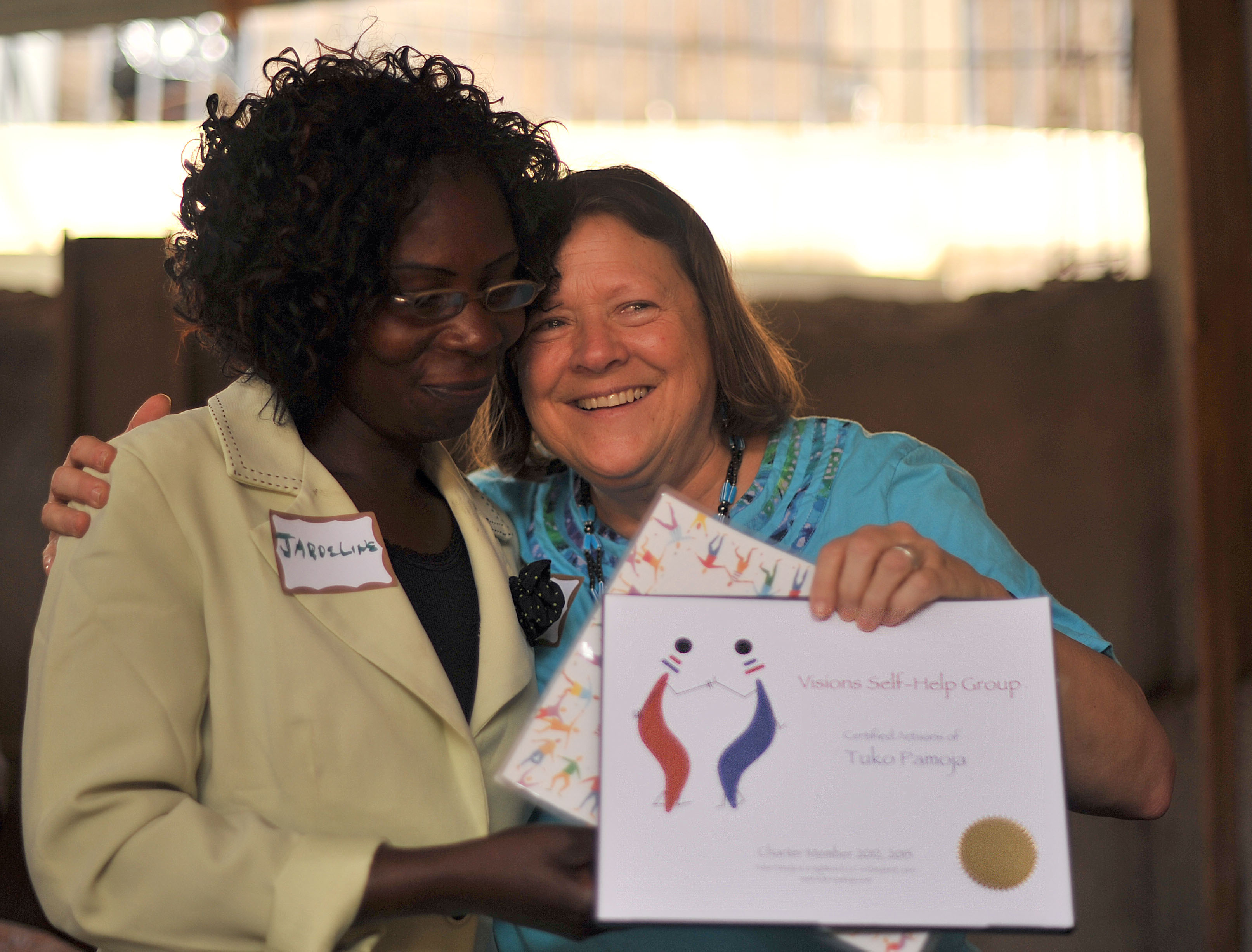
Tuko Pamoja certificate for the Vision Self help group
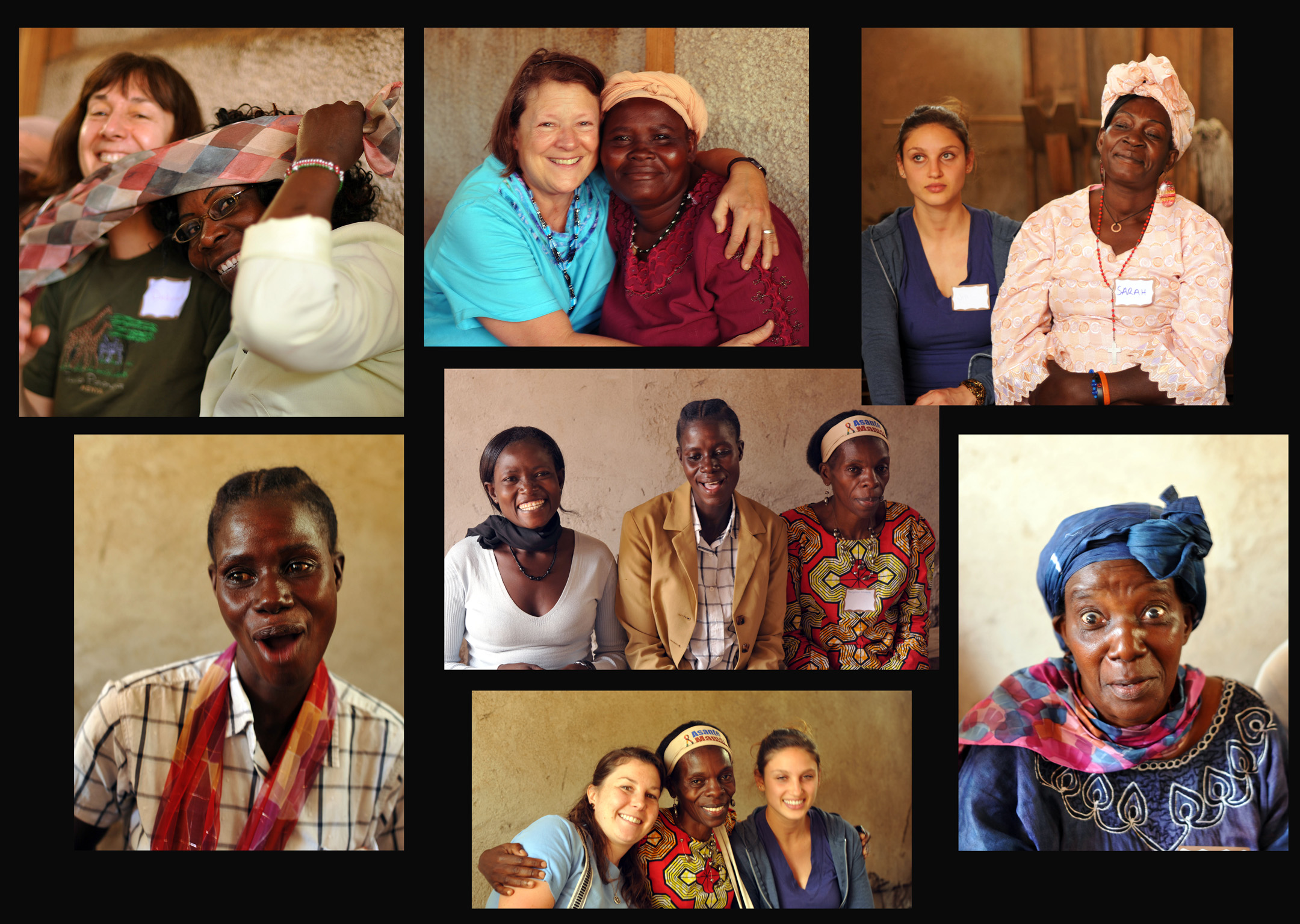
Visit with the Vision Self Help Group of Dandora
One thing that we did a little differently here was to spend more time talking a circle as a larger group and by the time that was done, with the women expressing such gratitude and such heart-felt sentiments, there was not a dry eye, virtually everyone was in tears. Although we don’t see these women often the incredible warmth of the welcome, the sharing of the connection, the way we are brought into their lives and they into ours, the emotional exchange, it all leads to a profound connection. we did life story interviews, shopped from their wares, and it was all too soon time to leave with very hard to say goodbyes.

Group photo with the Vision Self Help Group
Following the time spent in Dandora, we had plans to do some “socially conscious shopping” in two sites where we have developed relationships with the staff and workers over time. The first stop was Amani (meaning peace in Swahili) which is a cooperative of African women refugees who have a very successful business selling many hand sewn items featuring hand died and batiked cloth. In fact, their business is so successful that we asked their marketing director, Maggie, to be a member of the TP Kenyan Board.
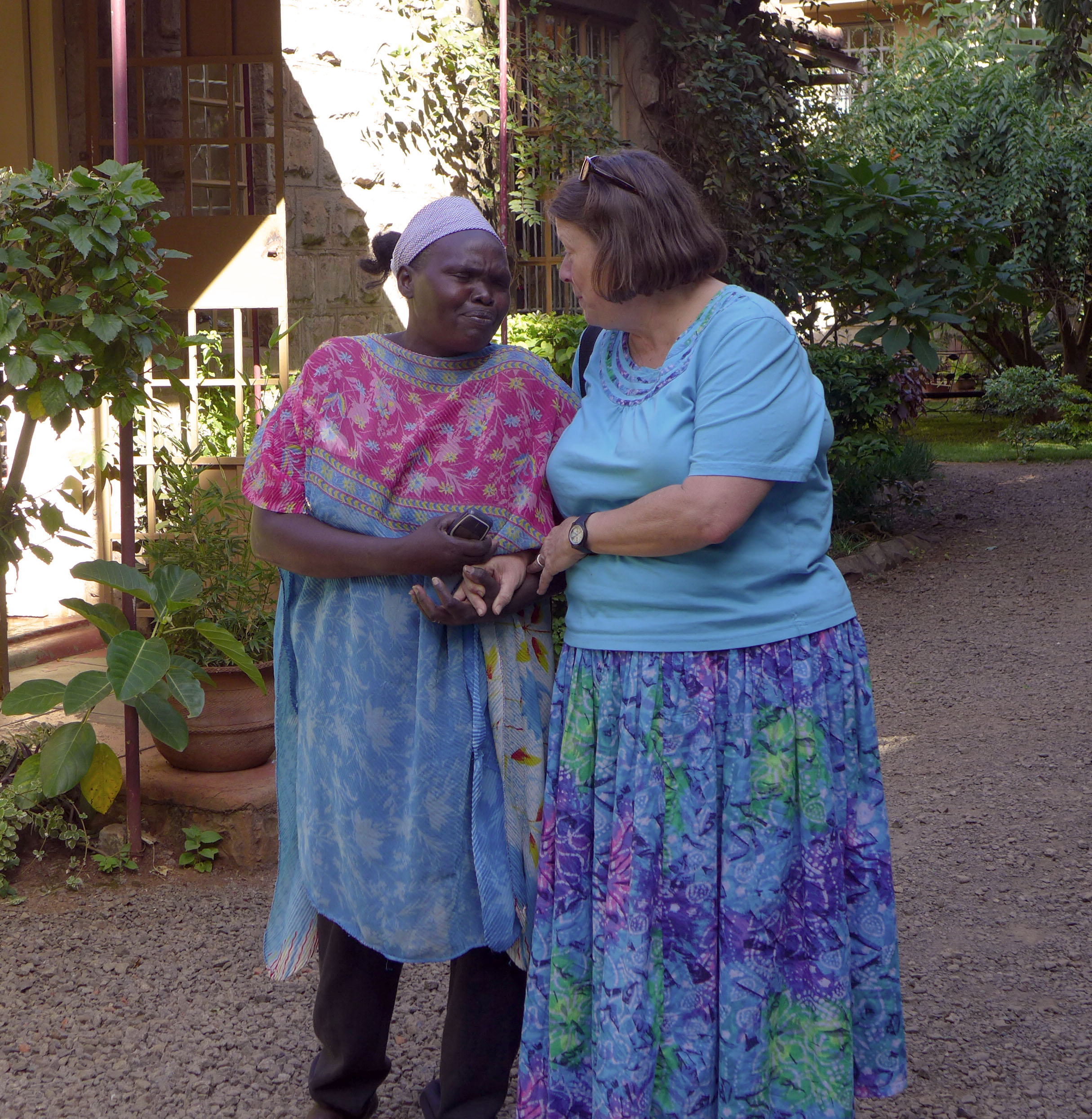
Maggie of Amani and Lloydie
We also made a stop at Kazuri Beads, another favorite place. This is another special place that now employs almost 350 people, predominantly women, many of whom are bused in from the slums. They receive excellent pay, have on site medical and day care and are treated very well. They make gorgeous pottery and ceramic beads from clay mined in Kenya. Learning about the process of mining and harvesting the clay, preparing it for shaping, hand shaping it, firing, then glazing and refiring it makes you appreciate the beauty of the beads even more. When we stopped at Kazuri Beads yesterday we were too late to see the workers because our day had gone too long so we could only do some shopping. So had to decide to leave early this morning to make sure that we could go back for the tour and especially to see the workers because we have a tradition of visiting them, getting welcomed in song and dance and handing out a little candy treat–lollipops this time, you may notice the sticks in the photos….
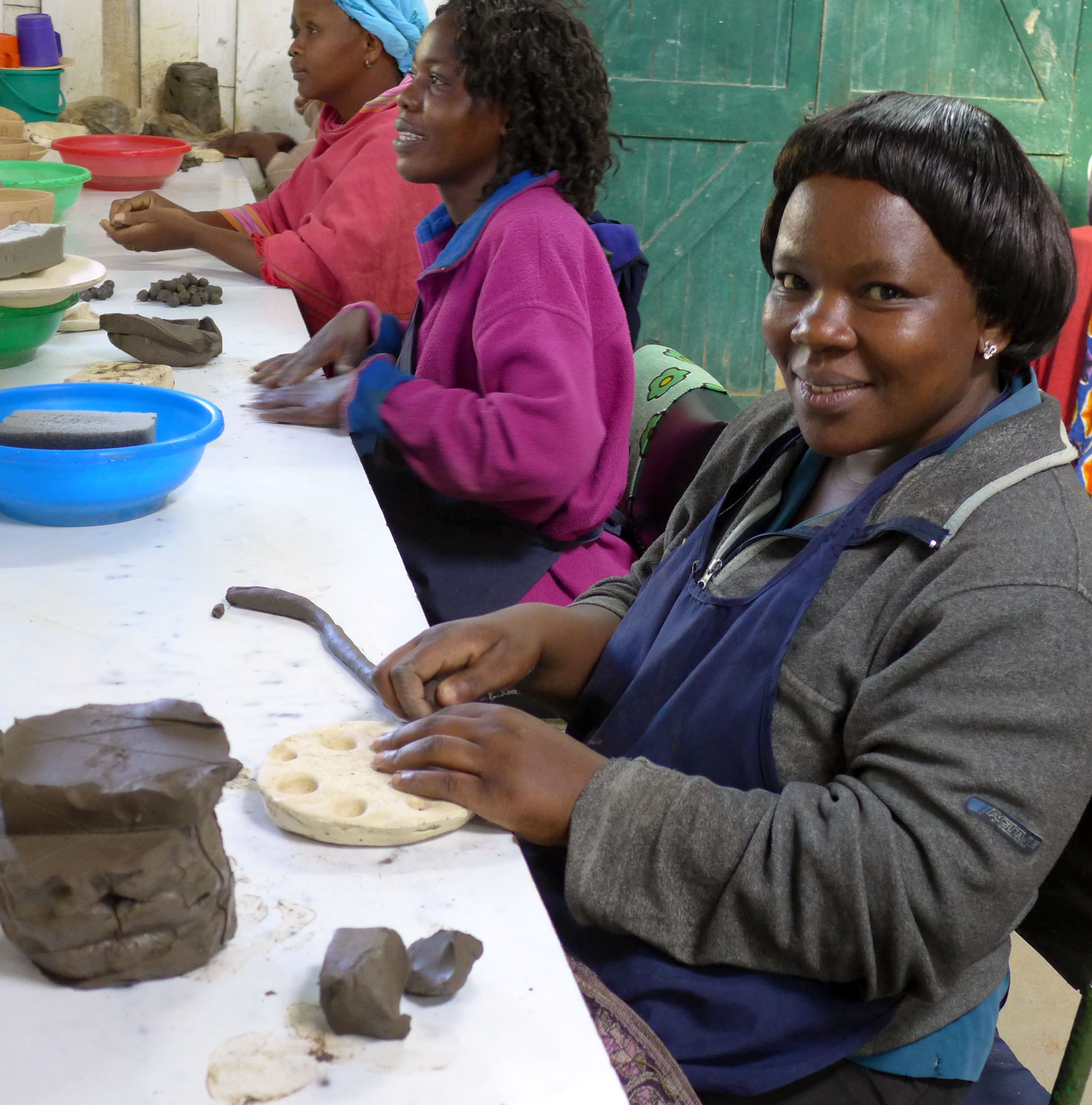
Making Kazuri Beads
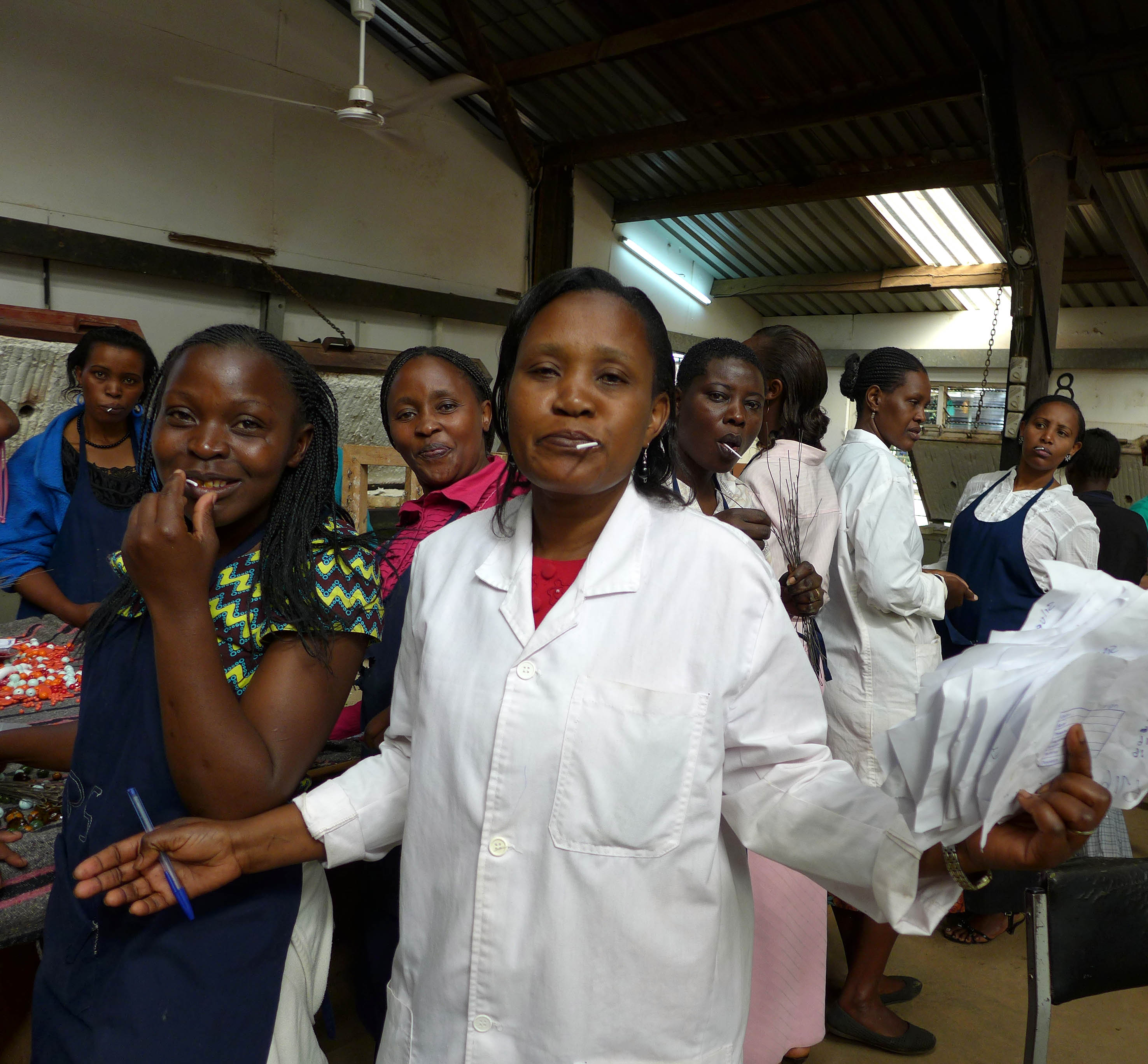
Kazuri Bead factory workers enjoying the sweets
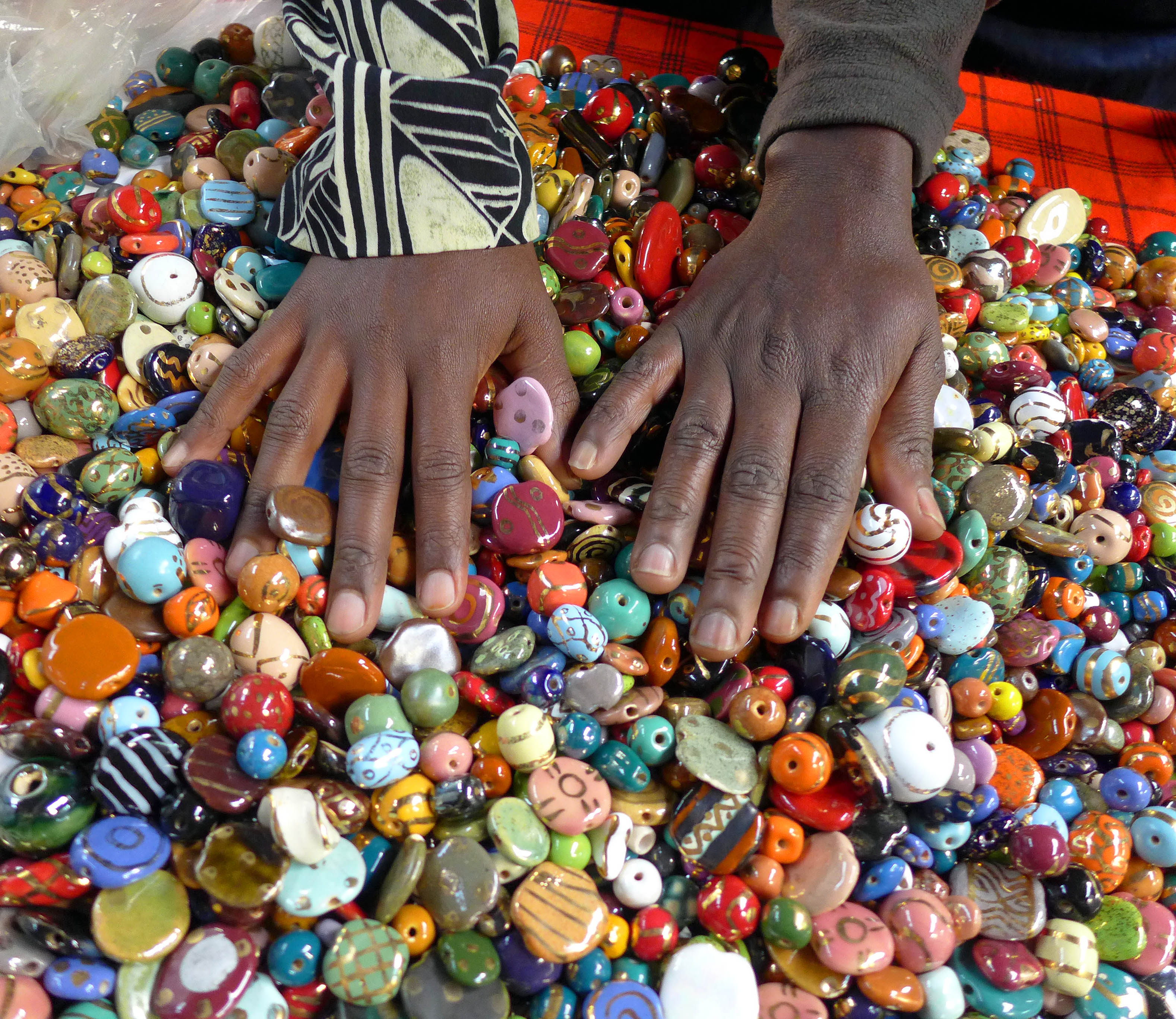
Kazuri Beads!!
We had to get an early start today to fit in the trip back to Kazuri Beads because we knew we had another full itinerary. In fact last night I had most of the group in my room helping me prepare for today’s project at Kibera Paper.
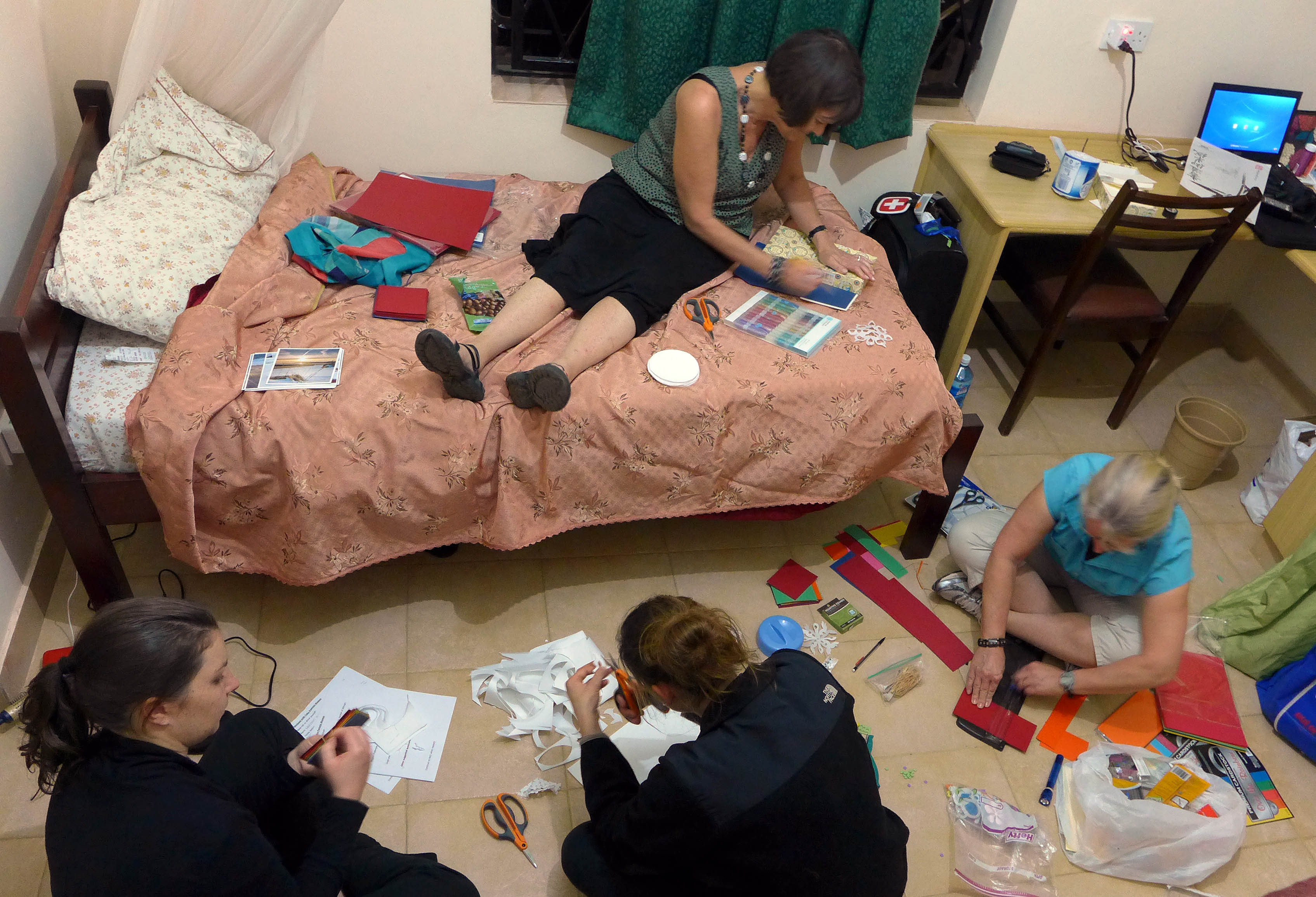
Late night project preparation
Today we headed to Kibera paper, the final Tuko Pamoja group from the slum area of Nairobi. This is the group of women who make l hand-made paper from recycled paper obtained from businesses into absolutely beautiful handmade cards which are each a piece of art. When we go to Kibera paper, anyone who hasn’t been there before has the opportunity for hands on instruction in paper making and making the cards. Deb and I have also established a tradition of sharing an art project with the women. So in addition to the Tuko Pamoja business meeting and presentation of the certificate, receiving our order and paying for it, doing the personal interviews, drinking chai and eating homemade mandazis (Kenyan like doughnuts) that one of the women had made for us, sharing in a circle, singing and dancing, we also did paper making and art projects which made for quite a busy time. Kibera paper was the fourth group that was so prepared and had 100% of their order ready for us even though we only expected 50 %. So all the groups are doing so well with getting their orders completed early, introducing new products and being professional in ways that will really make them successful!

Making cards, dancing, singing at Kibera Paper
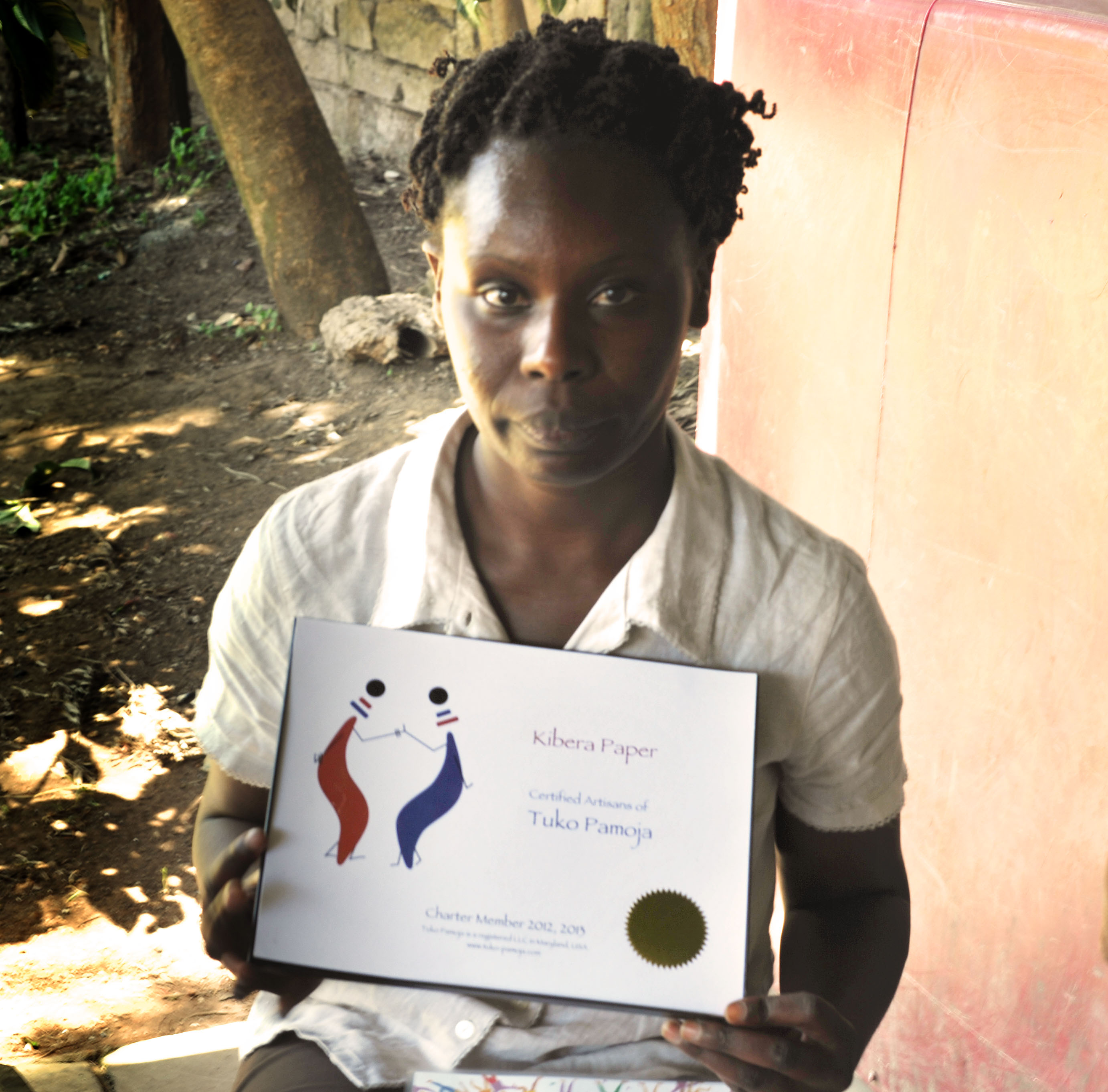
Cecily and the TP certificate at Kibera Paper
Both Deb and I make handmade cards and decided to make a different kind of card with them. She made very fancy valentines and I decided to teach them a bit about snow by making snowflake cards. Since none of them had ever experienced snow, that was quite a lot of fun! I brought plenty of photos I had taken in the winter in Maine with various quantities of snow, but the big hit was one of my children when they were younger posing with a snowman they had made. The women really got into it once they once they got the technique for cutting a six pointed snowflake and the snowflakes and glitter were flying everywhere because there was a bit of a breeze and the paper was very light. At one point I looked down and there were about a dozen snowflakes on the ground by the table and it made me laugh to think we had made it snow in Kenya today! I love working with these women–they have a lot of spirit! So once again it was a hard goodbye with singing and dancing…..lots of hugs and tears.
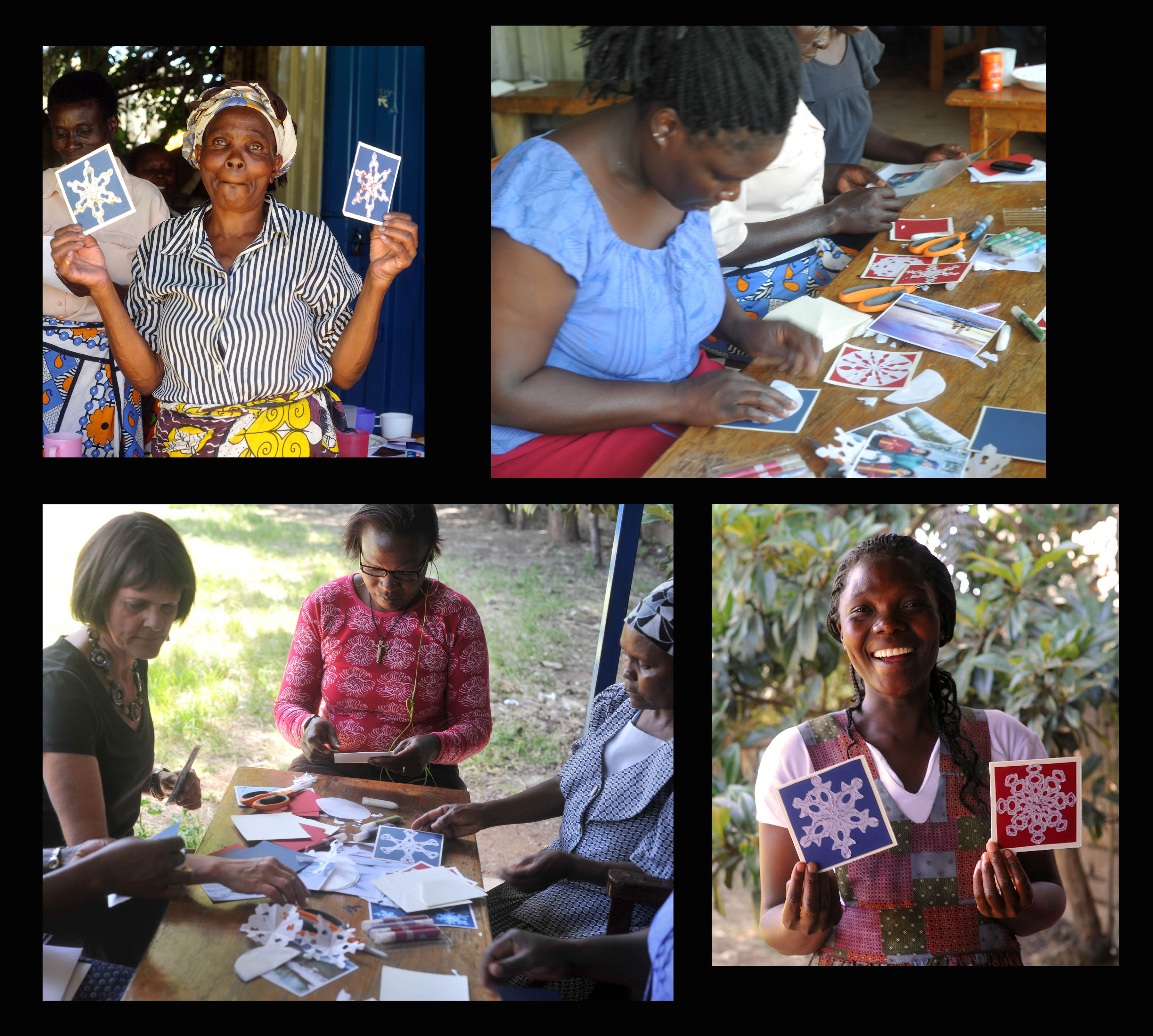
Making snowflake cards
Following spending most of the day at Kibera Paper we drove further into Kibera to pay a visit of support the Power Women’s Self Help Group.
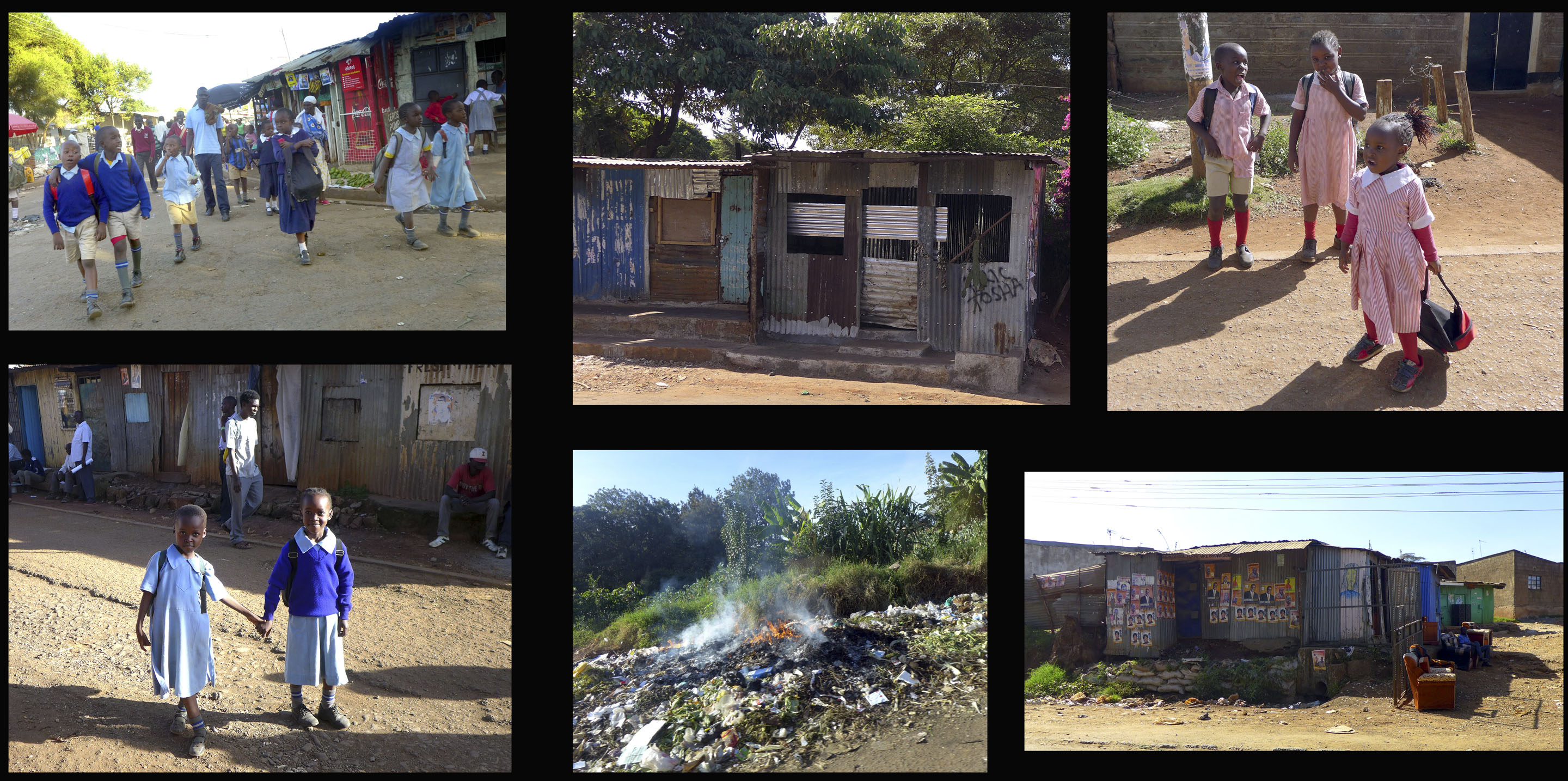
Glimpses of Kibera
They are also a Lea Toto founded self-help group, but through some extra support, really hard work and exceptionally good financial decisions they have become self-sustaining and own and operate their own shop to sell their goods. They have also recently expanded to having a hair salon attached to their shop. Their president, Everline, is on the TP Kenyan Board. We sat and talked with them about the history of their group, how they run the business, and let them know that the other self-help groups have similar aspirations and see them as an inspiration.
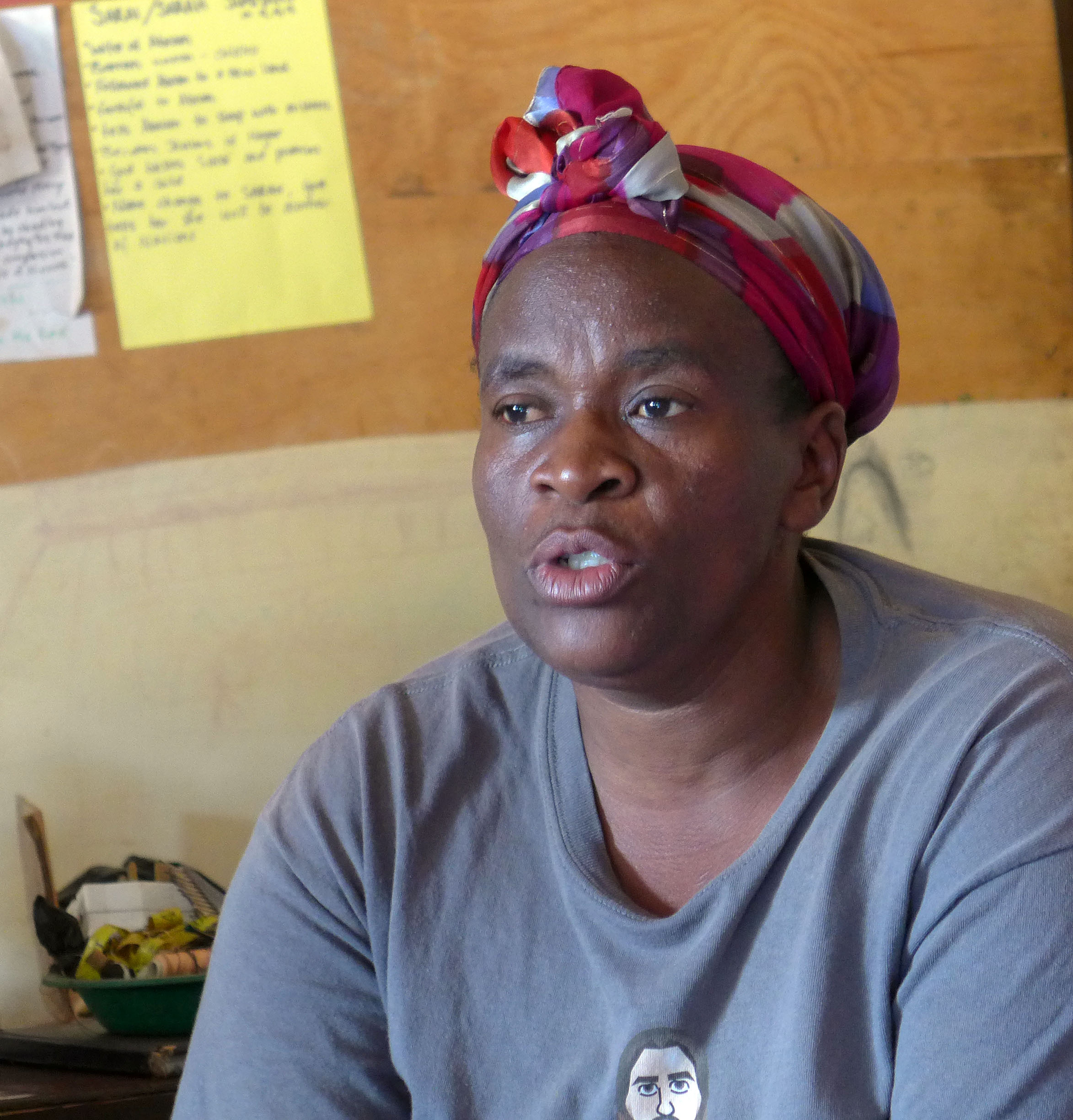
Everline of the Power Women”s Self Help Group
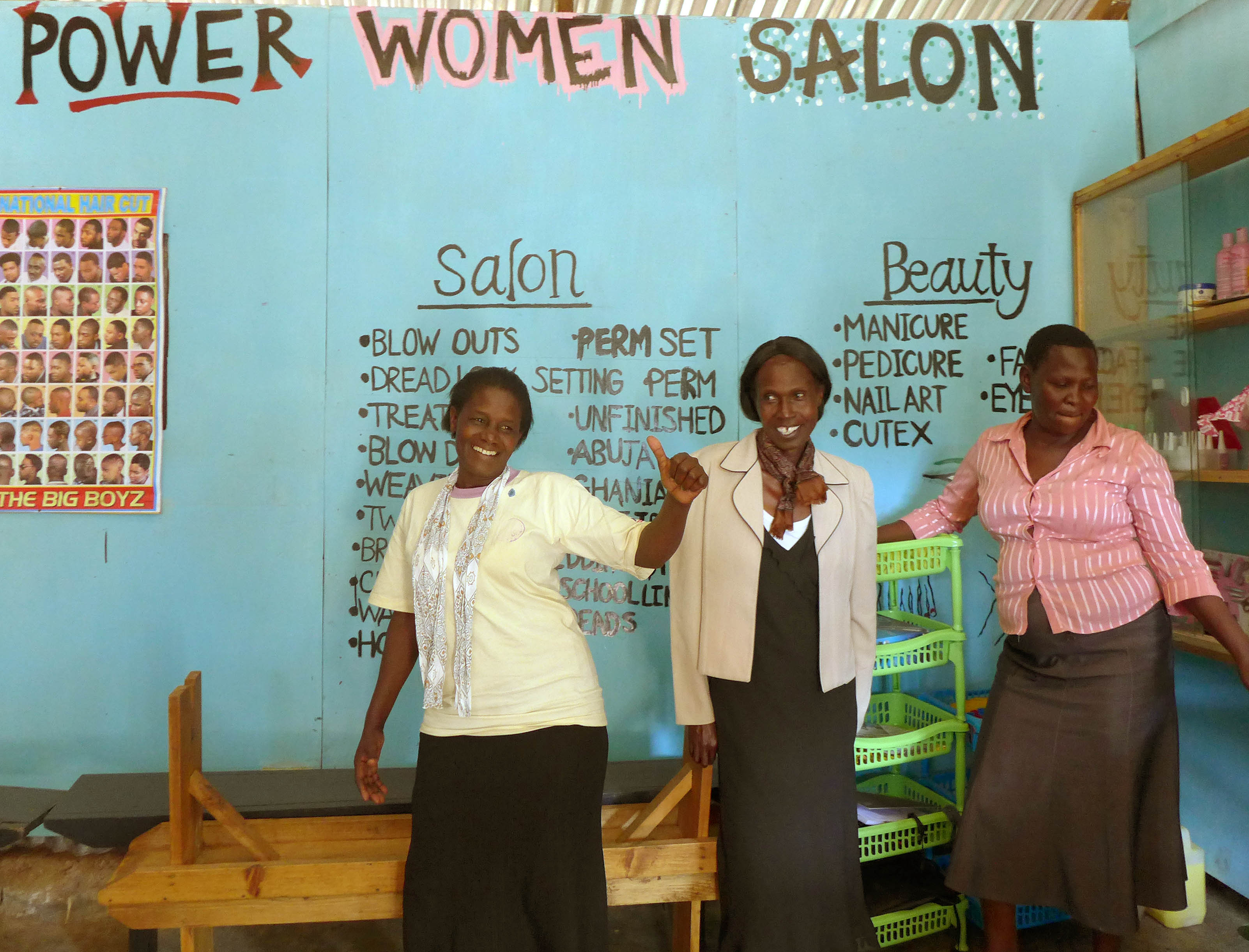
Power Women’s Hair Salon
It’s very late here in Kenya and its time to get a few hours of sleep before we head out in the morning on a little bit different path. It has been an intense, but very rewarding past few days. We will be headed to the Maasai community of PCDA to do more Tuko Pamoja business, but also to spend some time supporting other projects in that community. You may recall some of the time we spent with the Mommas and the children last year. If not, I will tell you ahead of time, the children are absolutely adorable, enthusiastic, engaging, beautiful little ones! Can’t wait……
Joyful Children’s Faces and Women Who Will Touch Your Heart
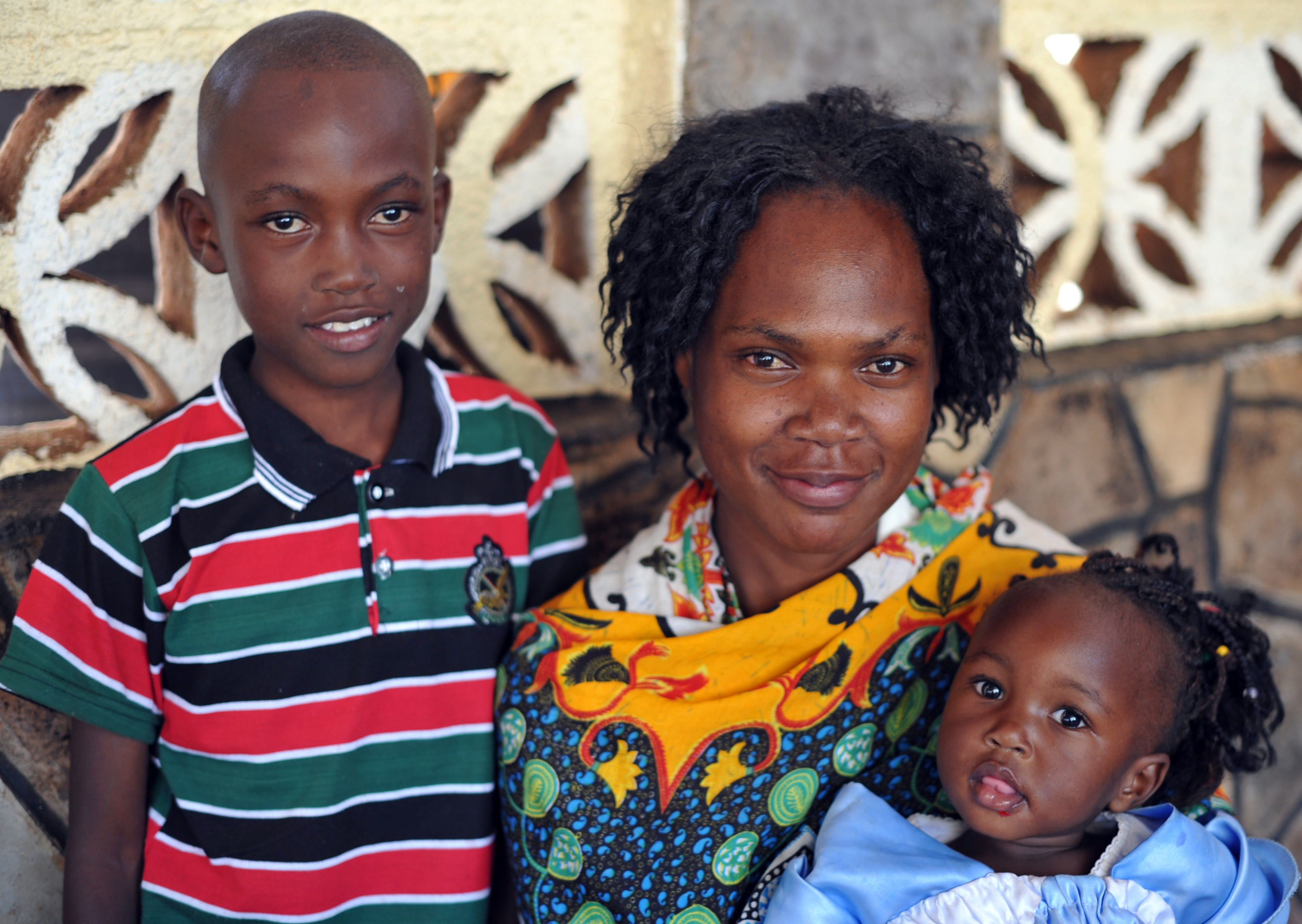
One of the Tuko Pamoja women and her children
We have had two busy and incredible days for the second and third days of our journey and an inability to recharge my electronics (mishap with the adapter we ultimately learned tripped the circuit breaker) left me wondering how I could possibly blog about these two days which were both so full of moments that had filled us with ideas and questions, left us speechless at moments, brought us to tears and touched our hearts.
We began yesterday at Nyumbani Children’s Home where the children are AIDS orphans and are HIV+ but get extremely good medical support and are doing very well. We arrived in the morning to many joyful greetings as the older children came out to greet us. There were plenty of hugs and remarks about how much they have grown especially from those of us who only see them once a year. All the children are really polite and respectful, but all have unique personalities and some have quite the enjoyable senses of humor. We were headed off the church , Kenyan style, which is a wonderful experience and tried to describe it to the new travelers, Sarah and Jillian, knowing that you can’t quite fully describe it—it is something you just have to experience. Everyone heads up to mass, even the really young children, dressed in Sunday clothes, and its a joyful migration to behold.
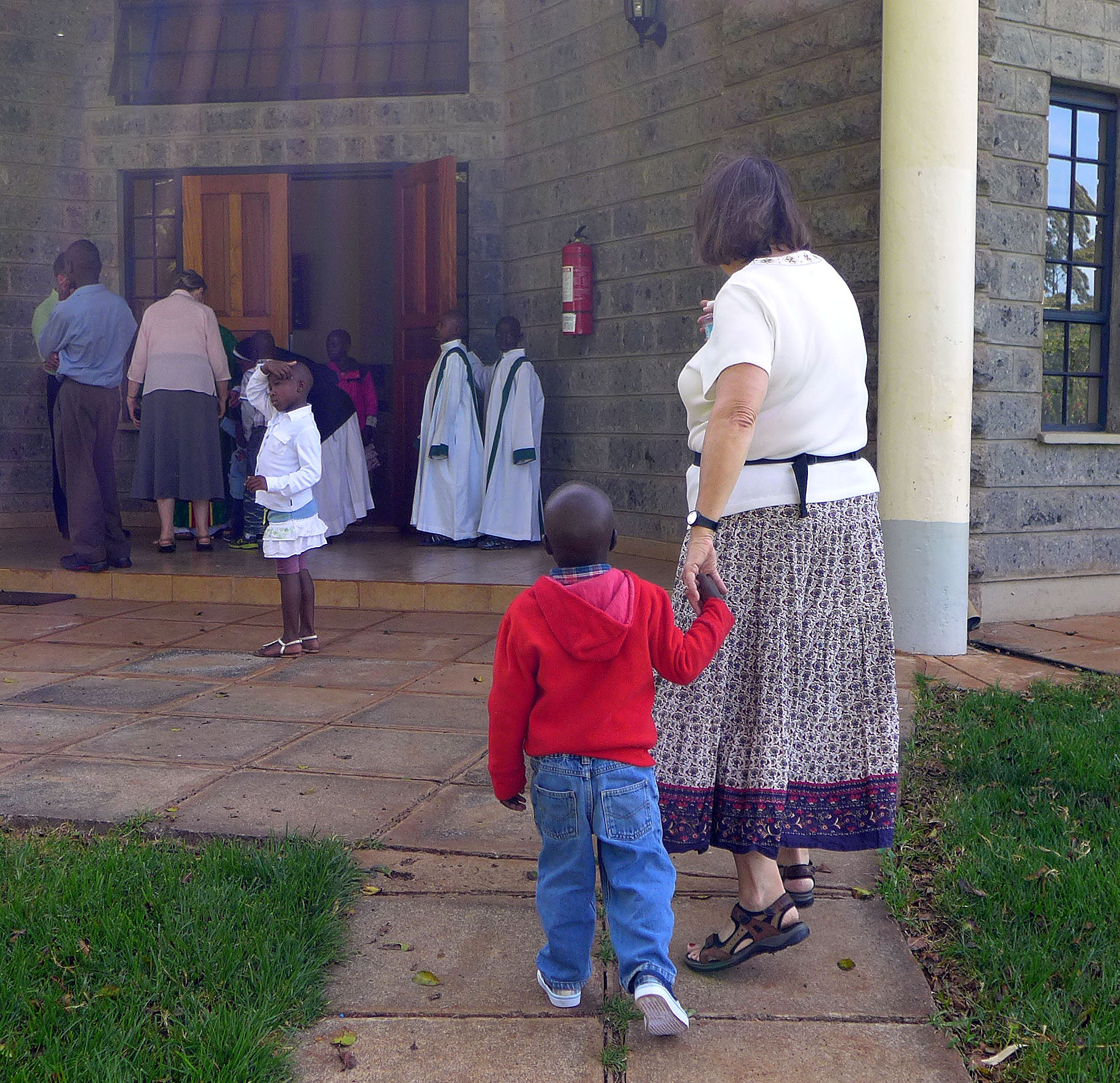
Lloydie with a child from Nyumbani Children’s Home headed to church
Once inside there are MANY children participating in the service–they are the choir, the musicians and drummers, the speakers, the servers, and my personal favorites, the dancers. And they are amazingly good at what they do! The youngest dancer who is getting taught the dances is 3 years old and has tremendous natural rhythm–and I am talking about African dancing and drumming, etc. And any children who aren’t in the front of the choir are singing and dancing–or drumming–at their seats. So this is a joyful, kid-friendly service in which priest talks to thee children, engages them, uses his sense of humor and they listen and participate. And if you are there as a visitor–you better clap, and sing and dance too!! They bless everyone who has a birthday that month and by doing it once a month practically all the children’s cottages have a birthday once a month–which brings a large cake and tub of ice cream. So we had our lunch and were invited to several birthday parties. The younger children are raised in cottages of families of 12 -14 children of mixed sexes with “Moms” who care for them. When they get older they move to the youth hostels which are divided by gender and are a little removed from the younger children.
In afternoon, we delivered bags of sidewalk chalk, temporary tattoos, and bottles of bubbles to each of the cottages. We also added 7 new scooters to the scooter supply. Sunday afternoon is the only concentrated time of free play that the children have so it is a caucophany of scooters going around the circular playground with the older children very lovingly teaching the younger ones the ropes of scootering
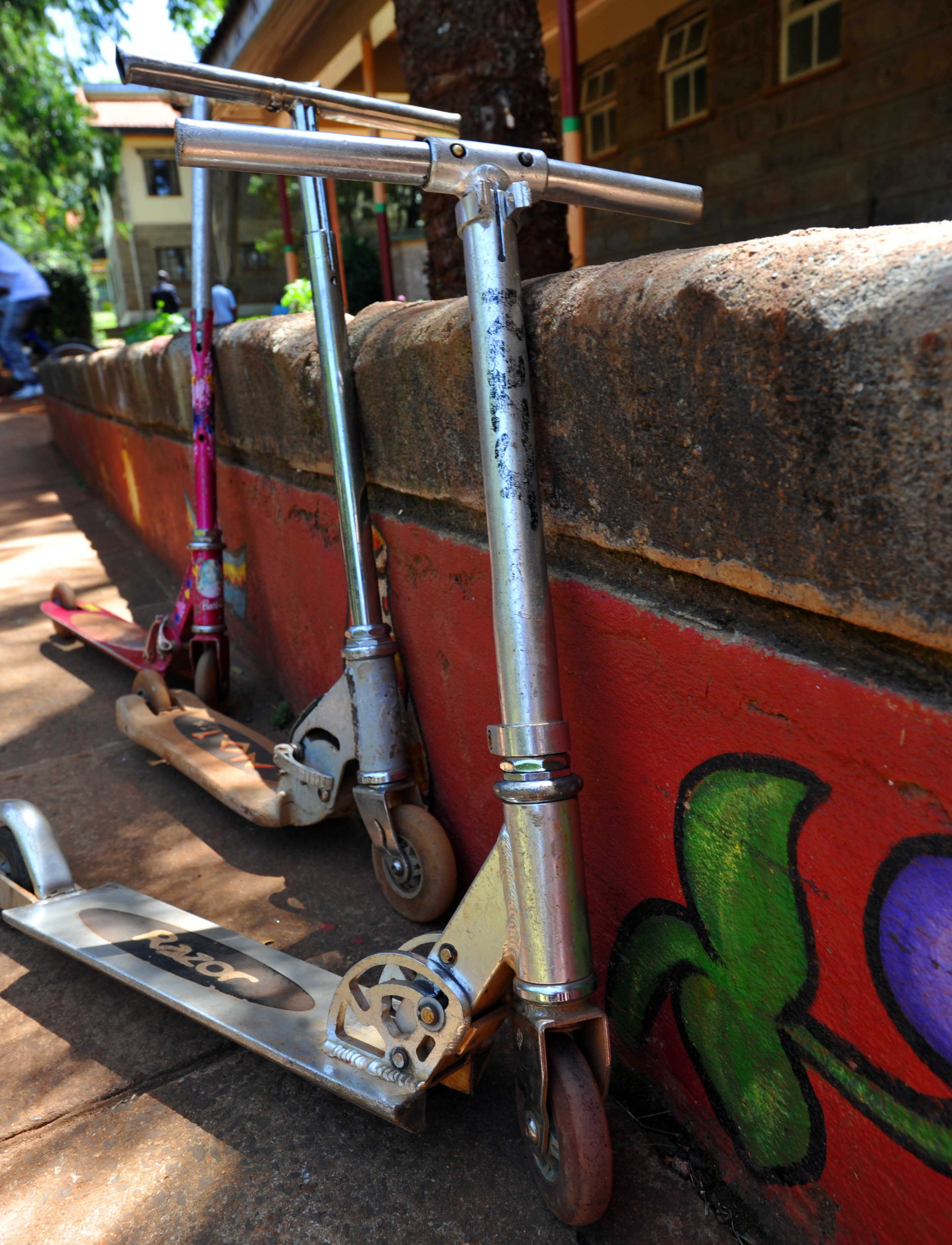
Scooters are very important at NCH and build strong legs
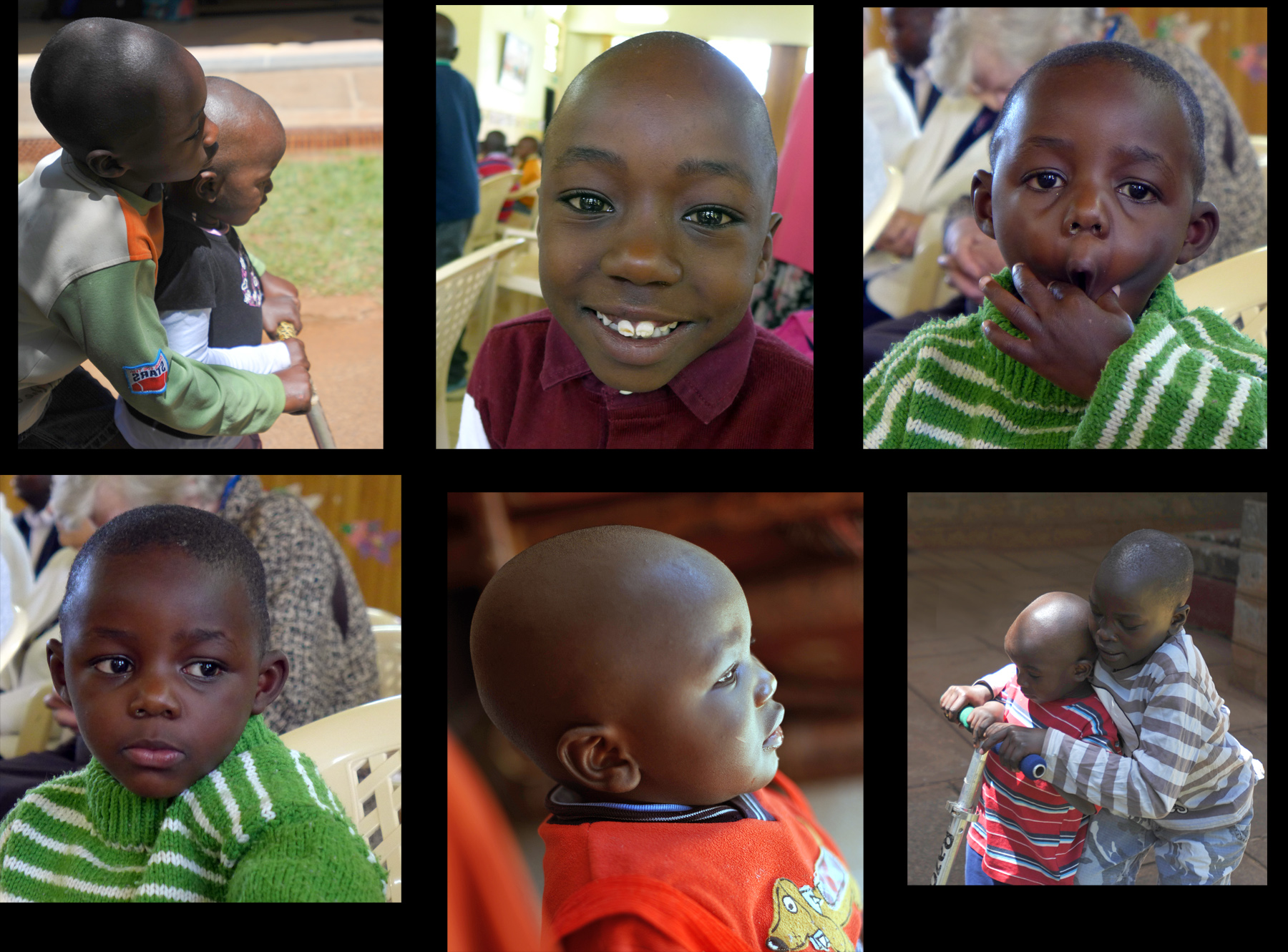
Faces of Nyumbani Children’s Home
As has been the tradition in the past when I have been at the Children’s Home, I planned to do face painting once again. I recruited some help from Sarah and Jill who asked me how I would let the children know when and where we would be with the face paint. I reassured them that all we had to do was set up outside somewhere and we would soon have children flocking to us. And so we did, and in no time we were surrounded by faces, and arm and hands…. And so we face painted for what was at least thee hours beside the playground with scootering, squealing children in the background and smiling children right there in front of us. I don’t know how many faces or arms we ended up painting but I know had a ball with all of them!
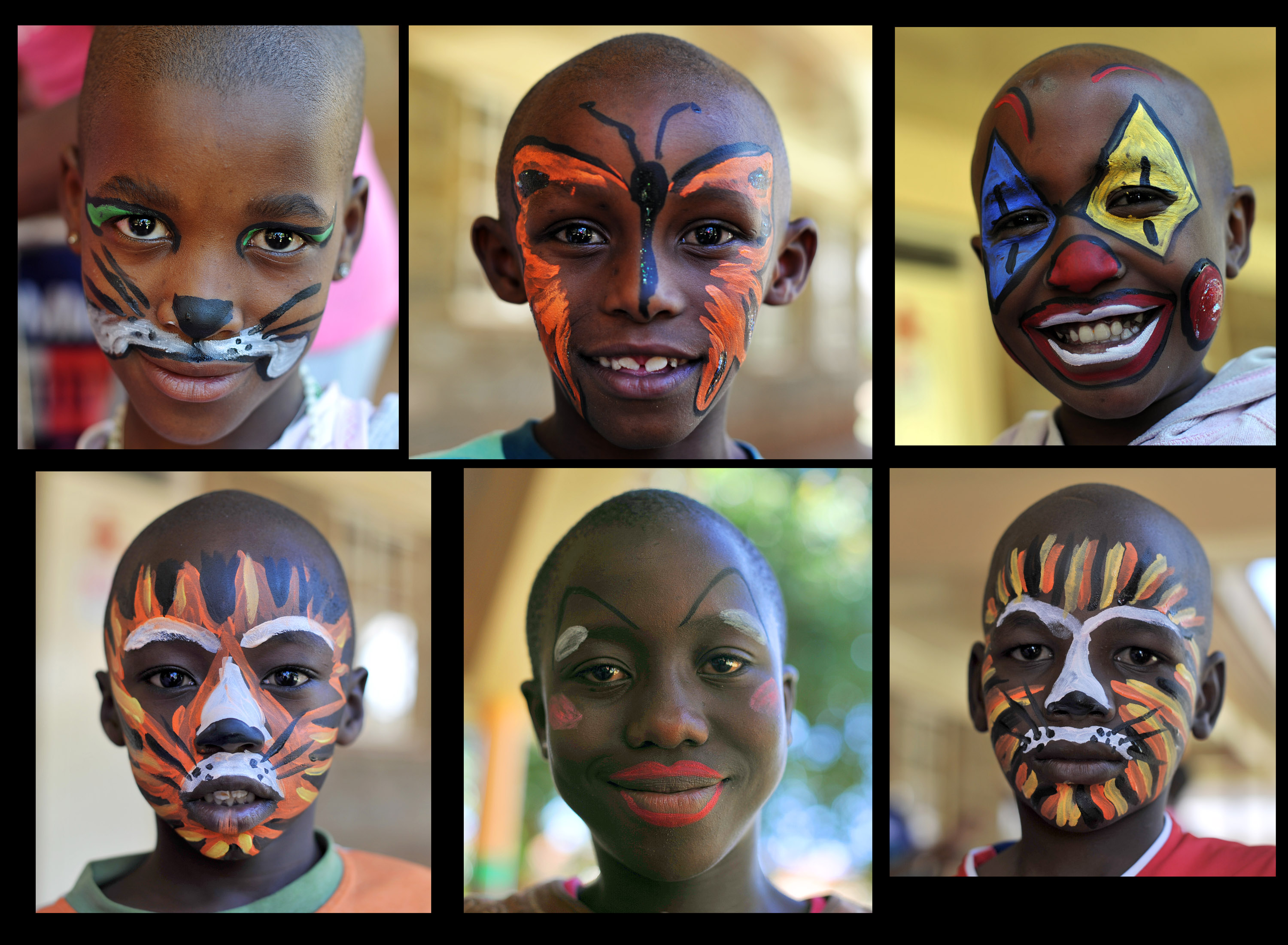
Just a few of the faces we painted!
We stayed around a little longer after that so that we could go cheer the boys at a football (here it would be soccer) game. Our wonderful driver Justus joined some others in creating a match team for the boys and we had a fun time cheering everyone on. By the time we actually left the Children’s Home it was about an hour and half later than we had planned and everyone was having a hard time saying goodbye even though we are going back next Sunday. We had plans to go out to dinner, one of two times which we will eat out during this trip, and after quickly cleaning up headed out to the restaurant Karen Blixen’s Estate (of Out of Africa fame).
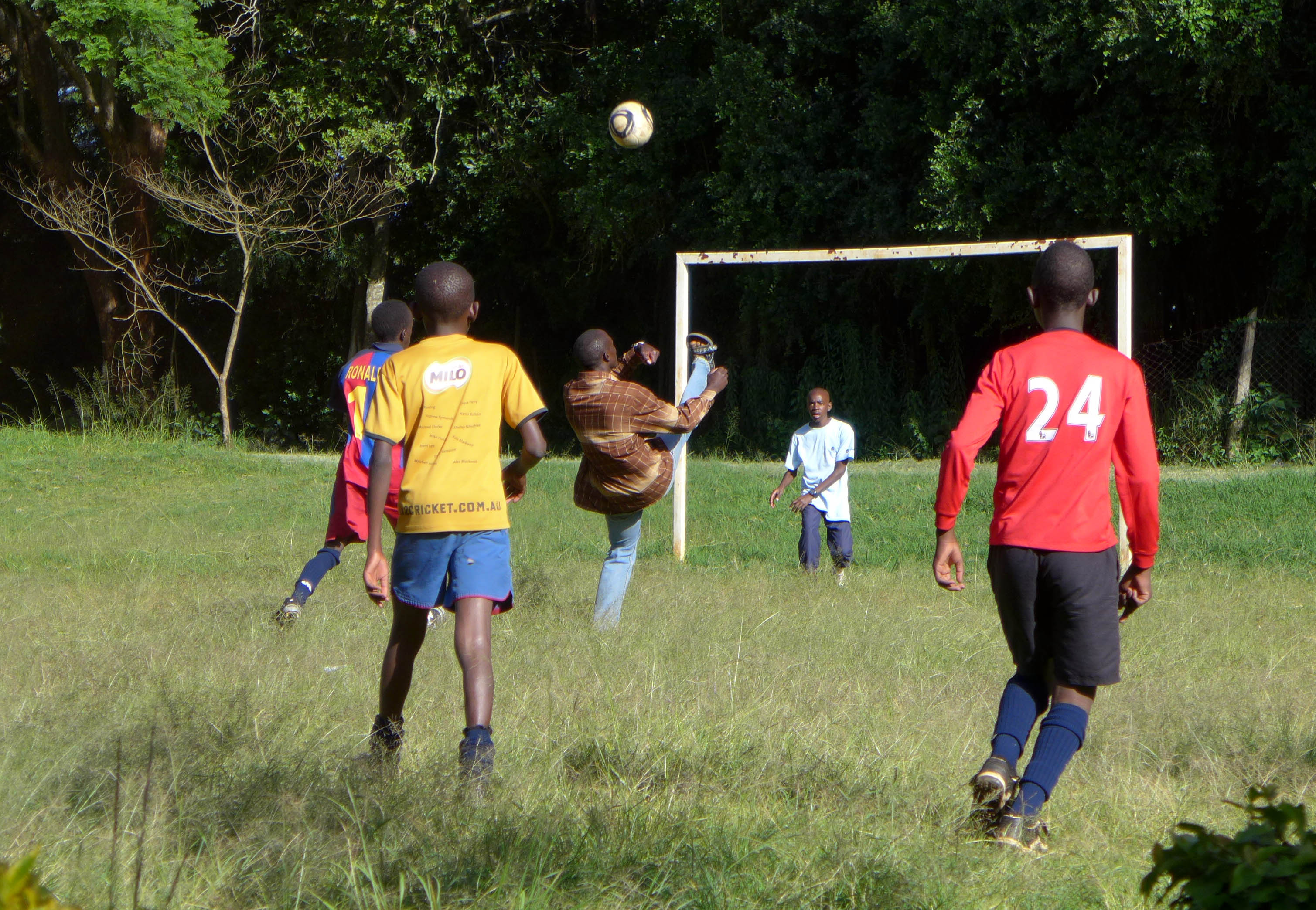
Boys football game
While yesterday was a lot of fun –and definitely some work with painting a lot squirmy children and sorting the locations for numerous of those many duffels, today was definitely more work and business oriented but so very touching in so many ways. Today was purely focused on Tuko Pamoja and going to two sites where we work with women artisans groups in very compromised communities. We spent the morning in Kangami and Dagoretti, both slums of Nairobi, where Nyumbani runs the Lea Toto Programs (Swahili for to “care for a child”) offering outreach care to children who are HIV+.
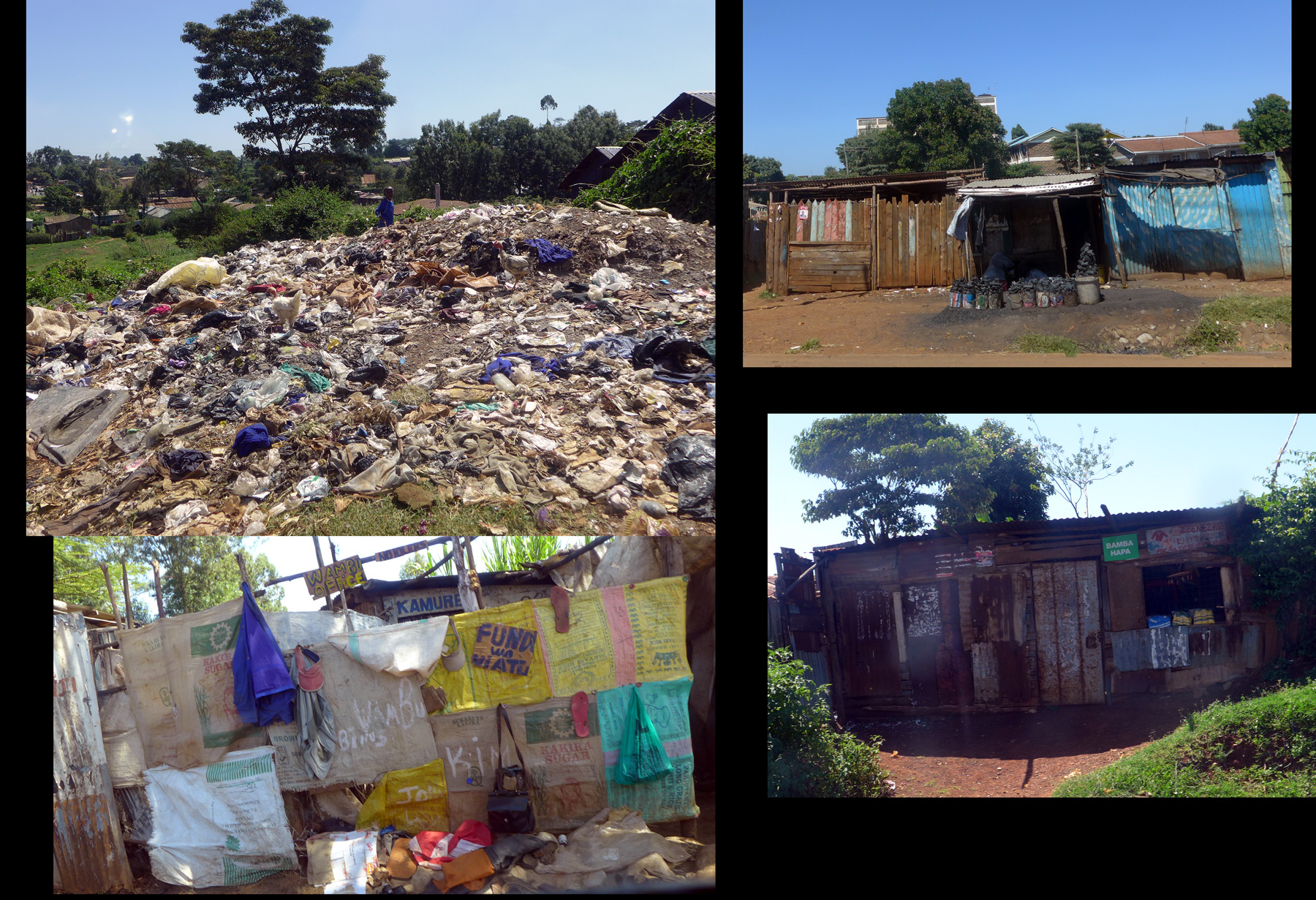
Pictures on the periphery of Dagoretti
Both of the groups we work with there are self-help groups — groups composed of caregivers for children with HIV–some are mothers or other relatives who may be actually raising the children, some are volunteer community caregivers—all have come together to support each other and to make crafts to earn a living or supplement insufficient income for survival. We met in the morning with the Good Hope self-help group of Kangemi and in the afternoon with the Miracle Caregivers self-help group of Dagoretti. In both cases, the agenda was the same. We wanted to share with them that Tuko Pamoja had a successful year having sold 85% of its inventory, that we had increased our order by 30 % and talked with them about the upcoming workshop. We gave them a lot of positive feedback about how their products were so well received.
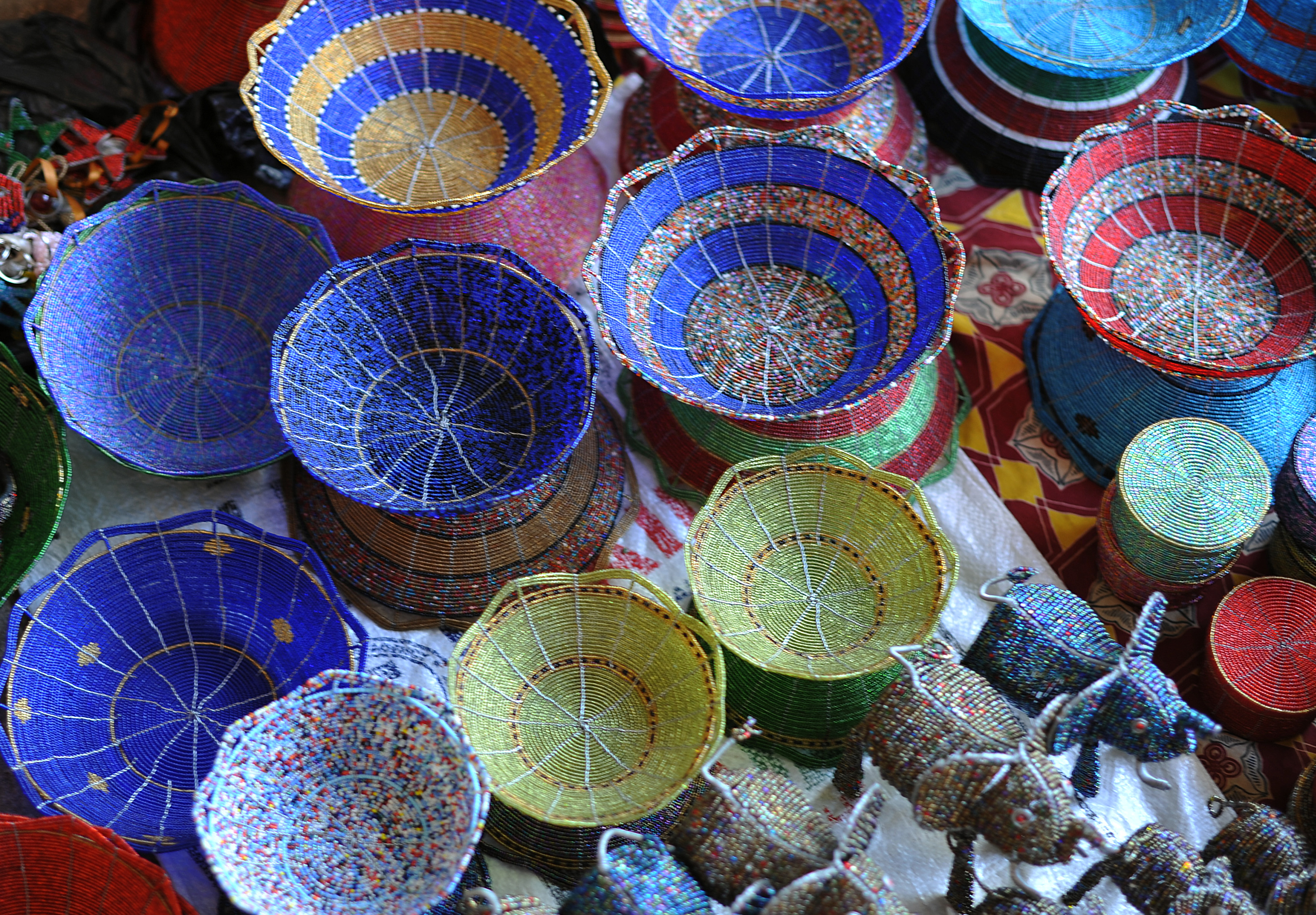
Some of the beaded products at Kangemi
We read to them the poem that I had written back in 2010 which was a tribute to Kenyan women and the way that has become tradition to open all Tuka Pamoja sales events and we gave them a certificate for being charter members of the Tuko Pamoja LLC which brought lots of cheering and clapping!
Tribute to the Women of Kenya
Oh women of Kenya,
do you know how beautiful you are?
With your dark eyes holding your
stories of such sorrow and despair
your shining faces still able to smile so lovely
despite hardship beyond imagination
Oh women of Kenya
do you know how strong you are?
To carry your sick children on your backs
for miles through the alleys of Kibera
to raise the children of a nation through
sickness and poverty with such love
Oh women of Kenya
do you know how powerful you are?
You are the true backbone of your country
the bricks and the mortar of your people,
the keepers of the culture and traditions
the past and the future
Oh women of Kenya
do you know how glorious you are?
you dance and sing with a lively spirit
that could fill the heavens
that suspends all time and lifts all hearts
with infectious joy
Oh women of Kenya
do you know how truly amazing you are?
You moved me in a way I could not have imagined
found places in my heart I never knew existed
A piece of me is there in Kenya with you
I am but a deep breath away and in my mind’s eye
I am remembering just how beautiful you are!
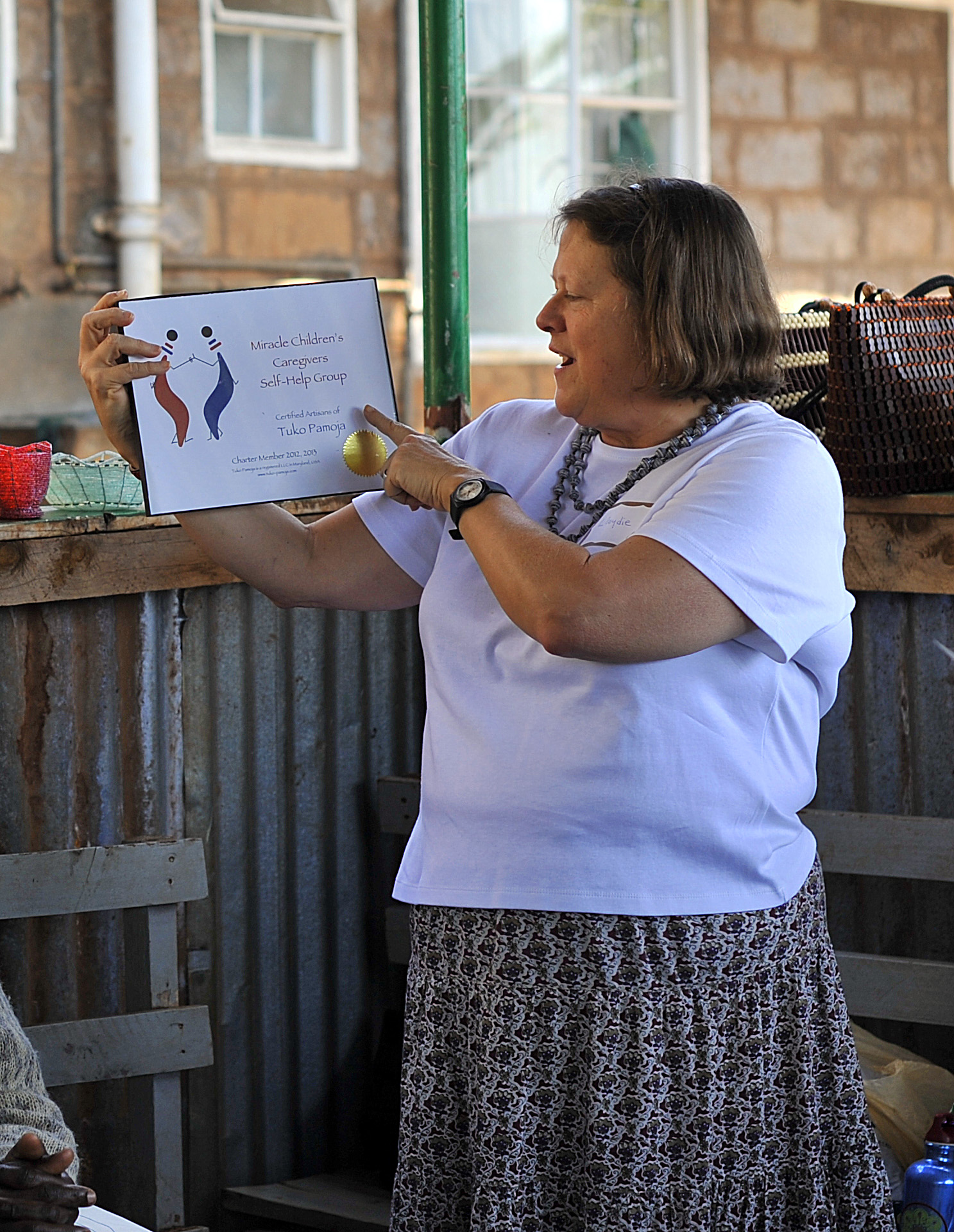
LLoydie showing the Tuko Pamoja certificate
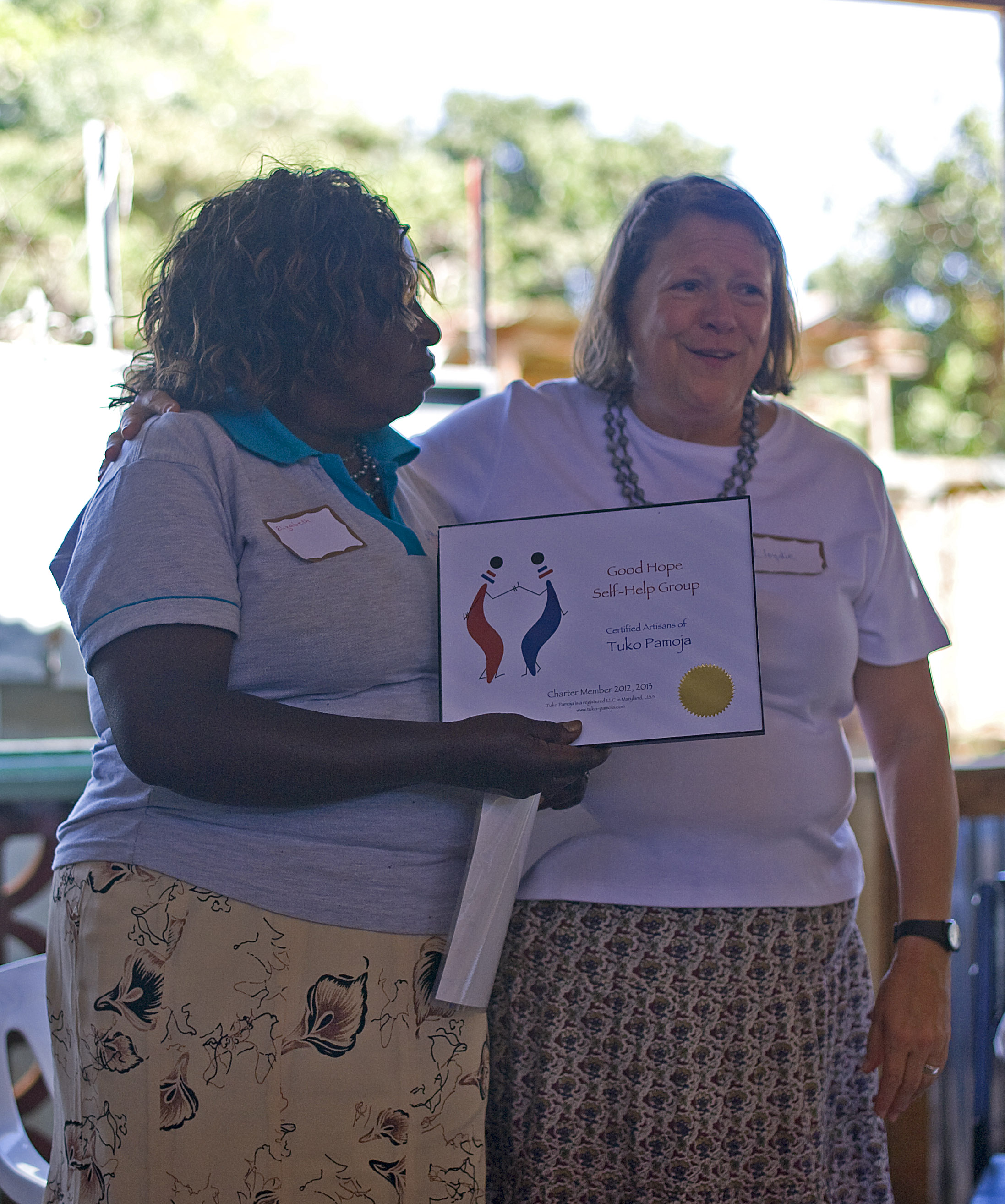
Presenting the Tuko Pamoja Certificate
We also told the women that we thought a major key to the success that people felt a connection to their personal stories because we told about the group and at least the story of one woman at each of the sales events. In that regard we talked with them about developing a book with a photo and story of each woman and asked if we could interview all of them so that we could say more about each of them. We also asked to do a video interview of the two women who could speak English most fluently explaining that although we could tell their stories we felt it would be best if people could hear them in their own voices and from their hearts. So I had the honor of doing the video interviews and they were heart wrenching, touching, honest stories of hardship and resiliency that in some cases made me cry with the women, but they were phenomenal and I will never forget them. These women live on the edge all the time. They have to pay rent, school fees, and put food on the table and often there is not enough money to buy food. They are loving mothers who often raising other people’s (i.e. sibling’s who have died of AIDS) children. They have endured their own hardship through many losses to AIDS and other diseases, but are very committed to educating the children and creating better lives for them. They are truly quite amazing. Once you meet them you cannot avoid being touched by them and wanting to help in some way.
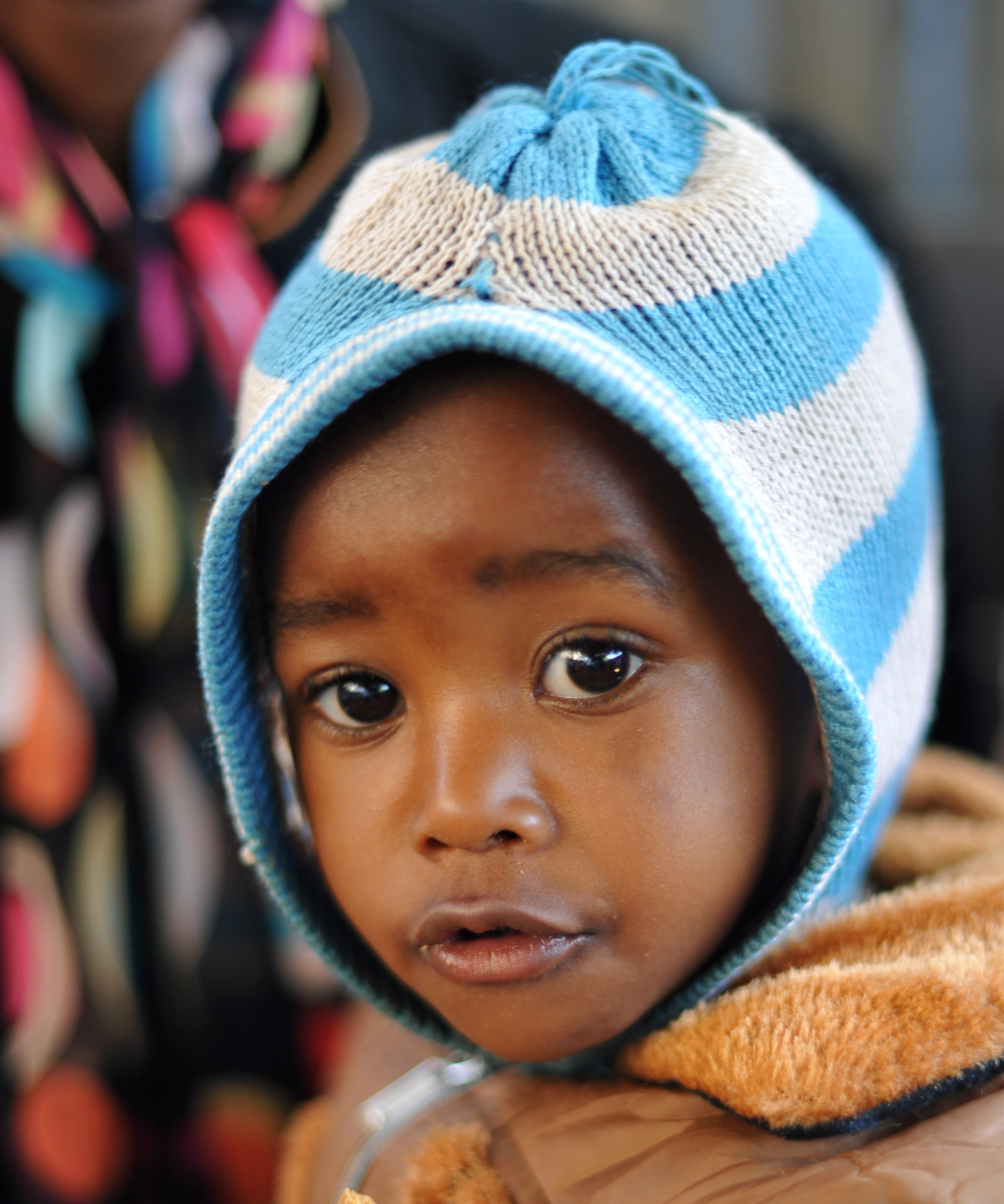
Son of one of the Tuka Pumoja women at Kangemi
Kenya, the oh so many faces…..and a heartwarming story, without a face.
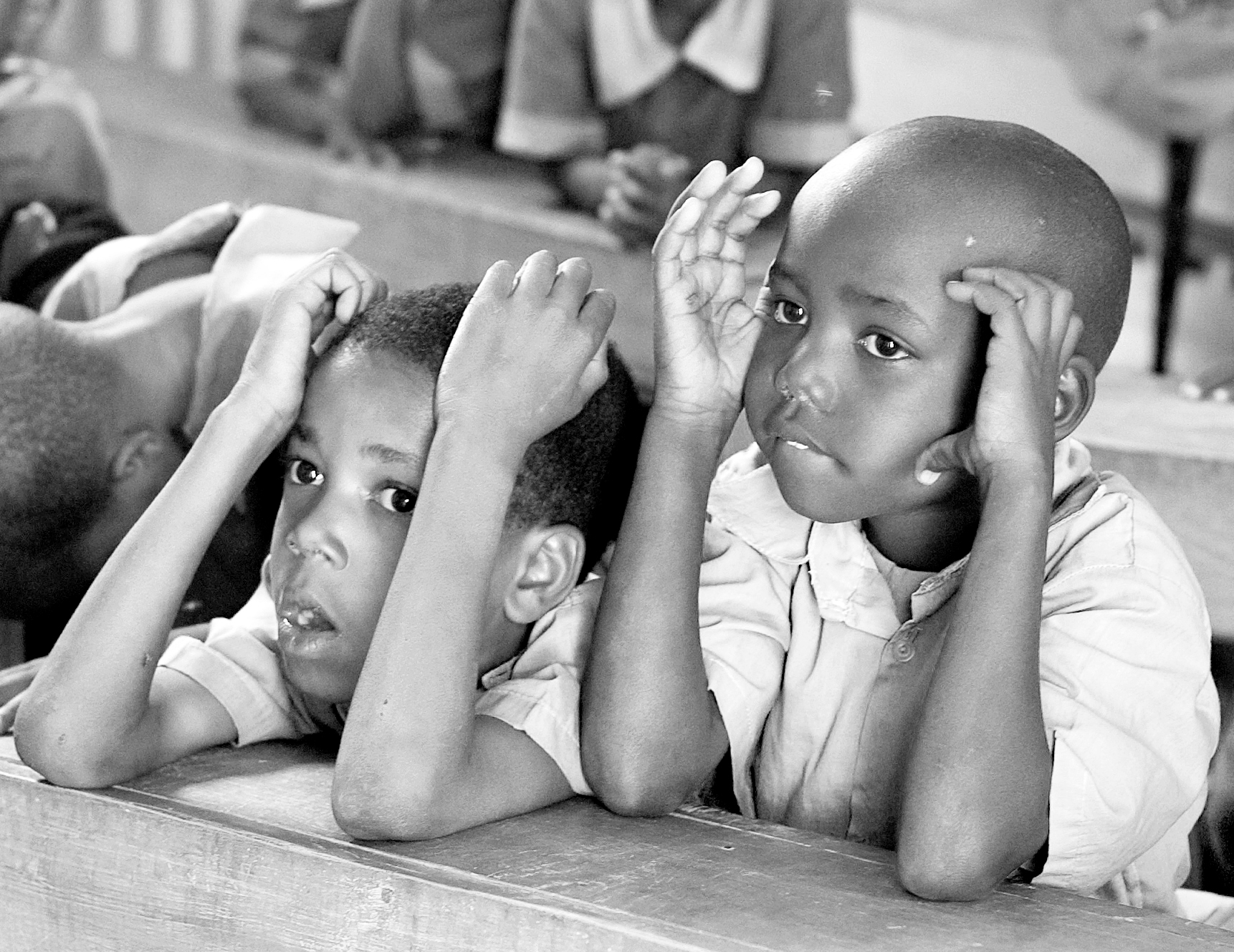
Maasai children listening to a story
Although I have been home for almost two weeks now, it still feels as though I just left Kenya. The trip, the countryside, the people, my fellow volunteers have all still been very much on my mind. I have been missing my fellow travelers but have manged to bridge the gap with email conversations, exchanging photos back and forth and making plans for other events (in a post yet to come.) I have been reliving the experience in Kenya through editing hundreds of pictures. Although Kenya and the Kenyan people are very colorful with their bright clothing, the most powerful of the photographs for me are the black and white photos of faces thought so often seem to convey something unsaid. So I will share some of those:
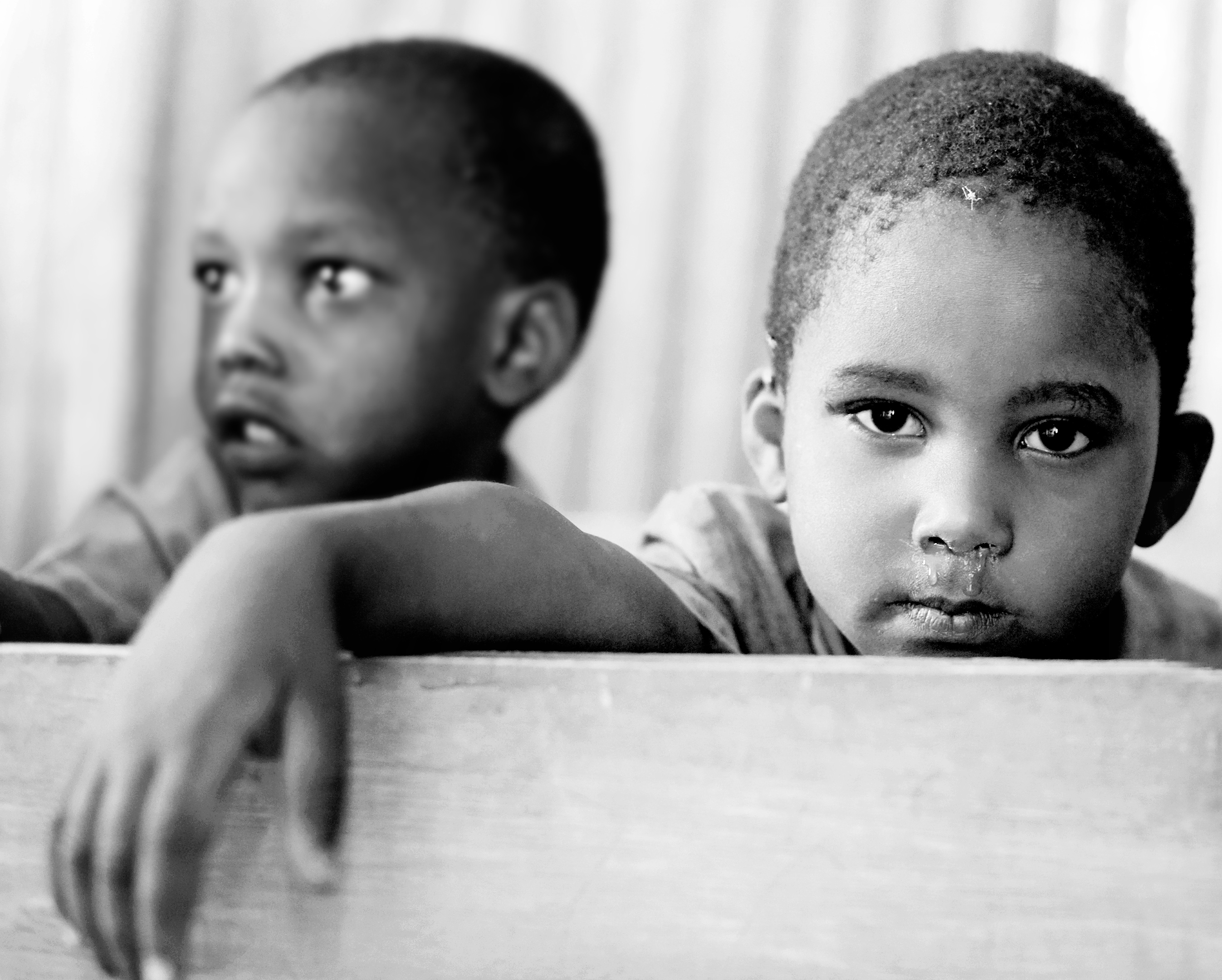
Maasai child in the classroom
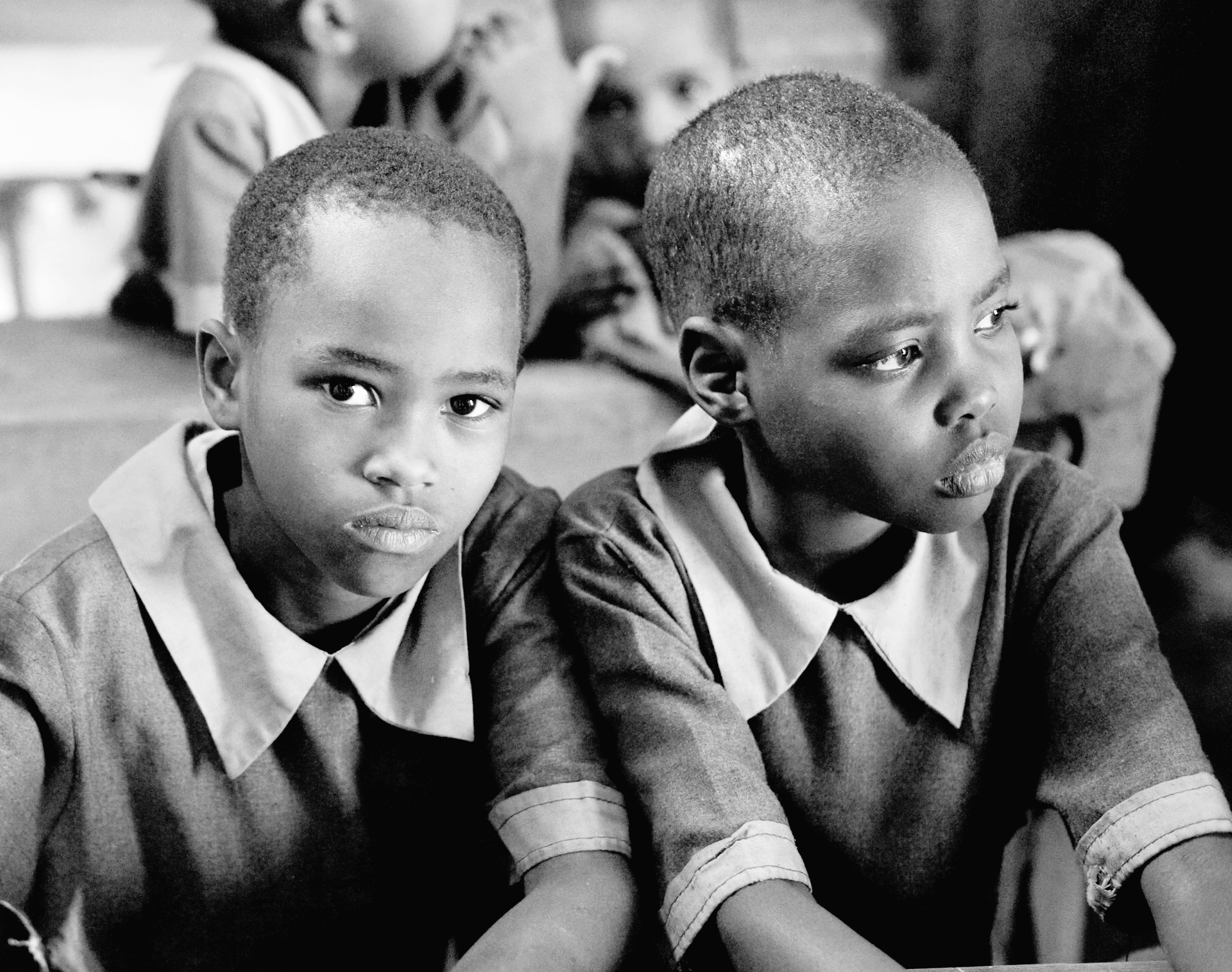
Two Maasai girls at school--I wonder what they are thinking?
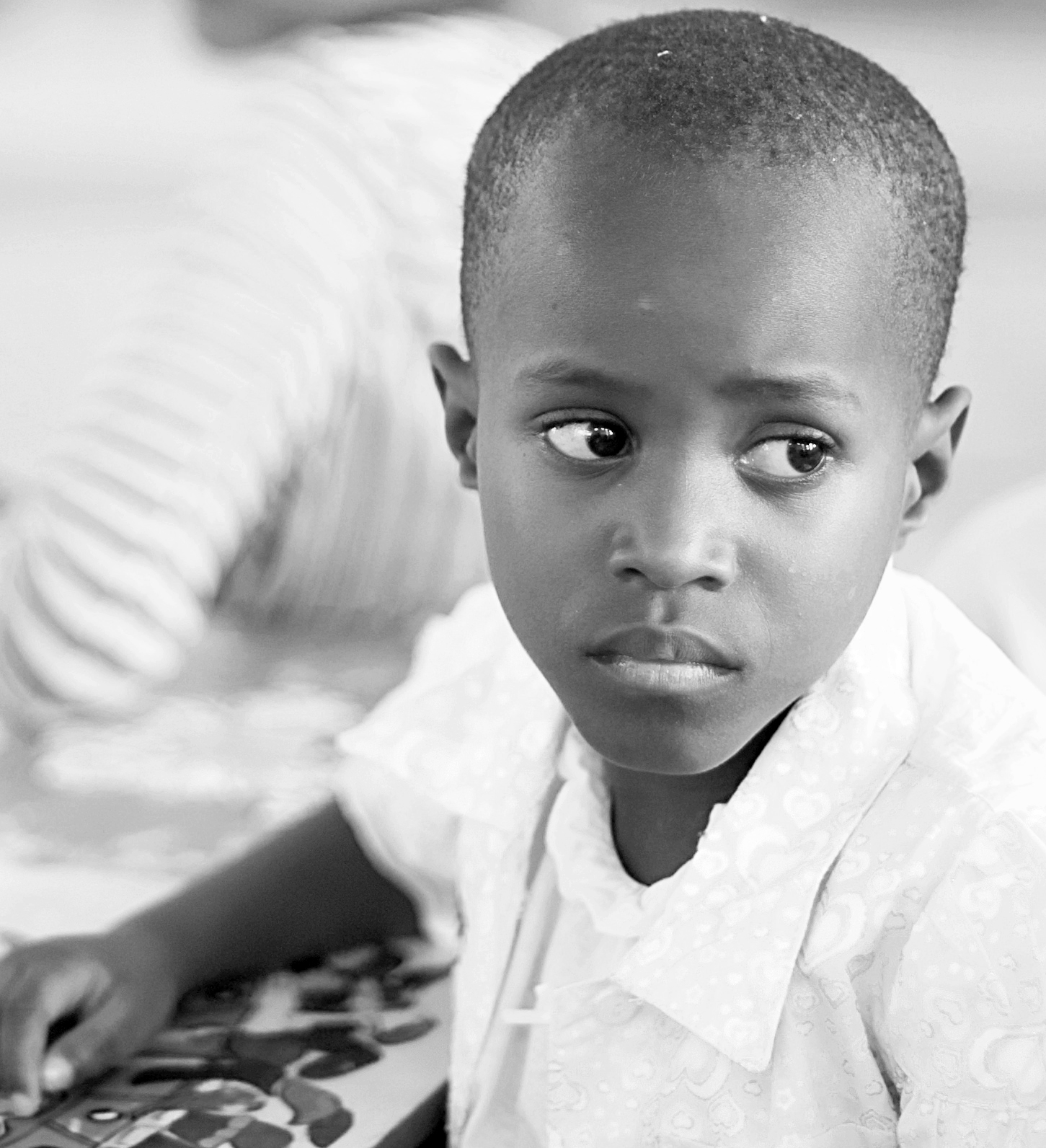
One of the girls in my cottage at the Children's Home
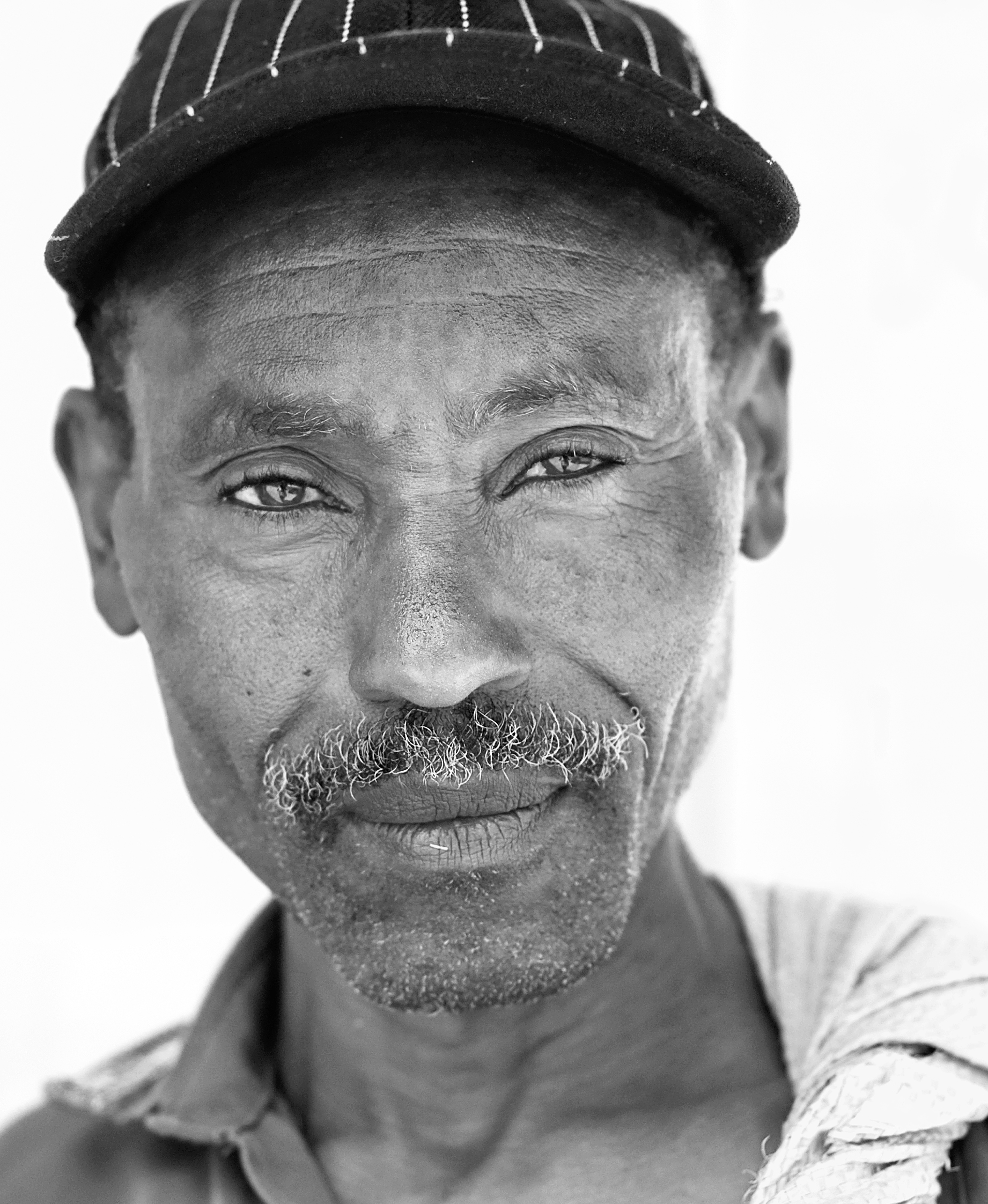
A man at Nyumbani Village--I met him at the food containers and wished I knew how to speak Kikamba with him.
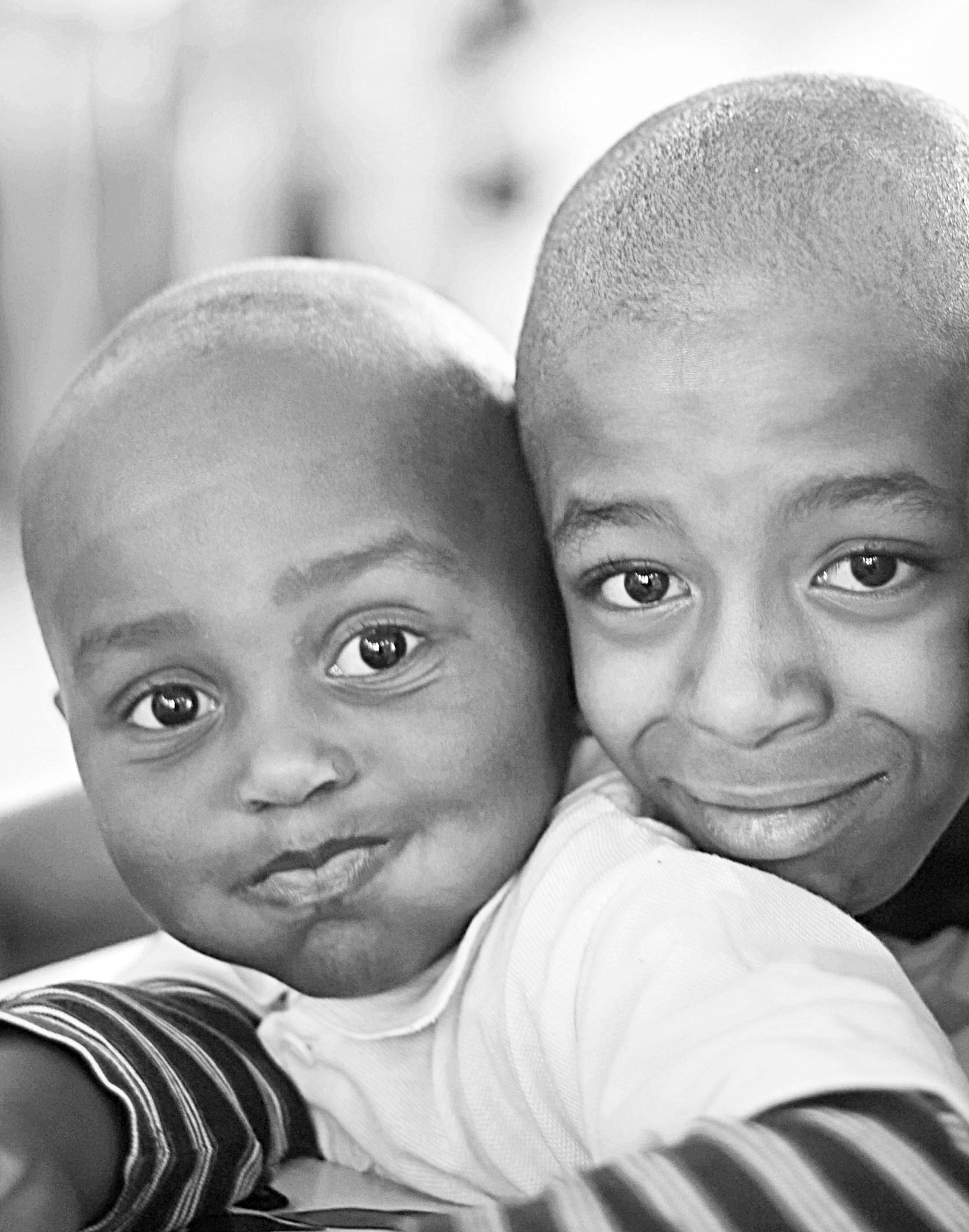
Two boys at the Children's Home-- I think with new haircuts and very impish grins
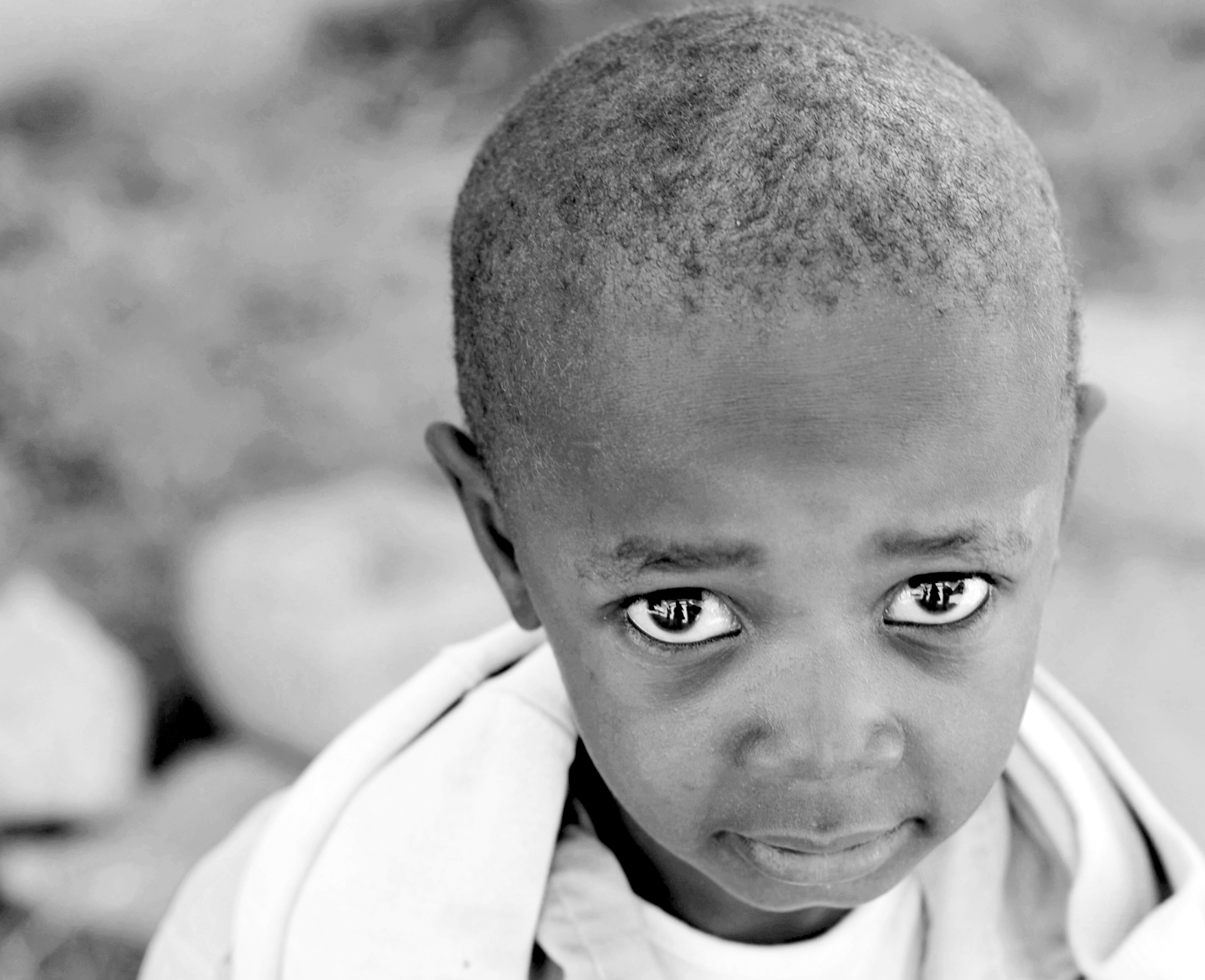
A Village child with an amazing face
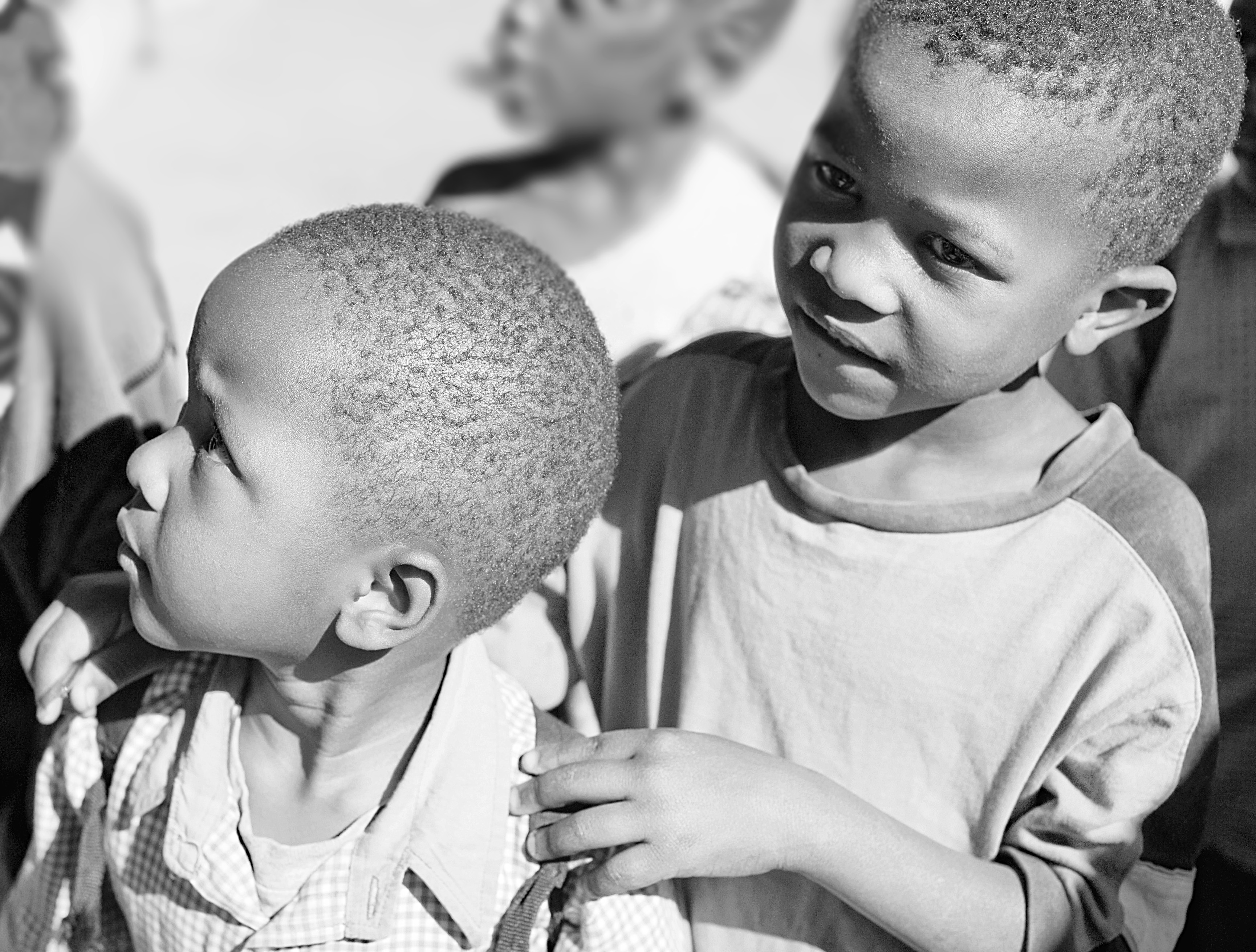
Two of a group of children who ran up to us in Kibera asking "How are You?" in a chorus
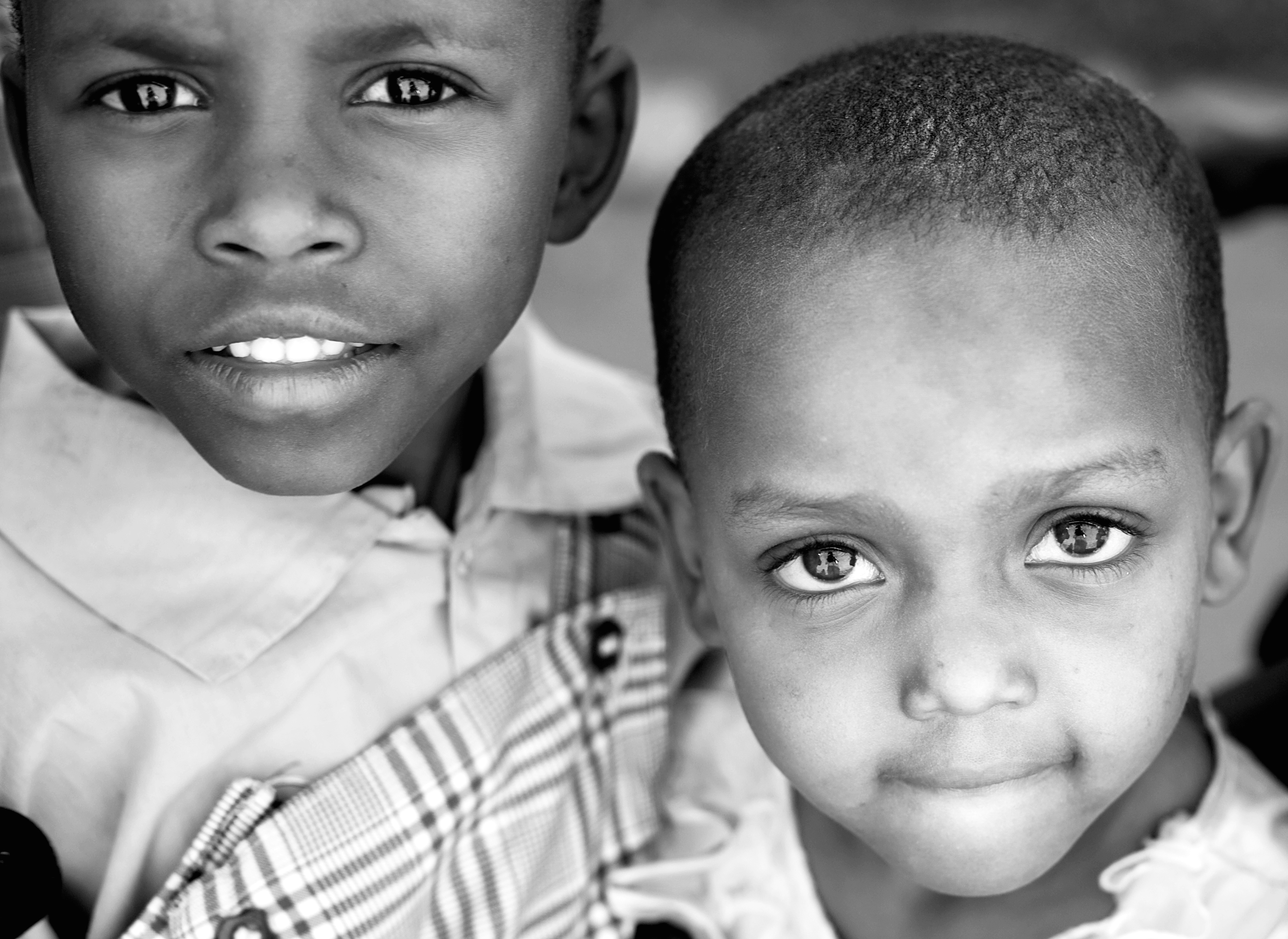
Two Village children on the schoolground
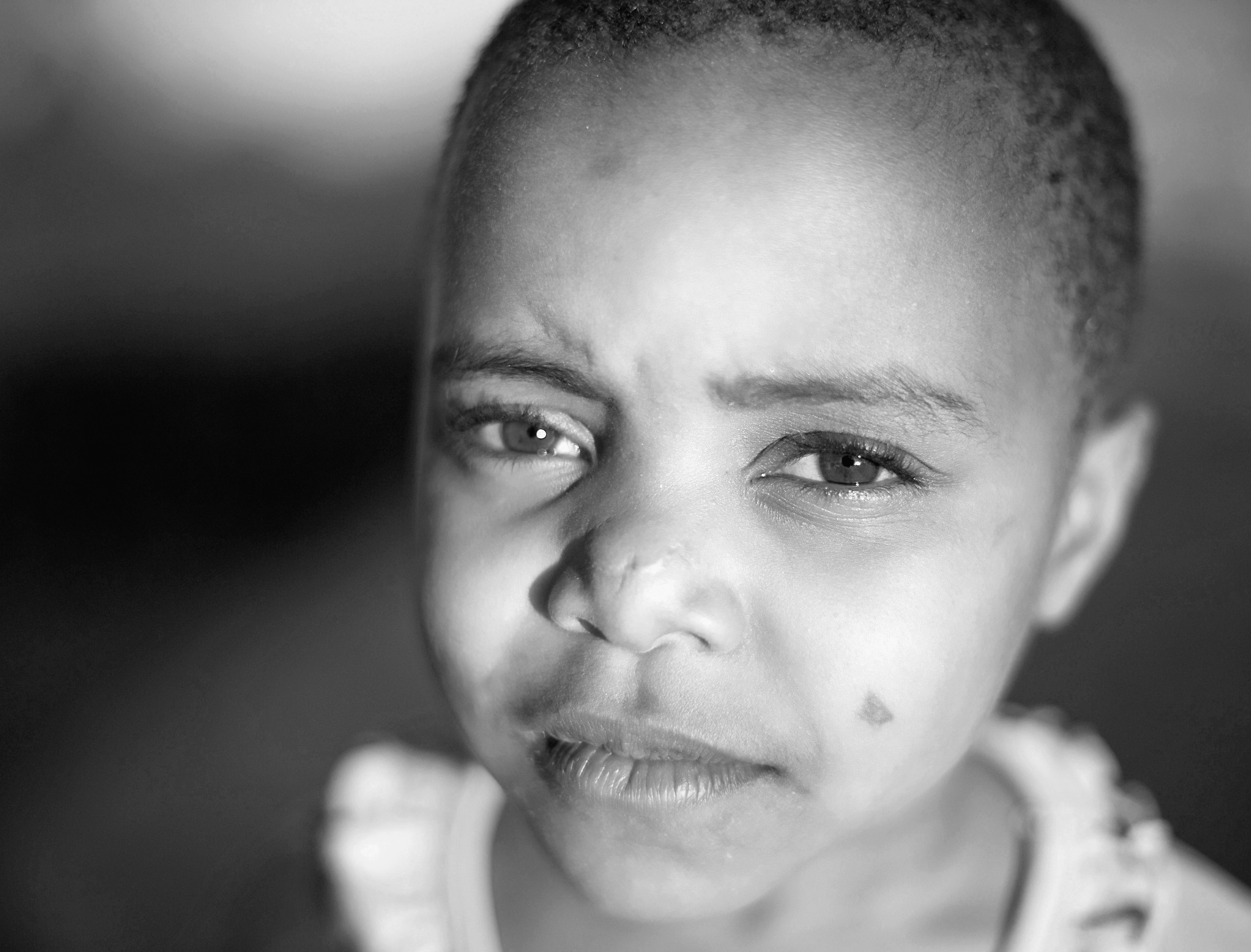
One of the Village children who frequently stopped by our lodging to play
A small sampling of the many photos which I could share and there is a story to go with each and every one of them
Instead, however, I will tell you a story that doesn’t have a picture to go with it. When I left Kenya to come home I did so with a heavy heart because I wished that I could have stayed longer, there was more to be done and LLoydie, Deb and Kristin were headed off to another community and another orphanage called Talitha Kum. I had 6000 ksh (Kenyan Shillings) left of my donations (about $75) which had not yet been used. It had been left over after we bought as much of the ingredients for the Maasai school lunch program as we could fit into four grocery carts and I had set it aside for another purpose yet to be determined. So when I left Kenya, I put it in good hands with Lloydie with the thought that we could perhaps add to the porridge supplies or some other need might present itself. And so it did. When Deb and LLoydie were attending a “prayer group” for members of the community at Talitha Kum, a man, a social worker, spoke up about how he was praying for help for a child with whom he had been working for a long time. The child was an adolescent boy who had lost both parents to AIDs at a young age and had been living on the streets for eight years. He had managed to develop a relationship with him and the child had been remarkably going to school all those years by begging or stealing the money for school fees and a school uniform. When he took the National Exam, a requirement for all form 8 students (8th graders) to be considered for high school, he scored extremely high. On the basis of that he was accepted into a very fine government high school; these are the best schools in Kenya to which every student wants to be admitted. But the cost of travel to the school which was such a distance away was too much and he could not attend. The social worker took him and his records to the “Elite School” (I include the name because it’s so cool) which was a more local private school and asked if they could do anything for him. There he was told that if he could come up with the first year of tuition they would accept him and the next three years would be paid for by the school. So the social worker and the boy had raised a lot of money, but it wasn’t enough for him to start school in a few days. Hence the prayer at the meeting, and the connection with the remaining 6000 ksh. LLoydie and Deb spoke up and offered to pay the remainder with that 6000ksh and 2000 that they each through in and made arrangements to do so at the school. So this boy is now guaranteed an education, but equally important is that because he will be in boarding school as high schools are in Kenya, this will be the end of eight years of living on the streets for him–he will have a bed, a home, and three meals a day. He must be an incredibly resiliant young man to have survived on the streets while succeeding so well at school. I think that this was a perfect way to spend the rest of the donations. It always amazes me how little it takes to impact someone’s life in Kenya, how sometimes the pieces just fall into place. When I was talking to Lloydie today about many ongoing and future plans–and because we were really missing each other, she said we need to visit this boy and the social worker when we go back to Kenya. I think that sounds like a fine idea.
Pastoral Community Development Association
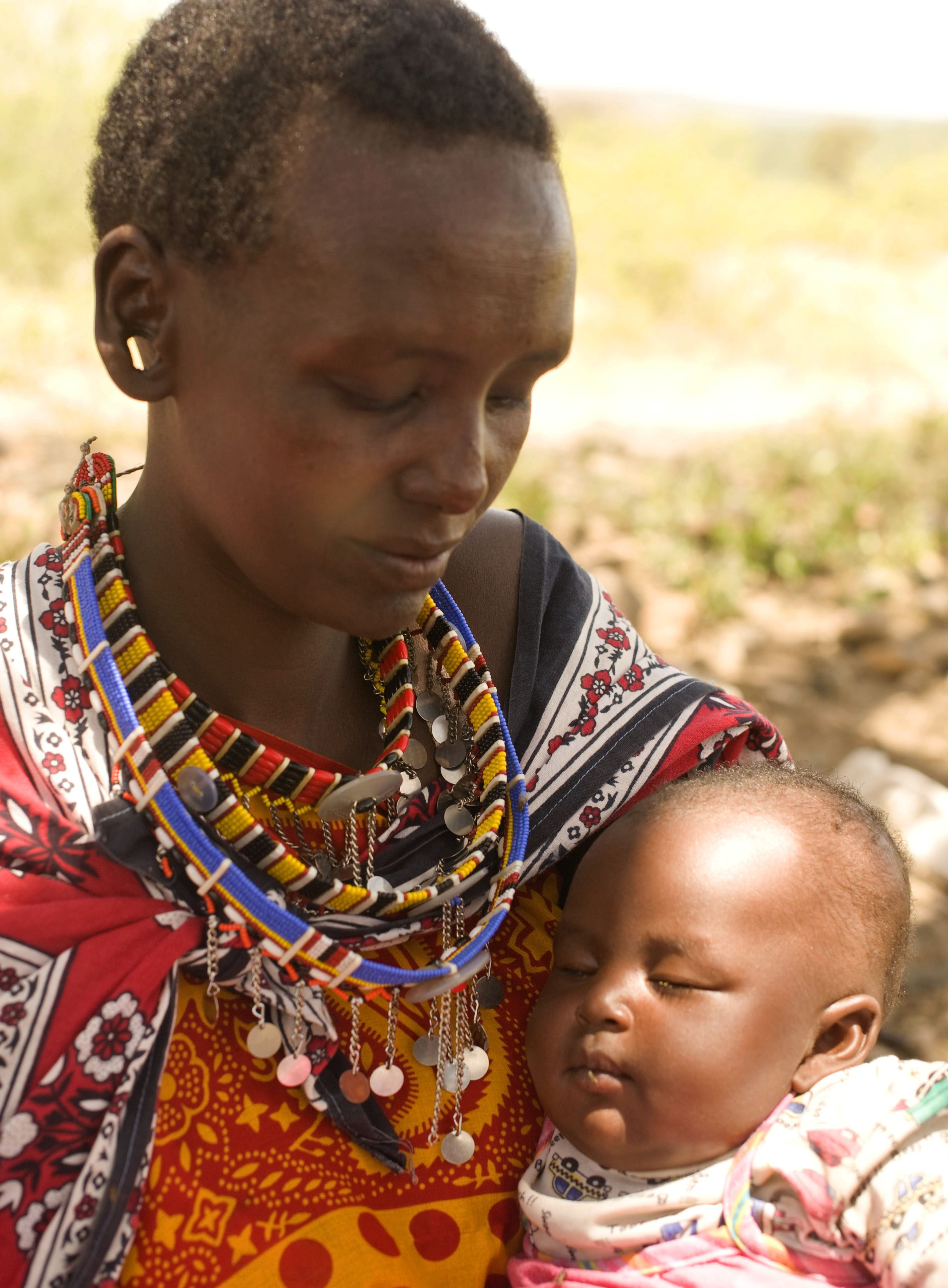
Maasai woman and her baby
This trip just keeps on being amazing! We have spent much of the last 2 days in a Maasai Village working with the PCDA (Pastoral Community Development Association). The drive there was quite beautiful as we drove beside the Ngong Hills and down into the Rift Valley. KEST became involved with this program rather serendipitously when Lloydie and Karen who was a fellow KEST volunteer with me in 2010 sat beside Philip the director on a long flight a year or so ago. Maasai communities are struggling to maintain their traditional culture of being semi nomadic despite pressures from the government to be more sedentary and obstacles from the environment such as drought. It is a male dominated culture in which the males are herdsmen and the women build the houses, cook, take care of the children, etc. Houses are made of sticks thatching and mud and cow dung covered walls. All children going to school such as the one that we visited in this village is a relatively modern phenomenon which is not a usual part of all Maasai culture. The goal of KEST’s involvement is to help with the school program development, to support the school lunch program (which may provide the only daily meal for some of the children) and to assist the women in selling their crafts through the Women4Women Initiative.
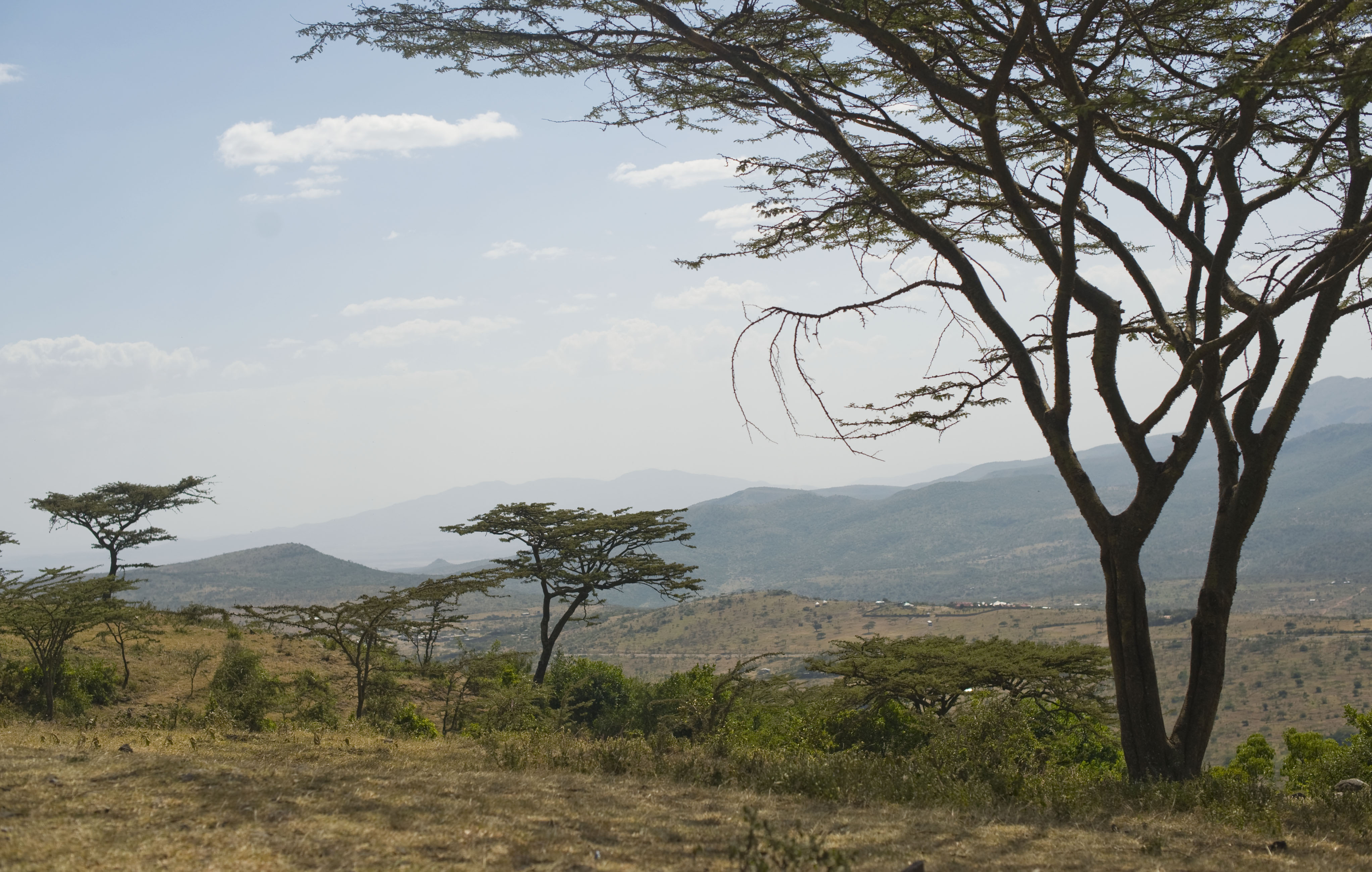
View of the Great Rift Valley
Friday we were at the school in the Maasai village and focused our time with the children. They were unbelievably cute! This involved singing, reading books, and crafts projects some of which built on previous lessons that they had learned from other KEST volunteers. As my assigned job, I got to rove back and forth between the two classrooms and help the children where help was needed and to take photos (much more fun than work). After the classroom work was done we went outside where the children got temporary tattoos from Kristen and face paint from Deb and me. Since there were so many children we were aiming to just paint one thing on one cheek and did butterflies, flowers and such on the girls and birds, turtles and oops….snakes on the boys. We learned that the snakes were a really bad idea when we discovered them wiping them off because they are quite afraid of snakes—a cultural faux pas which we rectified with “do-over’s”. The children were very enthusiastic learners, very well behaved, and seemed to really enjoy having us around. For those of you who gave me monetary donations, some will go to help with purchasing food to keep the stock of supplies (maize flour, oil, powdered milk and sugar) necessary to make daily porridge for the school lunch program.
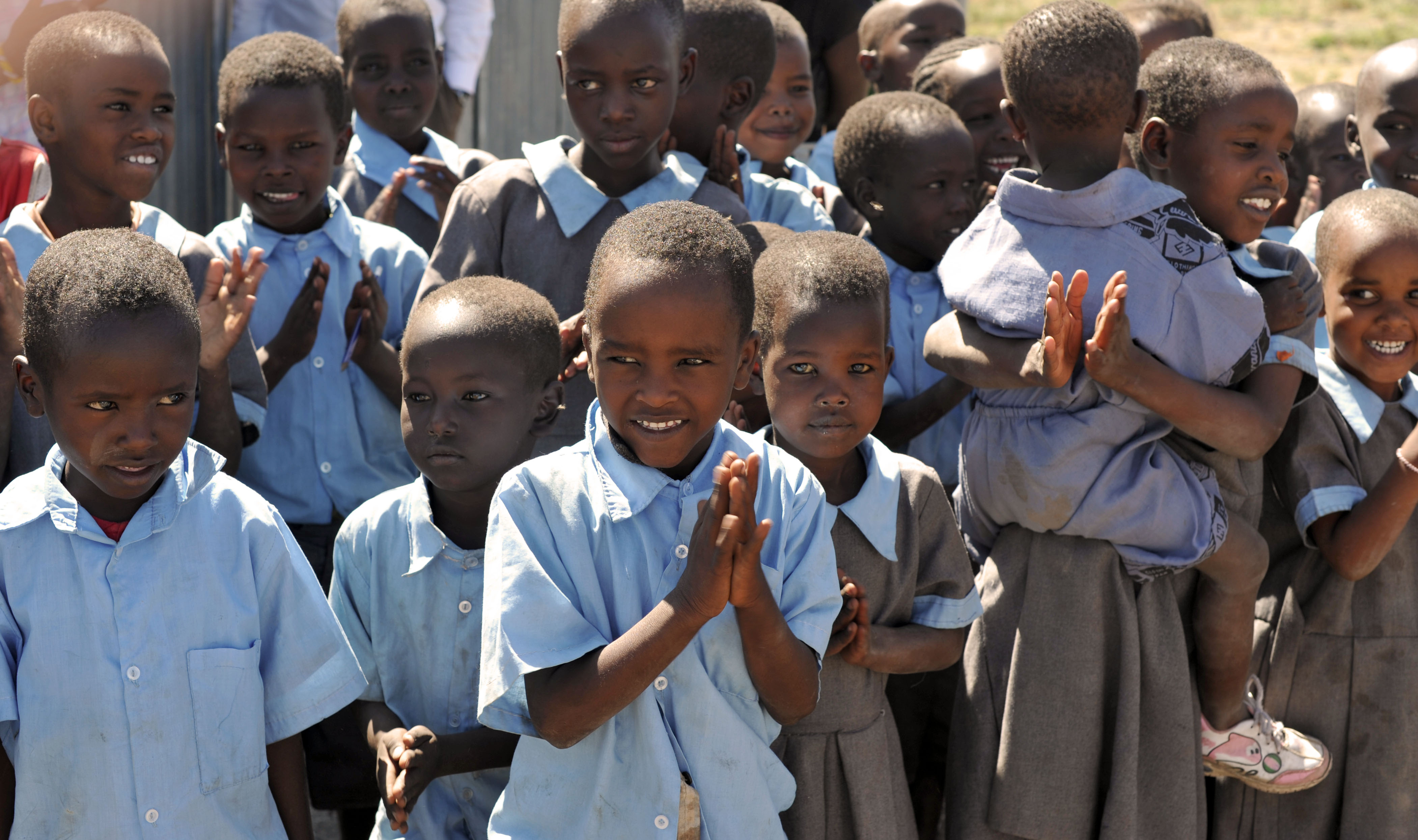
Maasai Children in the School yard

Maasai Children at school
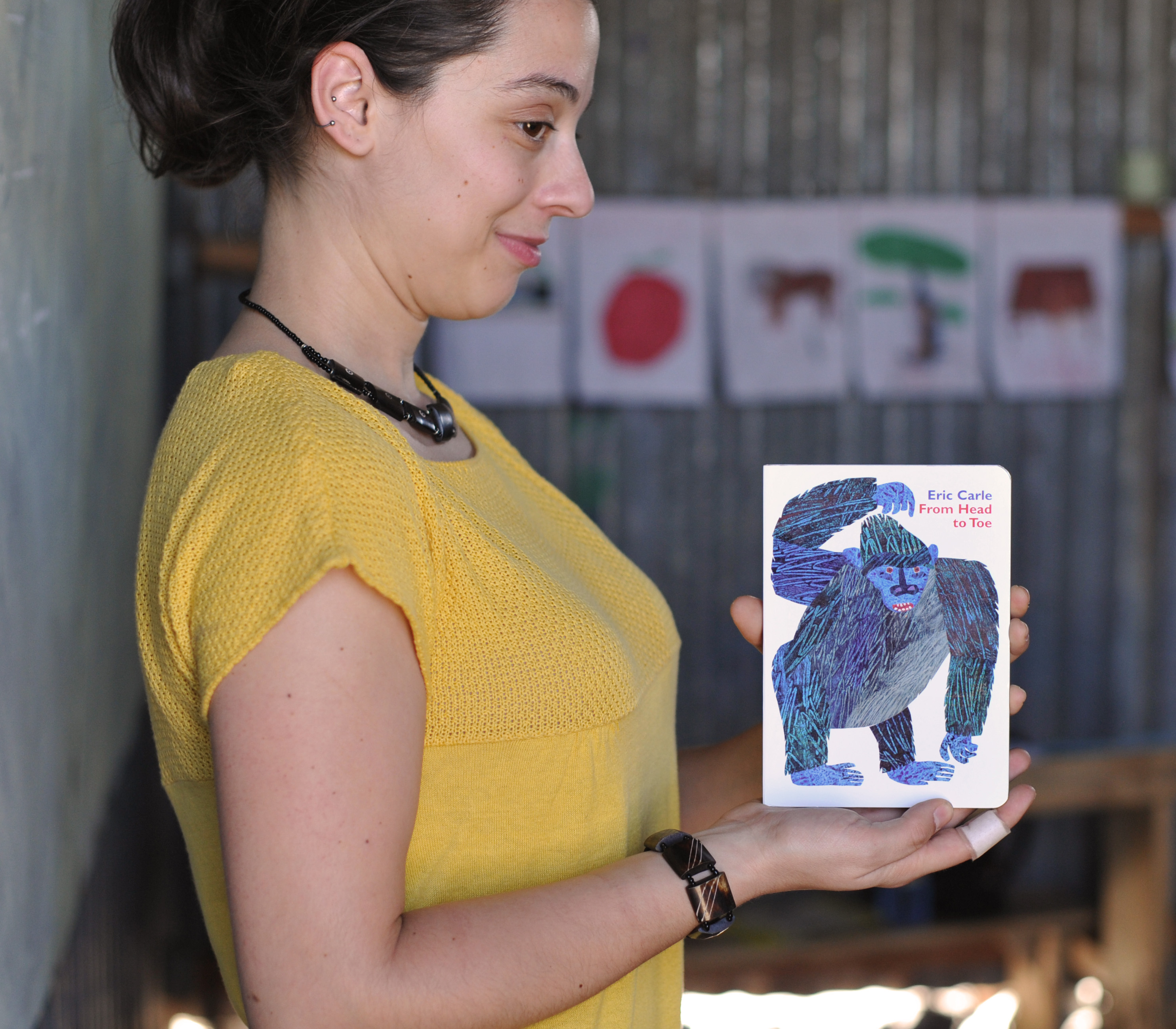
Kristen reading an Eric Carle book to the children
Watch and hear the children sing BELOW:
On Saturday we went to the homes of the families and each was assigned to help a Momma with the daily chores (except for Walter who got to sharpen his herding skills!) I went off with Jane and was assisted by Helen a lovely 13 year old who could speak English very well. After going inside the very hot and dark hut we made a fire and made chai from milk, sugar and loose tea. We talked a lot over tea and translations and Jane gave me a Maasai name that I have no idea how to spell and it took me many tries to learn how to say. It sounds like this—Nasorrrwah with the r’s being rolled a bit and it means “one who gives” in Maa (Maasai language) I thought it was rather a sweet name though in the course of my practicing my emphasis was bit off…and so was my pronunciation which had Jane’s nine year old Joy rolling with laughter and together we all had a fun time with it. Helen, who I actually the daughter of Jane’s neighbor loved to take pictures and did quite a good job, she took pictures of me doing the dishes and then she took me outside to see the baby goats,. She said to me “You catch a kid and I will take your photo.” Well, they are not that easy to catch and they move a lot faster than you might think, so she had to catch one for me (SHE made it look easy). That was good for quite a few laughs. Finally she did take my picture with the baby goat and the little boy Morris looking on.
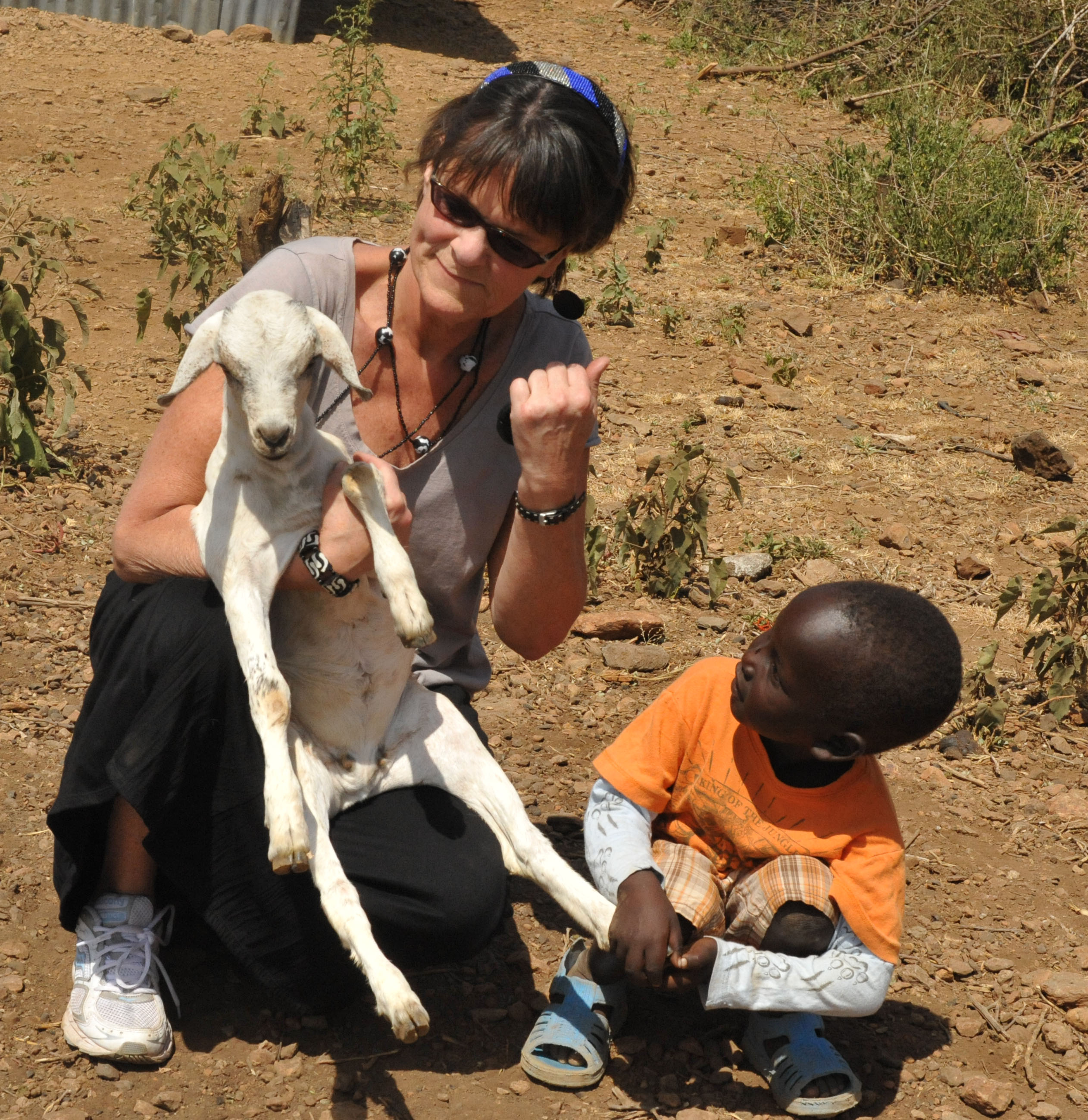
The babyy goat and Morris and me
She then took some pictures with Jane and me and her mother with beautiful Maasai jewelry on. When it came time to leave Jane actually gave me a bracelet and a beautiful necklace which I will treasure.
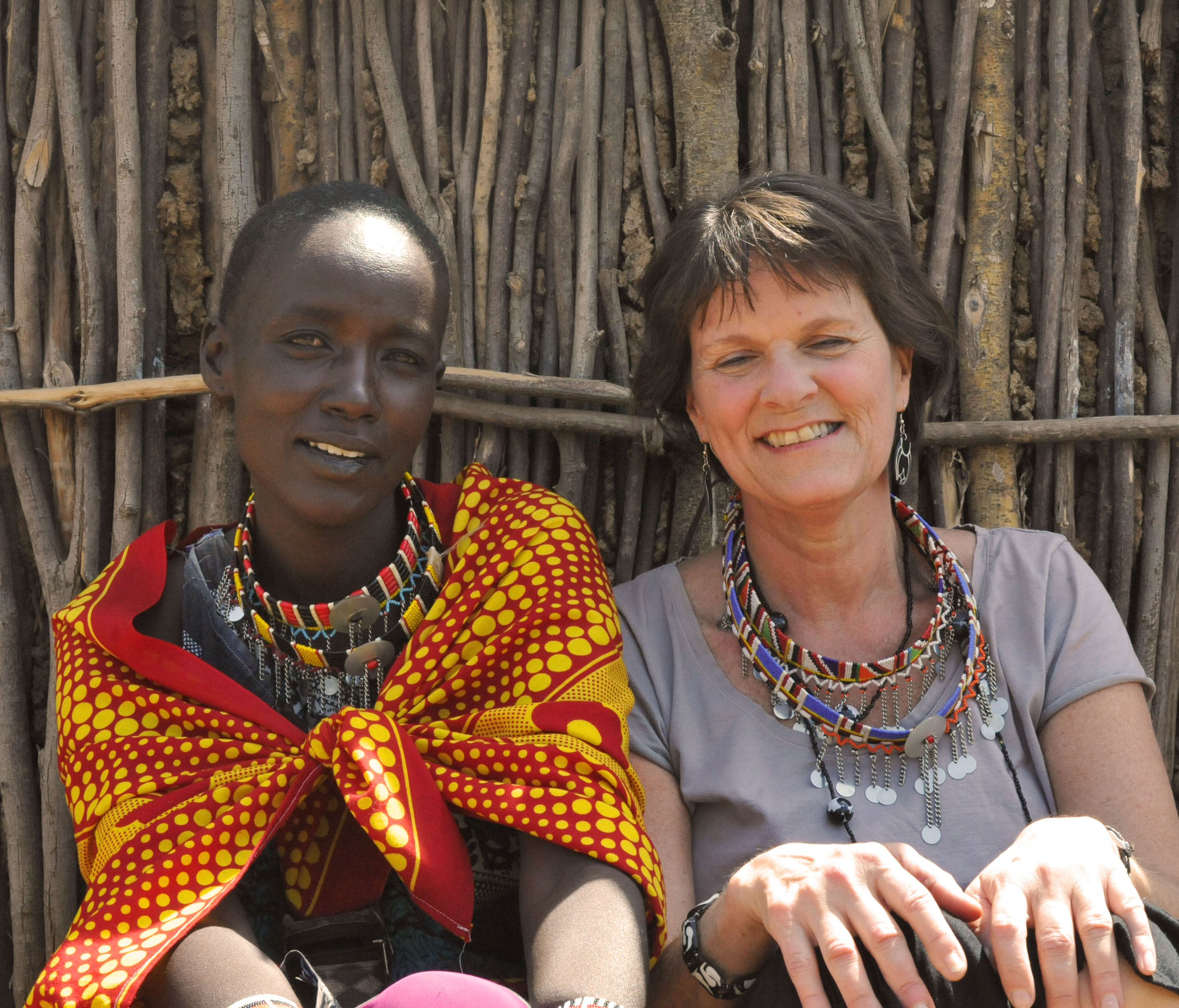
Jane and me
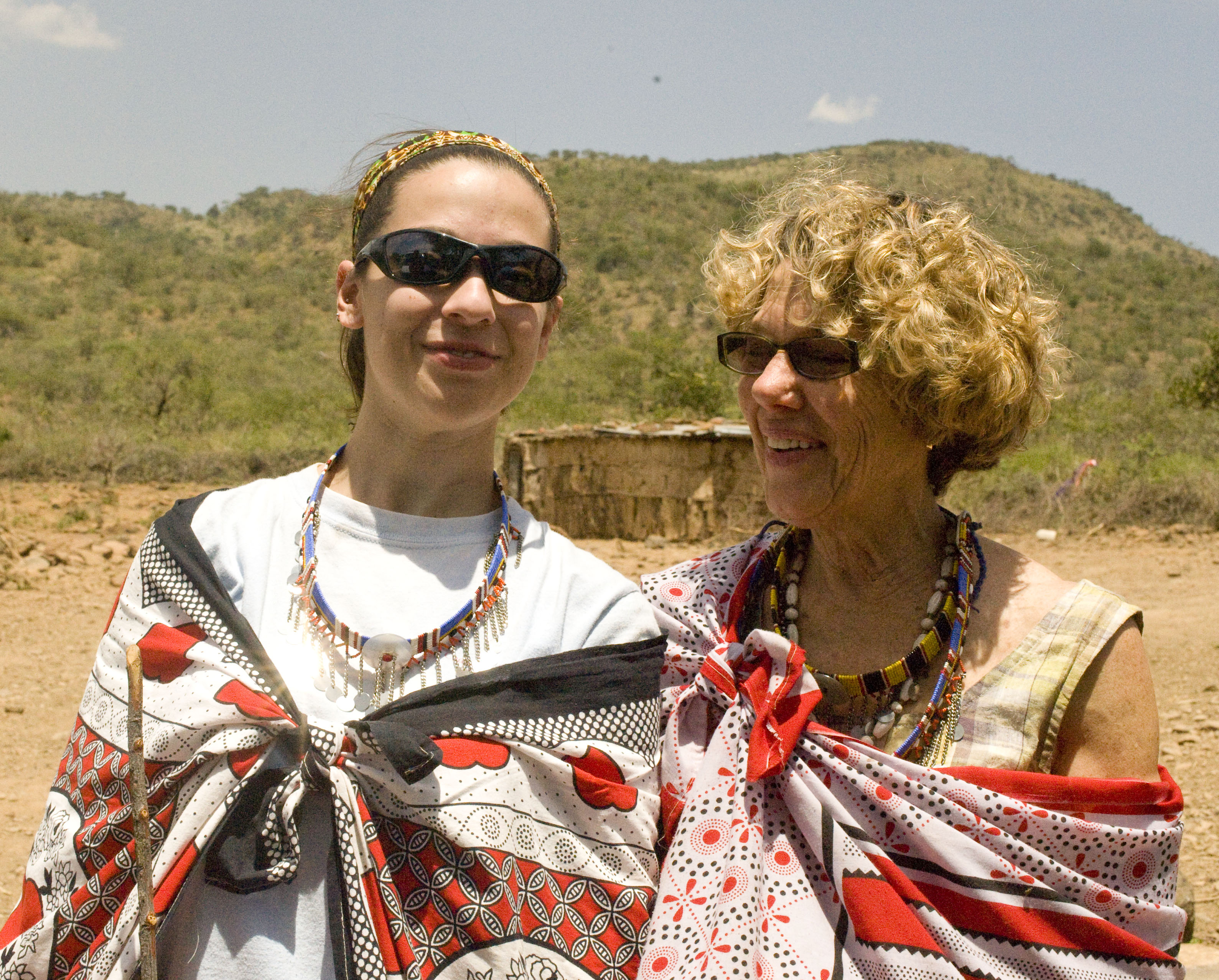
Kristen and Lynne, Mzungu Maasais
In the afternoon we met with the women who do crafts which largely involve some kind of very fine beading. They were seated beside the road under a tree; all dressed in beautiful brightly colored clothing and traditional jewelry with their ware spread out on beautiful cloth. It was like this spectacular patch of bright colors in an otherwise nearly monochromatic sea of muted green.
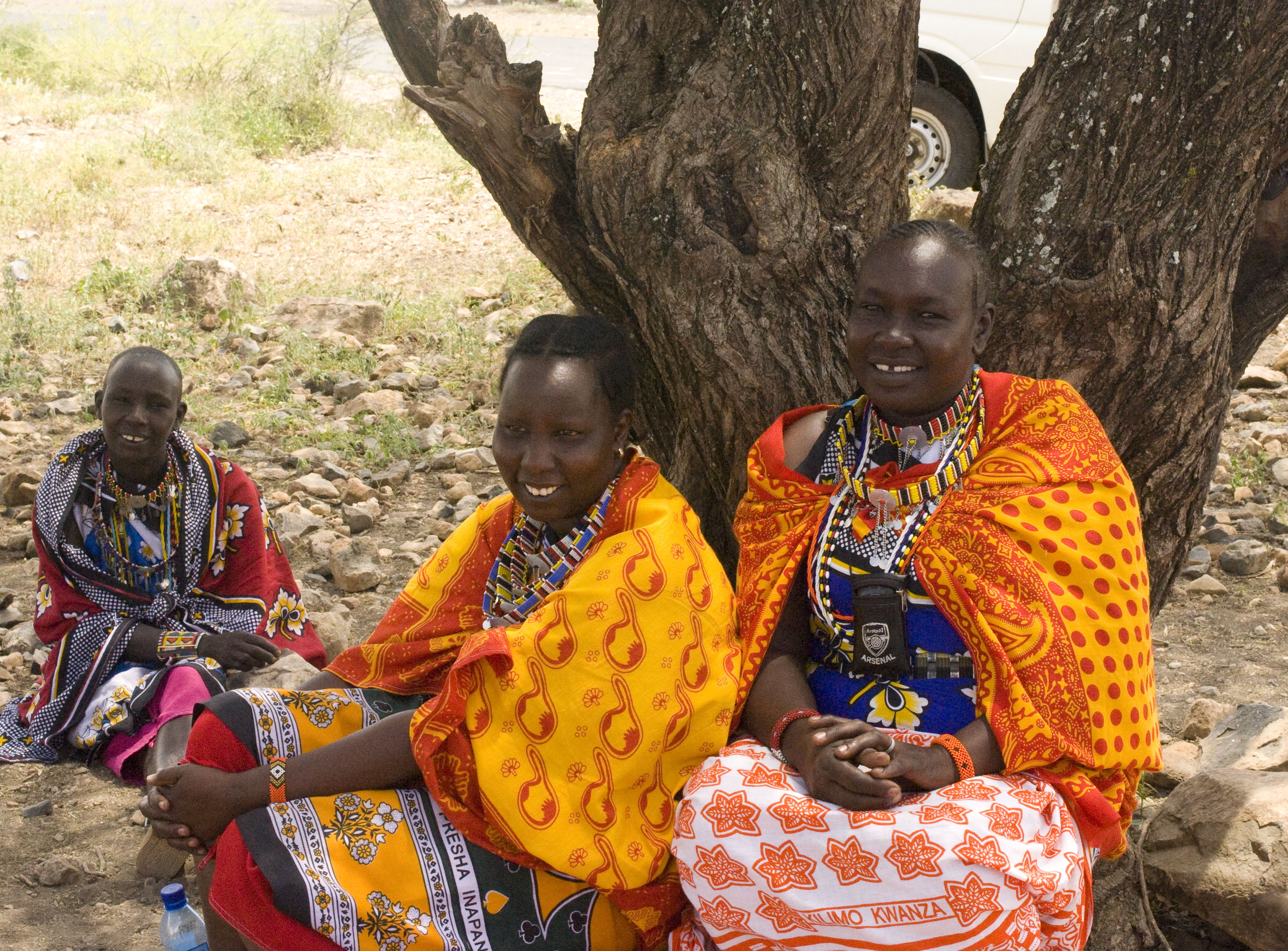
PCDA Craft Women
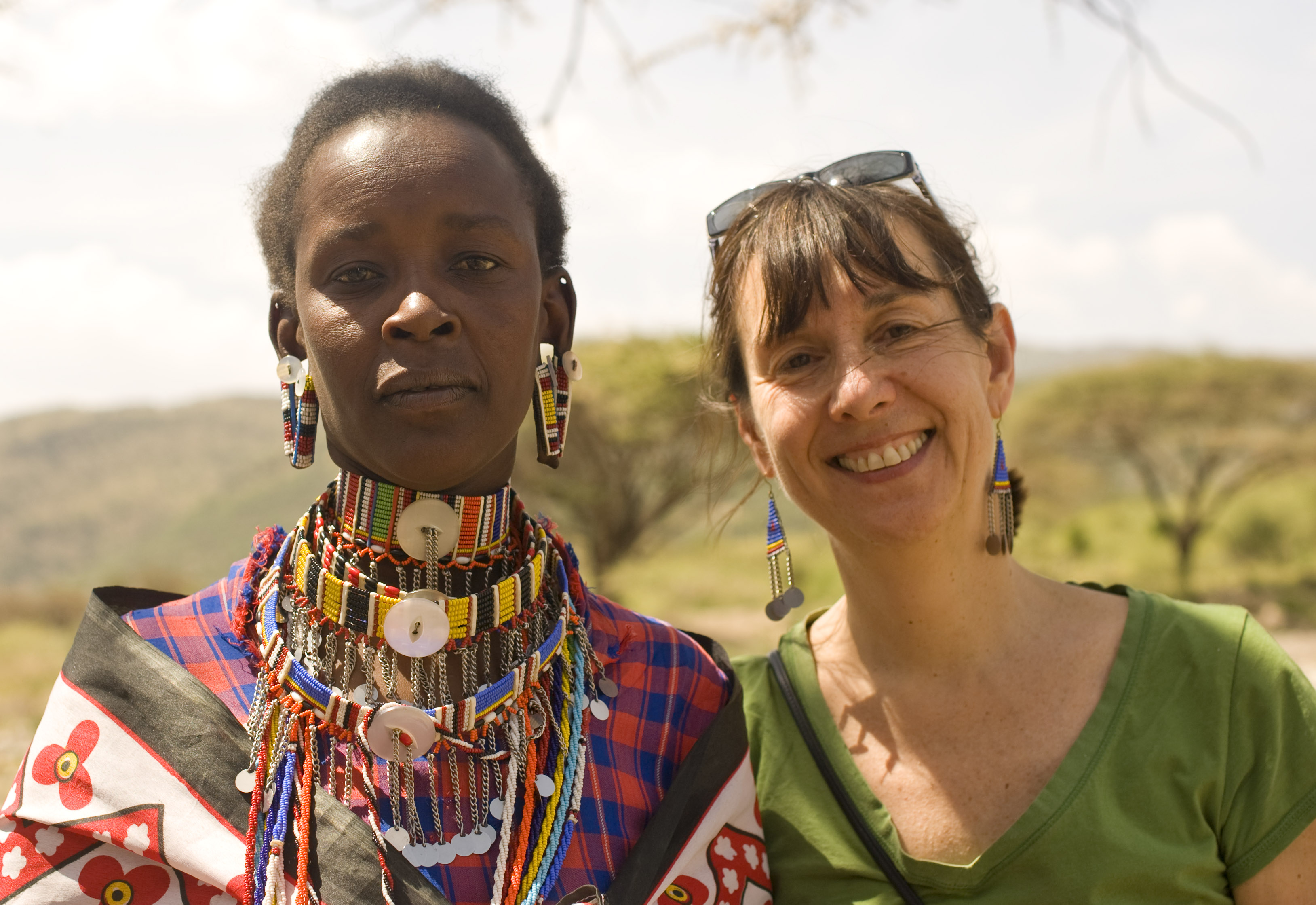
Deb and her Maasai Friend
Lloydie explained the Women4Women Initiative with help of Philip as translator. We talked about their crafts and mingled and enjoyed seeing the work that they had done which had many reflections of the culture contained within it. Before our departure they sang us a song….of course. It was a great couple of days of cultural exchange, building relationships, and making a committment to help this struggling community in an ongoing way.
Kibera Paper and so much more……….
Wednesday and Thursday were two really packed days such that when I arrived back at our lodging on Thursday night after 10 I was too exhausted to get a blog post done.They were as usual two incredible days filled with new experiences, inspiration, dancing and singing and yes once again tears from being touched by the experience. You go through a lot of tissues here!
We spent the better part of two days at Kibera Paper. I blogged in an earlier post, before I departed, about how Kibera Paper employs women from the Kibera slum and enables them to earn income to support their families when they would otherwise not be able to afford the basic necessities of life. We had two incredible days working with the women at Kibera Paper, getting to know them, working alongside them , learning their craft, exchanging ideas with the 2 young male artists who create many of the designs and really touching each other’s hearts. The KEST volunteers learned from the women how to make cards from beginning to end—that included “processing” the recycled paper (squishing it by hand in the water) into mush and then making it into sheets.
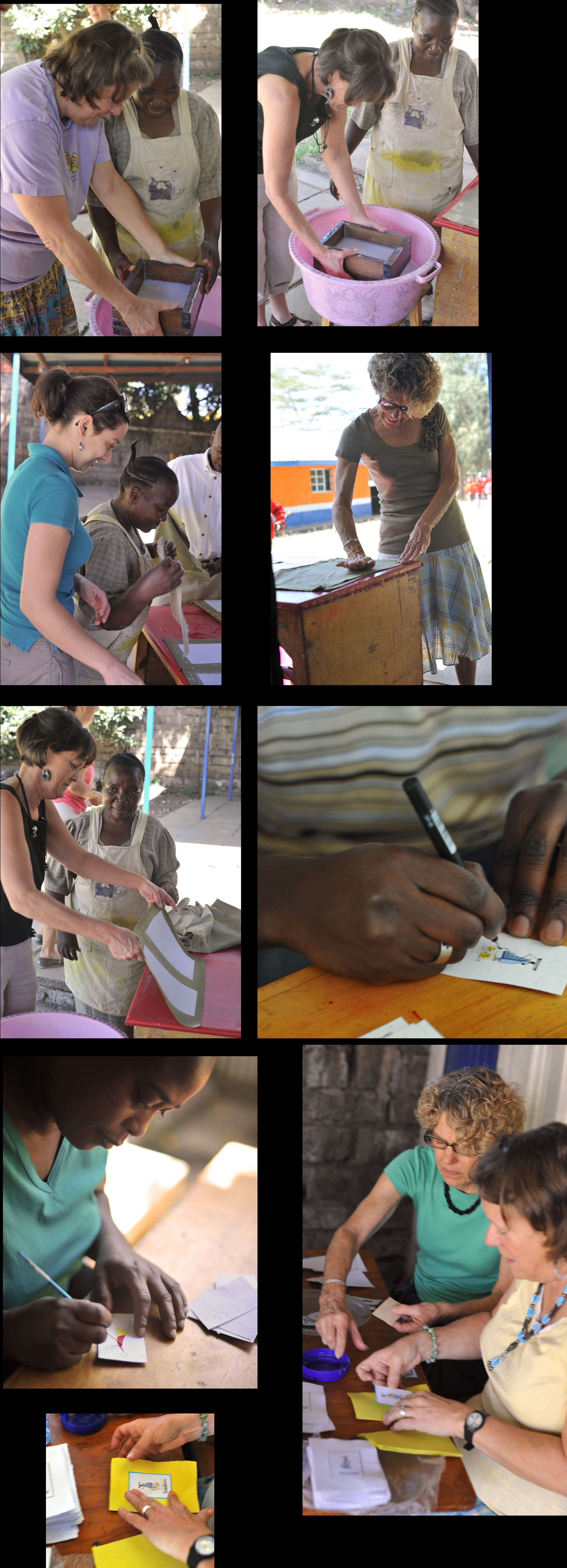
Learning to make Kibera cards-- Start to finish!
We also painted, beaded and threaded some designs and glued them together, folded and threaded the cards, put the Kibera Paper logo and description on the bag and even signed some of them. Since they were in the process of making more of my favorite mother and baby cards I was especially delighted that we got to participate in the making of those. We really learned how time consuming and intricate a process it is to make Kibera cards since they are handmade every single step of the way in the finest detail.
Bothe Deb and I worked with the Mommas to help them create cards with a technique that we use. Deb brought a lot of materials to make valentines since we are coming upon that holiday and that is recognized in Kenya.
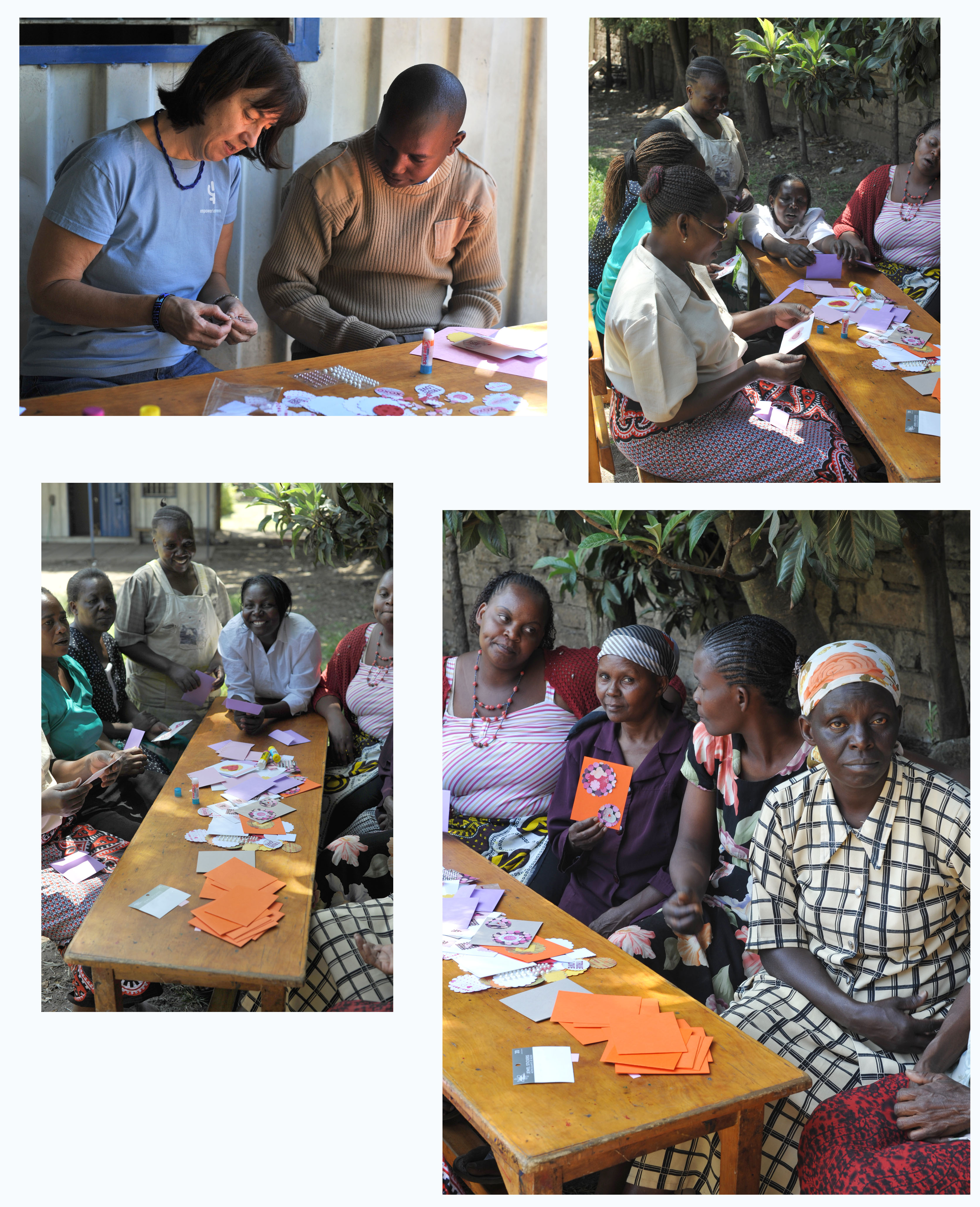
Deb's valentine project with the Kibera Paper women (even Justice helped out with this)
I really wanted to work with the woman to teach them a technique that they might be able to incorporate into their production and might be both fun by introducing something new, but also sustainable if I brought extra materials. I decided to teach them how to make small block prints with softcut linoleum and lino cutters and how to print them. If they liked the process and the designs, they would then be able to print the same blocks over and over again since I brought a lot of extra ink, printing paper and other materials to keep them going for a quite awhile. Wel, l I have to say that this was very exciting to me. They started out being very hesitant and unsure of themselves and by the end they were so proud of the work they had done that it just warmed my heart to see this unfold. I felt so happy to tell them what a wonderful job they had done and how proud I felt to have taught them. And they were profusely grateful for the lesson and the materials.
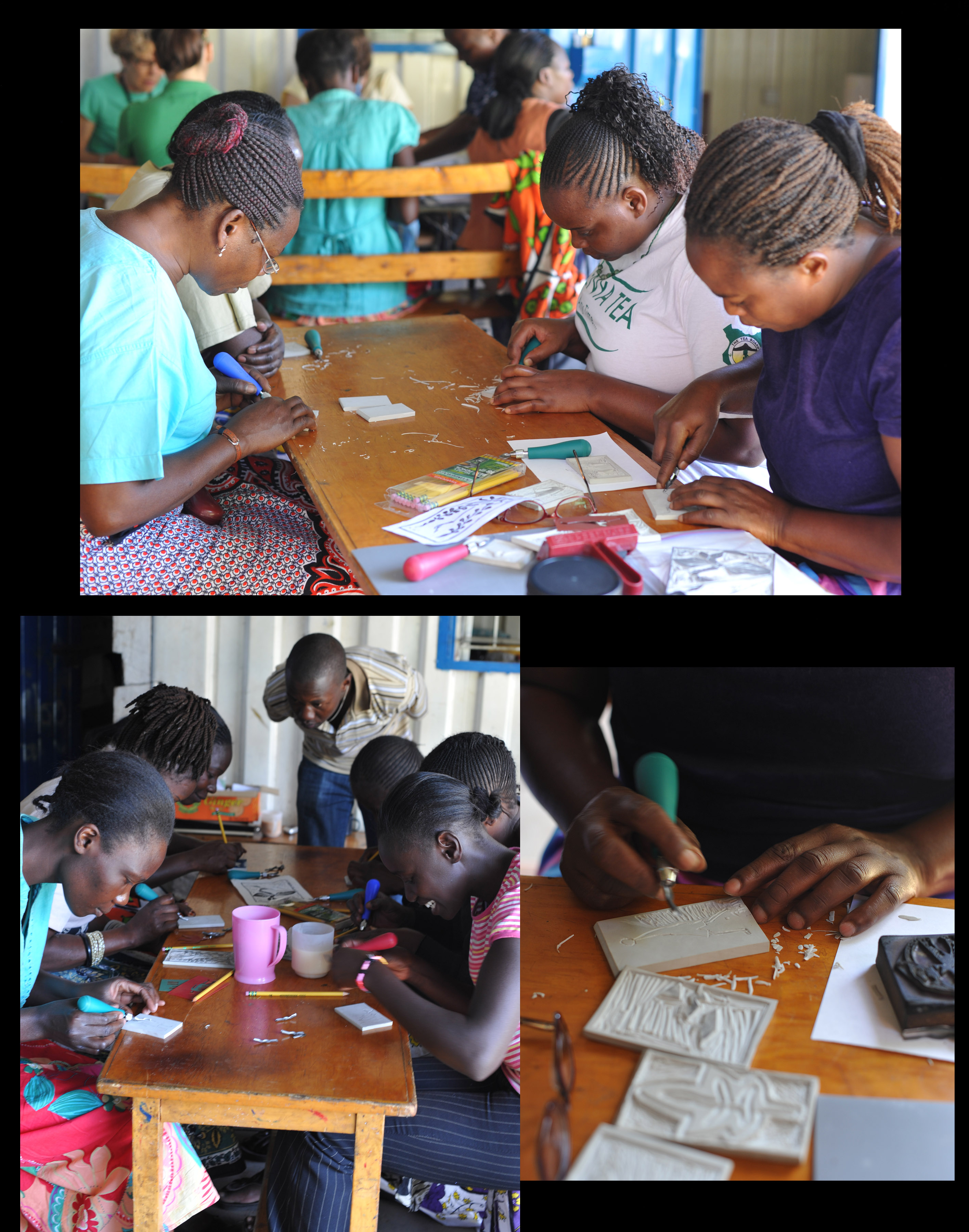
Kibera Paper women making block prints
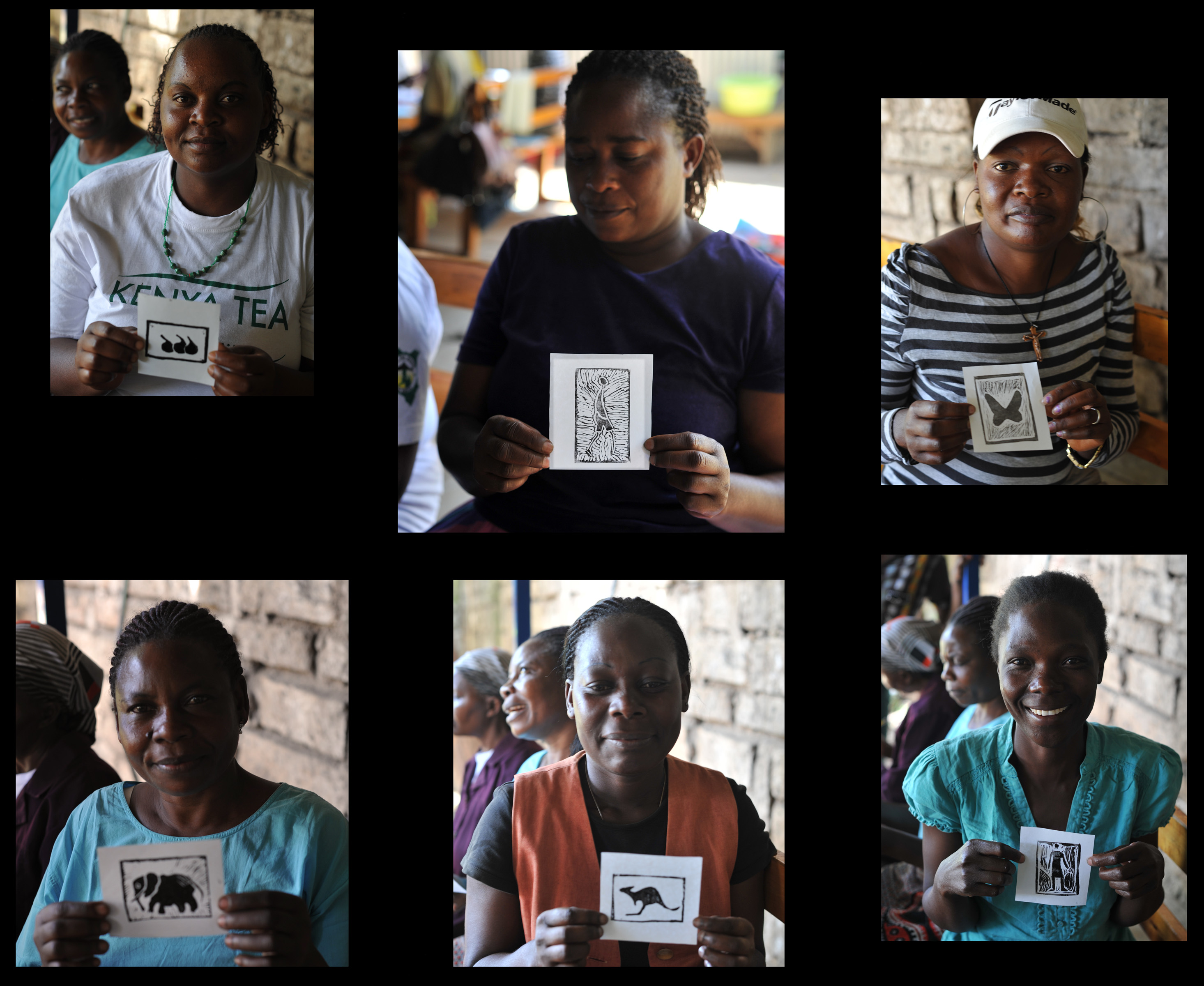
Proud of their work!
Both days we enjoyed chai and biscuits together and shared a genuine exchange of warmth and affection. Lloydie explained the mission of the Women4Women Program and how it would work and its intention to increase their sales in the U.S. We also shopped heartily form their stock of cards which are just beautiful.
When it came time to leave there was a lot of singing and dancing, the most joyous of which you can see in these videos.
There were also blessings in song and words shared in the Kenyan way which is to speak from the heart without being shy in a way that we don’t tend to do in the U.S. and when you experience it in Kenya it is so profoundly touching—well, that is why we always end up in tears. They are not shy about acknowledging that our hearts have been touched by each other and doing it in the loveliest of ways. And Kenyan goodbyes—well everyone gets hugs and you are escorted to your vehicle and hands are held, and more hugs and people are still waving as you drive away……
Since Kibera Cards are made on the property of a church and school where space is rented to allow for making and storing the cards , there are sometimes school children around as was the case when we were there. Since they were so adorable and I can never pass up an opportunity to photograph a child, I thought I would give you a peek and these children looking especially “smart” (Kenyan term for sharp, stylish) in their red school uniforms.
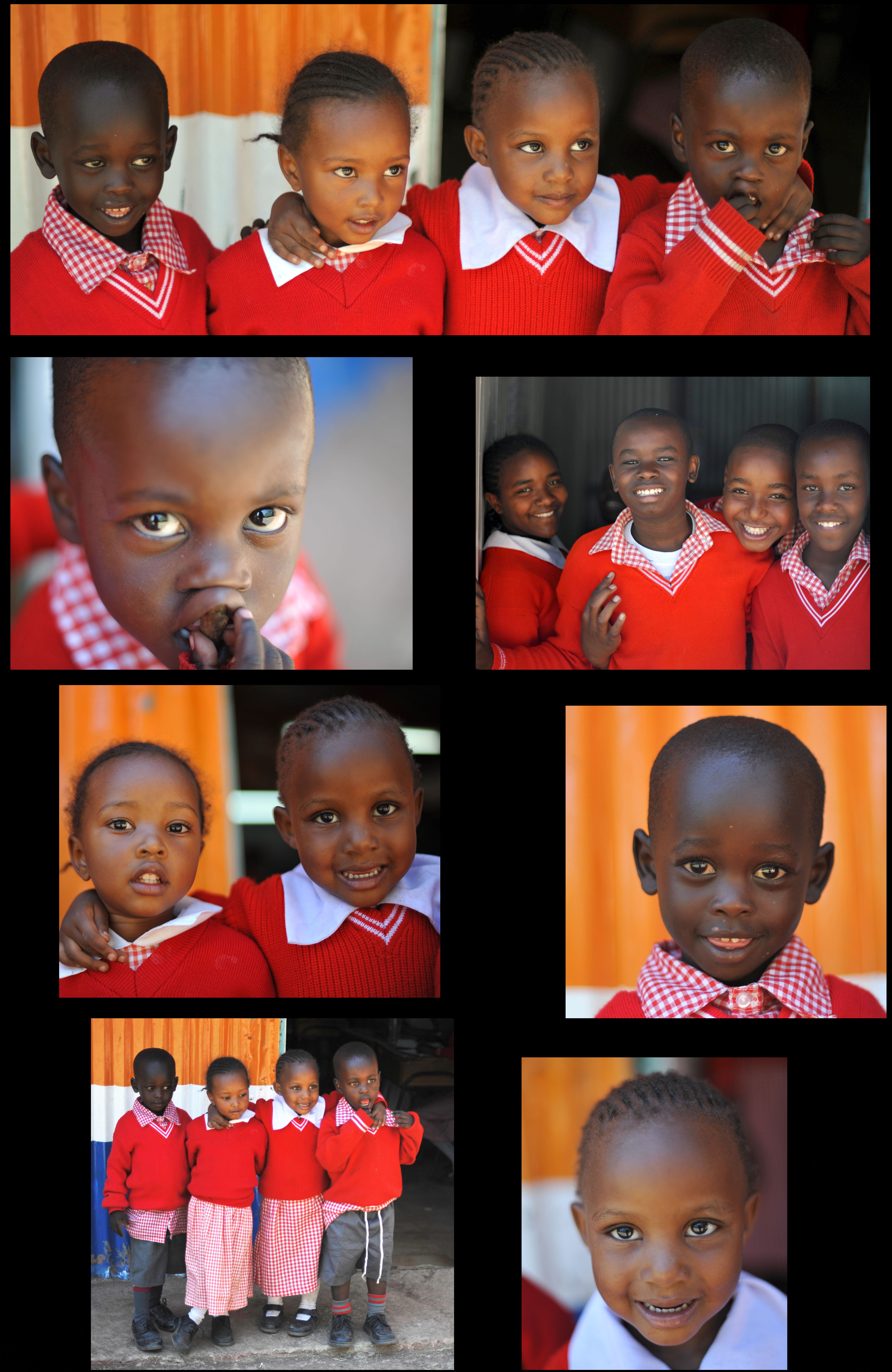
School children at Kibera Paper
Included in our two packed days were also some other activities, we drove into Kibera and stopped at a storefront that is run by one of the longest established Self Help Groups. They call themselves Power Women. Although not one of the groups for KEST’s Women4Women Initiative we did want to meet with them and to hear their story since they have a long history of success. And of course we came upon some other children and the usual chorus of children shouting after us “How are you?” which is what they do whenever they see white people (Mzungus) in Kibera.
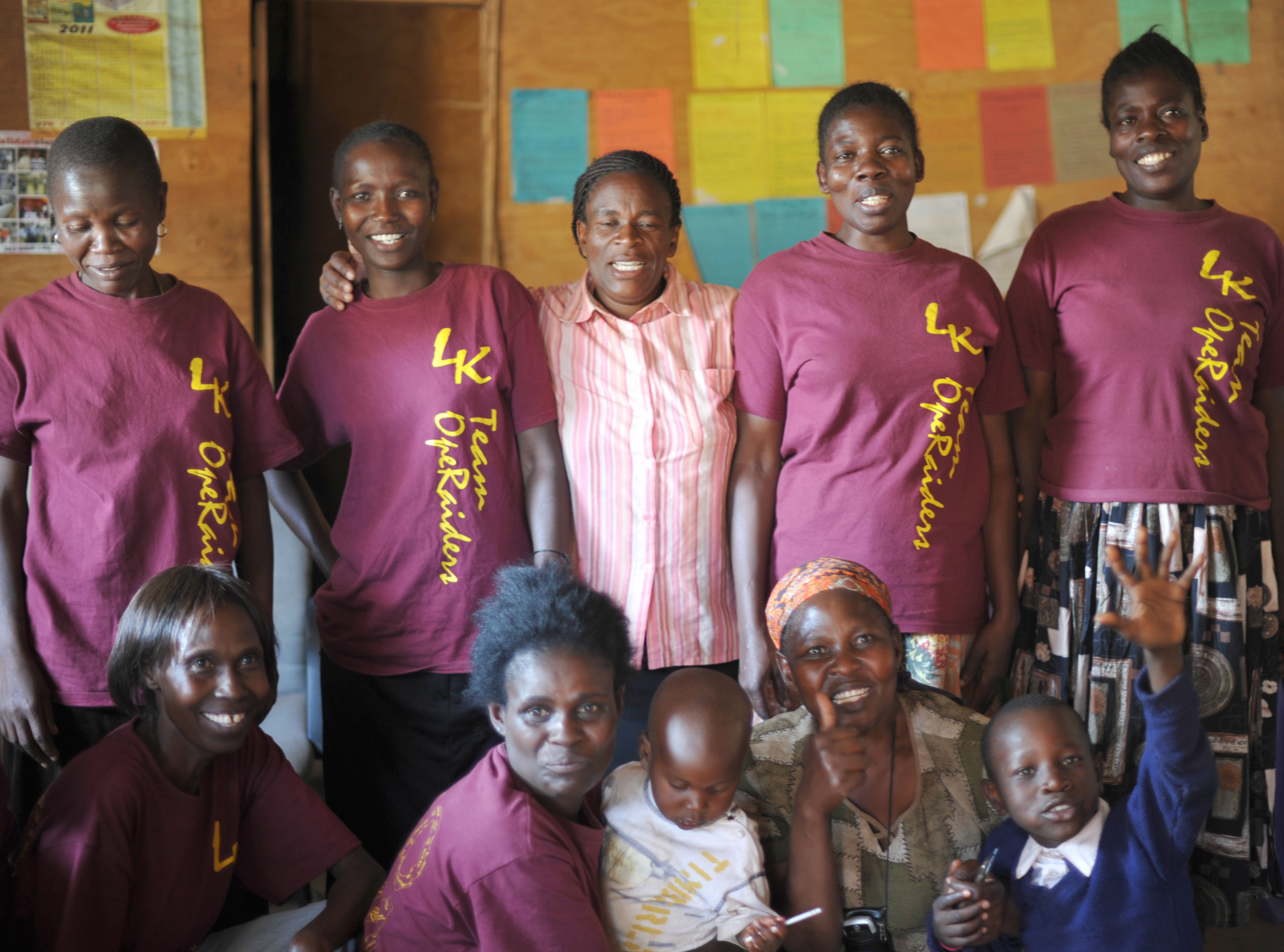
Power Women in their Kibera store front
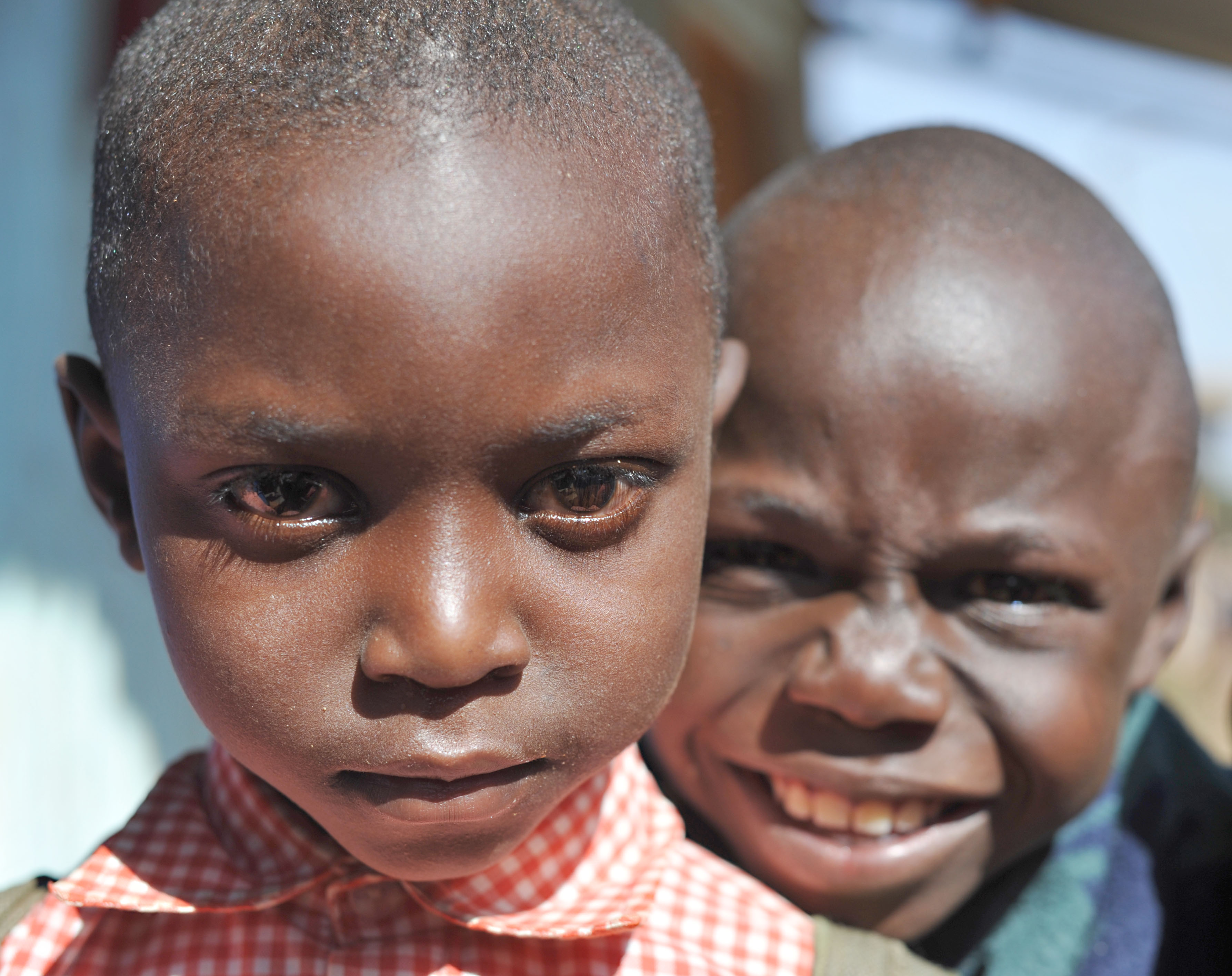
Kibera Kids
We also took a trip to Amani ya Juu (Higher Peace in Swahili), a women’s sewing and training program based in Nairobi for marginalized women and women refugees from many African Nations and cultures. The focus is on mentoring women, holistic development, producing quality environmentally friendly goods, peaceful existence and self sustainability. We had a lovely meal there and then browsed and purchased some of their goods.
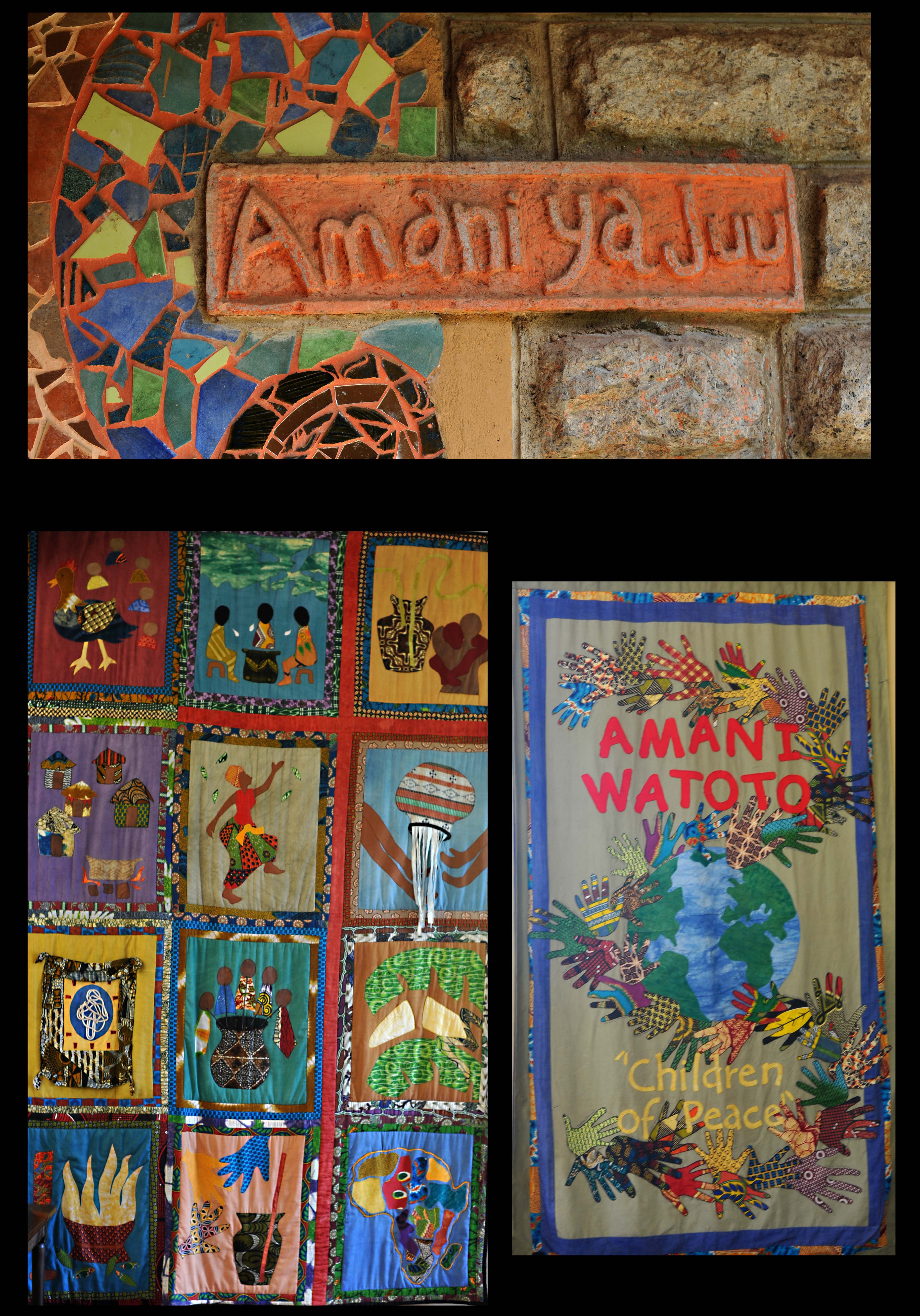
Amani: the Peace Quilt and The Children's Peace Quilt
Finally, we actually managed to fit something more into these two days—on Thursday evening we took the adolescents who will be going away from the Nyumbani Children’s Home to begin high school Form 1 or fist year of high school) out for a celebratory evening. In Kenya, after eighth grade children take standardized exams and only are accepted into high school if they pass and get adequate scores. All high schools require tuition and are boarding schools and acceptance is based entirely on test scores. This is all very anxiety provoking. All 14 students from Nyumbani Children’s Home will be going on to high school and will be leaving in the early part of February. We took them to a “nyama choma” (literal translation=grilled meat) and had a meal, hired a DJ for dancing and they had a wonderful evening. We road on the bus with them and KEST volunteers danced under the disco ball with them! I had the pleasure of sitting next to Thomas, a very bright young man who is very articulate and we had some wonderful conversation. Lloydie gave them all a bag of catsup, peanut butter, and hot chocolate—apparently the most missed food items when away at boarding school. Sitting back, looking at all of them having a wonderful time, dancing up a storm, well, it’s something to marvel at considering that many of them were so sick when they arrived at Nyumbani Children’s Home that they weren’t expected to live. Now that truly is something to celebrate!
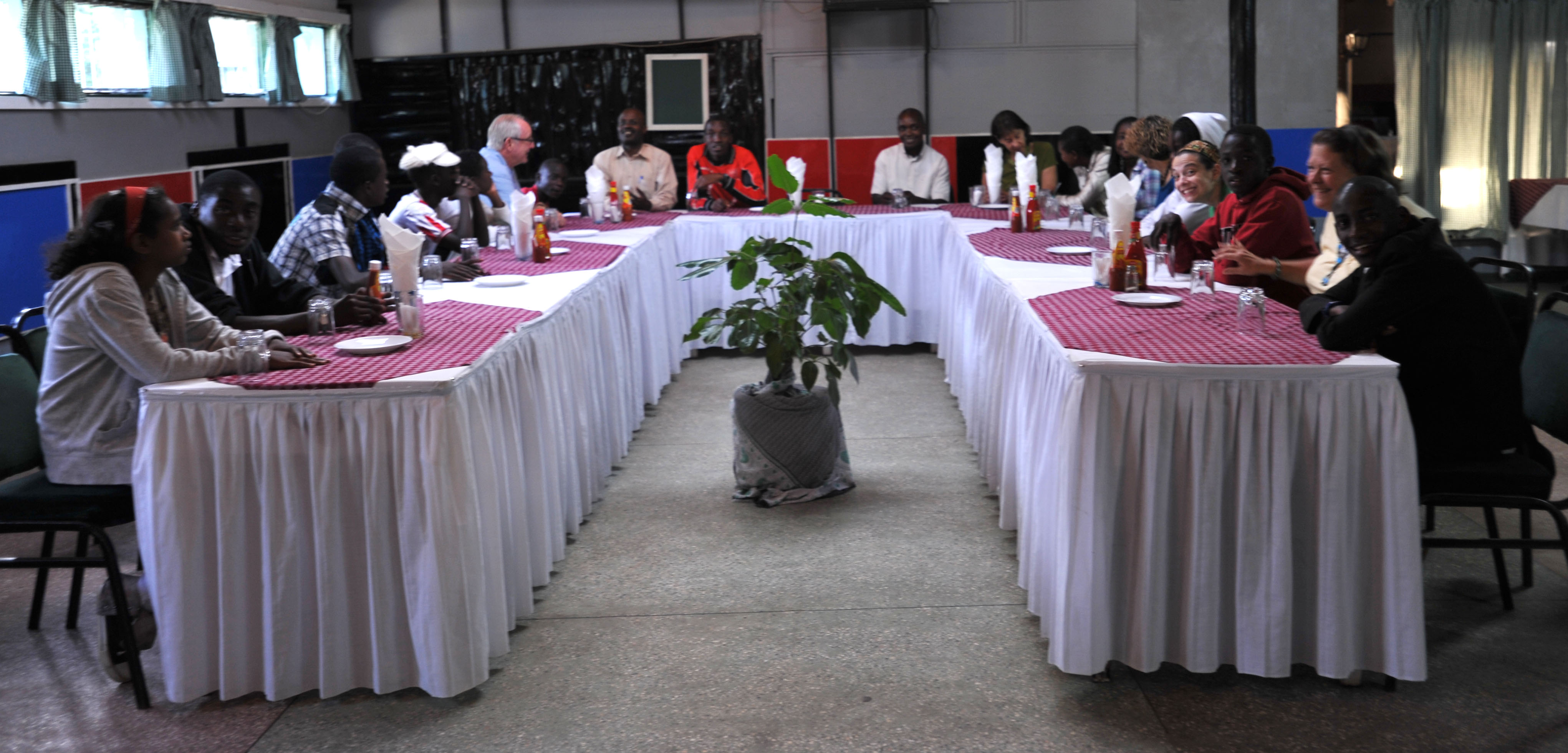
Nyumbani Children's Home Form One Students "Send Off" Dinner
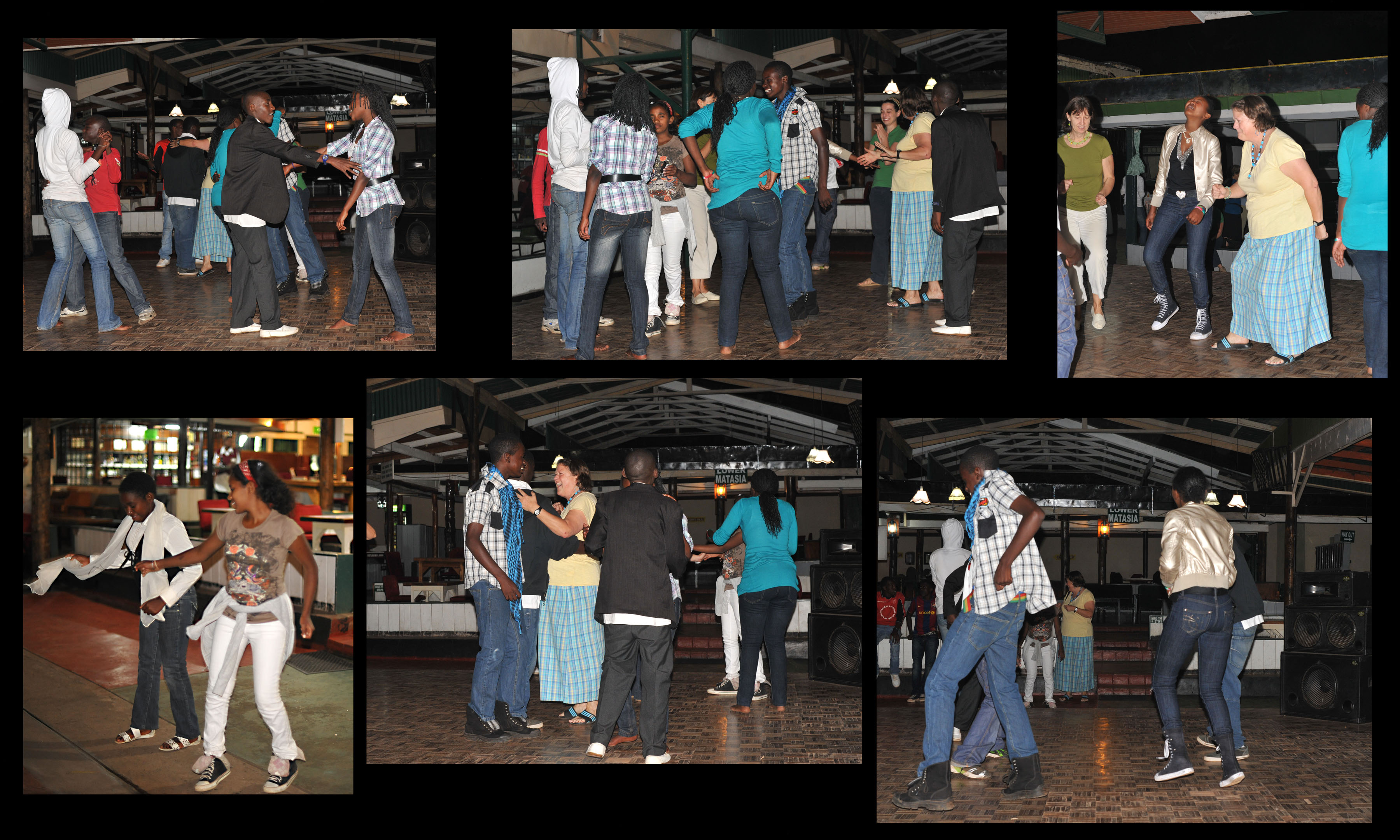
NCH Form One students and KEST volunteers dance the night away
Next stop PCDA (Pastoral Community Development Alliance) in the Maasai community and some of the most adorable children…stay tuned. LLala Salama! (Goodnight)
Two Extraordinary Days in the Slums of Nairobi

Meet the group: Justice, our driver and Kenyan guide extrordinaire and Lloydie, Deb (center), Kristen (lower right), Walter and Lynne
Now I have the impossible task of trying to put into words the past two days—days in which we have laughed, sang (even in sign language), danced, hugged and been hugged too many times to count, cried for being touched by the stories of tremendous resilience and grace, been humbled by the strength of character and generosity of people and were profusely thanked often by people with whom we felt honored to be able to share some time together. These have been the two days in the slums of Dandora, Kangemi, and Kawangware in the clinics of the Lea Toto programs, the Dandora Program for the Deaf and meeting with the Self Help Groups.
In each of the three sites we visited we talked with various different staff members of the programs—the Directors of the Eastern and Western divisions of the Lea Toto programs, a medical officer, a nurse, counselors, social workers and community health workers. This gave an opportunity for those who haven’t come to lea Toto before to get an overview and for others who have to get a chance to be updated. When a parent or guardian brings a child whom is suspected of being HIV+ to the clinic, they first meet with a counselor and testing is done at the same time along with counseling. If the results are positive the child receives a medical evaluation, nutritional assessment and begins on ARVs. The entire family receives nutritional support for the first year during which time they are expected to save the resources not spent on food to develop some independence from the food support. The caregivers are provided with extensive counseling and the child is given emotional support, support for school fees if needed, etc. Social workers do home visits on a regular basis and community support worker are volunteers who receive extensive and ongoing training and do home visits as well. When we met with community support workers, many of them were former or current clients in the Lea Toto Programs who felt that they were grateful for what they had received that they wanted to give back to others. The dedication of this staff, the workload that they carry is phenomenal and hearing them talk about why they do the work and what it means to them was so inspiring that when it came our time to speak we could hardly talk—Kristen and I were first and we were just passing the tissues back and forth. Paul, the Director at Dandora, and the Director of the western division of the Lea Toto Programs, was a very thoughtful and well spoken man, who told us to remember that every little bit of help matters, no matter how small, and that it can be overwhelming to look at the overall larger picture, but when you help the person who is there in front of you, that help is enormous. He also told us that people often have many needs, but what they need most from you is “heart” and the rest follows. We did do several home visits with the social worker and the community support worker at Kangemi . In fact we found that often the several of the women of the self help groups also worked as community support worker.
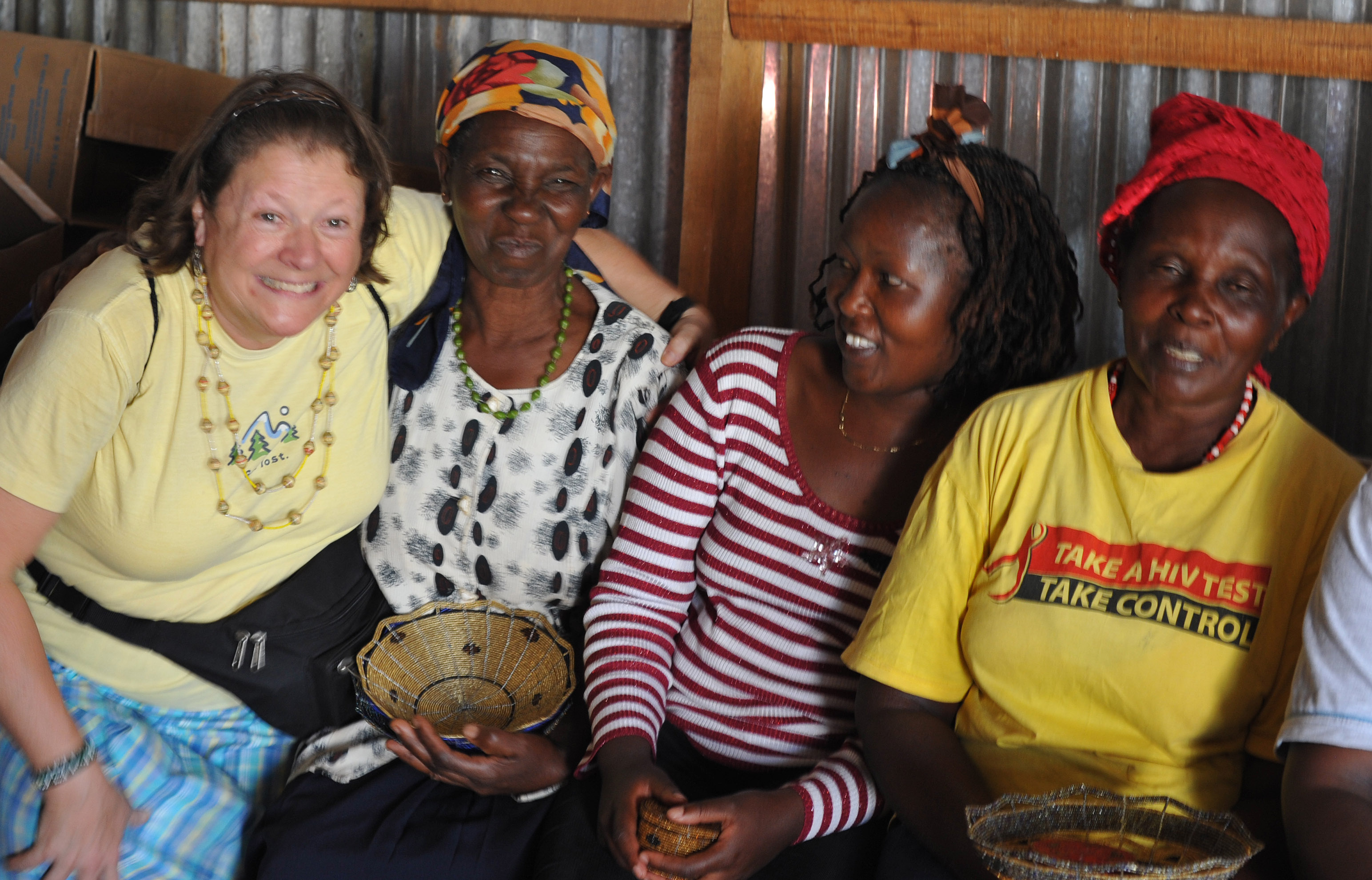
Lloydie with Good Hope Self Help Group members
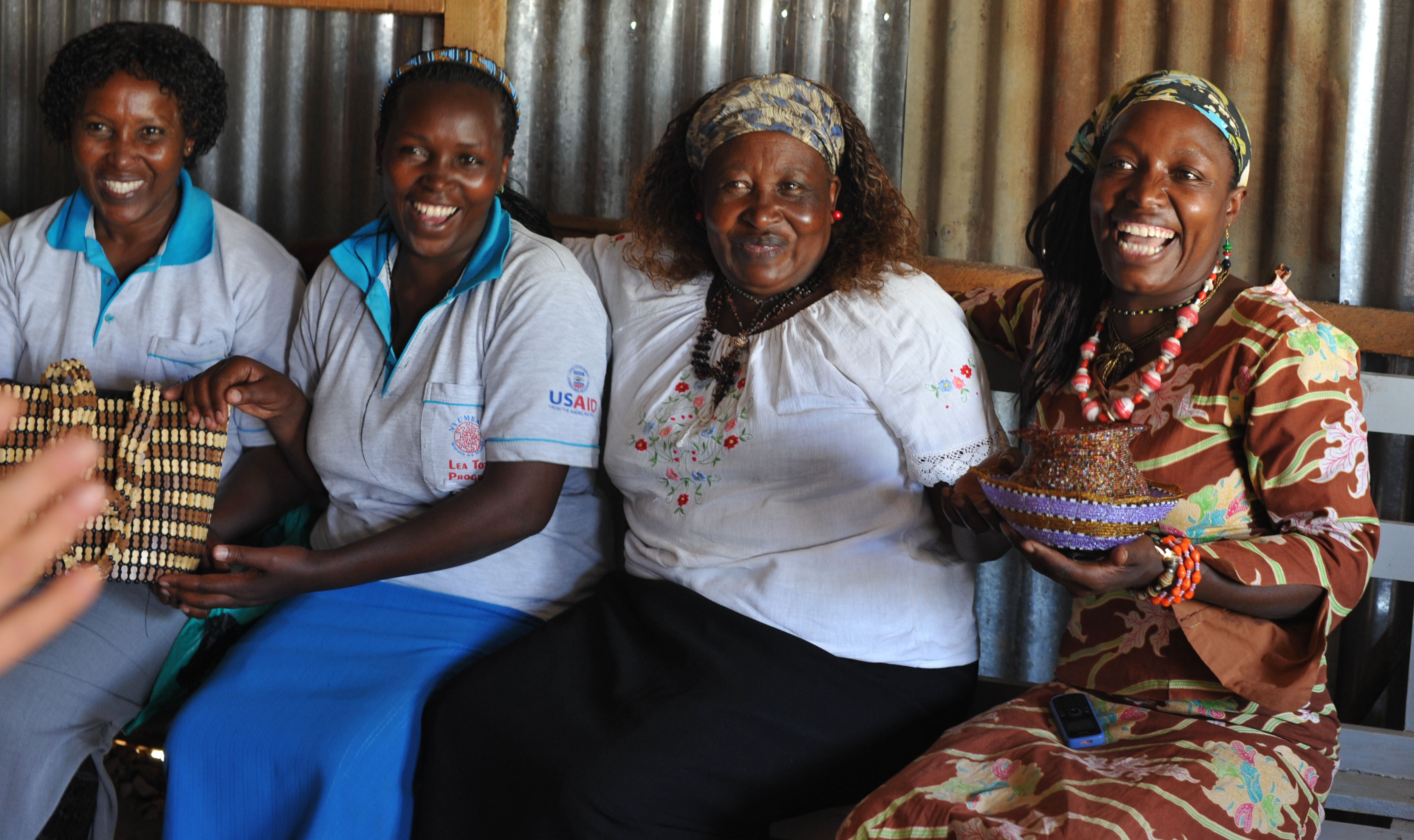
Other members of the Good Hope Self Help Group
We also met with the Self Help Groups to share time with them continuing to build relationships and to shop from their crafts. This included groups at all three sites including the Vision Self Help Group whom I had previously met in Dandora 2 years ago. These are wonderful groups of very lively vibrant women who each have incredible stories to tell. Every story is captivating but I have to say that Sally of the Vision Self Help Group had the most powerful story because she has been HIV+ since 1991 and has a daughter who is HIV+ as well. She has a strong powerful voice and is incredibly articulate about living positively with HIV and a powerful commitment to bringing that message to others. (I made a deal with her that next time I come to Kenya I will do a video interview because she has a voice and a story that really should be heard and can speak for many others).
We also had the mission of meeting with representative Self Help Groups in the three sites where Lloydie explained that it has often felt difficult for volunteers to feel like they are really able to be helpful in the Lea Toto sites and that KEST has taken on a new initiative to support those communities by supporting the Mommas of these groups. She explained the plan to select from their crafts items to be considered for sales in the US and that when she returns in June she will place a larger order for these items and pay fair market value when she gets them in August. Then KEST volunteers will sell them in the US and the additional profit will be brought to them next January and the cycle will repeat and hopefully grow. This plan was met with overwhelming enthusiasm and gratitude.
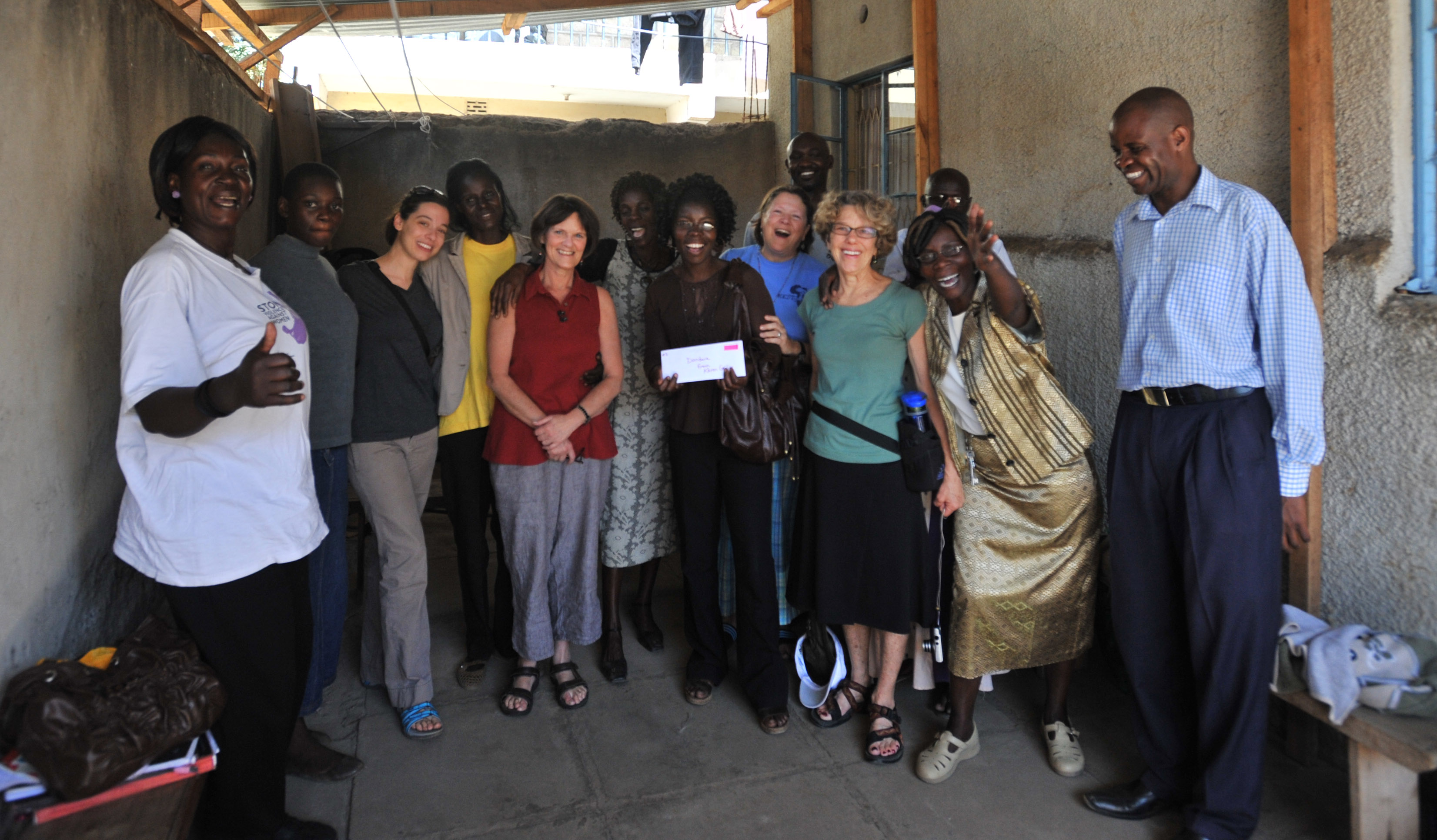
"Thumbs up!" from the Vision Self Help Group
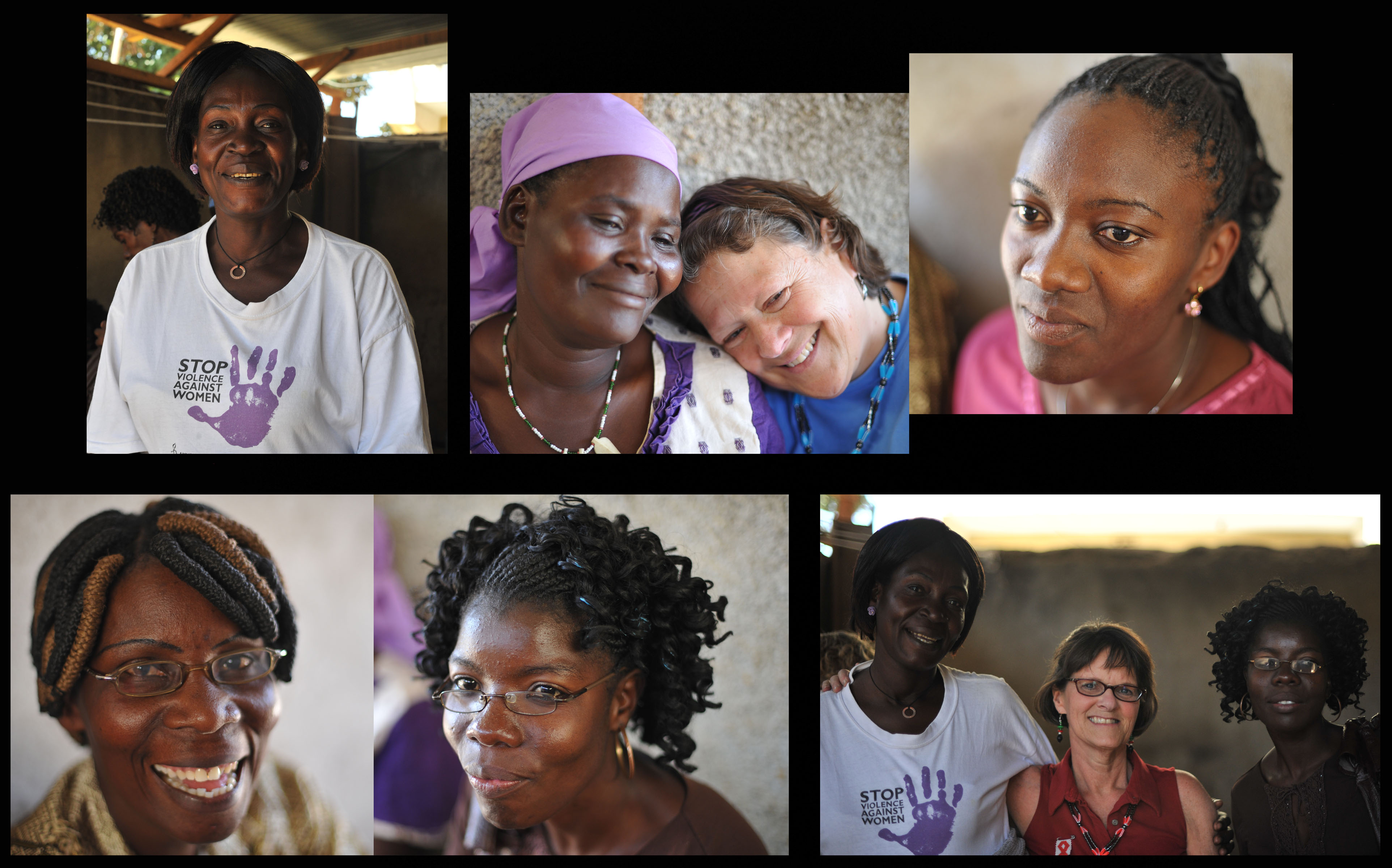
Meeting with the Vision Self Help Group
Finally we spent the afternoon today meeting with Boniface, who has a “ministry for the deaf”. We met with him and his wife, both of whom are deaf as well as 3 other deaf people with whom he works. Boniface is a sign language teacher and he and the others in the group spoke to us through William, an interpreter. We learned that there are schools for the deaf in Kenya but not a lot of other support and that they really have come together to support each other. Although Boniface and his wife are employed the other are currently without work though have skills. One fact that really struck me was that all five of the deaf people with whom we met (and this is largely true for Kenyans) were born hearing and became deaf as a result of illness in childhood, often common illnesses like mumps or measles for which we get vaccinated in the U.S. I can’t quite describe what it was like to spend time with them—they may not have been able to speak, but they could certainly communicate in a phenomenally moving way that was deeply touching. I had heard through Lloydie that Boniface really needed a digital camera for work with his students and it warmed my heart to be able to give him. They say to us in sign language, taught us to sing by signing…..and more tears. I have a wonderful videotape of this that I hope to be able to upload (after 3 failed attmpts have to try again later–aaah the joys of technology…)
As always, there is so much more I could say, so many more words I could use, but words can’t capture this…..
It’s after midnight here, please pardon my typos, no more energy to proofread and a busy day tomorrow….kwaheri from Kenya!
The Vision Self Help Group Of Dandora
I have introduced you to one of the women’s artisan’s groups with whom we will be working in Kenya in the Women 4 Women Initiative. I thought I would take a break from my packing frenzy having accomplished the mission of having one duffel packed at a weight of 48 lbs (just under the 50 lb limit) and no longer sitting in a sea of medical and art supplies, children’s socks and underwear, etc. I want to introduce another group, the Vision Self Help Group of Dandora. Dandora is another of the impoverished slum areas around Nairobi similar to Kibera. This group began almost ten years ago with the inspiration of Sister Little from Nyumbani Children’s Home. Sister Little who I had the pleasure of spending some time with during our last trip, including going to the slum with her, is like her name, little, but she is otherwise, despite not at all being a youngster, quite big on spunk and determination.Though she is supposed to be retired now, I hear she still shows up in Kibera to check out the Lea Toto Programs since they are her biggest devotion.
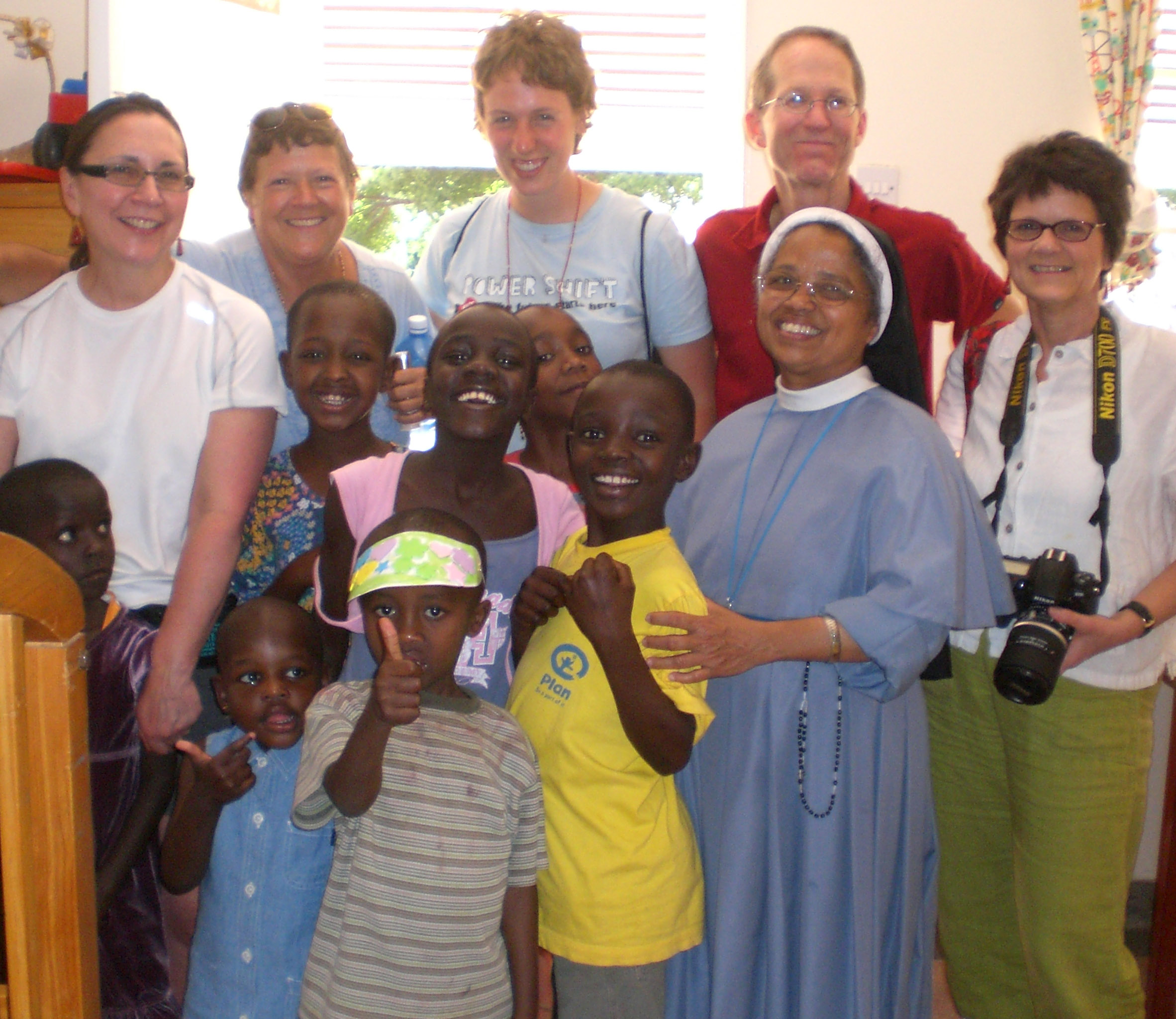
Sister Little with The 2010 KEST Adult Group and Nyumbani Children (anyone who makes me look tall has to be little!)
It was her idea to help this group of women, many of whom are HIV+, all of whom have HIV+ children getting care from the Lea Toto Clinic of Dandora by assisting them in developing a skill which would lead them to be self sufficient and able to earn enough income to support thier families. She brought them together to support each other and helped them to learn the art of jewelry making, particularly beading. They work together, create together, have developed a tremendous sense of comraderie and share the income that they produce. When we met with them last time I was struck by the support that they give to each other and how much they value creating together and felt a powerful connection because that process of creating together reminded me of my own women’s art group. As they each individually told us their own stories I was incredibly moved by their strenth, resiliency, devotion to their families and how they have taken their own hardship and used it to help others by doing such things as becoming AIDS advocates and community leaders. They were clearly a part of the inspiration for my poem about Kenyan women. They make lovely jewely and have increased the breadth of their ware by expanding into other items as well–I’ll be sure to take photos when we see them this time. And they, like many groups whom we met welcomed us with lovely song and dance which Im so looking forward to experiencing again.
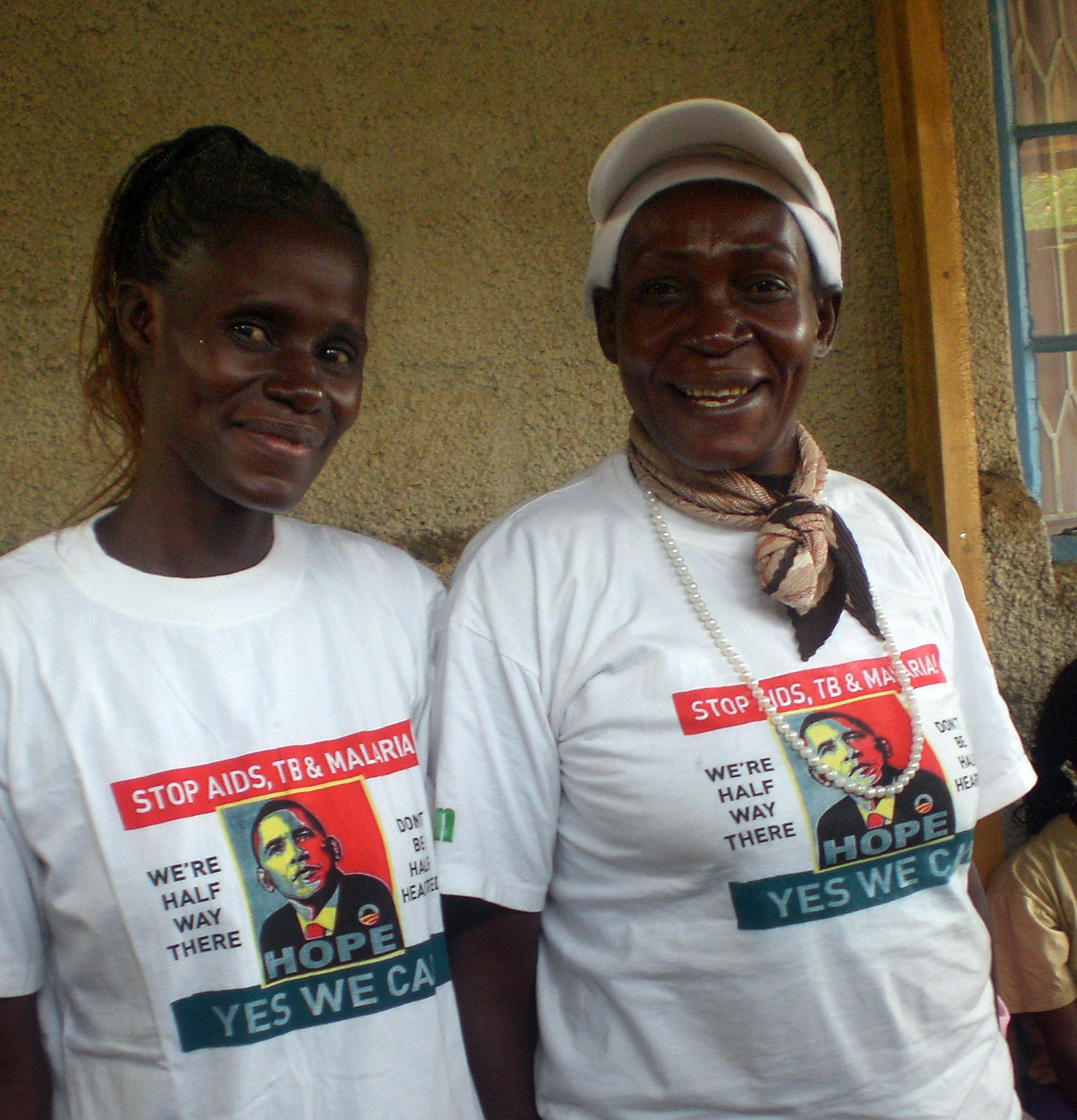
Vision Self Help Project Women in their Stop AIDS, Malaria and TB.......and Obama Tees!
WE leave in JUST 4 more days!!
Preparations, Donations, and Communications……
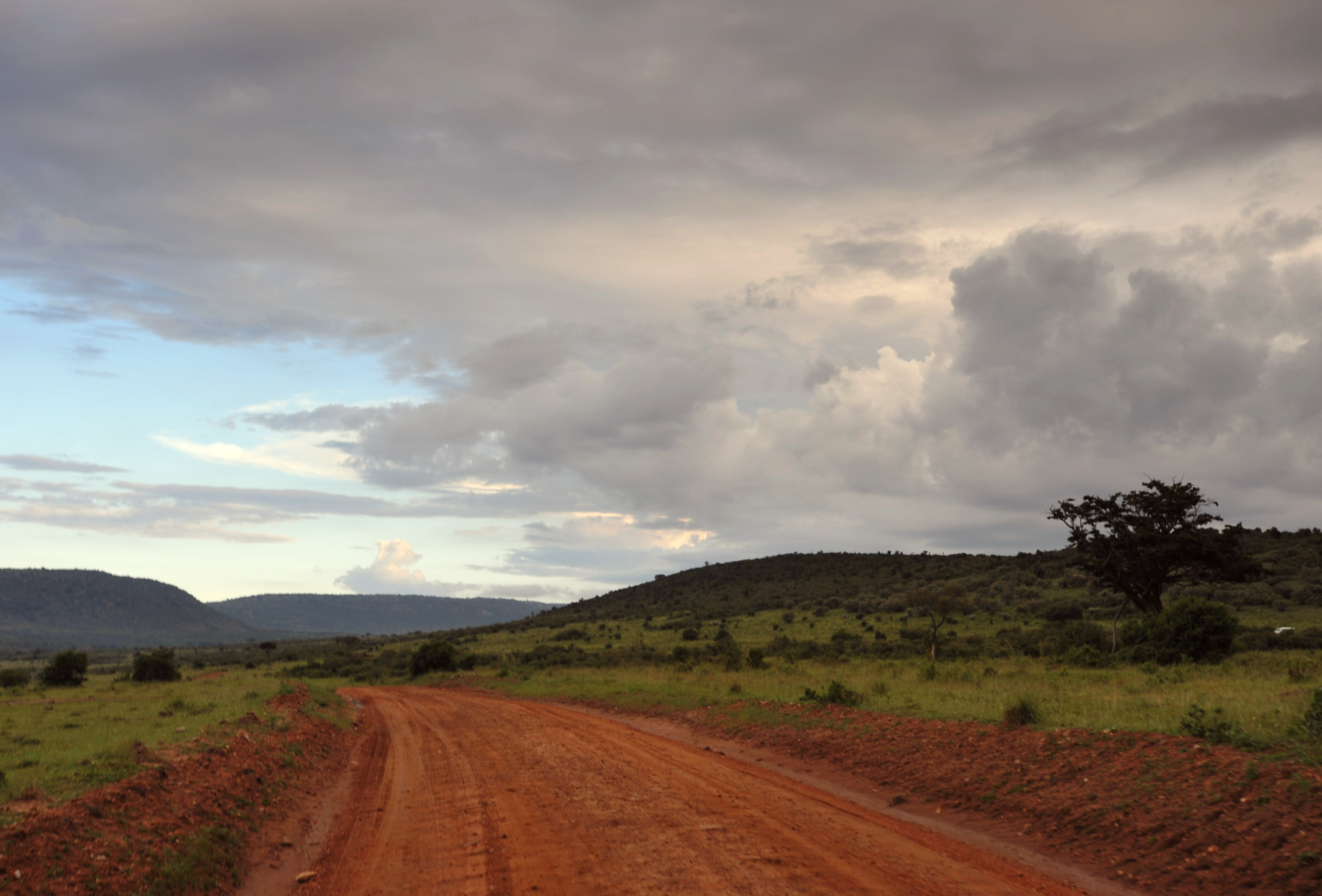
On the road in Kenya
Well, it’s only 10 days before we leave and the excitement is mounting… and so is the pressure to get everything done before departure. I have to say that it’s hard to concentrate on all that needs to be done here when my thoughts keep drifting to Kenya and the email communications about planning are flying fast and furiously through cyberspace. This post will be a potpourri of things to share that may not seem necessarily that connected, but that is a reflection of my whirling brain……
- Amongst the email communications was one that just came from Jen and the group of KEST travelers who are currently in Nyumbani Village with the “translation” provided by Lloydie:
“it’s HOT, and the water taps keep going out (and the showers at the convent don’t work anymore). Pack lots of sunscreen, bug spray, and baby wipes. Oh, and some locks for the doors – we all have singles in the guest house, and John (the cook) didn’t have enough to go around.”
Translation… “it’s HOT, water is questionable so take a long shower before we leave for the village, we will have drinking water with us, bring the recommended items above , and ESPECIALLY a pad lock just in case it is needed. Plan to leave the lock behind so they will have enough for future visitors. We do not have our lodging assignment yet. It will either be in the convent or the guest house but either way, it seems like there are NO showers… pole sana, TIA… This IS Africa!“ - These e-mails made me smile. You have to have a sense of humor about such things and no where else on earth would I voluntarily put up with HOT and no showers! Aaah life in Nyumbani Village!! There’s nothing like it to make you appreciate the smallest creature comforts like a shower, not to mention cold water to drink, a way to cool off in the heat… And though water may be in short supply I’m sure that there is plenty of ugali that staple food of maize made porridge that sits like a brick in your belly (your favorite, right Lloydie?!) However, there will also be ample Kenyan hospitality seeped in Kikombe culture with singing and dancing and smiling from children and grandmothers alike since the village, with its simple ways, is a very magical place. And at the end of the day, you get to be mesmerized by the most star filled sky you’ll ever see.
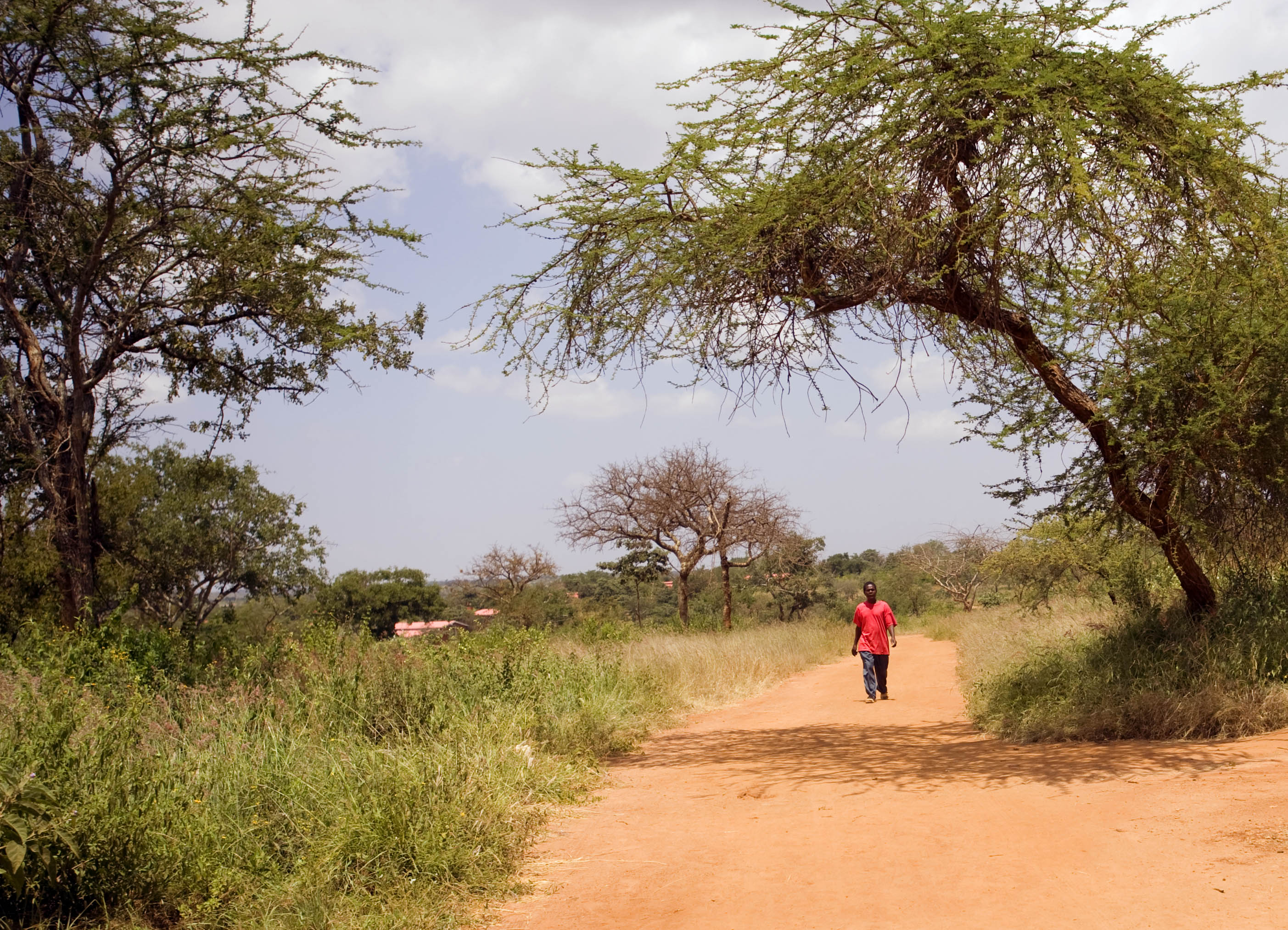
Under the tree canopy in Nyumbani Village
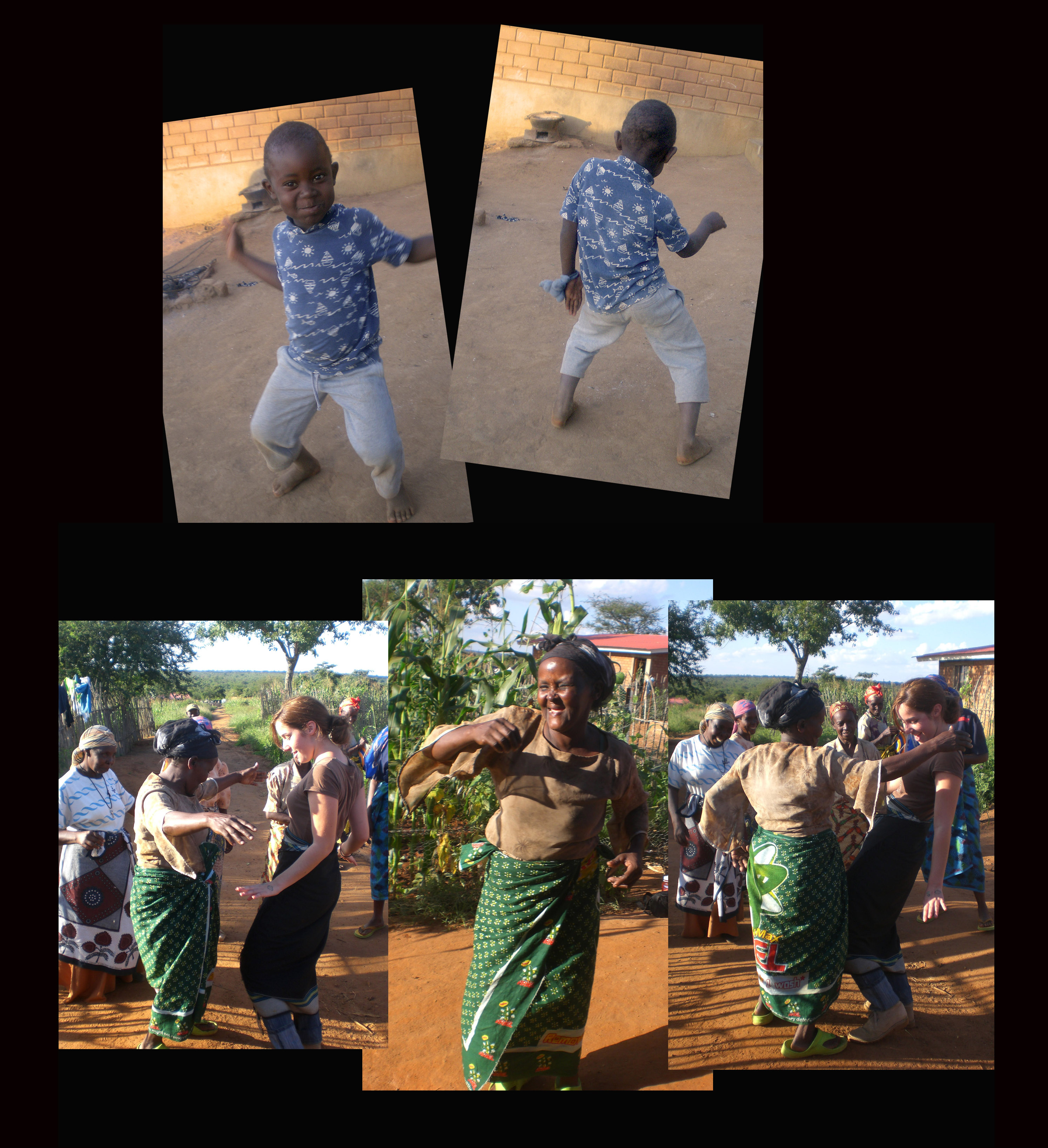
Dancers--from children to grandmothers--of Nyumbani Village Photos by Karen Orrick
- One of my donors was also asking about whether or not she could specifically give to the Women 4 Women Initiative, but that is in the early stages of development and not quite ready for specific donations yet. Lloydie’s reply as an alternative was “ I think the best plan is for you to decide which community you want to help… Nyumbani Village for mattresses (they just admitted 36 new orphaned grandchildren and 4 orphaned grandparents in December), or the Maasai for the school food program (porridge every day at school for lunch, for some their only meal)”. Although I am very much aware of the need in Kenya the thought of the school food program providing the Maasai children with their only meal of the day is a very sobering thought. And the fact that 36 new children and 4 new grandparents have been admitted to Nyumbani Village is a reminder of the increasing need and number of AIDs orphans and the elderly who have lost their children upon whom they would have relied to care for them. The village has really grown–the last figure I heard was close to 800 orphans are living there. I’m not sure what the current count is, but I will find out.
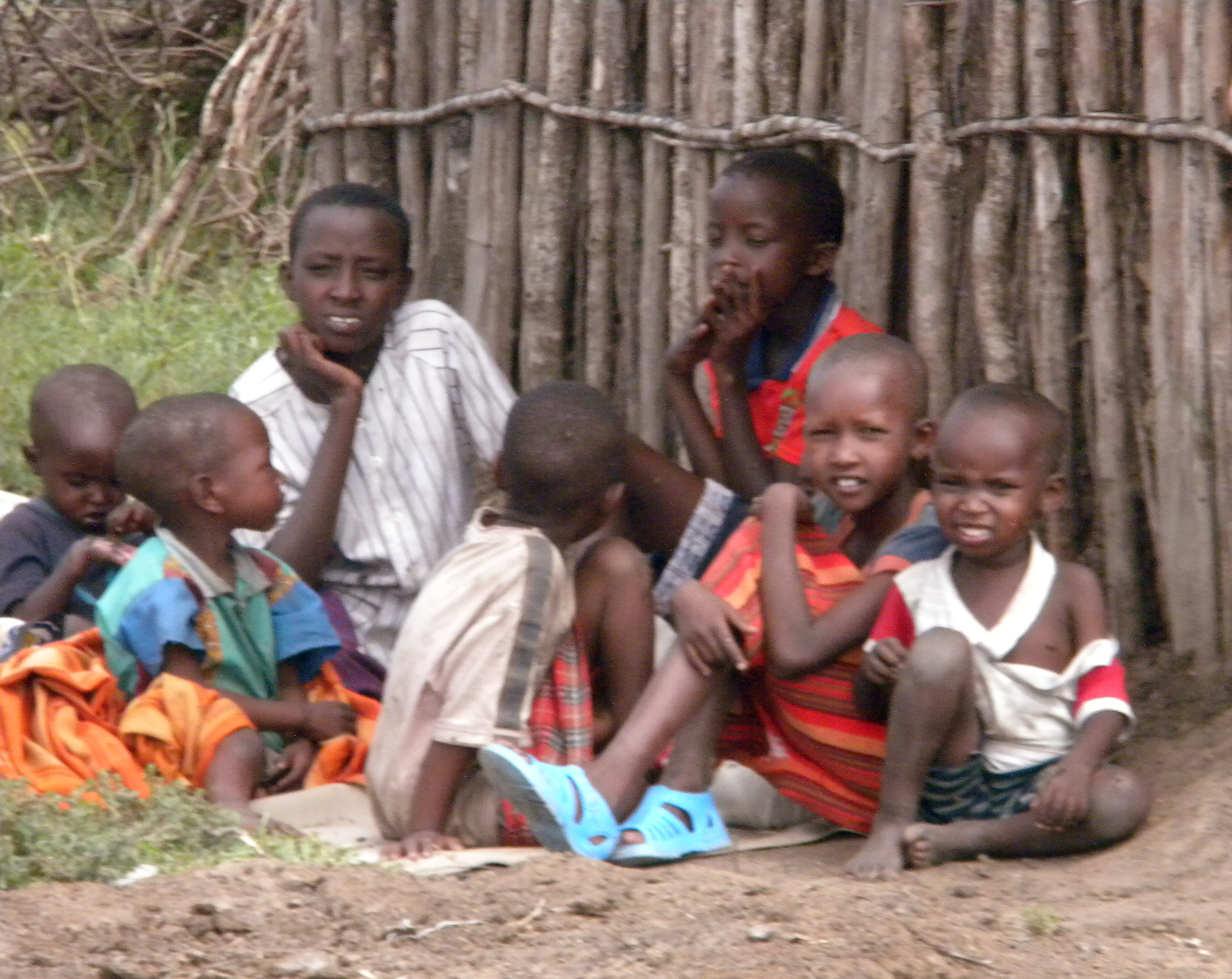
Maasai Children
- About donations–these are the things I’m bringing to Kenya to donate guided by a list of needed items and anything that is not monetary has to fit in duffels to go onboard the airplane with me. Somethings like underwaer and socks and medical supplies are always needed. Other things, like matresses, not to be stuffed into duffels, but rather purchased once there, are new on the list. Having reached out to family and friends and done some special purchases of my own, the gathering seems to be going quite nicely. I also had the opportunity to go to the warehouse for Mid Coast Hospital last week where supplies and goods are stored that are no longer being used at the hospital, but are ready for anyone wishing to take them to third world countries. I met a very nice young man there who was traveling to the Dominican and also gathering supplies. As we looked through all the storage areas and came across things that would suit our purposes we both got increasingly excited and started to say “This is just like Christmas!” I gathered gauze and band aids and wound cleaner and ace bandages and slings and …… Now I have to get all the donations in one place–from my office, the car, my son’s car, various places in the house–and pack them in 2 duffels that weigh each less than 50 lbs. A Houdini-like task even without the mattresses–this is the magic that begins before you leave for Kenya–well a piece of it anyway!
 Lynn Ouellette
 Watoto Wote Wazuri
2 comments